


Key Takeaways
- MPLX expects to raise its distribution 12.5% in both 2026 and 2027, while VICI Properties raised its dividend 3.5% in fiscal 2025.
- At each one’s current dividend rate, MPLX yields 7.65% and VICI Properties 8.0%.
- MPLX’s distributable cash flow coverage was 1.4x in fiscal 2025 and is expected at 1.3x in fiscal 2026, in line with management’s target.
- VICI Properties’ AFFO payout ratio was 74% in fiscal 2025, and consensus has it at 74% again in fiscal 2026.
Anyone hunting for a yield near 8% that still grows is going to land on stocks like MPLX (MPLX) and VICI Properties (VICI).
On Aug. 4, MPLX said it expects to raise its distribution 12.5% in both 2026 and 2027. VICI’s July 29 report was quieter by comparison. It guided to 2026 AFFO of $2.45 to $2.47 a share, and analysts expect it to keep paying out 74% of that.
So which is the better high-yield dividend stock?
| Metric | MPLX (MPLX) | VICI Properties (VICI) |
|---|---|---|
| Dividend yield | 7.65% (at the current rate) | 8.0% |
| Yield at the current rate | 7.65% | 8.04% |
| Dividend growth, fiscal 2020–2025 | 8.2% a year | 7.1% a year |
| Coverage, fiscal 2025 | 1.40x distributable cash flow coverage | 74% AFFO payout ratio |
| Coverage, fiscal 2026 consensus | 1.29x distributable cash flow coverage | 74% AFFO payout ratio |
| Net debt / EBITDA (LTM) | 4.0x | 4.81x |
| Interest coverage (LTM) | 4.09x | 4.33x |
MPLX is spending its cushion on raises
Natural gas is doing the heavy lifting at MPLX. Its Natural Gas and NGL Services segment grew adjusted EBITDA 11% to $614 million in Q2 2026. Management also raised its 2026 growth capital outlook by $500 million to $2.9 billion.
As a pipeline partnership, MPLX is judged on distributable cash flow coverage, and it’s had room to spare every year since fiscal 2016.

Coverage ran between 1.35x and 1.68x from fiscal 2016 to fiscal 2025, ending at a comfortable 1.40x. Consensus has it at 1.29x for fiscal 2026. Over that year, distributions rise from $4.07 to $4.55 a unit, while distributable cash flow rises from $5.68 to $5.86. That’s by design. CFO Carl Hagedorn said, “we continue to target our 1.3x coverage ratio for both ’26 and ’27 and frankly, beyond.” This year’s raise is guided, not declared yet: last year’s came on Oct. 28.
MPLX is an MLP, so it pays distributions on units and sends holders a K-1 at tax time. $10,000 at its 7.65% yield pays $765 a year now. Growing at its 8.2% five-year rate, that becomes about $1,549 in year 10, a 15.5% yield on your cash.
There’s a catch, though. Q2 2026 coverage slipped to 1.3x from 1.5x a year earlier, and MPLX’s own leverage ratio rose to 3.7x from 3.1x.
VICI Properties keeps it steady
Where MPLX is drawing down its cushion to raise faster, VICI has held its payout in a tight band. AFFO per share rose 4.6% to $0.62 in Q2 2026.
As a REIT, VICI is judged on its AFFO payout ratio, and that’s barely moved.
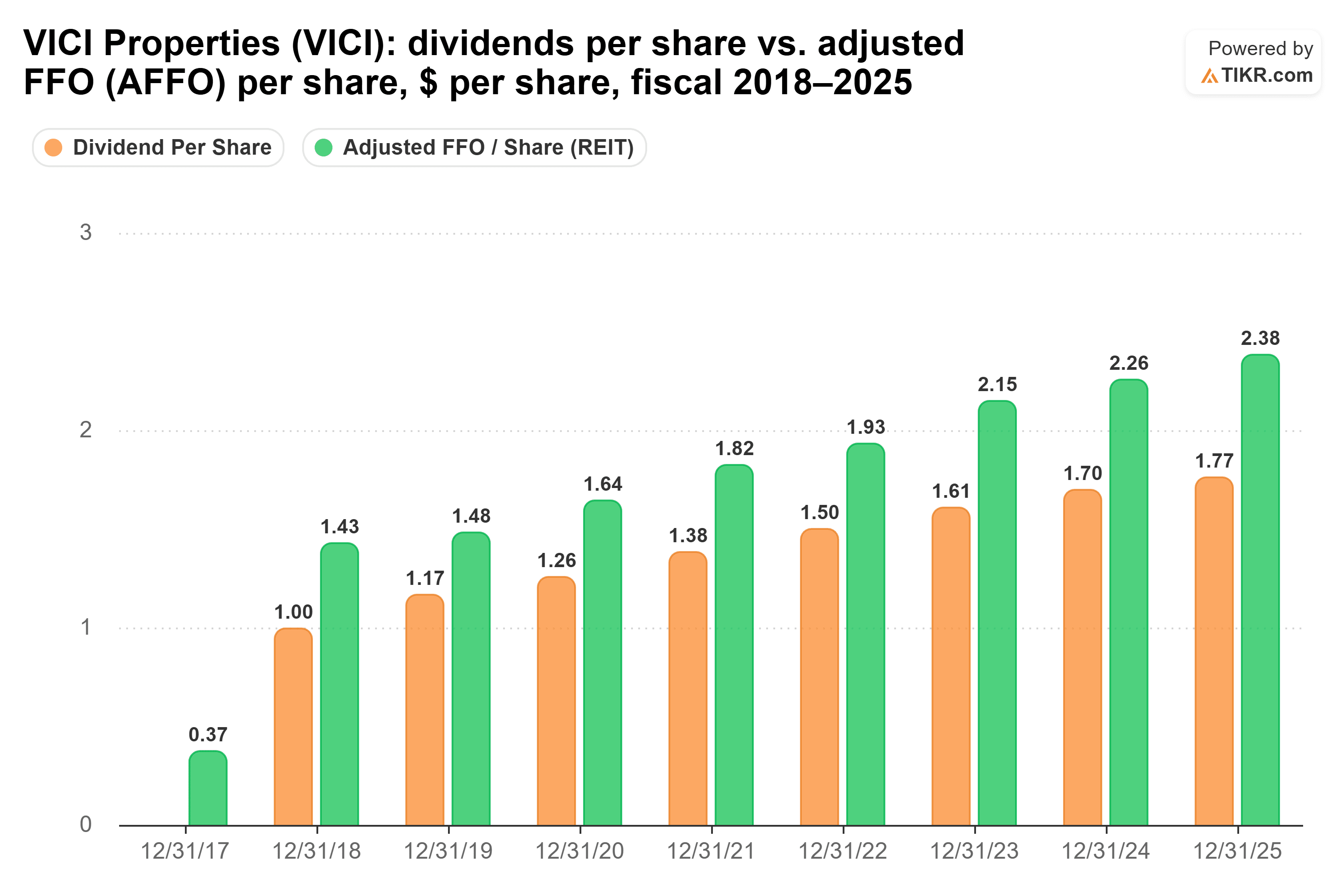
The ratio stayed between 69.9% and 79.1% from fiscal 2018 to fiscal 2025, finishing at a well-covered 74%. Consensus puts it at 74% again for fiscal 2026, with $1.83 of dividends against $2.46 of AFFO a share. VICI has raised its dividend, in management’s words, “every single year since we went public in 2018.” On its April 30 call, management said it intends “to continue to protect the sanctity of the dividend,” and on Sept. 3 it raised the dividend 2.2%, to $0.46 a quarter.
The risk is slower growth, and a tenant in flux. The dividend rose 3.5% in fiscal 2025, against 7.1% a year from fiscal 2020 to fiscal 2025. And Caesars, one of its two biggest tenants, is being bought by Fertitta Entertainment for $31 a share in cash, a deal regulators still have to clear. CEO Ed Pitoniak said in July that the rent on its regional casinos “is a conversation that will take place at some point,” while VICI collects “every dollar of rent in the meantime.” The stock closed at $22.88 on Oct. 9, near its 52-week low.
So which dividend wins?
MPLX is the better high-yield dividend stock. VICI pays more today, $800 a year on $10,000 against $765. But at each dividend’s five-year rate, MPLX’s income passes VICI’s around 2031, and it pays about $1,549 in year 10, against $1,481 from VICI. At each one’s pace now (MPLX’s 12.7% raise and VICI’s 3.5% raise in fiscal 2025), it passes VICI’s around 2027, and year 10’s gap widens to about $2,251 against $1,093. And MPLX funds those raises from a growing business, with coverage right at its 1.3x target and less net debt to EBITDA, 4.0x against VICI’s 4.81x.
VICI’s case is a strong one. Its payout ratio barely moves, and it’s raised its dividend every year since going public. At today’s dividend rates, it even yields more, 8.04% against MPLX’s 7.65%. It’s just that MPLX’s distribution is growing far faster, its cash flow still covers it with room to spare, and its customers aren’t renegotiating.
Of course, MPLX’s raises depend on that $2.9 billion of 2026 growth spending paying off. If it doesn’t, VICI would start to look a lot better.
So what is MPLX stock actually worth?
TIKR lets you forecast the future price of any stock in less than a minute. Just enter a few assumptions into TIKR’s valuation model and see what MPLX could be worth. Start from Wall Street consensus estimates, or adjust the inputs to reflect your own view of the business. It’s free to use.
Disclaimer:
Please note that the articles on TIKR are not intended to serve as investment or financial advice from TIKR or our content team, nor are they recommendations to buy or sell any stocks. We create our content based on TIKR Terminal’s investment data and analysts’ estimates. Our analysis might not include recent company news or important updates. TIKR has no position in any of the stocks mentioned. Thank you for reading, and happy investing!


