Key Takeaways
- Campbell’s cut its quarterly dividend 36% to $0.25 per share on Sept. 3, 2026, and now yields 5.3% against Kraft Heinz’s 7.2%.
- Kraft Heinz’s dividends took 50% of its free cash flow over the twelve months to June 2026, against 69% at Campbell’s over the twelve months to August 2026.
- Analysts expect Kraft Heinz’s figure to rise to 69% in fiscal 2026 as free cash flow falls, while the cut brings Campbell’s down to 40% in fiscal 2027.
- Both companies expect lower adjusted profits in their current fiscal years, and Campbell’s carries more debt, at 3.4x net debt to EBITDA against 2.7x.
Campbell’s (CPB) cut its dividend 36% on Sept. 3, to $0.25 a share each quarter from $0.39, so it can pay down debt faster.
That cut sends anyone hunting for a big yield in the grocery aisle over to Kraft Heinz (KHC). It yields 7.2% on a $1.60-a-share dividend, the same as it paid in fiscal 2020. And its sales are shrinking too.
So which of these high yields is the better one to own?
| Metric | Kraft Heinz (KHC) | Campbell’s (CPB) |
|---|---|---|
| Dividend yield | 7.2% | 5.3% |
| Dividend growth, fiscal 2020–2025 | 0.0% per year | 1.9% a year |
| Cash dividend payout ratio, TTM | 50% | 69% |
| Cash dividend payout ratio, forward | 69% (fiscal 2026) | 40% (fiscal 2027) |
| Net debt / EBITDA | 2.71x | 3.44x |
| Interest coverage | 4.93x | 3.65x |
Source: TIKR, Oct. 9, 2026. TTM is the twelve months to June 27, 2026, for Kraft Heinz and to Aug. 2, 2026, for Campbell’s. Campbell’s growth figure comes from before its cut.
Kraft Heinz: flat, but well-covered
Kraft Heinz’s dividend hasn’t grown since fiscal 2020, but the check is well-covered, eating up 50% of free cash flow over the twelve months to June 27, 2026.
Kraft Heinz hasn’t raised its dividend since fiscal 2020, but the payout looks well covered, taking up 50% of free cash flow over the twelve months ended June 27, 2026. The dividend has stood still while the cash behind it has grown.
Free cash flow has covered the payout in every fiscal year since 2019 except one. Fiscal 2022 was the miss, with $1.55 billion in free cash flow against $1.96 billion paid to shareholders. By fiscal 2025, the picture had flipped, with $3.66 billion in free cash flow against $1.90 billion in dividends, which is nearly twice the cost of the check.

That cushion shrinks this year. Analysts expect free cash flow to fall 25% in fiscal 2026, to $2.76 billion, which would take the payout to 69%. Five analysts make that forecast, and last year’s final consensus landed within 4% of the actual.
The drop follows management’s guidance: adjusted operating income down 16% to 18% for 2026, as it raises its extra investment, mostly in marketing, to about $700 million. “We have seen that our brands respond well when we invest behind them,” CEO Steve Cahillane said.
At a 69% payout, Kraft Heinz still has some breathing room, though the spending behind it has to pay off. Organic net sales fell 1.3% in the second quarter of 2026 from a year earlier, so the top line needs to start showing the return.
Campbell’s: a cut that buys room
Kraft Heinz’s coverage got better, and Campbell’s went the other way. Free cash flow fell from $1.10 billion in fiscal 2020 to $678 million in fiscal 2026 (the year ended Aug. 2, 2026), while dividends paid rose from $426 million to $470 million. The payout climbed from 48% of free cash flow in fiscal 2022 to a stretched 69%…
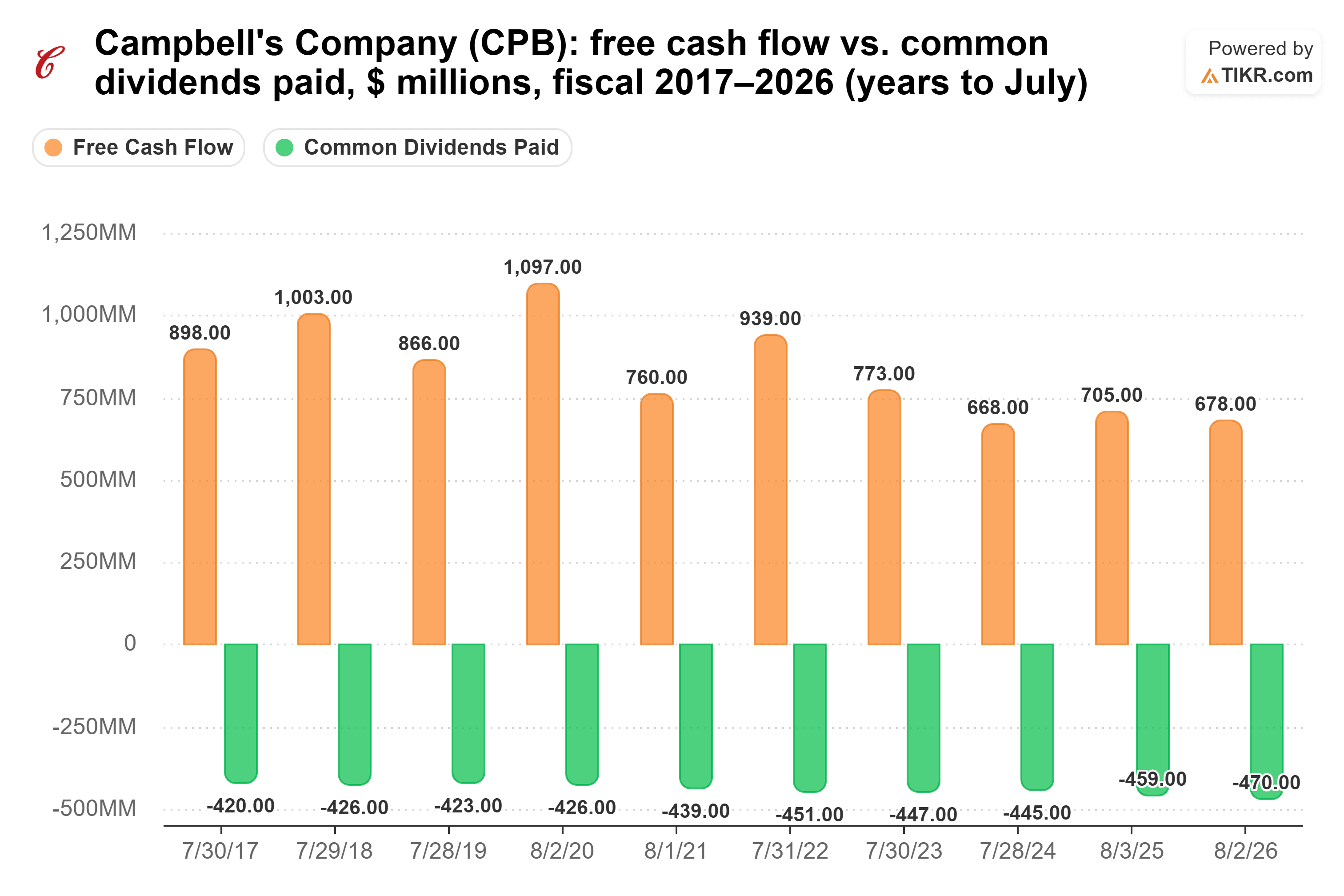
Campbell’s says the dividend cut saves about $170 million a year, and that money goes toward paying down debt. Analysts expect the payout to fall to a comfortable 40% in fiscal 2027, on free cash flow of $767 million.
CEO Mick Beekhuizen called the cut “obviously a difficult decision, but it is unfortunately a necessary decision,” and CFO Todd Cunfer said: “Our priorities are clear: return Campbell’s to a sustainable long-term value creation model, reduce financial risk and maintain our investment-grade credit rating.” On Sept. 23, Moody’s cut Campbell’s to Baa3, the lowest investment-grade rating, with a negative outlook.
Campbell’s core business is in rougher shape. Net sales fell 5% to $9.7 billion in fiscal 2026, and management expects organic sales to fall another 2% to 4% in fiscal 2027, with adjusted EPS of $1.65 to $1.80, down 17% to 24%. Rao’s is the bright spot, still growing by double digits. Leverage is the other pressure point, with Campbell’s putting its own net leverage at 4.3x on Sept. 3, well above the roughly 3x management is aiming for.
So which dividend wins?
Kraft Heinz is the better high-yield dividend stock. It pays the bigger check, covers it with half its free cash flow, and carries less debt.
$10,000 in Kraft Heinz pays $720 a year at today’s yield, against $530 from Campbell’s. Even if Campbell’s went back to raising at its pre-cut pace of 1.9% a year (fiscal 2020 to fiscal 2025), its income wouldn’t pass Kraft Heinz’s until about 2043.
Campbell’s has a fair case. After the cut, its dividend has more room, at 40% of fiscal 2027’s expected free cash flow against Kraft Heinz’s 69% in fiscal 2026. Rao’s gives it a growing brand. But Campbell’s bought that room by taking 36% of its shareholders’ income away, and its debt is still above target. Kraft Heinz pays more, and it covers that check without a cut.
Don’t count on raises from Kraft Heinz: what you’re buying is a big, flat check. Of course, if the marketing push doesn’t lift sales, that cushion gets thinner. Its third-quarter report and its Nov. 12 investor day are the next tests.
So what is Kraft Heinz stock actually worth?
TIKR lets you forecast the future price of any stock in less than a minute. Just enter a few assumptions into TIKR’s valuation model and see what Kraft Heinz could be worth. Start from Wall Street consensus estimates, or adjust the inputs to reflect your own view of the business. It’s free to use.
Disclaimer:
Please note that the articles on TIKR are not intended to serve as investment or financial advice from TIKR or our content team, nor are they recommendations to buy or sell any stocks. We create our content based on TIKR Terminal’s investment data and analysts’ estimates. Our analysis might not include recent company news or important updates. TIKR has no position in any of the stocks mentioned. Thank you for reading, and happy investing!