


Key Takeaways
- Nebius Group stock fell 9.9% on Friday, Nov. 13, after Baird and BofA cut their price targets over data center delays, adding to a 16.8% drop on the day of its third-quarter report.
- Short seller Jim Chanos says the $12 billion to $13 billion 2027 revenue guide works out to $8 million to $9 million per megawatt. That’s the same as the current 2026 run-rate, he says, and far below the $20 million-plus per megawatt Nebius says it’s signing.
- That makes next year’s 4x revenue growth a bet on construction, and management admits some colocation sites, including New Jersey, are behind schedule.
- The stock now trades far below its 3-year average on forward sales. That only looks cheap if the new capacity comes online on time.
Nebius Group (NBIS) fell 9.9% on Friday, Nov. 13, as Baird and BofA cut their price targets over data center delays. That followed a 16.8% drop on Nov. 12, the day it reported third-quarter results. Other AI cloud stocks fell too, with CoreWeave closing down 6.1%, a day after Nvidia announced CEO Jensen Huang’s resignation.
The report’s big promise was revenue of $12 billion to $13 billion in 2027, about 4x what Nebius expects this year.
Jim Chanos, the short seller who called Enron’s collapse, took that guide apart in a post on X addressed to “$NBIS (and neocloud) Bulls”:
“Can you please tell me how 2027 revenue guidance of $12-13B on average 2027 MW of 1,500 is consistent with the ‘signing contracts at $20-25M per MW’ narrative? That’s $8-9M per MW, the same as the current 2026 run-rate.”
Which, ouch.
TIKR tracks 23 analysts on Nebius. How many say “Buy”?
See the full breakdown of Buy, Hold, and Sell ratings on Nebius, along with Wall Street’s revenue and earnings estimates, all in one place. More than 500,000 investors use TIKR to research stocks like this one. See Nebius’ Analyst Ratings
Rising prices, flat revenue per megawatt
He’s right on the arithmetic. Divide $12 billion by Chanos’s 1,500 megawatts (his estimate of Nebius’s average 2027 capacity; the company hasn’t published one) and you get $8 million each, and $13 billion works out to about $8.7 million.
Compare that with what Nebius says it’s signing. On the company’s third-quarter call, CEO Arkady Volozh said third-quarter agreements closed above $25 million per megawatt in annual contract value, up from $20 million to $25 million in the second quarter. CFO Dado Alonso added that “prices for capacity in 2027 are going up.”
At $20 million to $25 million, 1,500 megawatts would bring in $30 billion to $37.5 billion a year. That’s more than double the guide.
Analysts’ consensus sits inside Nebius’s range, at $12.3 billion of revenue for 2027, then climbs to $26.0 billion in 2028.
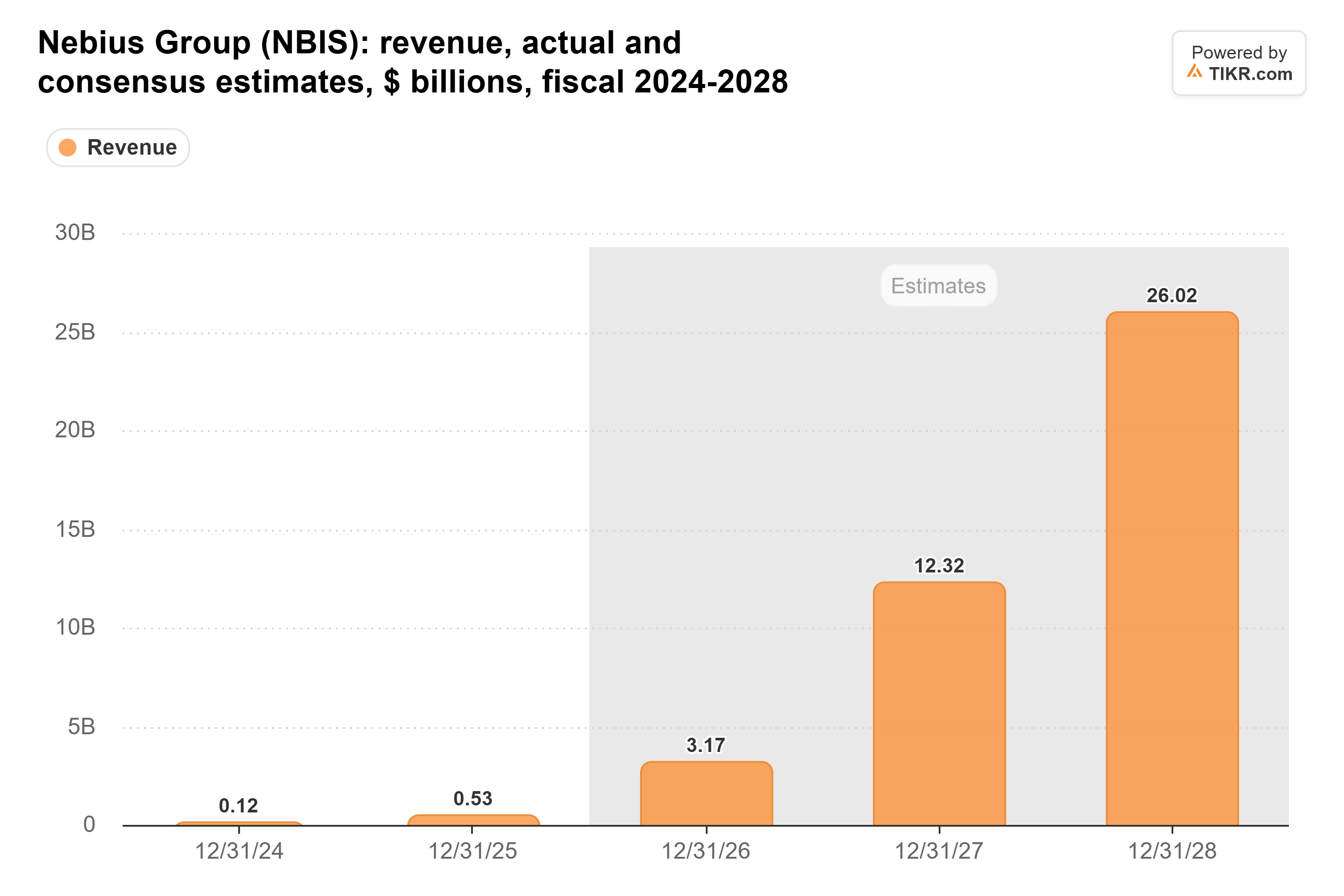
So the Street isn’t counting on a pricing windfall next year either.
The guide is really a construction schedule
Volozh more or less said so himself: “We expect revenue to quadruple next year on a conservative view of the pace of our build-out.”
Asked what the guide assumes, Alonso said Nebius needs two things: “We will need to have the capacity on time, and this capacity should be ready to be sold.” Selling it isn’t the worry, he said, since prices are rising.
Capacity is where Nebius is already slipping. Volozh admitted that “some of our colocation sites, including New Jersey, are behind schedule. Customers have been kept informed, and none of that capacity is canceled. Some of it has shifted to 2027.”
Some third-party capacity now lands in the first half of 2027, so Nebius trimmed its 2026 revenue range to $3.0 billion to $3.2 billion, from $3.0 billion to $3.4 billion. It now expects run-rate revenue to top $7 billion in February, after guiding to $7 billion to $9 billion by December. Baird cut its target to $200 from $340 and BofA to $265 from $310 over those delays, though Baird kept its Outperform rating and BofA its Buy.
The build keeps getting bigger, too. Nebius spent $7.3 billion on capex in the quarter to Sept. 30, 2026, up from $960 million a year earlier.
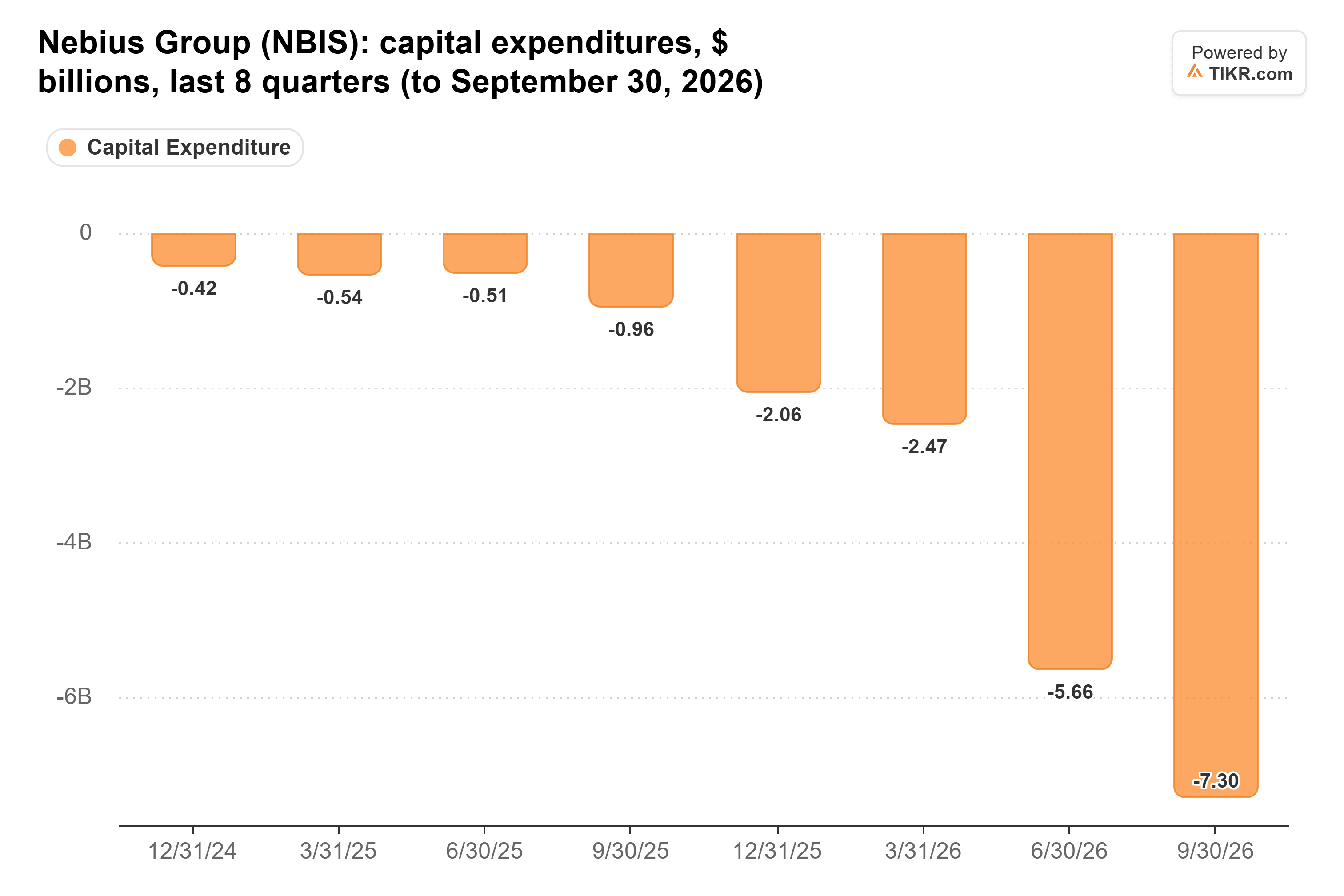
It now expects about $27 billion of capex this year, up from $20 billion to $25 billion, and $40 billion to $45 billion in 2027. The 2027 figure is sized for more than 1 gigawatt of new capacity.
New contracts only help once they’re live
Some of the per-megawatt gap has an innocent explanation. New megawatts arrive through 2027 and take time to start billing, older contracts signed at lower prices are still on the books, and management calls its timing assumptions conservative. Alonso even said revenue “could be higher” if the capacity comes in on time.
Every one of those depends on the same thing: megawatts going live sooner. A $25 million-per-megawatt contract adds nothing until the racks behind it are running, so any upside to this guide has to come from the construction schedule.
Demand looks fine. Prepayments on new contracts now cover more than 100% of the capital needed to bring that capacity online. But Alonso expects prepayments and asset-backed financing to cover just 75% to 85% of 2027’s capex. The rest of a $40 billion-plus bill has to come from the balance sheet, new debt or new stock.
Cheap, if the cranes keep moving
After the selloff, Nebius trades at 3.8x forward sales, far below its 3-year average of about 12x.
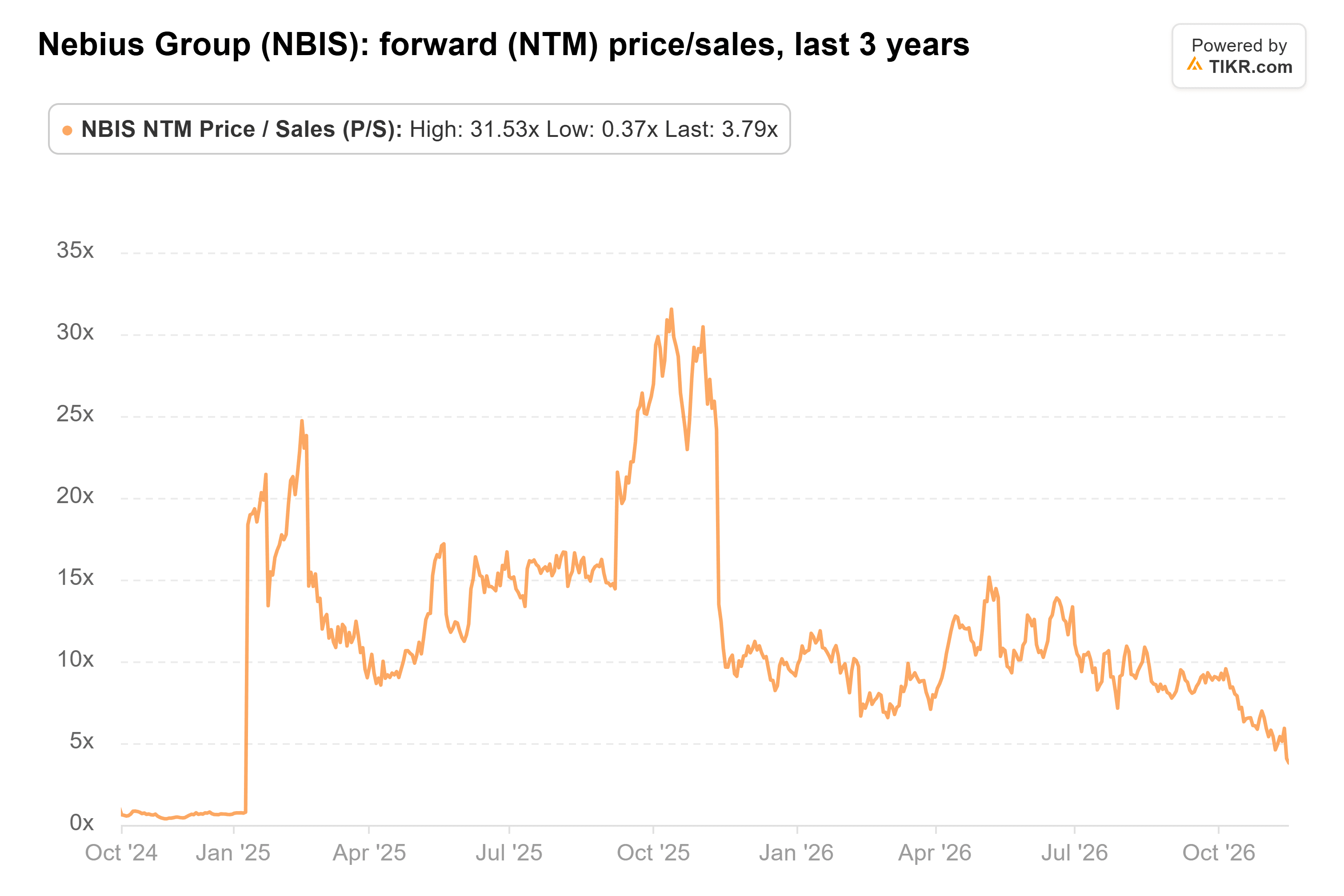
That multiple already prices in plenty of doubt. Bottom line: Chanos is asking the right question of the whole AI cloud trade. Nebius is signing richer contracts, but its own guide doesn’t count on them. Hitting next year’s number takes megawatts arriving on schedule, and Nebius is already behind on some of them. That’s bad news for anyone buying the neocloud story on rising prices.
Of course, Volozh says Nebius’s own sites are “on track and even ahead of schedule,” and most of the next gigawatt will come from them. Nebius’s fourth-quarter report early next year, and the remaining New Jersey tranches due in the second quarter of 2027, will show whether the delays stay at the colocation sites.
So what is Nebius stock actually worth?
TIKR lets you forecast the future price of any stock in less than a minute. Just enter a few assumptions into TIKR’s valuation model and see what Nebius could be worth. Start from Wall Street consensus estimates, or adjust the inputs to reflect your own view of the business. It’s free to use.
Disclaimer:
Please note that the articles on TIKR are not intended to serve as investment or financial advice from TIKR or our content team, nor are they recommendations to buy or sell any stocks. We create our content based on TIKR Terminal’s investment data and analysts’ estimates. Our analysis might not include recent company news or important updates. TIKR has no position in any of the stocks mentioned. Thank you for reading, and happy investing!


