
Key Takeaways
- Apple (AAPL) stock gained approximately 28% over the past year, closing near $342 on November 6 as stronger iPhone demand and earnings supported its rally.
- Microsoft (MSFT) reported approximately $41 billion in quarterly capital expenditures, including finance leases, while Alphabet (GOOGL) recorded negative $9.1 billion in third-quarter free cash flow amid substantial AI infrastructure spending.
- Apple reported fiscal fourth-quarter revenue of $114.5 billion, up 12%, but its December-quarter gross margin guidance of 45% to 46% highlights pressure from rising memory costs.
- Apple appears potentially overvalued at its premium earnings multiple, leaving limited room for slower earnings growth or weaker profitability.
What Happened?
Apple (AAPL) stock climbed approximately 28% over the past year, closing at $342.37 on November 6, as stronger iPhone demand, improving earnings, and relatively restrained AI infrastructure spending supported investor confidence.
Unlike Microsoft (MSFT) and Alphabet (GOOGL), which continue investing heavily in AI data centers, Apple has focused on integrating AI into its devices and services while relying partly on technology partnerships.
According to Microsoft’s fiscal fourth-quarter earnings call, the company reported approximately $41 billion in capital expenditures, including $5.6 billion in finance leases and $35.8 billion in cash payments for property and equipment.
Alphabet’s third-quarter earnings commentary showed $51.4 billion in capital expenditures, primarily supporting technical infrastructure, while the company recorded negative $9.1 billion in free cash flow. Inventory investments and a European Commission fine payment also affected cash generation.
Apple’s November 2 earnings report reinforced its operating momentum, with fiscal fourth-quarter revenue increasing 12% to $114.5 billion and diluted earnings per share rising 14% to $2.10.
The announcement marked Apple’s first earnings report under CEO John Ternus, with September-quarter iPhone revenue reaching a record and Services revenue hitting an all-time high.
Ternus described the results as “capping off our best fiscal year ever,” reflecting continued strength across Apple’s core businesses.
However, higher memory prices and weaker gross margin guidance suggest Apple’s profitability could face pressure despite its more restrained AI infrastructure spending strategy.
Apple’s Earnings Growth Supports Its Stock Rally
Apple’s financial performance has provided substantial support for its share-price gains, with quarterly revenue growing 16% in December, 17% in March, 16% in June, and another 12% in September.
For fiscal 2026, annual revenue reached approximately $478.8 billion, up 15%, supported by stronger iPhone demand and expanding Services revenue.
Services revenue increased 13% to $123.3 billion, while Greater China revenue climbed approximately 28% to $82.4 billion, highlighting improving demand in one of Apple’s most important international markets.
Annual iPhone revenue also increased approximately 21% to $254.1 billion, reinforcing Apple’s ability to generate growth from its core hardware business while competitors commit substantial resources to AI infrastructure.
Apple’s expanding Services business and strong iPhone sales provide additional earnings opportunities, although sustaining that momentum will become increasingly important as growth moderates.
According to TIKR data, Apple’s normalized EPS reached approximately $8.84 in fiscal 2026, while analysts expect EPS to rise to $9.55 in fiscal 2027.
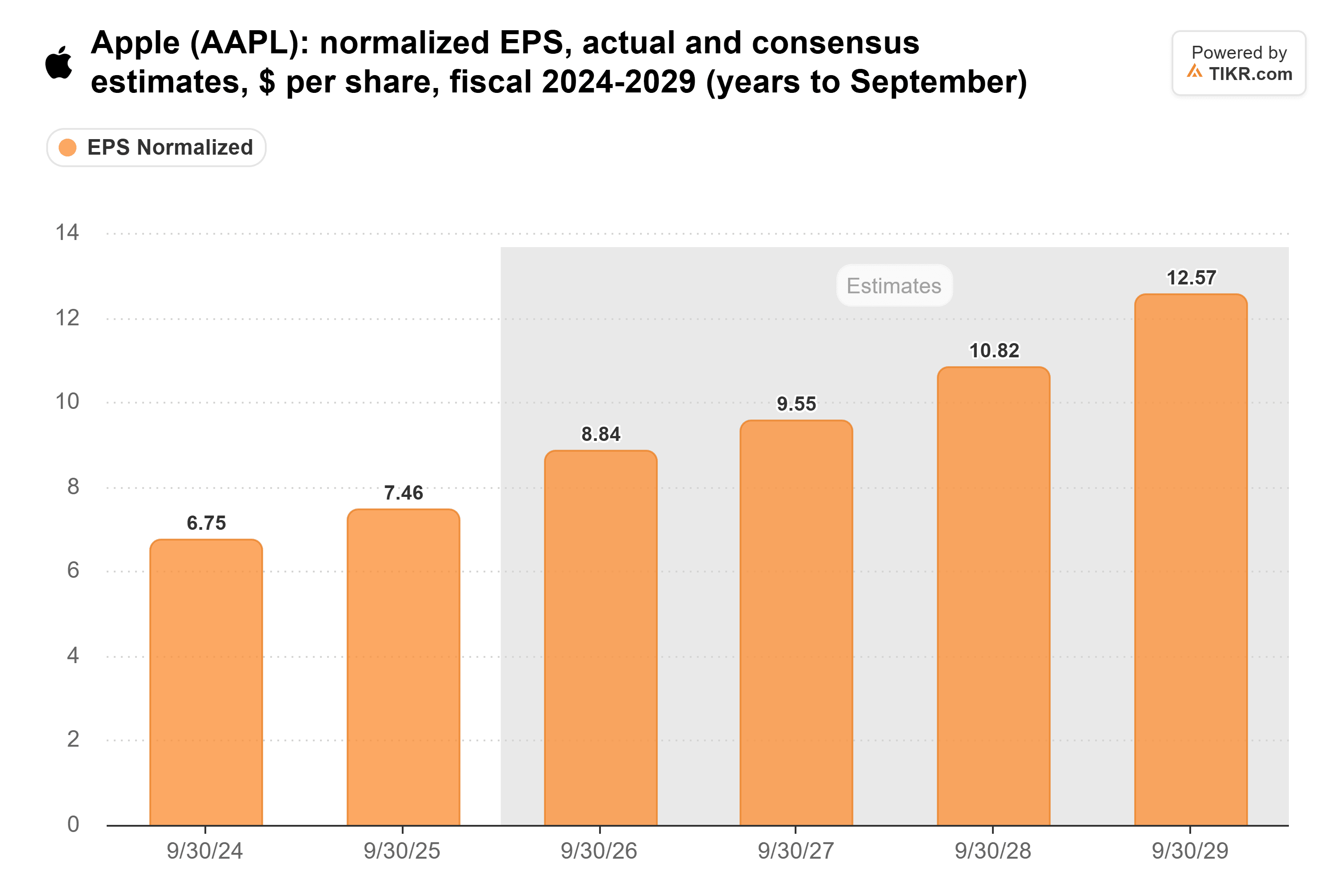
That represents approximately 8% expected earnings growth in fiscal 2027, suggesting Apple’s profitability could continue expanding but at a slower pace than its recent performance.
Continued iPhone demand, Services expansion, and improving AI capabilities could support future earnings, but rising component costs and additional AI-related expenses could offset some of those gains.
Is Apple Stock Undervalued or Overvalued?
Apple appears potentially overvalued following its substantial rally, particularly because its premium earnings multiple leaves limited room for slower growth.
According to the original TIKR valuation chart, Apple traded at approximately 37.5 times forward earnings at the end of October, compared with its five-year historical average of roughly 29 times.
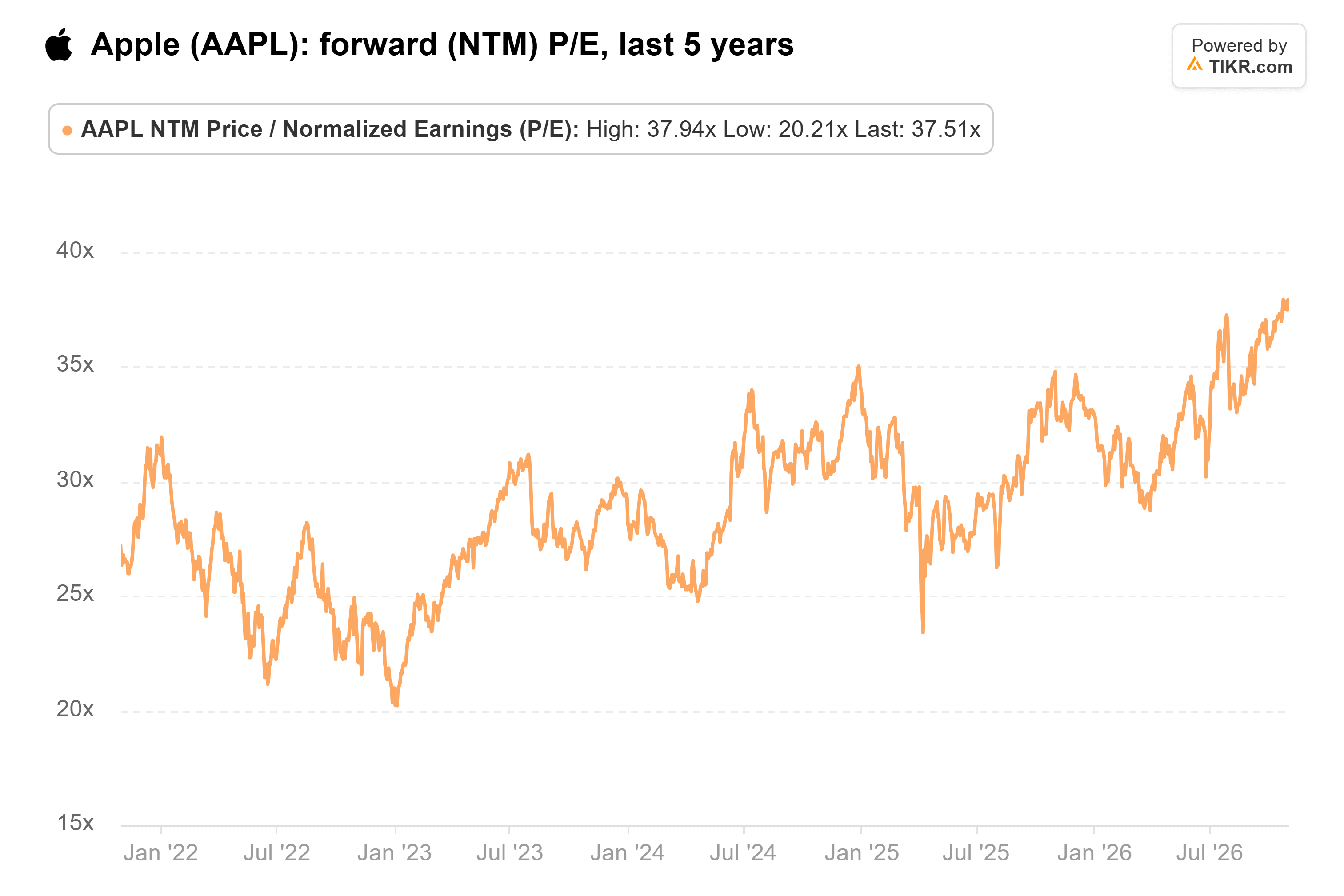
That premium reflects Apple’s customer loyalty, expanding Services business, and ability to generate substantial cash flow without matching competitors’ largest AI infrastructure investments.
However, rising component costs could pressure profitability. Apple’s September-quarter gross margin of 47.9% included approximately one percentage point of benefit from tariff refunds, while management guided to 45% to 46% for December.
During Apple’s fiscal fourth-quarter earnings call, CFO Kevan Parekh explained that higher memory costs would account for most of the expected sequential decline in gross margin, while costs associated with the Siri AI rollout would also contribute.
This highlights an important risk: Apple’s restrained AI infrastructure spending does not fully protect its profitability from rising component costs associated with the broader AI investment cycle.
Apple’s annual gross margin improved from 41.8% in fiscal 2021 to 46.9% in fiscal 2025, making the latest outlook an important test of whether the company can maintain its historical profitability gains.
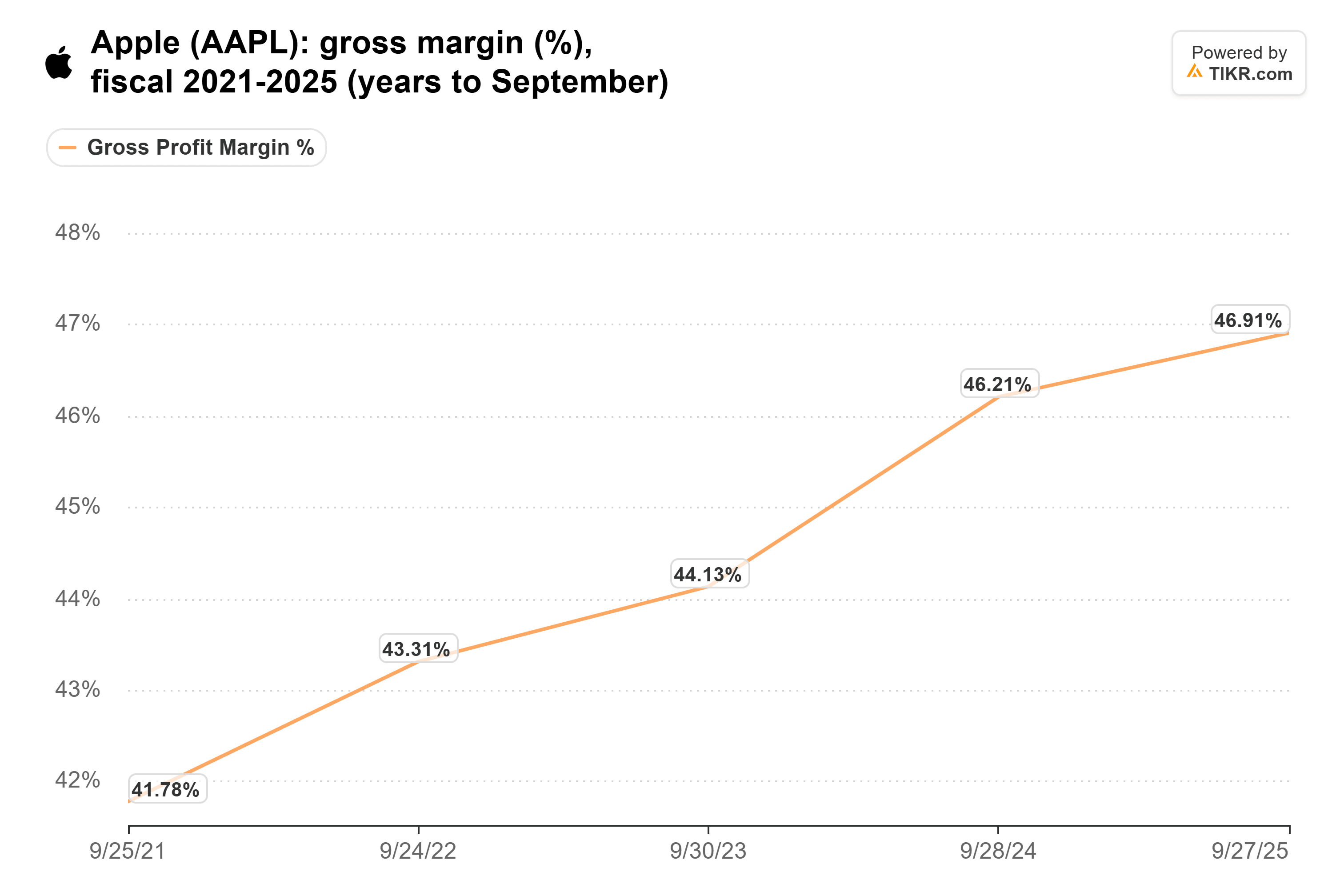
Over the next 12 months, stronger iPhone shipments, continued Services growth, and expanding AI capabilities could support earnings, although memory inflation and weaker margins may limit further upside.
Using the original TIKR draft’s fiscal 2027 normalized EPS estimate of $9.55, a hypothetical 30 times earnings multiple would imply a share price of approximately $287, representing roughly 16% downside from Apple’s November 6 closing price.
That scenario is not a price forecast, but it illustrates how a contraction toward Apple’s historical valuation could affect shareholders even if earnings continue growing.
Apple remains a highly profitable business, but its elevated valuation already reflects considerable optimism about future performance.
At approximately $342 per share, the stock looks more attractive for existing shareholders than for investors seeking a substantial margin of safety. A lower entry price or clearer evidence of stabilizing margins would strengthen the investment case.
So what is Apple stock actually worth?
TIKR lets you forecast the future price of any stock in less than a minute. Just enter a few assumptions into TIKR’s valuation model and see what Apple could be worth. Start from Wall Street consensus estimates, or adjust the inputs to reflect your own view of the business. It’s free to use.
Disclaimer:
Please note that the articles on TIKR are not intended to serve as investment or financial advice from TIKR or our content team, nor are they recommendations to buy or sell any stocks. We create our content based on TIKR Terminal’s investment data and analysts’ estimates. Our analysis might not include recent company news or important updates. TIKR has no position in any of the stocks mentioned. Thank you for reading, and happy investing!