Key Takeaways
- AbbVie raised its quarterly dividend 5.2% to $1.82 a share on Oct. 30, while Pfizer has paid $0.43 a share every quarter of 2026.
- Pfizer yields 5.7% to AbbVie’s 2.5%, but AbbVie grew its dividend 6.6% a year from fiscal 2020 to fiscal 2025, against 2.5% for Pfizer.
- Pfizer’s dividend took 89% of its free cash flow over its latest twelve months, against 65% for AbbVie.
- Analysts expect Pfizer’s revenue to fall to $55 billion in 2028, so its 2027 guidance is the next thing to watch.
AbbVie (ABBV) raised its quarterly dividend 5.2% to $1.82 a share on Oct. 30, alongside a third-quarter earnings beat and another raise to its full-year guidance.
Pfizer (PFE) is holding steady instead. Its fourth-quarter dividend, declared Oct. 6, is $0.43 a share, the same as every quarter of 2026. Even so, Pfizer yields 5.7% to AbbVie’s 2.5%.
So which one pays you more over the next 10 years?
| Metric | Pfizer (PFE) | AbbVie (ABBV) |
|---|---|---|
| Dividend yield | 5.7% | 2.5% |
| Annual dividend | $1.72 | $7.28 |
| Dividend growth, fiscal 2020-2025 | 2.5% a year | 6.6% a year |
| Cash dividend payout ratio (TTM) | 89% (to June 28, 2026) | 65% (to Sept. 30, 2026) |
| Net debt/EBITDA (LTM) | 2.0x | 2.0x |
| Interest coverage (LTM) | 7.0x | 8.2x |
Source: TIKR, Nov. 5, 2026. AbbVie’s annual dividend is at its new $1.82 quarterly rate.
6 safe dividend stocks paying retirees 6%+ yields
There are over 100 stocks paying 6%+ annual dividends today.
But after an extensive investment review leveraging TIKR’s proprietary data, we now believe only six of them are truly safe for retirees.
They’re all yours for free as part of our new investment report, which you can access right here.
Pfizer’s big check has a thin cushion
Pfizer’s newer drugs are carrying more of the load. Third-quarter revenue of $16.6 billion was relatively flat from a year earlier, operationally, as Paxlovid fell 63% and the Prevnar family 10%, while the products it launched or acquired grew 32%. Management raised its 2026 revenue guidance to $62.0-$64.0 billion, from $60.5-$62.5 billion.
Pfizer’s free cash flow covered its dividend easily in fiscal 2021 and 2022, on COVID sales, then fell to $4.79 billion in fiscal 2023, about half the $9.25 billion it paid out, and has hovered around the dividend since:
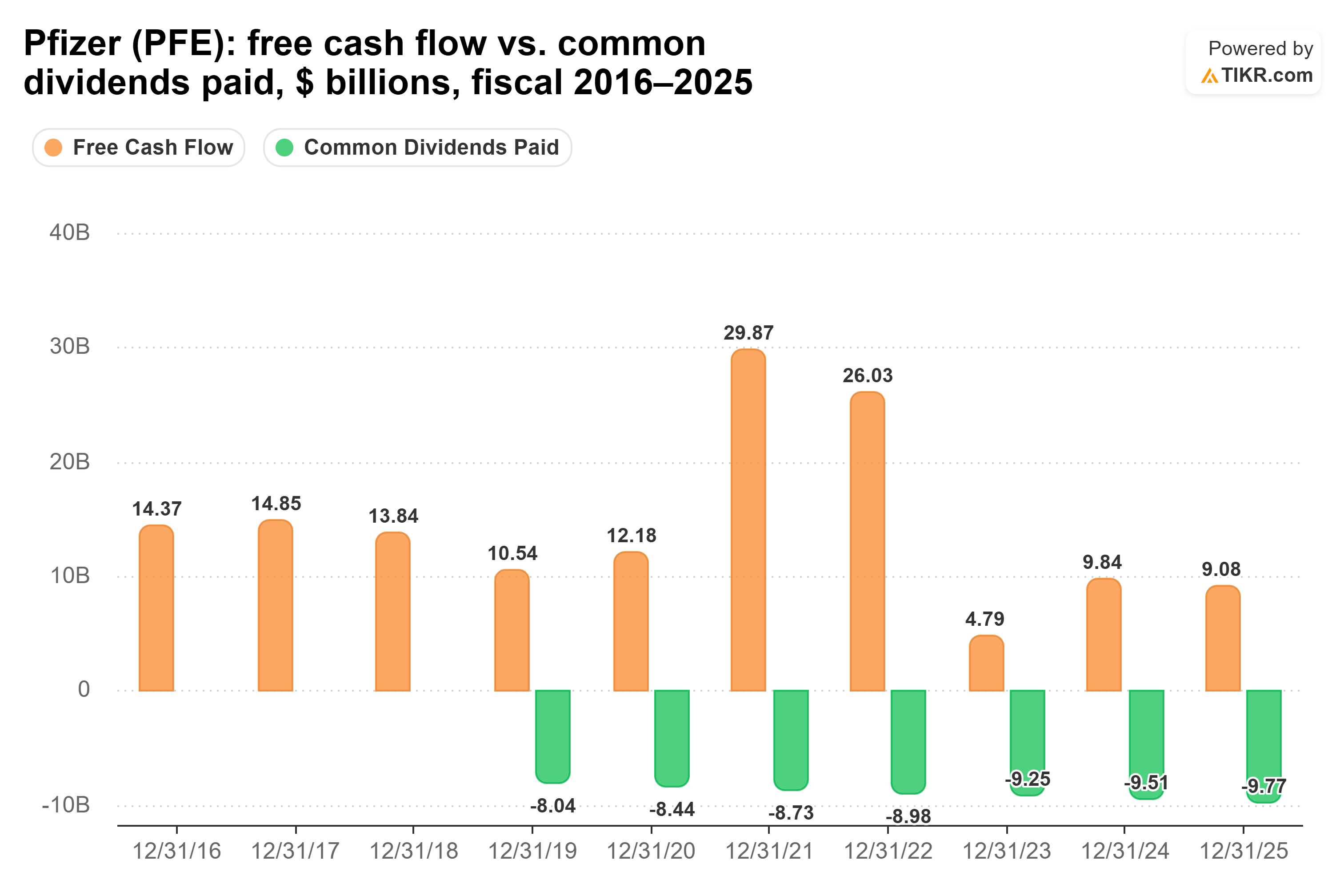
In fiscal 2025, Pfizer paid $9.77 billion of dividends from $9.08 billion of free cash flow. Its cash dividend payout ratio eased from that year’s 107.7% to a still-risky 89% over the twelve months to June 28, 2026.
Talking about the dividend on the second-quarter call in August, CEO Albert Bourla said: “We feel extremely confident that we will — even the most stretched scenarios that we are running, we will be able to maintain our dividend.”
Cecile Guegan, named CFO on Nov. 3, kept the dividend among Pfizer’s priorities. Still, Ibrance, Xtandi and Eliquis outside the US all lose exclusivity in the next few years.
AbbVie has room to keep raising
AbbVie’s check is smaller, but the business behind it is growing. Third-quarter net revenues rose 10.3% from a year earlier to $17.4 billion, led by Skyrizi, up 22.7% to $5.78 billion, which more than made up for Humira’s 31.2% drop to $683 million. AbbVie raised its 2026 adjusted EPS guidance to $13.95-$13.99, from $13.76-$13.96.
AbbVie’s free cash flow climbed from $6.56 billion in fiscal 2016 to $24.3 billion in fiscal 2022, then fell to $17.8 billion in fiscal 2025 as its dividends kept rising:
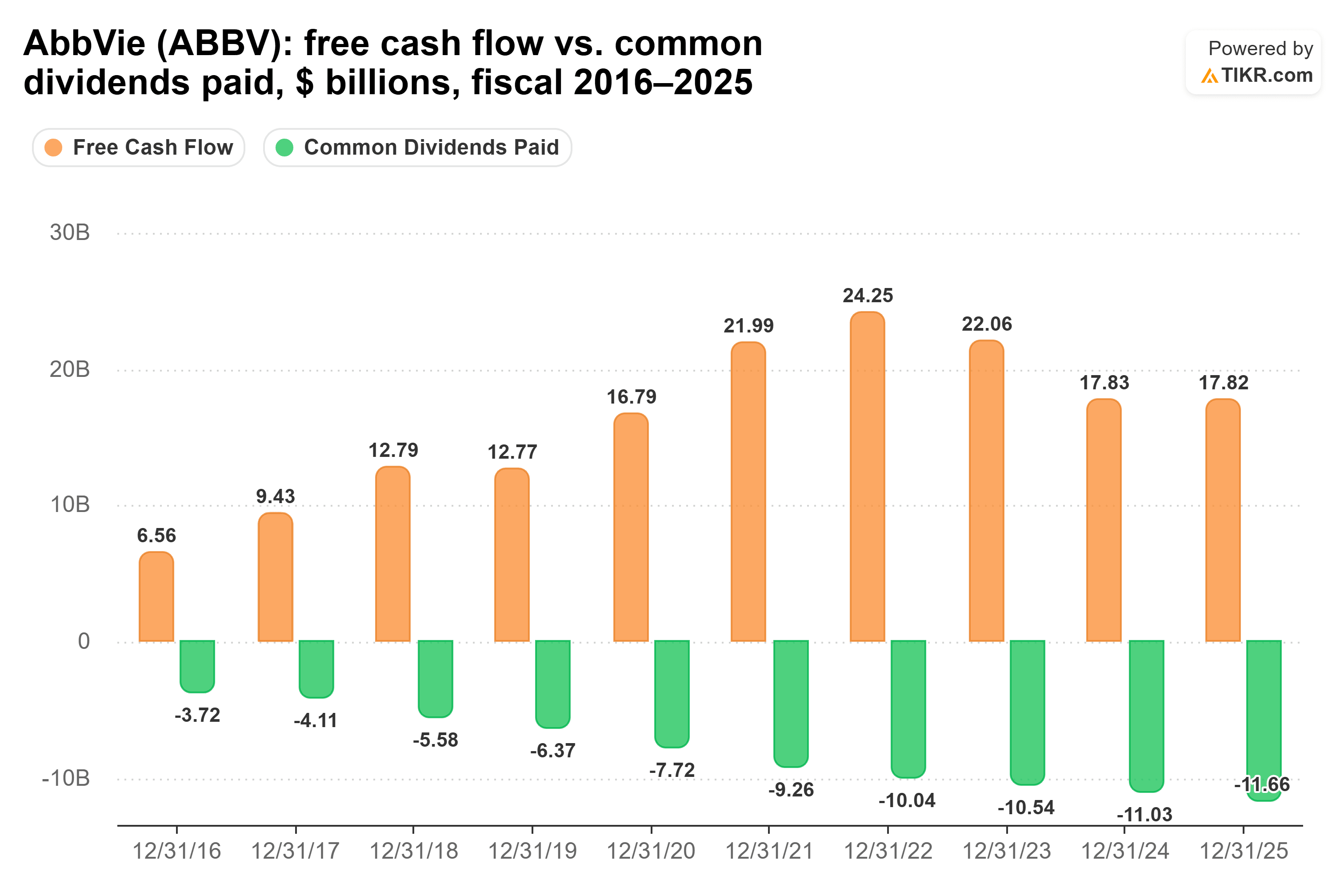
That pushed its cash dividend payout ratio from 41.4% in fiscal 2022 to 65.4% in fiscal 2025, and it was a well-covered 65% over the twelve months to Sept. 30, 2026.
AbbVie says it has raised its quarterly dividend 355% since its 2013 inception. But its latest raise, 5.2%, is slower than its 6.6% yearly pace from fiscal 2020 to fiscal 2025.
So which dividend wins?
Pfizer pays you more over 10 years, by a wide margin.
Put $10,000 into Pfizer at its 5.7% yield, and it pays $570 a year today. Growing at its 2.5% five-year rate, that’s about $6,387 over the decade. The same $10,000 in AbbVie pays $250 a year and, at its 6.6% rate, about $3,383 in all. At those rates, AbbVie’s yearly income wouldn’t catch Pfizer’s until about 2048.
Pfizer doesn’t even need its 2.5% rate. If it never raised again, that $10,000 would still pay $5,700 over the 10 years.
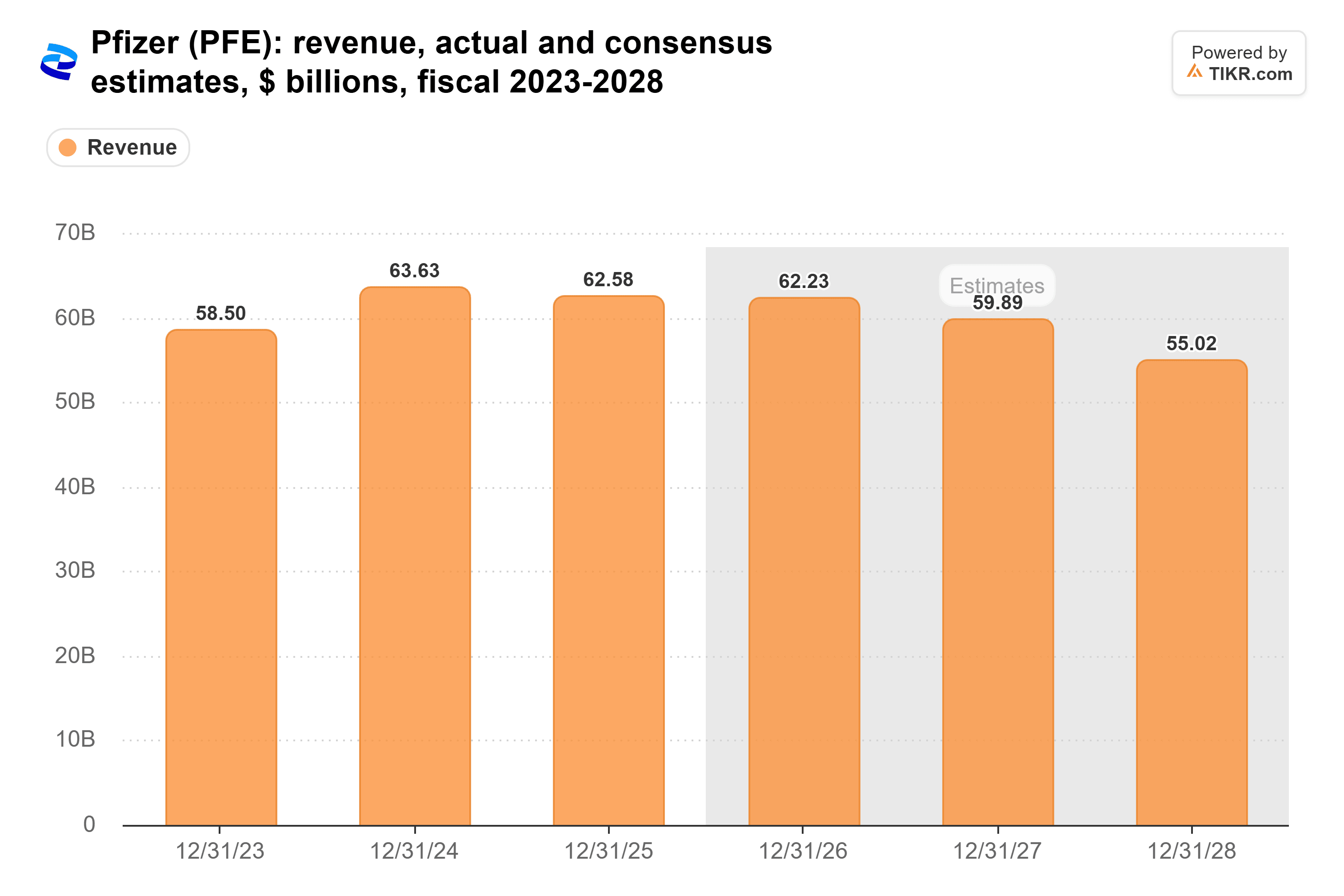
What Pfizer does need is the cash to keep paying, and analysts expect its revenue to shrink from $62.6 billion in fiscal 2025 to $55.0 billion in fiscal 2028.
Two of its products also get Medicare’s negotiated prices in 2027, which CFO Guegan said Pfizer will reflect in its 2027 guidance.
AbbVie’s dividend is the better-covered one, its business is growing at double digits, and its raises keep coming. For someone investing for 20-plus years, that’s a real case. It’s just that over 10 years, Pfizer’s head start is too big to give up.
Of course, that rests on Pfizer finding the cash as its patents roll off, and its 2027 guidance will be the first real look at whether it can.
Forget Pfizer: 6 safe 6%+ dividend yields you can buy right now
Dividends can hold the key to enormous wealth. But only if you buy the right ones.
Picking the right high-yield dividend stock can be the difference between a dream retirement…and scraping by every month, waiting for the next Social Security check to clear.
We’ve identified six stocks yielding 6%+ that we believe every retiree should know about right now. (And Pfizer isn’t one of them.)
Disclaimer:
Please note that the articles on TIKR are not intended to serve as investment or financial advice from TIKR or our content team, nor are they recommendations to buy or sell any stocks. We create our content based on TIKR Terminal’s investment data and analysts’ estimates. Our analysis might not include recent company news or important updates. TIKR has no position in any of the stocks mentioned. Thank you for reading, and happy investing!