Key Takeaways
- Texas Instruments raised its quarterly dividend 7% in September, and HP named former GSK CEO Emma Walmsley its next CEO on Nov. 4.
- HP yields 4%, twice Texas Instruments’ 2%, and its dividend uses 28% of its free cash flow, against 71% at Texas Instruments.
- Texas Instruments’ dividends ran ahead of its free cash flow from fiscal 2023 to 2025 during a factory build-out, and falling capital spending is bringing its coverage back.
- HP faces rising memory costs and expects PC units to fall in 2027, while Texas Instruments’ third-quarter revenue rose 28%.
HP Inc. (HPQ) named a permanent CEO on Nov. 4: former GSK chief Emma Walmsley, starting Jan. 4, 2027. The stock rose 7% on the news, after a rough few weeks of worry about memory costs.
Texas Instruments (TXN), by contrast, has had a strong fall. It raised its quarterly dividend 7% in September, then reported third-quarter revenue up 28% in October.
So one yields 4.0% while fighting rising memory costs, and the other yields 2.0% with its business booming. Which is the better dividend stock?
| Metric | HP (HPQ) | Texas Instruments (TXN) |
|---|---|---|
| Dividend yield | 4.0% | 2.0% |
| Annual dividend | $1.20 | $6.08 |
| Dividend growth, fiscal 2020-2025 | 10.6% a year | 8.1% a year |
| Cash dividend payout ratio (TTM) | 28% | 71% |
| Net debt/EBITDA | 1.2x | 0.5x |
| Interest coverage | 9.8x | 15.1x |
| Forward P/E (NTM) | 9.5x | 27x |
Source: TIKR and StockAnalysis, Nov. 5, 2026. Payout ratios are for the 12 months to July 31, 2026 (HP) and Sept. 30, 2026 (Texas Instruments).
6 safe dividend stocks paying retirees 6%+ yields
There are over 100 stocks paying 6%+ annual dividends today.
But after an extensive investment review leveraging TIKR’s proprietary data, we now believe only six of them are truly safe for retirees.
They’re all yours for free as part of our new investment report, which you can access right here.
HP’s dividend has room to spare
In its fiscal third quarter, ended July 31, 2026, HP’s revenue rose 12.5% to $15.7 billion. Personal Systems grew 18% on AI PCs, while Printing fell 2% on tougher pricing and lower hardware volumes.
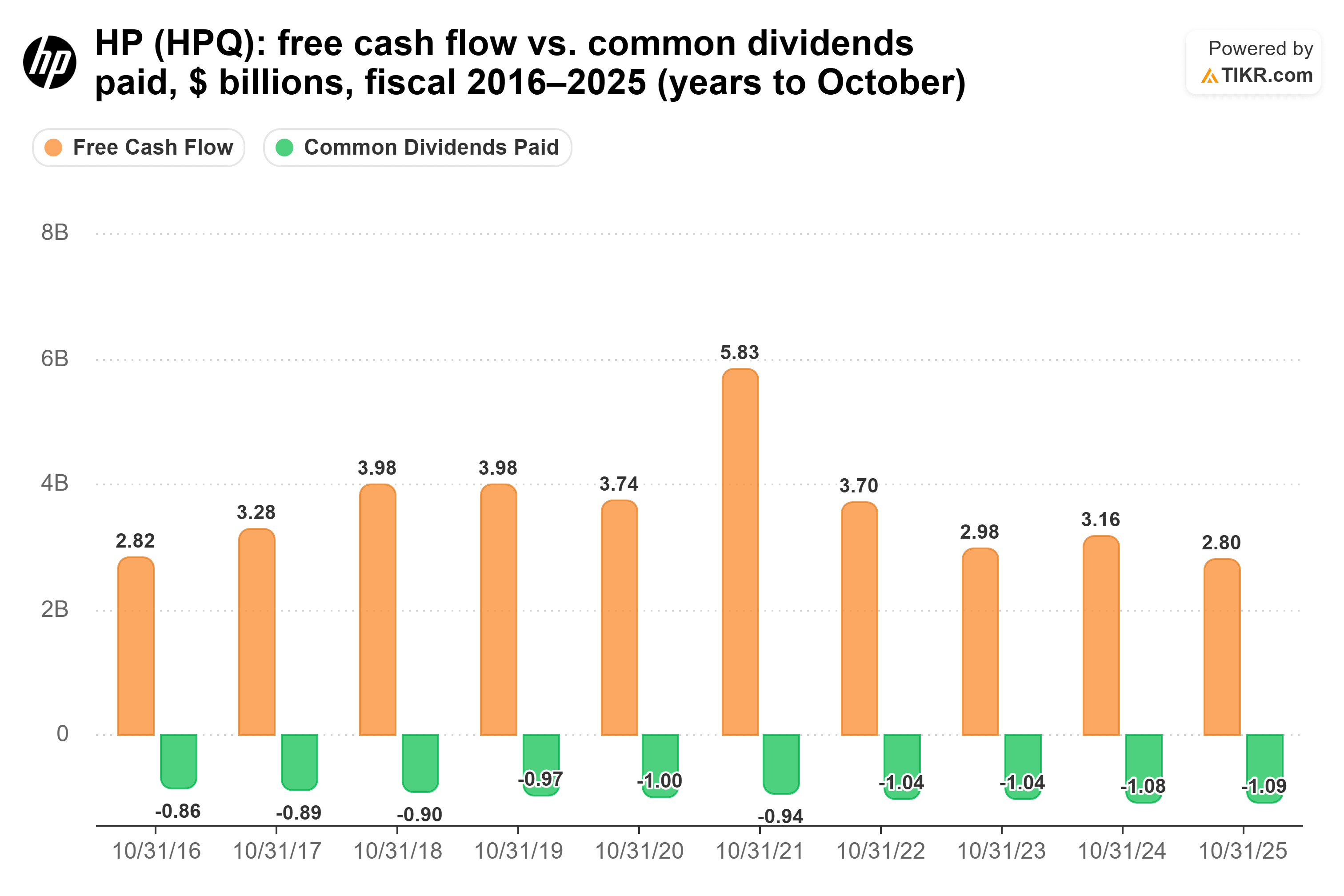
The dividend uses only a small slice of the cash. Over the 12 months to July 31, 2026, HP paid $1.09 billion in dividends, a comfortable 28% of its $3.88 billion of free cash flow. HP also raised its fiscal 2026 free cash flow forecast to $3.0 billion-$3.2 billion, well over double what the dividend costs.
The ratio climbed from 16.1% in fiscal 2021 to 38.9% in fiscal 2025 as free cash flow fell from its $5.83 billion peak. Even so, free cash flow covered the dividend more than twice over in every year on the chart:
The risk is the PC business. In a Sept. 21 SEC filing, HP said it expects global PC units to fall by a mid-single-digit percentage in calendar 2027 as AI data centers pull memory supply away from PCs, and it gave no fiscal 2027 guidance. The stock fell about 4% that day, then 9% on Oct. 30 after Intel CEO Lip-Bu Tan warned that memory shortages are choking PC demand. A dividend this well covered can ride that out, but its raises could slow.
Texas Instruments’ coverage is mending
Texas Instruments has the reverse setup: its business is strong, and its dividend is what got stretched. Third-quarter revenue rose 28% to $6.06 billion and net income rose 78% to $2.43 billion, as industrial, automotive and data center sales grew.
On Sept. 17, it raised its quarterly dividend 7% to $1.52 a share, and said the raise “marks 23 consecutive years of dividend increases.”
Keeping that streak alive got expensive, though. Free cash flow fell from $5.92 billion in fiscal 2022 to $1.35 billion in fiscal 2023, while the dividend kept growing. Dividends ran at 337.8%, 320.1% and 192.0% of free cash flow in fiscal 2023, 2024 and 2025:
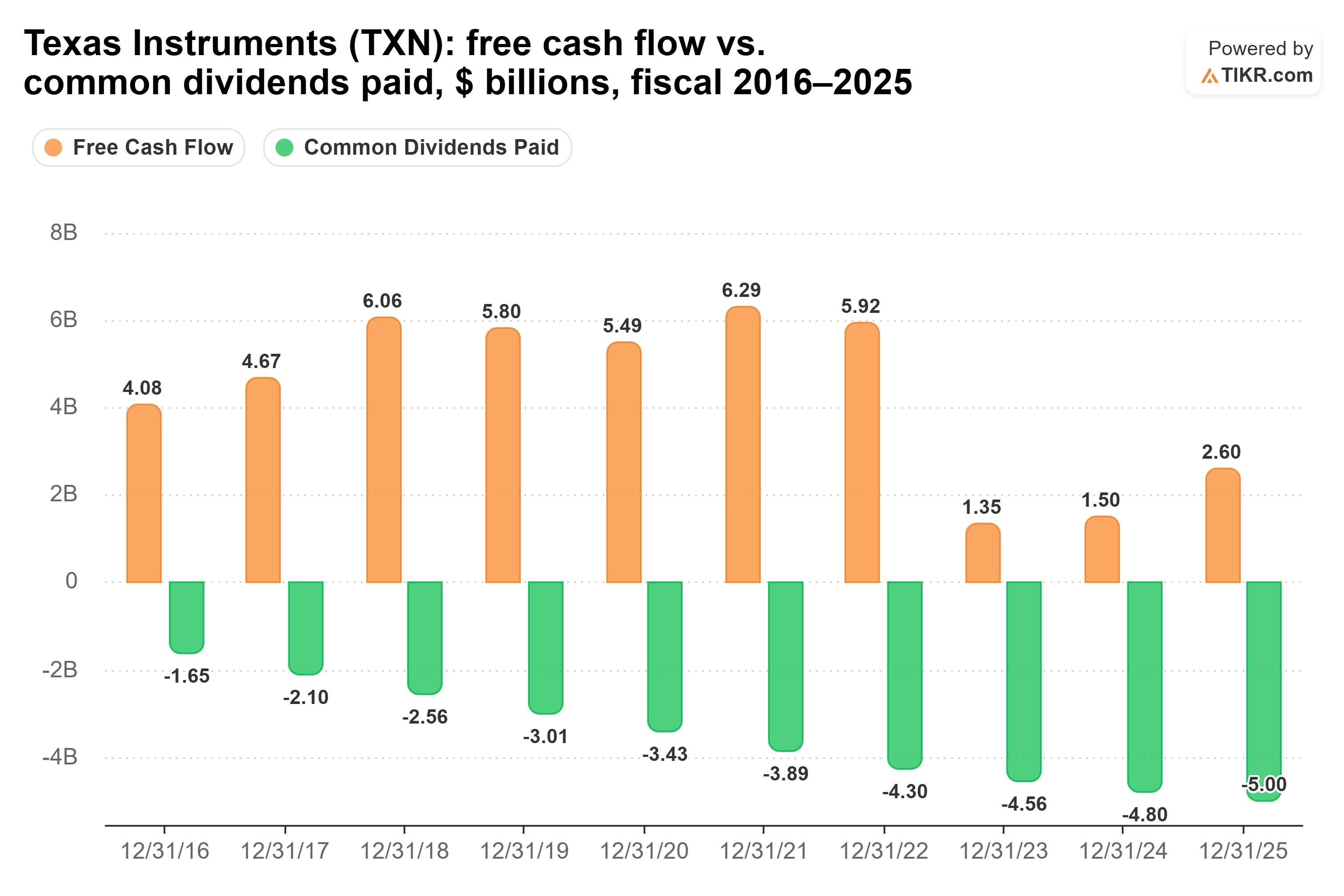
Over the 12 months to Sept. 30, 2026, the ratio is back down to 71%, with $5.17 billion of dividends against $7.32 billion of free cash flow. The dividend is covered again, but with far less room than HP’s, in an industry that swings with industrial and automotive demand.
So which dividend wins?
HP is the better dividend stock. It pays twice the yield of Texas Instruments and covers that check with far more room: 28% of free cash flow against 71%.
Put $10,000 in HP and it pays $401 a year today, against $200 from Texas Instruments. At their fiscal 2020-2025 growth rates of 10.6% and 8.1% a year, that’s about $995 from HP in year 10, a 10.0% yield on the original $10,000. Texas Instruments would pay about $404, or 4.0%. At their fiscal 2025 raises of 5.5% and 4.6%, it’s about $647 against $299. Either way, Texas Instruments never catches up.
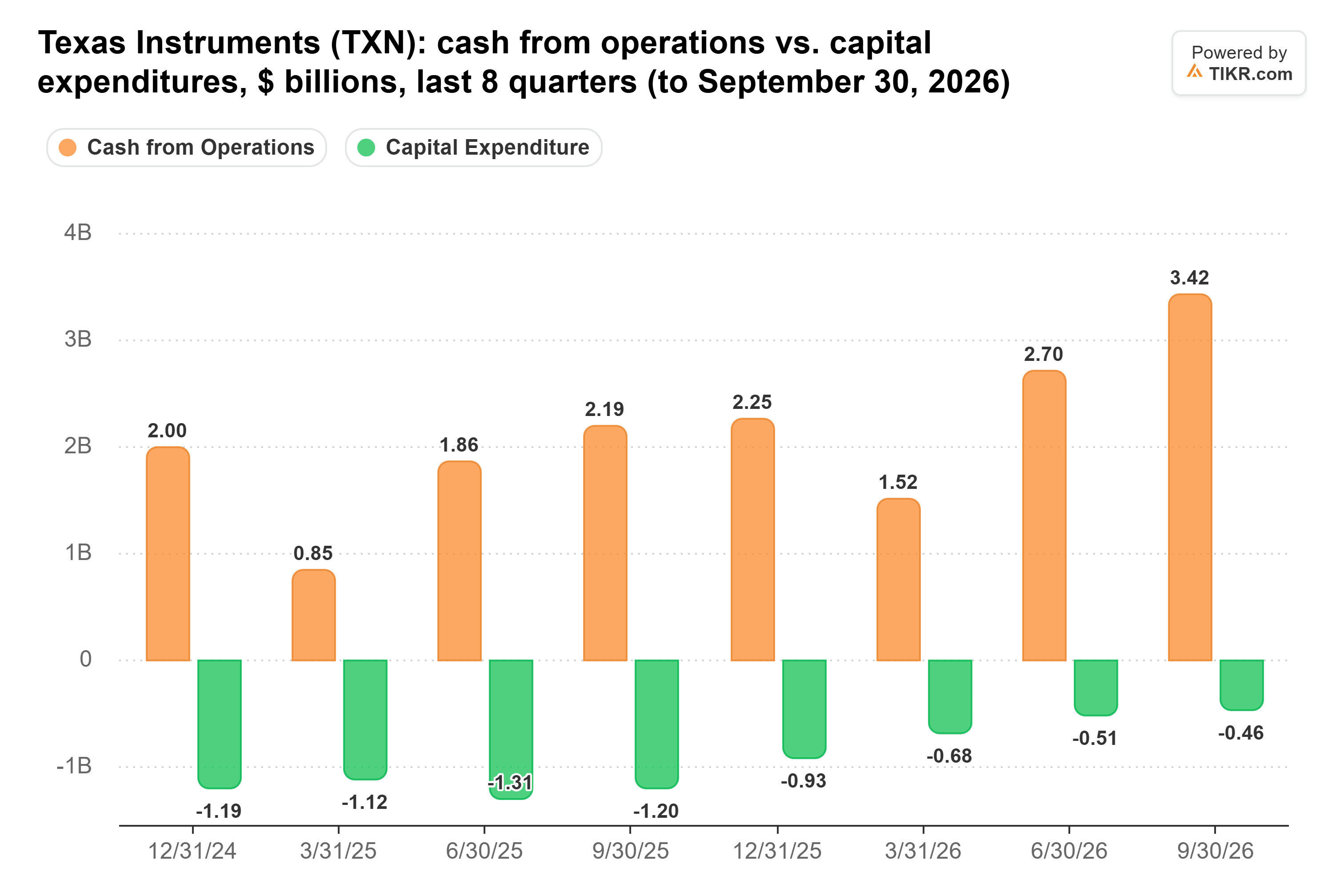
Texas Instruments still has a real case. Its business is growing faster, and its debt is lower, at 0.5x EBITDA against HP’s 1.2x. And its 23 years of raises come with a stated aim of “a sustainable and growing dividend.” Its coverage is mending, too. Over the eight quarters to Sept. 30, 2026, quarterly capital spending fell from $1.19 billion to $0.46 billion, while cash from operations rose from $2.00 billion to $3.42 billion:
It’s just that HP’s dividend could absorb a much bigger drop in free cash flow, and it pays twice as much today.
Of course, Walmsley takes over on Jan. 4, and she’ll set HP’s capital priorities just as PC units are expected to shrink. If memory costs climb faster than HP expects, that 28% won’t stay so low.
Forget HP Inc.: 6 safe 6%+ dividend yields you can buy right now
Dividends can hold the key to enormous wealth. But only if you buy the right ones.
Picking the right high-yield dividend stock can be the difference between a dream retirement…and scraping by every month, waiting for the next Social Security check to clear.
We’ve identified six stocks yielding 6%+ that we believe every retiree should know about right now. (And HP Inc. isn’t one of them.)
Disclaimer:
Please note that the articles on TIKR are not intended to serve as investment or financial advice from TIKR or our content team, nor are they recommendations to buy or sell any stocks. We create our content based on TIKR Terminal’s investment data and analysts’ estimates. Our analysis might not include recent company news or important updates. TIKR has no position in any of the stocks mentioned. Thank you for reading, and happy investing!