Key Takeaways
- Amazon’s AWS revenue rose 39% to $46.0 billion in the third quarter, its fastest growth in nearly five years.
- Shares fell 6.5% after hours as trailing free cash flow swung to a $42.4 billion outflow.
- Microsoft’s Azure grew 48% and Alphabet’s Google Cloud doubled, so AWS is growing more slowly than its two biggest rivals.
- The fourth-quarter report in early February will show whether AWS growth tops 40% and advertising growth reaches the high teens.
Amazon’s cloud business just had its best quarter in almost five years. Investors sold the stock anyway.
Amazon.com (AMZN) reported third-quarter revenue of $201.9 billion on October 29, up 12% but just shy of the $202.2 billion Wall Street expected. So shares fell 6.5% in after-hours trading. The bigger worry sat in the cash flow statement, where trailing free cash flow swung to a $42.4 billion outflow.
Rivals make the comparison tougher, too. Microsoft (MSFT) grew Azure revenue 48% to $33.2 billion in the same quarter. Alphabet (GOOGL) went further, as Google Cloud revenue doubled to $30.7 billion.
So AWS’s 39% looks great on its own and merely solid next to its peers. Meanwhile, Amazon keeps borrowing to fund the buildout, with more than $92 billion of bonds sold this year.
AWS carried the quarter
The headline numbers were mostly excellent:
- AWS revenue rose 39% to $46.0 billion, a $184 billion annualized run rate.
- Operating income climbed 61% to $28.1 billion, for a record 13.9% operating margin.
- Earnings per share slipped to $1.89 from $1.95, since last year included $9.5 billion of Anthropic gains.
AWS growth keeps speeding up, quarter after quarter…
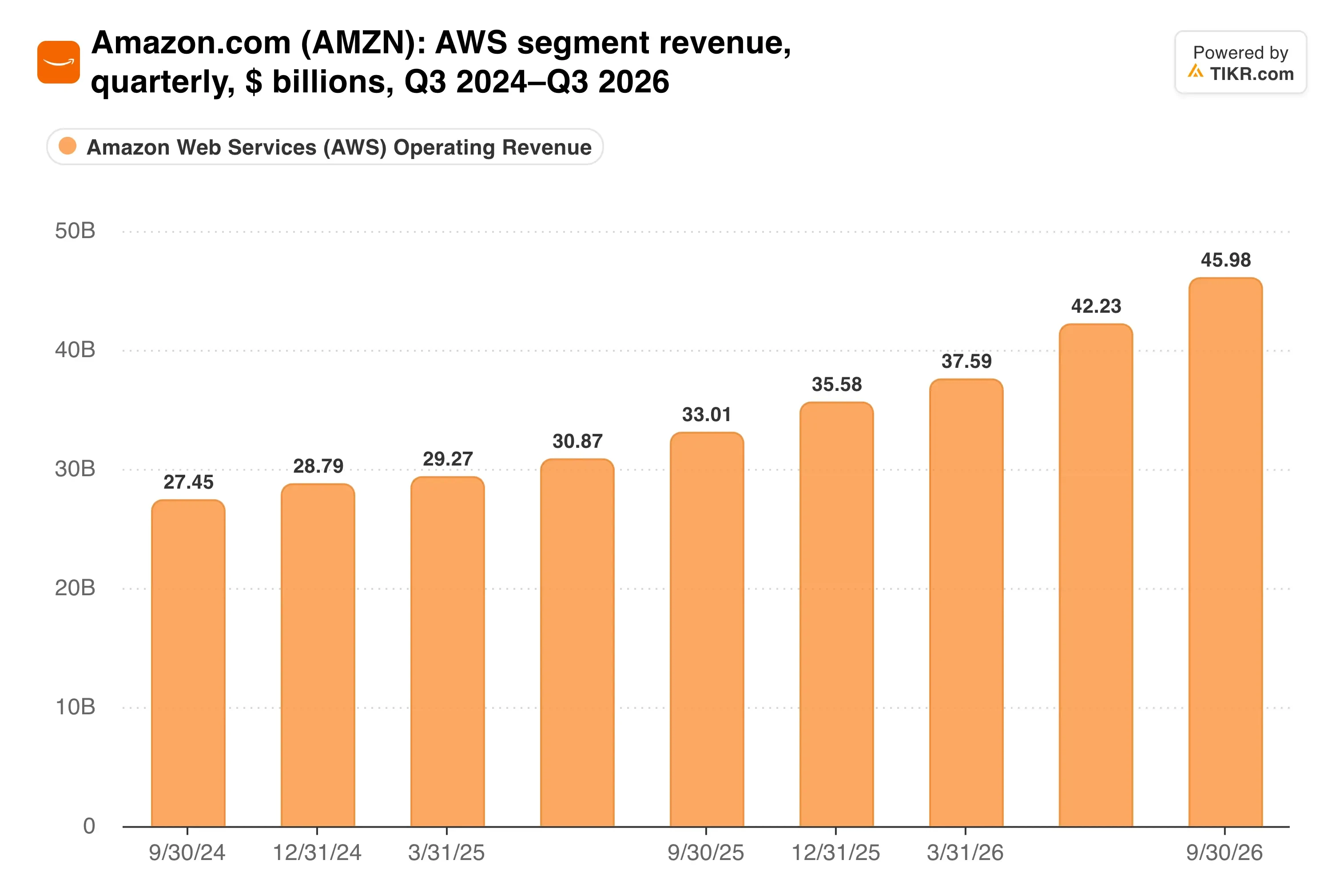
The segment added about $13 billion of revenue from a year earlier. That is roughly the size of a large software company, and it took twelve months.
Retail did its part too. North America operating income rose to $8.7 billion from $4.8 billion on 6% sales growth. Prime Day moved into the second quarter this year, and Amazon says total growth would have been about 4 points higher without that shift.
Where the profit comes from
AWS produced $17.8 billion of operating income, about 63% of the company total on less than a quarter of revenue. Its operating margin reached 38.7%, and a year earlier it was 34.5%.
That mix keeps pulling the consolidated margin higher. How far has it come?
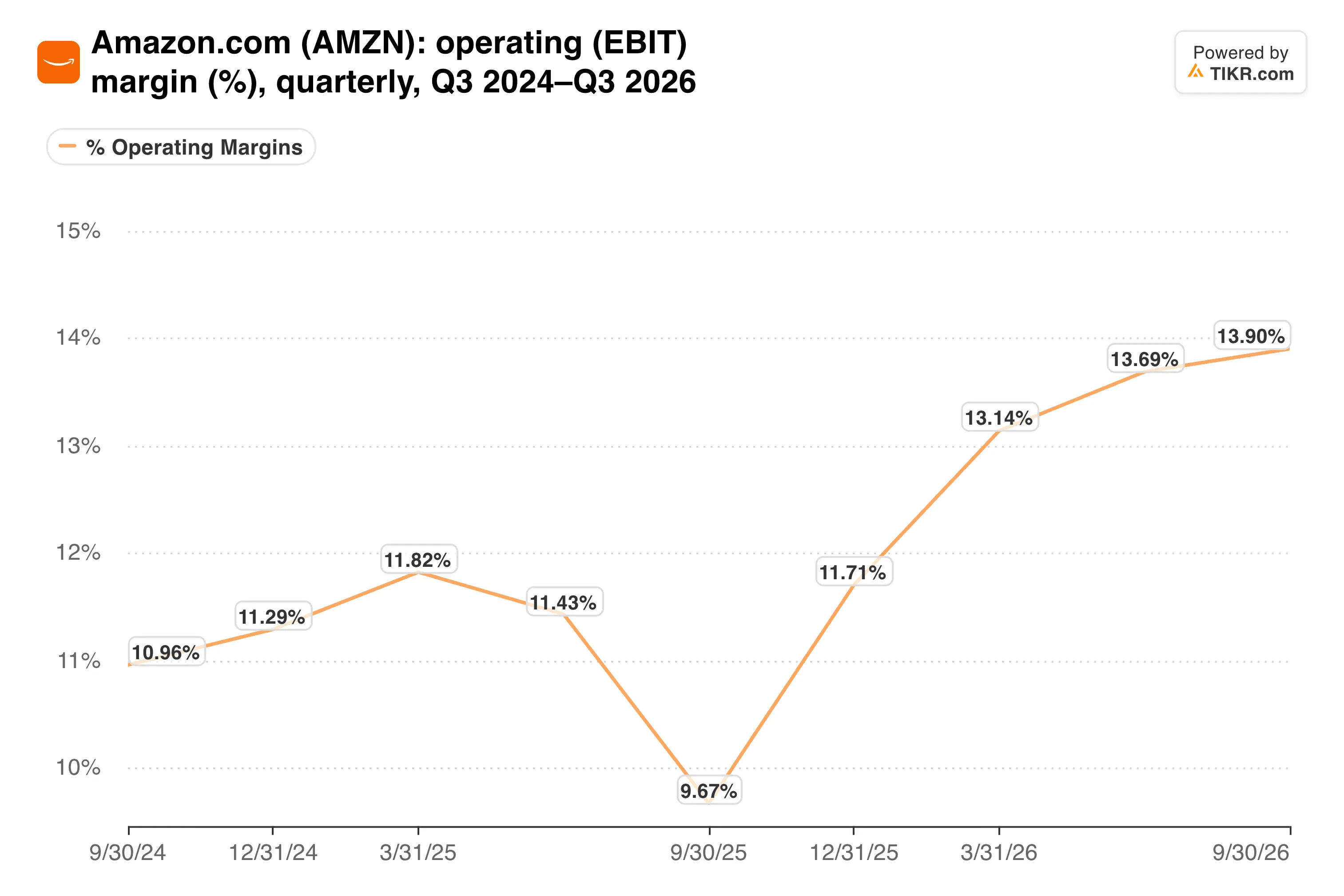
Amazon’s operating margin rose to 13.9% from 9.7% a year earlier. Fourth-quarter guidance calls for $28.5 billion to $33.5 billion of operating income, against $25.0 billion last year.
And demand looks secure for now. The AWS backlog grew to $578 billion from $496 billion at the end of June. “Almost as fast as we install capacity, customers are gobbling it up,” Jassy said on the earnings call.
TIKR tracks 60 analysts on Amazon. How many say “Buy”?
See the full breakdown of Buy, Hold, and Sell ratings on Amazon, along with Wall Street’s revenue and earnings estimates, all in one place. More than 500,000 investors use TIKR to research stocks like this one. See Amazon’s Analyst Ratings
The cash is the catch
But building that capacity is expensive. Purchases of property and equipment rose $94.8 billion over the trailing year, and Amazon still expects about $220 billion of cash capex in 2026. Jassy also told analysts he expects to spend meaningfully more in 2027.
Here’s what that does to cash.
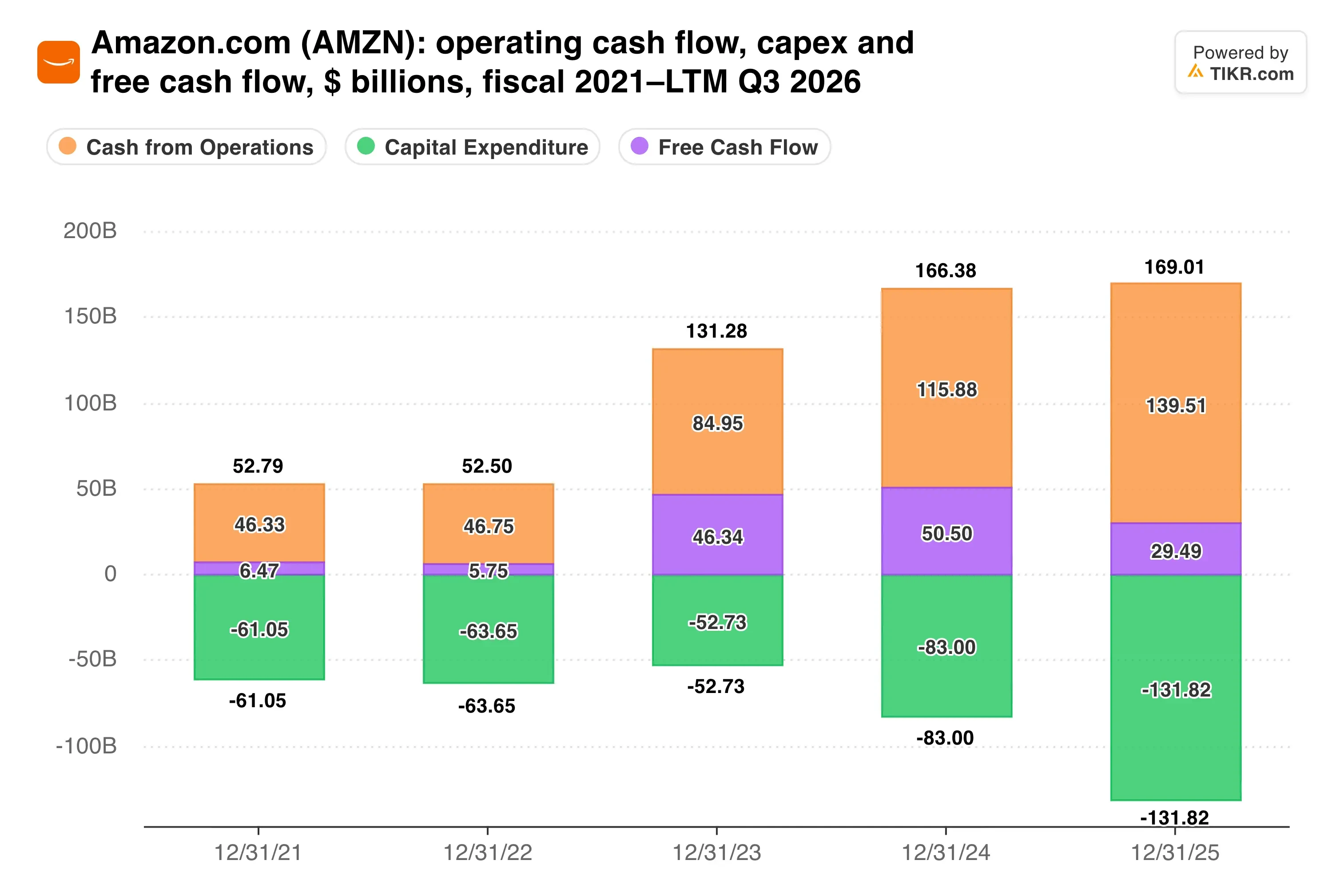
Operating cash flow grew 29% to $168.3 billion over the trailing twelve months. However, capex swallowed all of it and then some.
So that gap explains the bond spree. In September, Amazon raised £4.25 billion in its first sterling deal, after euro, Swiss franc, Canadian dollar and US dollar sales earlier in the year. Jassy argues the payoff will be huge, since he thinks Amazon could run two businesses with $1 trillion of revenue each within a decade.
My take: I think the selloff punished Amazon for spending on demand that is already signed. A $578 billion backlog and 38.7% AWS margins make a strong base. Still, Azure and Google Cloud are growing faster, and negative free cash flow leaves little room for a stumble. I’d want to see that outflow narrow before calling the stock cheap.
The next checkpoint is the fourth-quarter report, expected in early February. It will show whether AWS crosses 40% growth and whether advertising returns to the high-teens growth Amazon guided.
So what is Amazon stock actually worth?
TIKR lets you forecast the future price of any stock in less than a minute. Just enter a few assumptions into TIKR’s valuation model and see what Amazon could be worth. Start from Wall Street consensus estimates, or adjust the inputs to reflect your own view of the business. It’s free to use.
Disclaimer:
Please note that the articles on TIKR are not intended to serve as investment or financial advice from TIKR or our content team, nor are they recommendations to buy or sell any stocks. We create our content based on TIKR Terminal’s investment data and analysts’ estimates. Our analysis might not include recent company news or important updates. TIKR has no position in any stocks mentioned. Thank you for reading, and happy investing!