
Key Takeaways
- On its third-quarter call, CoreWeave said it won’t use unsecured debt at current yields and expects about $9 billion of customer prepayments and deposits in the next three months.
- That puts more of CoreWeave’s credit risk on its customers’ ability to pay up front and less on the bond market, which matters to its chip supplier and shareholder too.
- The CFO expects to raise less than $5 billion of new parent-level capital through 2027, though fourth-quarter interest expense is guided above $1 billion.
- Bonds priced near distress look too gloomy for a company whose customers are paying for its build-out, as long as they keep paying.
CoreWeave (CRWV) has found a cheaper lender than the bond market: its own customers.
With its unsecured parent-company debt yielding about 16%, CEO Michael Intrator used the company’s third-quarter call to draw a line:
“We will not use the unsecured debt market to fund our business at current yields nor do we need to.”
That’s a bold thing to say with $37 billion to $39 billion of capex planned this year, most of it for a fleet of GPUs from NVIDIA (NVDA), which also owns a piece of CoreWeave.
TIKR tracks 42 analysts on CoreWeave. How many say “Buy”?
See the full breakdown of Buy, Hold, and Sell ratings on CoreWeave, along with Wall Street’s revenue and earnings estimates, all in one place. More than 500,000 investors use TIKR to research stocks like this one. See CoreWeave’s Analyst Ratings
The contract loans are still cheap
Most of CoreWeave’s borrowing never went through the unsecured market anyway. Intrator said most of the capex left to deliver its backlog will come from delayed-draw term loans tied to specific customer contracts. Since the IPO, those loans have priced 225 to 550 basis points above SOFR, which he said comes to “less than 10% at the high end” today. CoreWeave’s weighted average cost of debt was 7.9% at the end of the third quarter, down 250 basis points in a year, and it has already paid down more than $4 billion of debt as those contracts pay out.
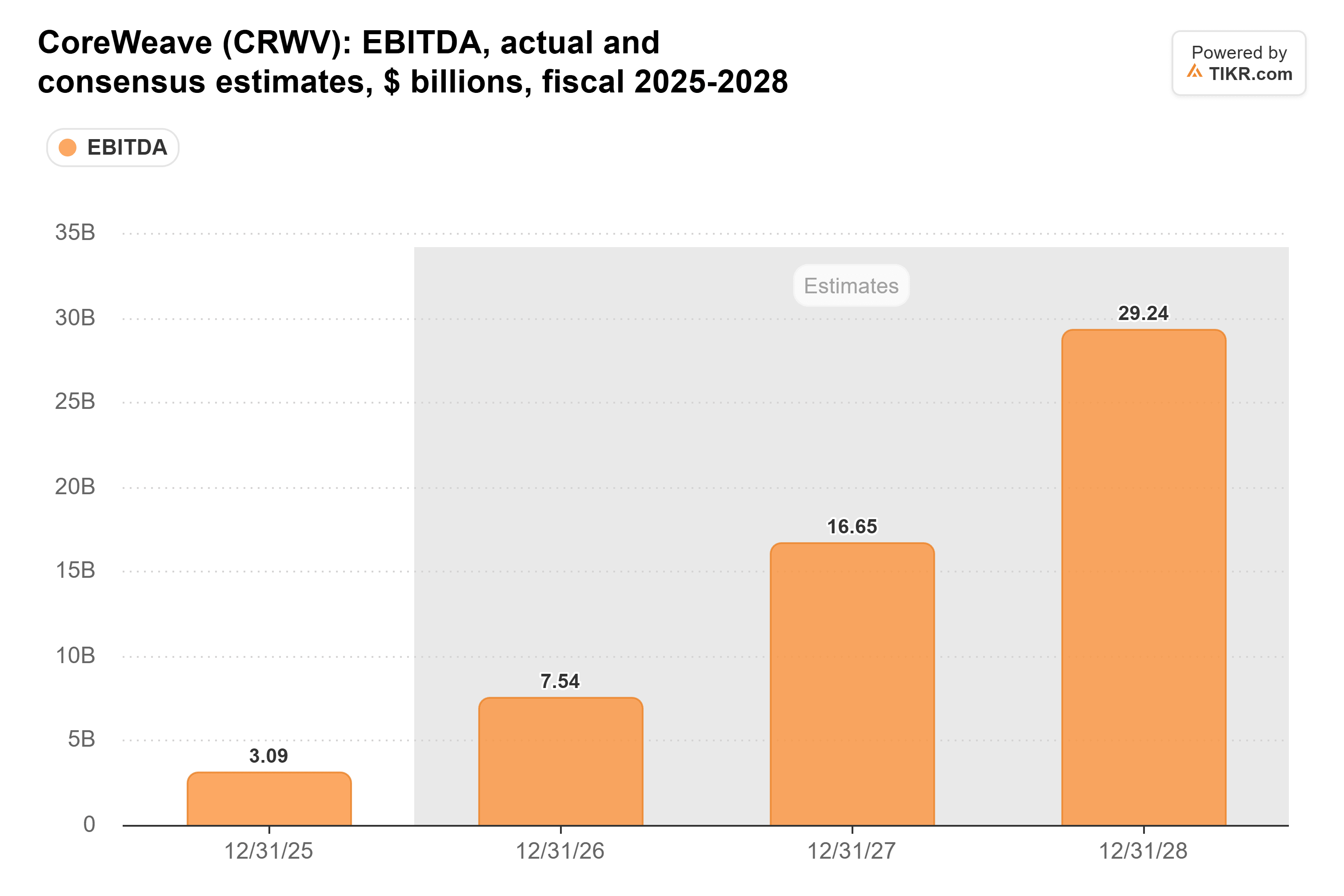
CFO Nitin Agrawal said cash flow from existing customer contracts should be enough “to service and repay the debt we have outstanding today as well as any additional debt we expect to raise to deliver these contracts.” Analysts expect that cash flow to more than double in 2026 and again in 2027:
Customers are paying up front
The bigger change is who’s paying for the build-out. Intrator said CoreWeave collected prepayments on 70% of its deals this year, with some customers paying up to 100% of the contract value up front. He expects about $9 billion of prepayments and deposits from signed contracts in the next three months alone. More than $3 billion of that is for gear that’s already paid off and was recontracted “at meaningful premiums to their original price,” so it’s cash with no debt to service.
Until now, debt has filled the gap between what CoreWeave spends and what its operations bring in. In the third quarter, it spent $9.4 billion on capex against $2.0 billion of cash from operations:
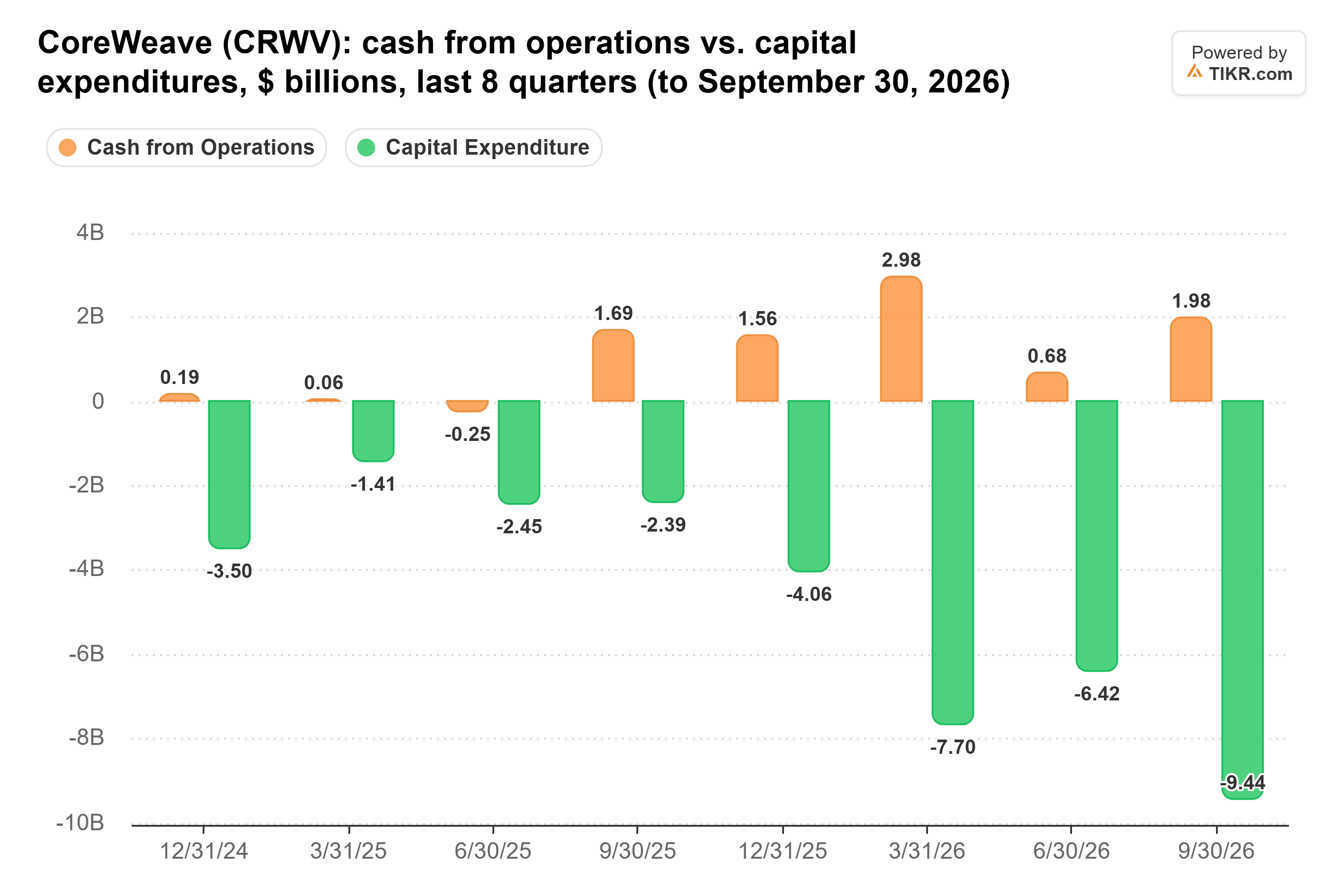
The $9 billion coming in over the next three months is more than that whole quarter’s gap. With prepayments, the nearly $5 billion still undrawn on its existing loans and more than $9 billion of infrastructure already built and waiting to go into service, Agrawal expects to raise less than $5 billion of new parent-level capital through 2027.
The customers carry the risk now
This changes whose judgment counts. In a post on X, Atreides Management’s Gavin Baker said the shift “Moves the diligence burden from private credit funds evaluating the creditworthiness of offtaker to the actual customer of the GPU making the prepayment.”
So CoreWeave’s credit now rests on whether its customers have the cash to pay up front, and keep doing it. Intrator said more than 75% of committed capex through 2027 is tied to investment-grade and enterprise customers. That’s a sturdier group than a 16% bond yield suggests.
NVIDIA has a stake in this too. On CNBC’s Closing Bell Overtime the night before the report, MoffettNathanson’s Nick Del Deo called CoreWeave “a critical partner for NVIDIA in terms of standing up an outlet, an alternative outlet, versus the hyperscalers that have their own chip programs.” When customers pay for the build-out, NVIDIA’s orders from CoreWeave depend less on bond buyers, and so does the $2 billion NVIDIA put into CoreWeave stock at $87.20 a share in January.
Prepayments still have to be earned
A prepayment is still a promise: CoreWeave has to deliver the capacity those customers paid for, and on time. It also does nothing about the debt CoreWeave already has, about $47 billion at Sept. 30. CoreWeave’s quarterly interest bill has grown more than fivefold since the end of 2024:
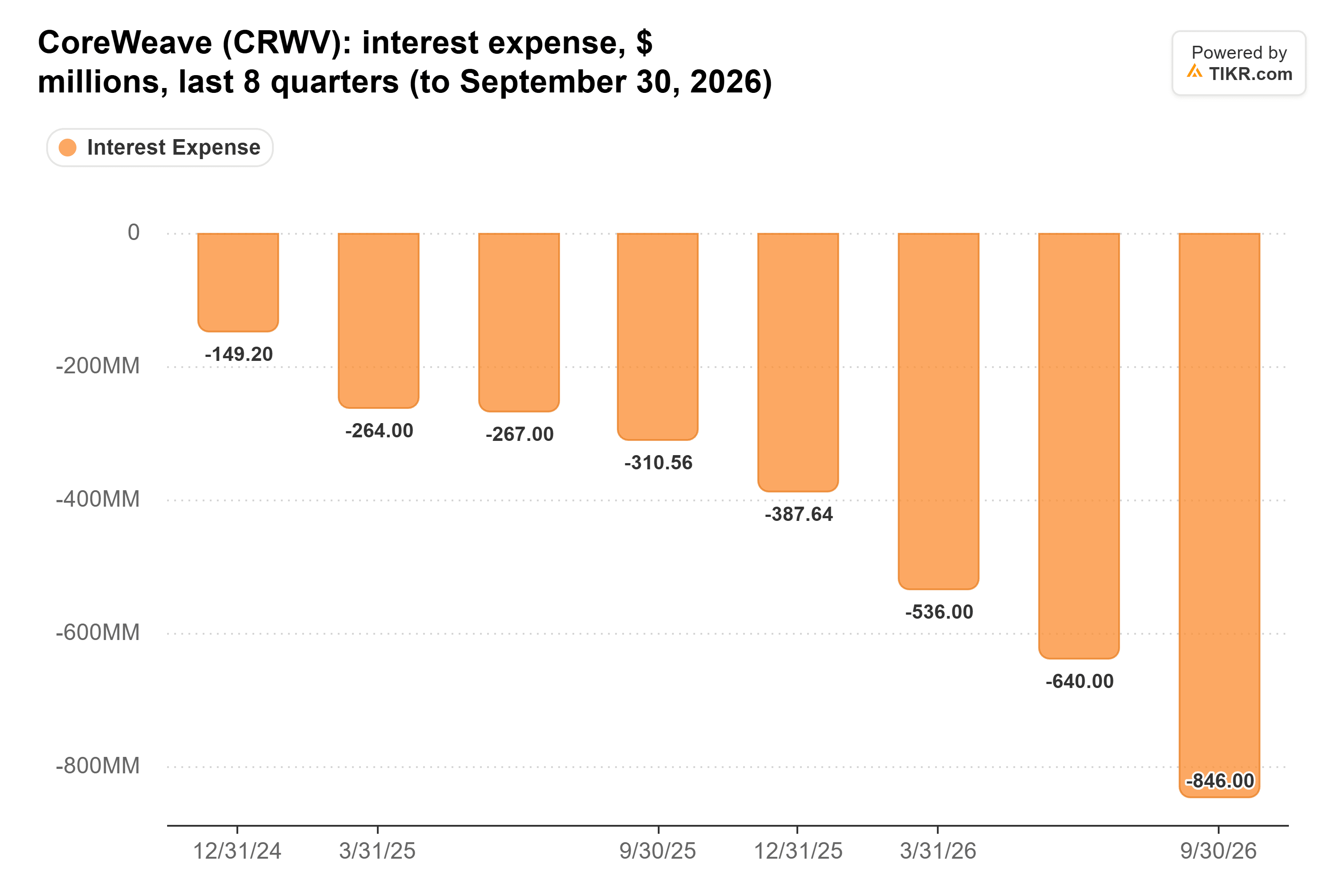
Management guides $1.05 billion to $1.15 billion of interest for the fourth quarter, an annual pace above $4 billion. That compares with $379 million of adjusted operating income in the third quarter. Intrator expects EBITDA less interest to more than double in 2027.
The way I see it, the bond market is pricing a company that has to borrow at 16% to survive, and CoreWeave just showed it doesn’t need to. Of course, that only holds while customers keep paying up front, and the fourth-quarter report in early 2027 will show whether the $9 billion actually came in.
So what is CoreWeave stock actually worth?
TIKR lets you forecast the future price of any stock in less than a minute. Just enter a few assumptions into TIKR’s valuation model and see what CoreWeave could be worth. Start from Wall Street consensus estimates, or adjust the inputs to reflect your own view of the business. It’s free to use.
Disclaimer:
Please note that the articles on TIKR are not intended to serve as investment or financial advice from TIKR or our content team, nor are they recommendations to buy or sell any stocks. We create our content based on TIKR Terminal’s investment data and analysts’ estimates. Our analysis might not include recent company news or important updates. TIKR has no position in any of the stocks mentioned. Thank you for reading, and happy investing!