Key Takeaways
- Amazon has arranged up to $80 billion of secured supplier financing for technology infrastructure, after a quarter in which its free cash flow was a $34.8 billion outflow.
- The facility is a reasonable way to fund AWS’s growth, but it shows Amazon’s AI build-out needs more money than its debt figures show.
- Chamath Palihapitiya says the money AI companies need to raise through 2027 equals 30% of what the Treasury will issue, so big borrowers like Amazon may pay more for money from here.
- Amazon’s 2027 capex outlook, due with its fourth-quarter results in early February, will show how much more borrowing the build-out needs.
Amazon (AMZN) just lined up a new way to pay for its AI build-out, and it says a lot about how big that build-out has become.
On the October 30 episode of Bloomberg Tech, Bloomberg’s Ed Ludlow summed up the 10-Q Amazon filed after its third-quarter results: “Amazon’s arranged about $80 billion of supplier financing for technology infrastructure starting next year.”
When he asked AWS CEO Matt Garman why Amazon needed it, Garman said: “When we see such a really large opportunity in front of us, we’re looking for ways to also responsibly fund that so that we can go as big as possible for our customers.”
Going as big as possible takes a lot of borrowed money, and Amazon isn’t the only one borrowing. All-In co-host Chamath Palihapitiya put the industry’s funding needs this way in a clip the podcast posted on X:
“When you look at these AI firms, the amount of money that they need to raise through the end of ’27, it’s 30% of all of what the Treasury’s about to issue in that same period.”
That’s a lot of new bonds chasing the same buyers.
Amazon’s Bill Is Bigger Than Its Debt
The facility is secured. Amazon can borrow against the hardware it buys from the start of 2027 through the third quarter of 2028, and lenders get collateral rights over some of those assets. (The 10-Q doesn’t say which ones.) Until now, Amazon had paid for its data centers and chips with cash from its businesses and its biggest-ever bond sales. It had mostly stayed away from the chip leases and joint financing deals some rivals have used.
But its operations no longer cover the spending. Free cash flow was a $34.8 billion outflow in the third quarter alone, as capex hit $77.3 billion. Analysts expect Amazon to keep burning cash this year and next before free cash flow turns positive in 2028:
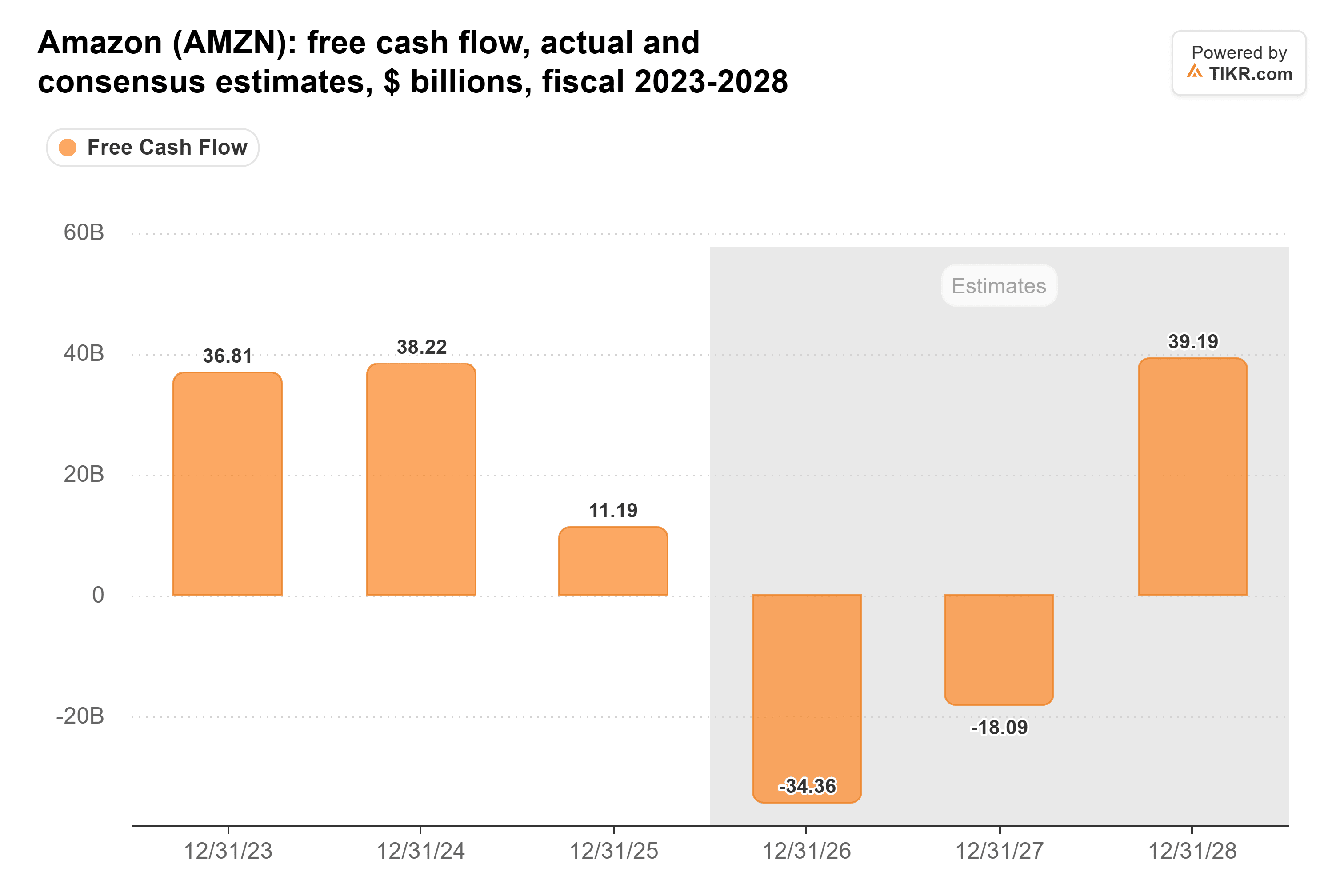
That adds up to about $53 billion of outflows across 2026 and 2027. And CEO Andy Jassy has said Amazon expects to “spend meaningfully more in 2027” than the roughly $220 billion it plans to spend this year.
TIKR Tracks 60 Analysts on Amazon. How Many Say “Buy”?
See the full breakdown of Buy, Hold, and Sell ratings on Amazon, along with Wall Street’s revenue and earnings estimates, all in one place. More than 500,000 investors use TIKR to research stocks like this one. See Amazon’s Analyst Ratings
How Much Amazon Has Already Borrowed
Amazon has borrowed to fill the gap. Its total debt, which includes leases, nearly doubled over the past year to $305 billion at the end of September:
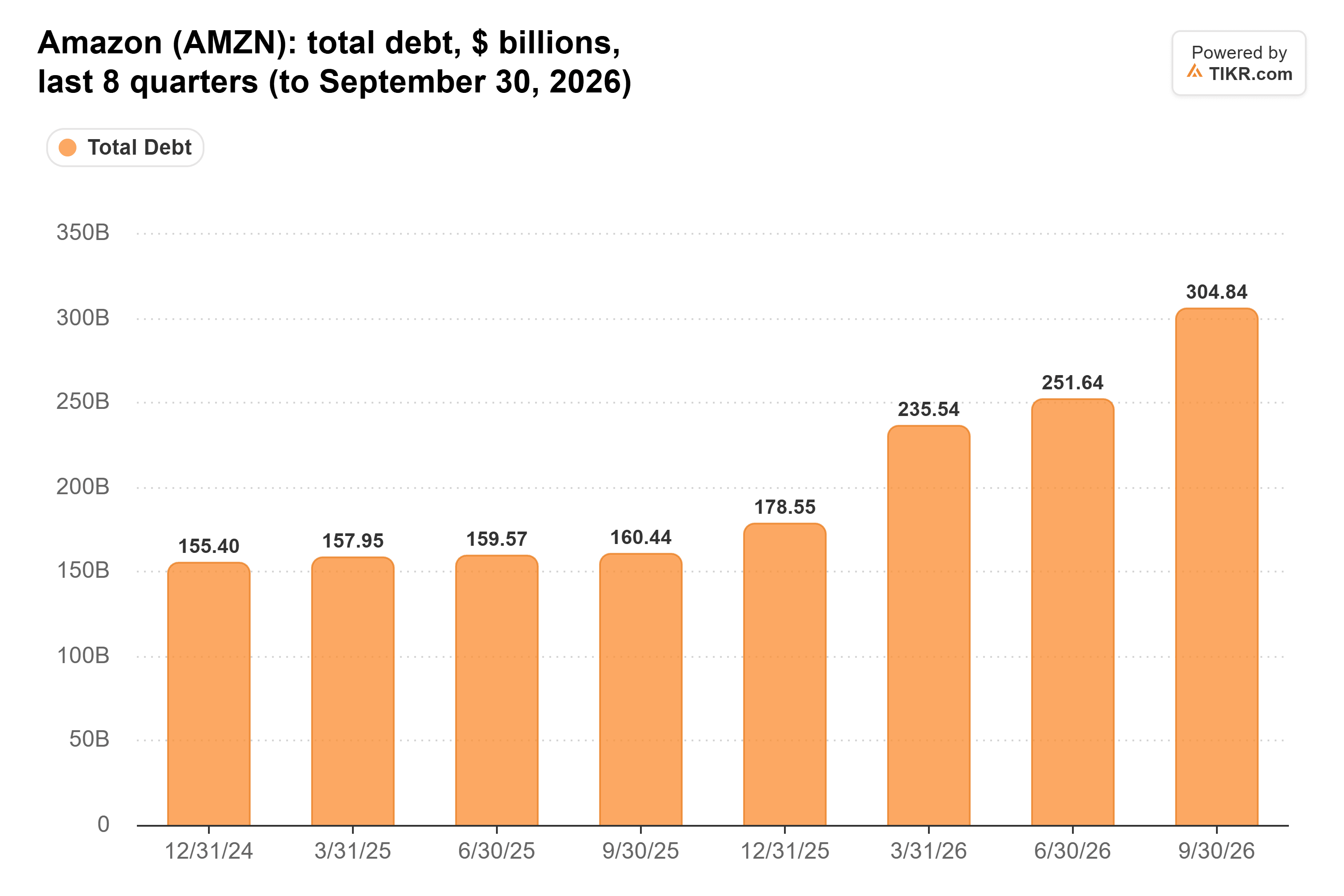
The bond sales are clearer on their own: long-term debt at face value jumped from $68.8 billion at the end of 2025 to $180.9 billion nine months later. None of the $80 billion is in either figure yet, because Amazon can’t draw on the facility until 2027, and the 10-Q says those draws will count as long-term debt. The filing also puts Amazon’s total commitments at $883 billion at the end of September, more than double a year earlier, once leases that haven’t started and equipment Amazon has agreed to buy are added to its debt and interest.
Treasuries Are Amazon’s Competition Now
Palihapitiya’s worry is that investors may prefer government debt to AI debt. If they do, he said on the episode, the hyperscalers and AI labs will pay higher rates to borrow. Smaller borrowers such as the neoclouds will pay more still, and the weakest could default sooner.
Amazon is nowhere near the weak end. But bond traders have noticed the borrowing: the cost of insuring Amazon’s debt against default for five years has risen about 50% since early August, according to Bloomberg data.
AWS Is Earning Its Keep
Lenders are offering $80 billion for a reason. AWS grew 39% to $46.0 billion last quarter at a 38.7% operating margin, and its backlog reached $578 billion. Jassy projects AWS growth above 40% in both 2027 and 2028, and management says customer commitments already cover much of the capacity it’s building. Borrowing against the servers that provide that capacity spreads their cost over the years customers pay for them, which is a sensible match.
What Amazon Investors Should Count
Amazon can afford this. The $80 billion still belongs in the AI bill, though, and the stock’s case rests on free cash flow turning positive in 2028. Until it does, Amazon is competing with the Treasury and every other AI giant for the same bond buyers, and its cost of money is the risk. I’d want to see that turn arrive on schedule before calling Amazon a cash machine again.
The first test comes in early February, when Amazon gives its 2027 capex outlook with fourth-quarter results. Morgan Stanley already expects $355 billion, about 60% more than this year’s $220 billion. A guide anywhere near that means more borrowing and a later turn.
So what is Amazon stock actually worth?
TIKR lets you forecast the future price of any stock in less than a minute. Just enter a few assumptions into TIKR’s valuation model and see what Amazon could be worth. Start from Wall Street consensus estimates, or adjust the inputs to reflect your own view of the business. It’s free to use.
Disclaimer:
Please note that the articles on TIKR are not intended to serve as investment or financial advice from TIKR or our content team, nor are they recommendations to buy or sell any stocks. We create our content based on TIKR Terminal’s investment data and analysts’ estimates. Our analysis might not include recent company news or important updates. TIKR has no position in any of the stocks mentioned. Thank you for reading, and happy investing!