Key Takeaways
- Marshfield Associates more than doubled its Nike stake in the third quarter, to 9.58 million shares worth $339 million, or 8.5% of its 13F portfolio.
- At its Investor Day, Nike said adjusted EPS will fall again in fiscal 2028, and it set its recovery targets for fiscal 2031.
- On Holding grew third-quarter sales 17.2% while holding full price, and Nike says it has limited ability to raise prices.
- The 2031 targets make Nike look cheap, but earnings are still falling, so I’d wait for proof before following the fund in.
Marshfield Associates more than doubled its stake in Nike (NKE) in the third quarter, according to its 13F for the quarter ended Sept. 30, filed Nov. 16. For that bet to pay off, Nike has to win back the runners and shelf space it has been losing to rivals like On Holding (ONON). On’s latest quarter shows it’s still growing fast at full price.
Nike is now a top-five holding
Marshfield held 9.58 million Nike shares on Sept. 30, up 121% from three months earlier and worth $339 million at that day’s price. That’s 8.5% of the $3.97 billion its 13F holds in US stocks, which makes Nike its fifth-largest of 17 positions and its biggest addition of the quarter. Nike’s stock has slipped 3% since Sept. 30 and sits 50% below its 52-week high. The filing shows only what Marshfield owned on the last day of the quarter. Its next 13F, due in mid-February, will show whether the fund held on through Nike’s Nov. 16-17 Investor Day.
TIKR tracks 44 analysts on Nike. How many say “Buy”?
See the full breakdown of Buy, Hold, and Sell ratings on Nike, along with Wall Street’s revenue and earnings estimates, all in one place. More than 500,000 investors use TIKR to research stocks like this one. See Nike’s Analyst Ratings
Nike’s own plan says the trough isn’t over
Nike’s normalized EPS has fallen every year since fiscal 2024, and analysts expect another drop in fiscal 2027, which ends in May:
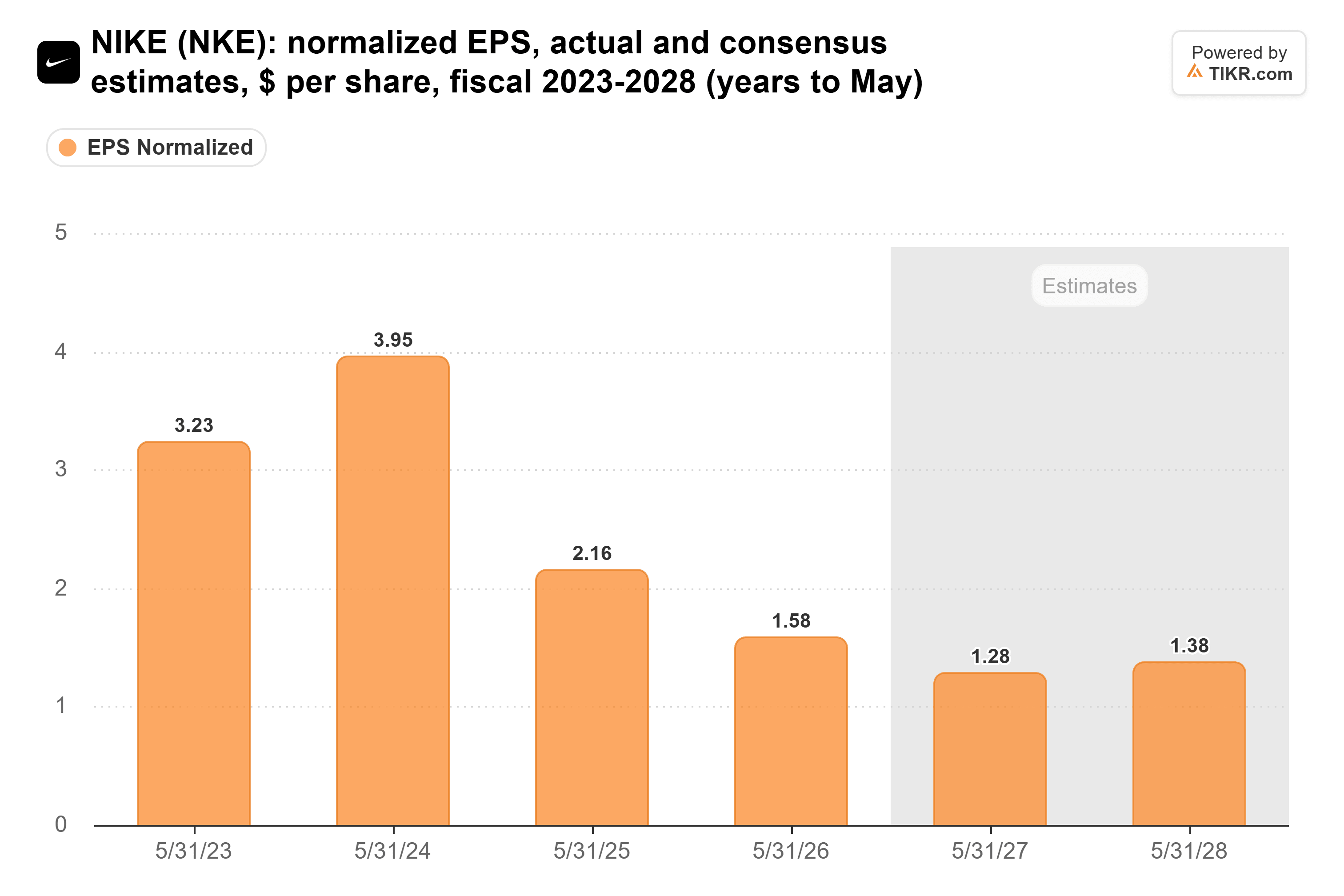
That $1.28 consensus for fiscal 2027 is about a third of the $3.95 Nike earned in fiscal 2024. The $1.38 analysts expect for fiscal 2028 still assumes growth, even though management said at Investor Day that fiscal 2028 “will be a challenging year financially,” with adjusted EPS expected to “decline modestly.” I’d expect that estimate to keep falling.
Even on those lower earnings, Nike isn’t cheap compared with its own history. It trades at 28x forward earnings, a little under its five-year average of 31x:
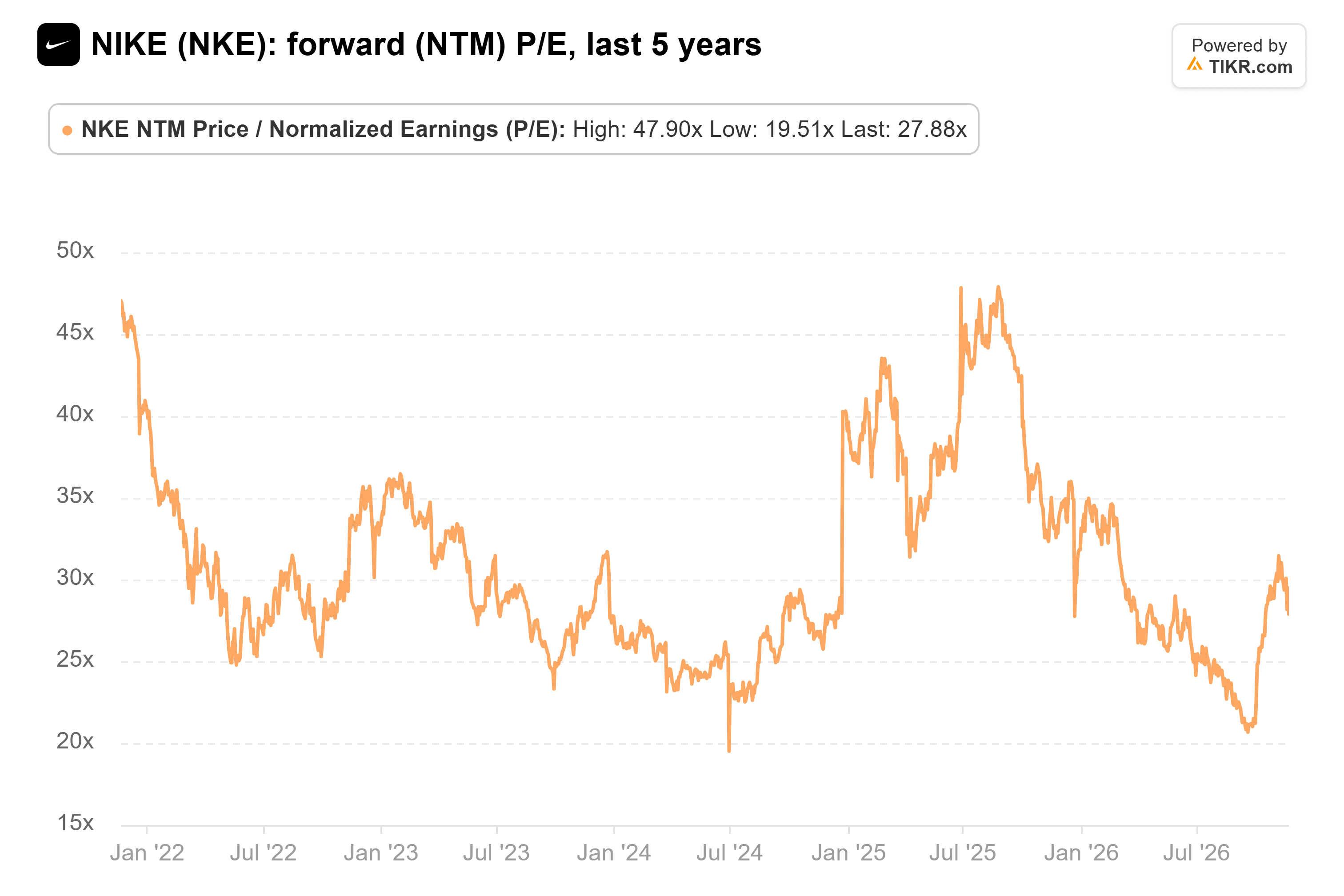
The price has fallen about as fast as the earnings, so the multiple sits close to where it usually does.
Analysts have cut their targets just as hard. The average target from the 44 analysts covering Nike has fallen from $83.30 a year ago to $36.70:
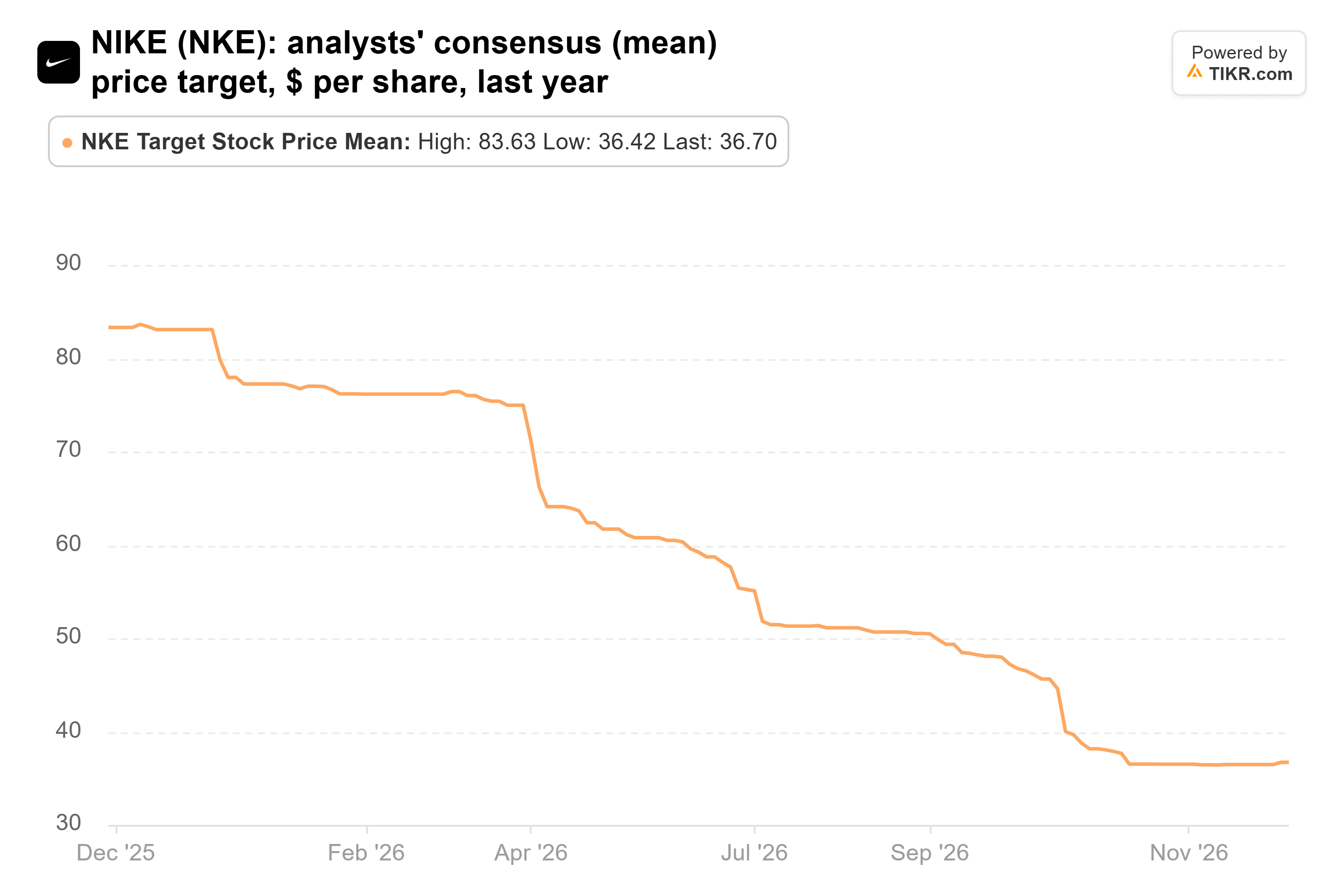
That’s 7% above the last close. Jefferies is at the top of the range with a $60 target it reiterated after Investor Day. Barclays cut its target to $42 from $45 on Nov. 18, and the lowest target on the Street is $19.
The bull case depends on fiscal 2031, when Nike is targeting adjusted EPS of $3.00-$3.50 and operating margins of 12%-14%. At today’s price, the stock trades at about 10x-11x those earnings, which is cheap if CEO Elliott Hill’s team gets there. Plus, the 4.8% dividend yield pays shareholders to wait, though fiscal 2027’s guided adjusted EPS of $1.15-$1.35 is below the $1.64 annual dividend. Nike had $8.4 billion of cash and short-term investments at the end of August to cover the gap in the meantime.
Running has to come back first
Running is where Nike’s comeback has the most to prove. Management says Nike’s running business has grown double digits for six straight quarters. But Nike doesn’t expect that push to show up as revenue growth until fiscal 2029.
On isn’t waiting. It grew net sales 17.2% to CHF 931.4 million in the third quarter, with a gross margin of 66.9% excluding US tariff refunds, and it reiterated full-year 2026 growth in the low-20% range in constant currency. “In a promotional market, we stayed true to who we are and held full price, delivering record sales and record underlying margins,” founder and co-CEO Caspar Coppetti said in On’s third-quarter release.
Nike’s management sounded very different at Investor Day, saying “we have limited ability to offset these trends through price, on the current health of our brands.” If Nike really is winning back runners, On’s growth is where it should show first. So the question for On’s next report is whether that growth slows at all.
I’d wait for December
Marshfield’s bet works if Nike hits its 2031 targets, and the dividend buys it time. But the numbers before then don’t back it yet. Earnings are still falling, the fiscal 2028 estimate looks high next to Nike’s own guidance, and the stock is no cheaper than usual on the earnings it has. The plan has also slipped before: in July, Nike expected its clean-up to be done by December 2026, and by October, the work on Sportswear, Jordan and China ran past fiscal 2027.
Personally, I’d wait for proof before following the fund in. Nike’s second-quarter report, expected in mid-December, is the next test. A revenue decline smaller than the roughly 9% that consensus implies for the rest of fiscal 2027, and a Greater China EBIT margin near the first quarter’s 21.0%, would start to make the case.
So what is Nike stock actually worth?
TIKR lets you forecast the future price of any stock in less than a minute. Just enter a few assumptions into TIKR’s valuation model and see what Nike could be worth. Start from Wall Street consensus estimates, or adjust the inputs to reflect your own view of the business. It’s free to use.
Disclaimer:
Please note that the articles on TIKR are not intended to serve as investment or financial advice from TIKR or our content team, nor are they recommendations to buy or sell any stocks. We create our content based on TIKR Terminal’s investment data and analysts’ estimates. Our analysis might not include recent company news or important updates. TIKR has no position in any of the stocks mentioned. Thank you for reading, and happy investing!