


Key Takeaways
- A $2.9 billion fund bought a new stake in SoundHound AI in the third quarter, 25.11 million shares worth $151 million at Sept. 30, and added 46% to its Pegasystems stake.
- SoundHound has fallen 52% since Sept. 30, after a third quarter in which revenue grew 48% but cash burn and adjusted losses widened.
- The stock trades at 4.0x forward sales, its lowest multiple in three years, and every analyst’s price target is well above the share price.
- The numbers back the fund’s bet at today’s price, as long as SoundHound’s $120 million of yearly cost cuts land before it sells much more stock.
SoundHound AI (SOUN) just got a big new backer. Lynrock Lake LP, a firm that manages $2.89 billion, reported a new 25.11 million-share stake in its 13F for the quarter ended Sept. 30, filed Nov. 16. It also added 46% to its stake in Pegasystems (PEGA).
Anyone thinking about following the fund into SoundHound should know this up front: the stock has fallen 52% since Sept. 30.
A new No. 2 position
The SoundHound shares were worth $151 million at quarter-end prices, or 8.1% of the fund’s 13F stocks. That made SoundHound the second-largest of 21 positions in $1.87 billion of US stocks. The Pegasystems stake, 2.60 million shares worth $86 million, is No. 4 at 4.6% of its 13F stocks. Both stocks are far below their highs: SoundHound is 78% below its 52-week high and Pegasystems is 56% below its own. The filing only shows what the fund held on Sept. 30, so there’s no telling what it paid for either stock or whether it still owns them.
TIKR tracks 7 analysts on SoundHound AI. How many say “Buy”?
See the full breakdown of Buy, Hold, and Sell ratings on SoundHound AI, along with Wall Street’s revenue and earnings estimates, all in one place. More than 500,000 investors use TIKR to research stocks like this one. See SoundHound AI’s Analyst Ratings
Revenue kept growing, and so did the burn
SoundHound’s third-quarter report on Nov. 5 explains much of the drop. Revenue rose 48% to a record $62.4 million. But non-GAAP gross margin fell to 50.3% from 59.3% a year earlier, and the adjusted EBITDA loss widened to $20.7 million from $14.5 million.
Some of that was by choice. SoundHound is giving up license revenue booked up front for hosted contracts billed over time, and walking away from contracts that lost money. License revenue booked up front fell to about 10% of the quarter’s sales from about a third in the second quarter. CFO John Collins said the changes cut expected 2026 revenue by about $8 million.
The cash is the bigger worry. Operating cash outflow reached $96.0 million in the first nine months of 2026, up from $76.3 million a year earlier, leaving $207.6 million of cash at Sept. 30. Management’s answer is $120 million a year of cost cuts, more than $80 million of it before Jan. 1, and a goal of adjusted EBITDA profit in the second half of 2027. It narrowed its 2026 revenue guidance to $250 million to $260 million and kept 2027 at $350 million to $400 million.
Is SoundHound cheap at 4.0x sales?
Analysts still expect fast growth. Consensus has revenue climbing from $169 million in 2025 to $255 million this year and $375 million in 2027, inside the company’s range:
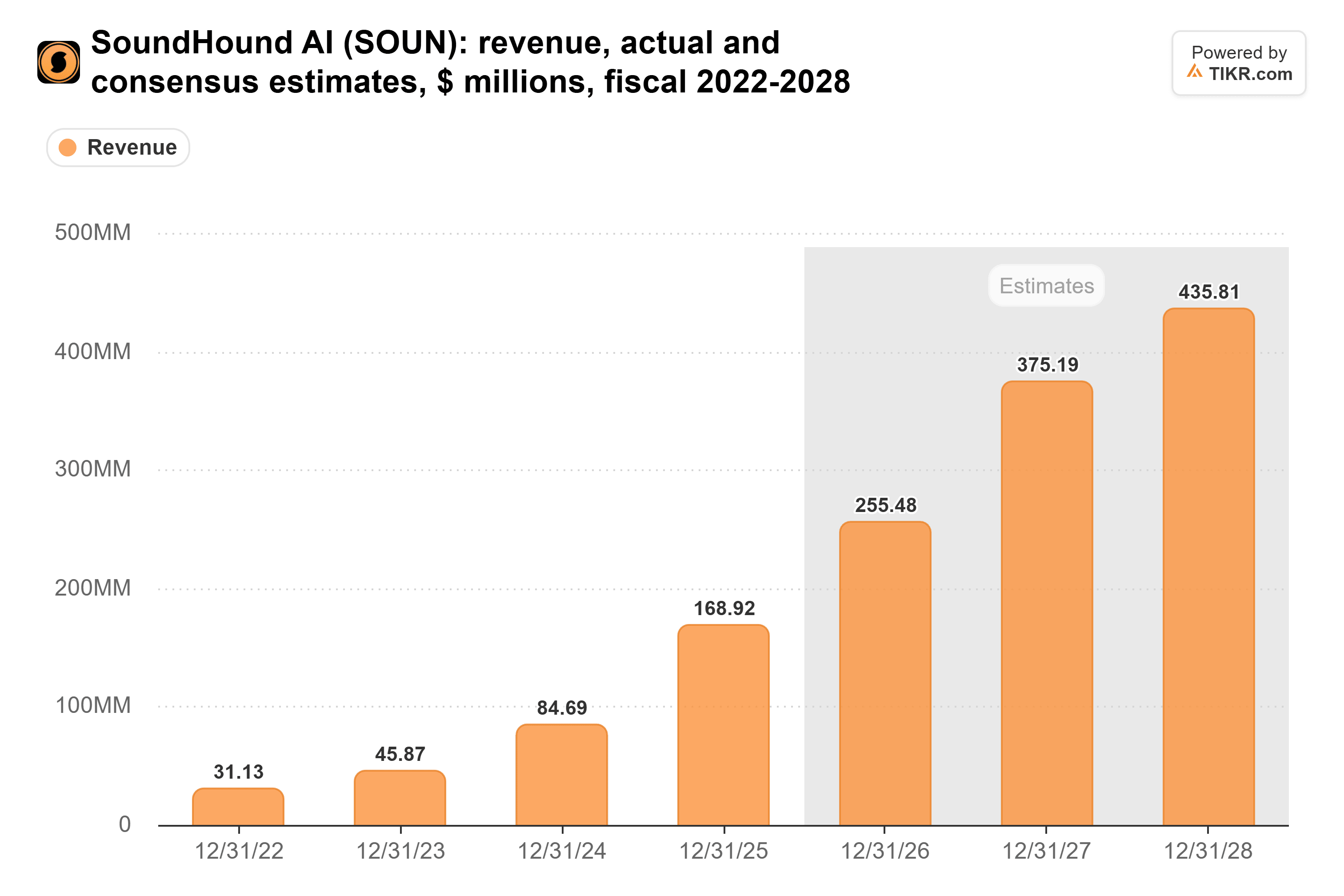
That 2027 figure counts on at least $100 million from LivePerson, which SoundHound bought in September. LivePerson’s revenue fell 11.9% to $52.5 million in the second quarter.
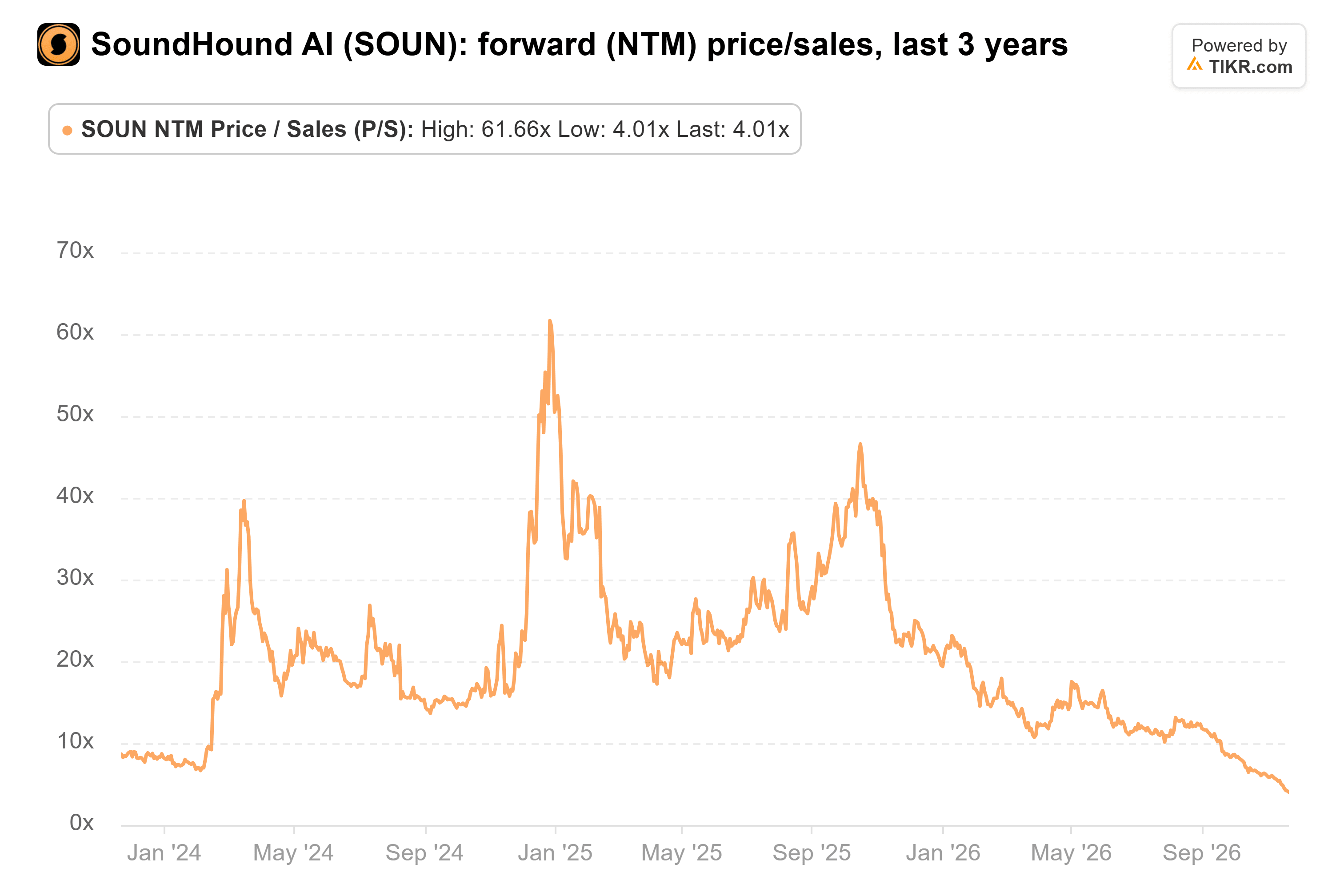
The market is paying for very little of that growth. SoundHound trades at 4.0x forward sales, its low for the last three years, against a 20x average and a peak of 62x in December 2024:
Wall Street’s targets have come down too, but far more slowly than the stock. The consensus target fell to $11.17 from $16.94 a year ago:
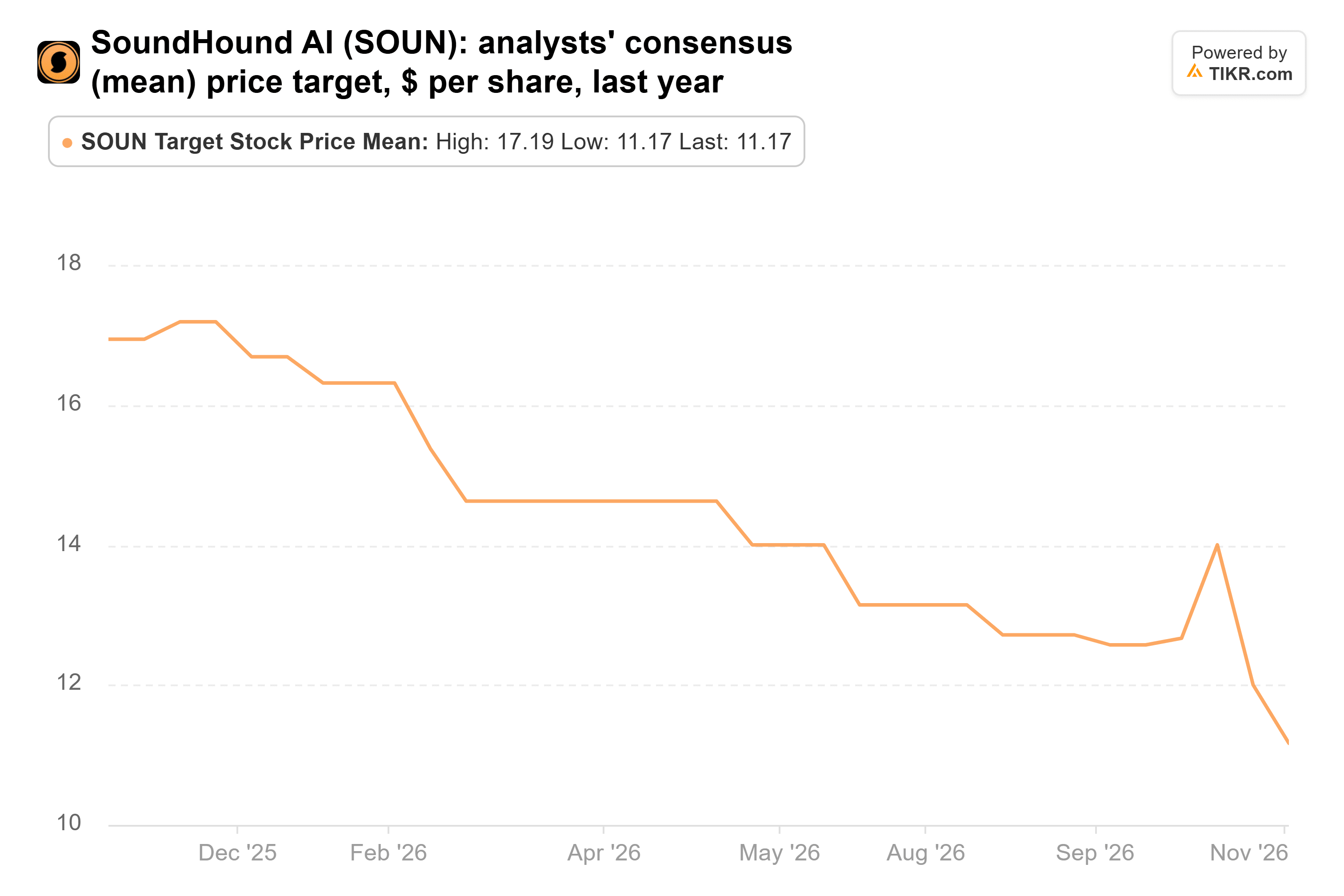
Over the same year, the stock fell from $11.63 to $2.91. Cantor Fitzgerald’s Thomas Blakey cut his target to $10 from $15 on Nov. 6 and kept his Overweight rating. Even the lowest of the seven analysts’ targets, $5, is well above the last close.
Worth the risk at this price
The risk is dilution. SoundHound’s share count rose 16% over the first nine months of 2026. Stock pay came to $80.6 million in 2025, nearly half of revenue, and the adjusted EBITDA goal leaves it out. If the cuts fall short, the $300 million share-sale program it set up in May is the obvious way to fill the gap.
That makes Pegasystems the calmer of the fund’s two software bets. It trades at about 12x forward earnings, and analysts’ $41 average target is 46% above its last close.
Still, I think the numbers back the fund on SoundHound at today’s price. Analysts expect it to more than double its 2025 revenue by 2027, yet it trades at 4.0x forward sales, so the market is already pricing in a lot of failure. If the cost cuts land and the burn shrinks, that multiple has plenty of room to recover.
The fourth-quarter report, likely in late February, is the next check. Operating cash outflow needs to shrink as the cuts take hold, with little stock sold, and management has to keep the $350 million floor for 2027. The fund’s next 13F, due in mid-February, will show whether it held on.
So what is SoundHound AI stock actually worth?
TIKR lets you forecast the future price of any stock in less than a minute. Just enter a few assumptions into TIKR’s valuation model and see what SoundHound AI could be worth. Start from Wall Street consensus estimates, or adjust the inputs to reflect your own view of the business. It’s free to use.
Disclaimer:
Please note that the articles on TIKR are not intended to serve as investment or financial advice from TIKR or our content team, nor are they recommendations to buy or sell any stocks. We create our content based on TIKR Terminal’s investment data and analysts’ estimates. Our analysis might not include recent company news or important updates. TIKR has no position in any of the stocks mentioned. Thank you for reading, and happy investing!


