Key Takeaways
- Realty Income raised its monthly dividend again on Nov. 10, while Kilroy Realty kept its quarterly dividend at $0.54 a share, the rate it has paid since fiscal 2023.
- Kilroy yields 6.1%, compared with 5.6% for Realty Income.
- Analysts expect Kilroy’s AFFO per share to fall 21% in 2026, which would raise its AFFO payout ratio from 64% to 82%. Realty Income’s would move from 75% to 73%.
- At each stock’s 5-year dividend growth rate, $10,000 in either would pay about $720 a year by year 10.
Realty Income (O) raised its monthly dividend on Nov. 10, to $0.2740 a share from $0.2715. That’s its 137th increase since it listed on the New York Stock Exchange in 1994.
Kilroy Realty (KRC) declared its own dividend the same day. It’s the same $0.54 a quarter it has paid since fiscal 2023. At a 6.1% yield, though, Kilroy still pays more than Realty Income’s 5.6%.
A bigger check is tempting for a retiree who lives off dividends. But a check you can count on for years matters more. So which REIT is the better dividend stock for retirees?
| Metric | Realty Income (O) | Kilroy Realty (KRC) |
|---|---|---|
| Dividend yield | 5.6% | 6.1% |
| Paid | Monthly | Quarterly |
| Dividend growth, fiscal 2020-2025 | 2.9% a year | 1.9% a year |
| AFFO payout ratio, fiscal 2025 | 75% | 64% |
| AFFO payout ratio, fiscal 2026 estimates | 73% | 82% |
| Net debt/EBITDA | 5.8x | 7.3x |
| Interest coverage | 2.4x | 1.6x |
6 safe dividend stocks paying retirees 6%+ yields
There are over 100 stocks paying 6%+ annual dividends today.
But after an extensive investment review leveraging TIKR’s proprietary data, we now believe only six of them are truly safe for retirees.
They’re all yours as part of our new investment report. Learn more about how to get access right here.
Realty Income keeps buying and keeps raising
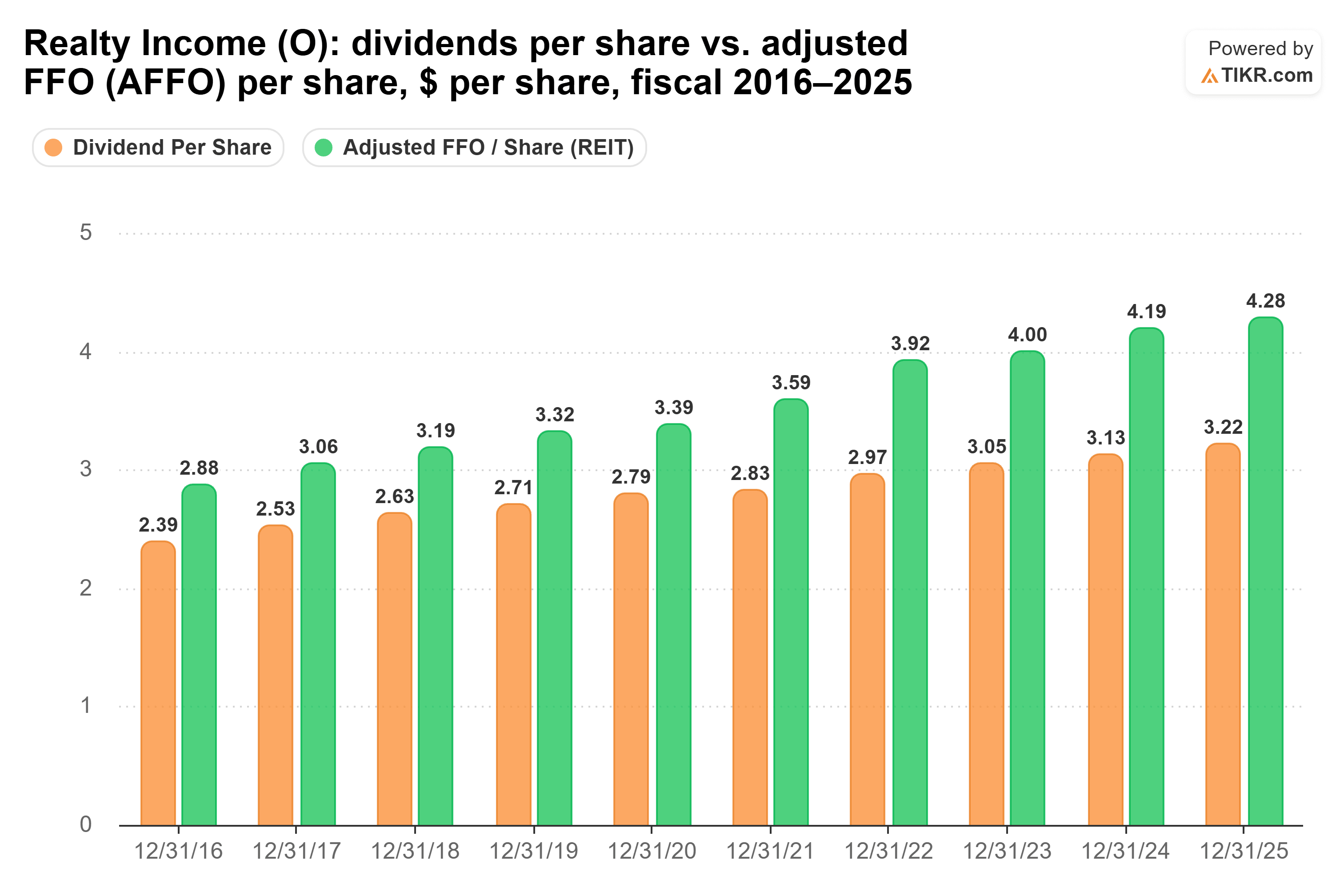
Realty Income’s dividend is well-covered. It used up 75% of AFFO in fiscal 2025 ($3.22 a share against $4.28). On fiscal 2026 consensus, that ratio slips to 73% ($3.26 against $4.45). The consensus matches management’s guidance of $4.45-$4.46, which it raised with its third-quarter results.
From fiscal 2016 to fiscal 2025, the dividend rose every year, from $2.39 to $3.22. AFFO per share grew faster, from $2.88 to $4.28, so the payout ratio fell from 83.0% to 75.2%:
The business is still growing. Realty Income invested $2.6 billion in the third quarter, with industrial properties as its biggest category. Europe made up 42% of its pro-rata volume, at a 7.1% yield. Occupancy was 98.8% at Sept. 30. The company is also selling less stock to fund its buying: public equity paid for 19% of this year’s investment volume through the third quarter, against a 47% three-year average.
Realty Income says it has declared 676 consecutive monthly dividends and has raised its dividend for more than 32 consecutive years.
The main risk is debt. About $2.9 billion matures in 2027 at a rate under 3%, and it will have to be refinanced at today’s higher rates. On Nov. 12, the company also said Neil Abraham, who runs Realty Income International, will leave at the end of the year. That’s a loss for its push into Europe, but it doesn’t change the coverage.
Kilroy’s coverage is getting tighter
Kilroy’s fiscal 2025 coverage was actually better than Realty Income’s: 64% of AFFO ($2.16 a share against $3.36). The problem is which way it’s heading. AFFO per share fell from $4.09 in fiscal 2023 to $3.36 in fiscal 2025, while the dividend stayed at $2.16:
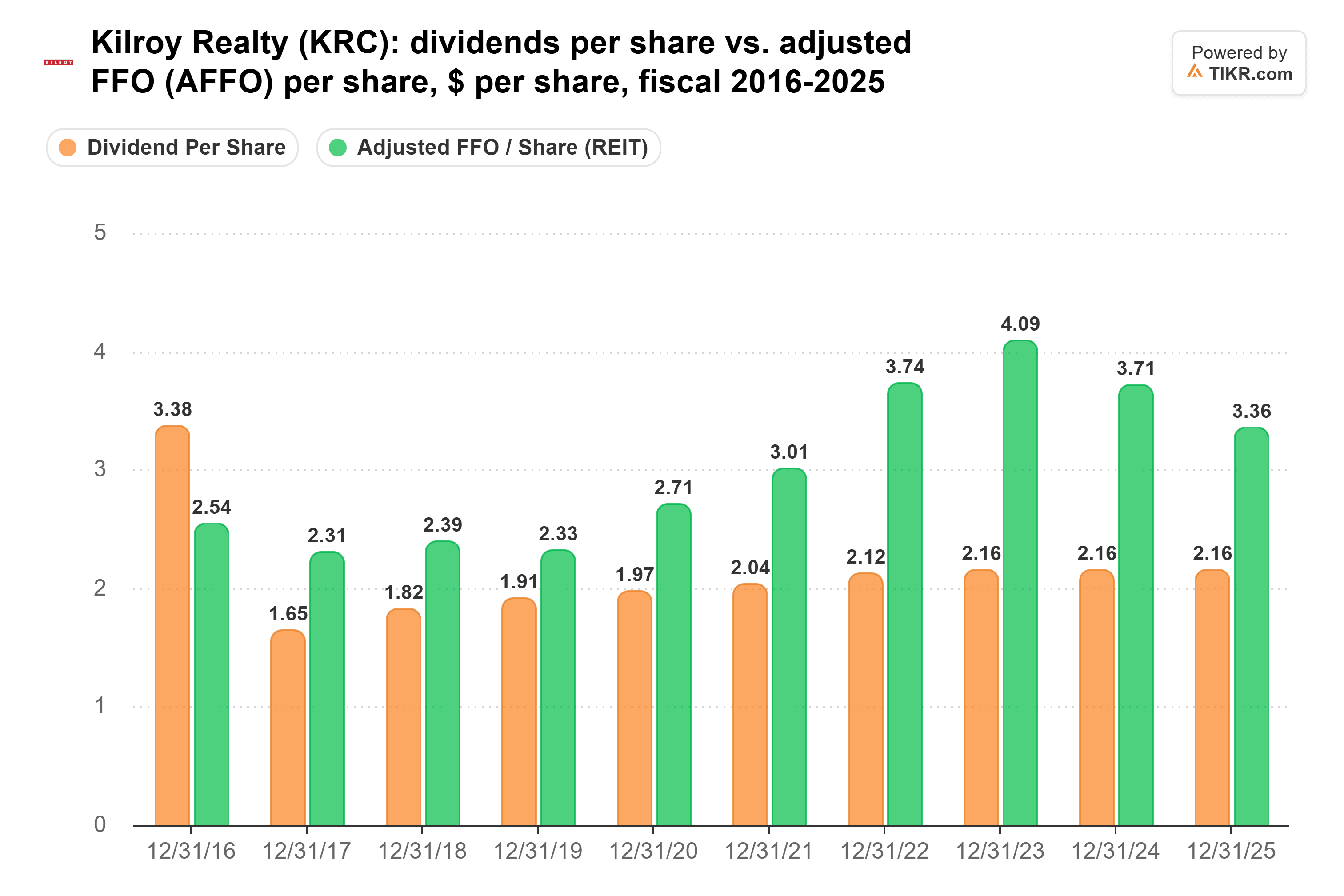
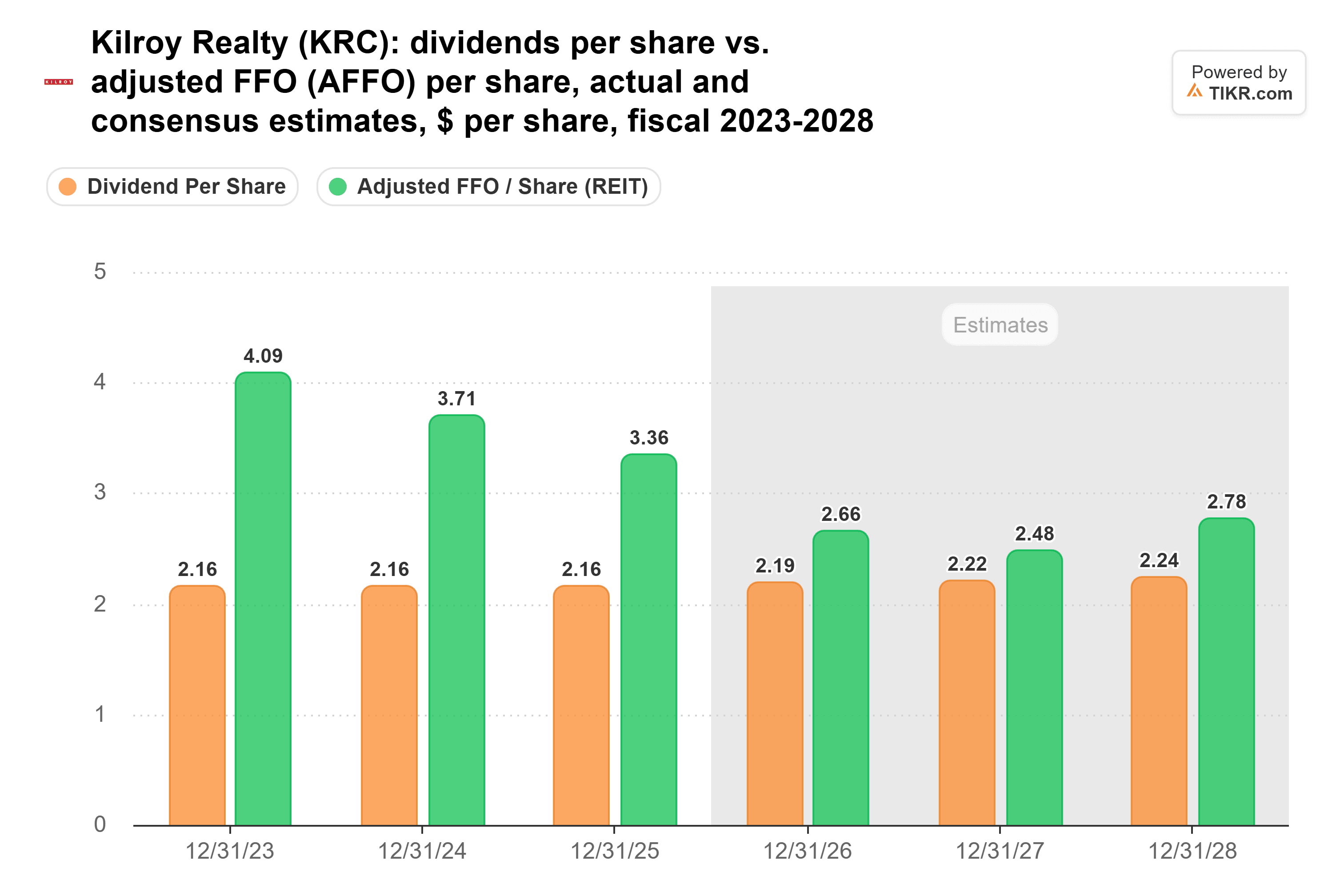
Analysts expect AFFO per share of $2.66 in fiscal 2026, against a $2.19 dividend estimate. That’s a riskier 82% payout ratio. Nine analysts make the estimate, and last year’s final consensus landed within 1% of the actual figure.
Kilroy’s latest quarter showed the same pressure. FFO fell to $0.88 a share in the third quarter, from $1.08 a year earlier. Its stabilized portfolio was just 76.9% occupied at Sept. 30. DIRECTV is shrinking its lease in El Segundo. And by Kilroy’s own measure, net debt to EBITDAre rose to 7.2x from 6.4x a year earlier.
Leasing is the bright spot. Kilroy signed about 815,000 square feet of leases in the third quarter, which CEO Angela Aman called “one of the Company’s highest quarterly leasing volumes since 2019.”
There’s a new risk, too. On Nov. 13, CRE Daily reported that Skydance, which now includes Paramount, may move its offices into buildings it owns. Paramount leases about 240,000 square feet at Kilroy’s Columbia Square complex in Hollywood.
So which dividend wins?
For retirees, Realty Income is the better dividend stock. Its check is smaller today, but its coverage is expected to hold steady while Kilroy’s tightens:
Kilroy has a fair case. On $10,000, Kilroy pays $610 a year today, compared with $560 from Realty Income. At each stock’s 5-year growth rate, the two checks end up about even by year 10: about $725 for Realty Income and $720 for Kilroy. That’s a 7.2% yield on the original $10,000 either way, with Realty Income pulling ahead around 2035. Kilroy also has 1.4 million square feet of signed leases that haven’t started paying yet.
Still, a retiree counting on that check should want the one with room to spare. Realty Income pays monthly and just raised its dividend again. It has less debt and covers interest 2.4x, against Kilroy’s 1.6x. Kilroy has to grow its way back to its fiscal 2025 coverage while carrying more debt.
Of course, if Kilroy’s new leases start paying sooner than analysts expect, that 82% could come down fast.
Forget Realty Income: 6 safe 6%+ dividend yields you can buy right now
Dividends can hold the key to enormous wealth. But only if you buy the right ones.
Picking the right high-yield dividend stock can be the difference between a dream retirement…and scraping by every month, waiting for the next Social Security check to clear.
We’ve identified six stocks yielding 6%+ that we believe every retiree should know about right now. (And Realty Income isn’t one of them.)
Disclaimer:
Please note that the articles on TIKR are not intended to serve as investment or financial advice from TIKR or our content team, nor are they recommendations to buy or sell any stocks. We create our content based on TIKR Terminal’s investment data and analysts’ estimates. Our analysis might not include recent company news or important updates. TIKR has no position in any of the stocks mentioned. Thank you for reading, and happy investing!