Key Takeaways
- SoundHound AI stock is down 57% in 2026, and Cantor Fitzgerald cut its price target to $10 from $15 on Nov. 6 while keeping its Overweight rating.
- Third-quarter revenue rose 48% to a record $62.4 million, but non-GAAP gross margin fell to 50.3% from 59.3% and the adjusted EBITDA loss widened.
- Cantor’s $10 works out to about 14x today’s forward sales, below SoundHound’s three-year average of 20x.
- The multiple behind $10 isn’t demanding. The harder part is cutting the cash burn before SoundHound sells much more stock.
SoundHound AI (SOUN) closed at $4.26 on Nov. 5, down 57% in 2026, ahead of its third-quarter report that evening. The next day, Cantor Fitzgerald cut its target to $10 from $15 but kept its Overweight rating. Even after the cut, $10 sits 135% above that close.
A Record Quarter With a Catch
SoundHound had missed free cash flow estimates four quarters running going into the report, and the quarter didn’t show its losses shrinking. Revenue rose 48% to a record $62.4 million. But non-GAAP gross margin fell to 50.3% from 59.3% a year earlier, and the adjusted EBITDA loss widened to $20.7 million from $14.5 million.
SoundHound narrowed its 2026 revenue guide to $250 million to $260 million. Part of that is by choice: it’s exiting contracts with negative gross margins and moving license deals to hosted ones, which book revenue over time instead of upfront.
Cantor Blames SoundHound’s Revenue Mix
Cantor’s Thomas Blakey tied the cut to that shift. Point-in-time revenue fell to about 10% of third-quarter sales from about a third in the second quarter, management said on the call. CFO John Collins said contract exits and business-line changes reduce expected 2026 revenue by about $8 million, while lower second-half licensing revenue accounts for another $27 million. Without those two hits, he put 2026 revenue near $290 million, against the $255 million midpoint SoundHound now guides to.
Management’s answer is $120 million of annualized cost cuts, with over $80 million scheduled to take effect before Jan. 1, 2027. SoundHound also guided to adjusted EBITDA profit within the second half of 2027, on 2027 revenue of $350 million to $400 million.
TIKR Tracks 8 Analysts on SoundHound AI. How Many Say “Buy”?
See the full breakdown of Buy, Hold, and Sell ratings on SoundHound AI, along with Wall Street’s revenue and earnings estimates, all in one place. More than 500,000 investors use TIKR to research stocks like this one. See SoundHound AI’s Analyst Ratings
Does $10 Add Up?
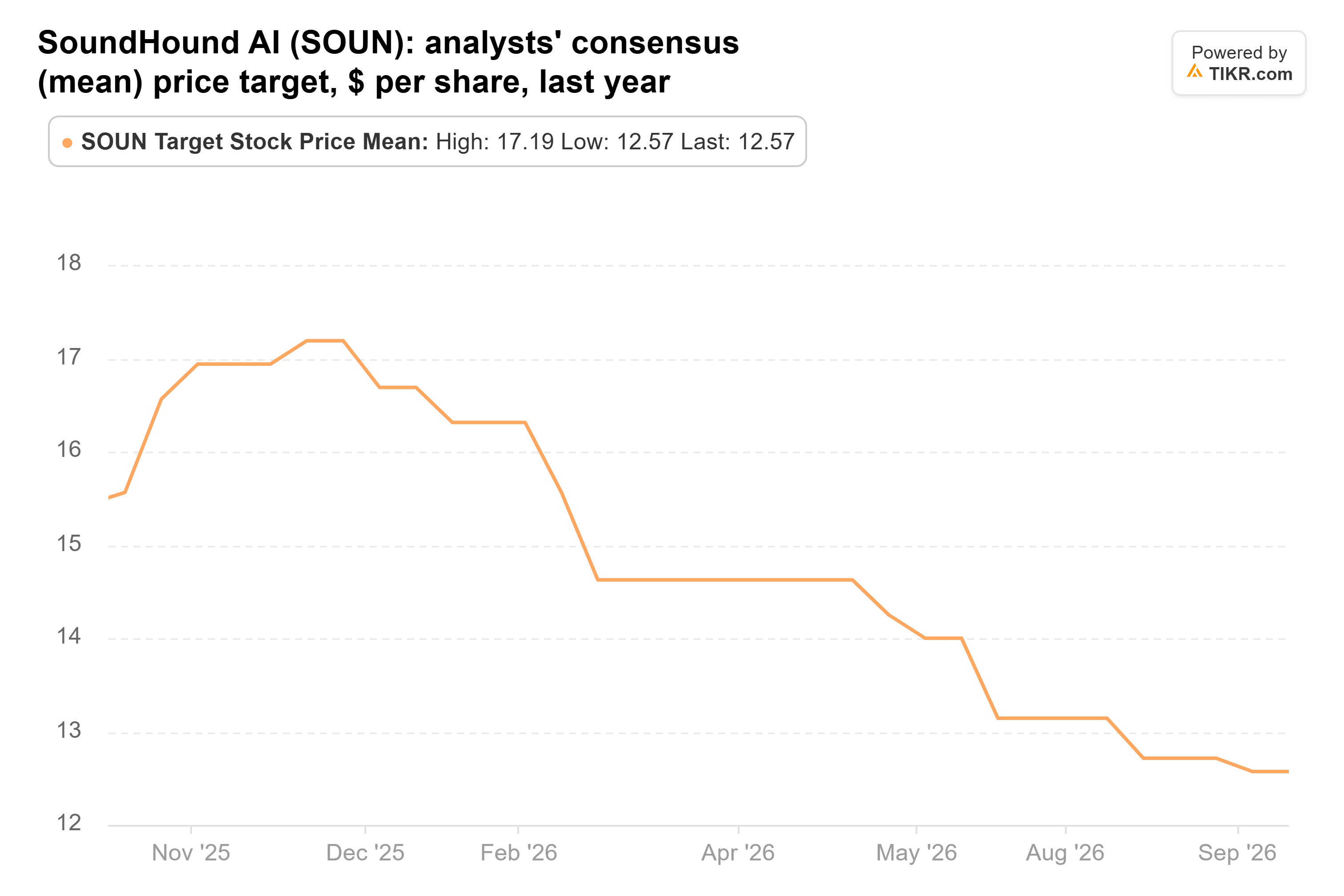
The consensus target fell to $13 in September from $16 a year earlier, before this week’s cuts:
Going into the report, analysts expected $390 million of 2027 revenue, near the top of SoundHound’s range:

The forward price-to-sales ratio hit a three-year low of 5.8x on Nov. 2, against a 20x average and a 62x peak in December 2024:

At the Nov. 2 close of $4.09, that’s about $0.70 of expected sales a share over the next 12 months. Cantor’s $10 is about 14x that, below both the three-year average and the one-year average of 16x. A 12-month target should really be judged on sales a year from now, which analysts expect to be higher, so the real bar is lower still.
Watch SoundHound’s Share Count
SoundHound had $207.6 million of cash at Sept. 30, but operations used $96.0 million in the first nine months of 2026, up from $76.3 million a year earlier. It also set up a $300 million share-sale program in May. Each share sold at these prices shrinks the sales per share behind $10.
At under 6x forward sales, the market is paying very little for a business guiding to at least $350 million of 2027 revenue, so Cantor’s direction looks right to me. The weak spot is funding: $10 needs SoundHound to reach that EBITDA profit without selling much more stock.
The first-quarter 2027 report, likely in early May, will be the first with a full quarter of the cuts scheduled before Jan. 1. If the burn narrows there with no new share sales, I’d take $10 seriously.
So what is SoundHound AI stock actually worth?
TIKR lets you forecast the future price of any stock in less than a minute. Just enter a few assumptions into TIKR’s valuation model and see what SoundHound AI could be worth. Start from Wall Street consensus estimates, or adjust the inputs to reflect your own view of the business. It’s free to use.
Disclaimer:
Please note that the articles on TIKR are not intended to serve as investment or financial advice from TIKR or our content team, nor are they recommendations to buy or sell any stocks. We create our content based on TIKR Terminal’s investment data and analysts’ estimates. Our analysis might not include recent company news or important updates. TIKR has no position in any of the stocks mentioned. Thank you for reading, and happy investing!