
Key Takeaways
- Canaccord Genuity cut its D-Wave Quantum price target to $31 from $35 on Nov. 11 and kept its Buy rating. That’s 191% above the last close.
- Getting to $31 takes a big fourth quarter, revenue growth of 70% to 86% a year through 2028, and a much higher sales multiple.
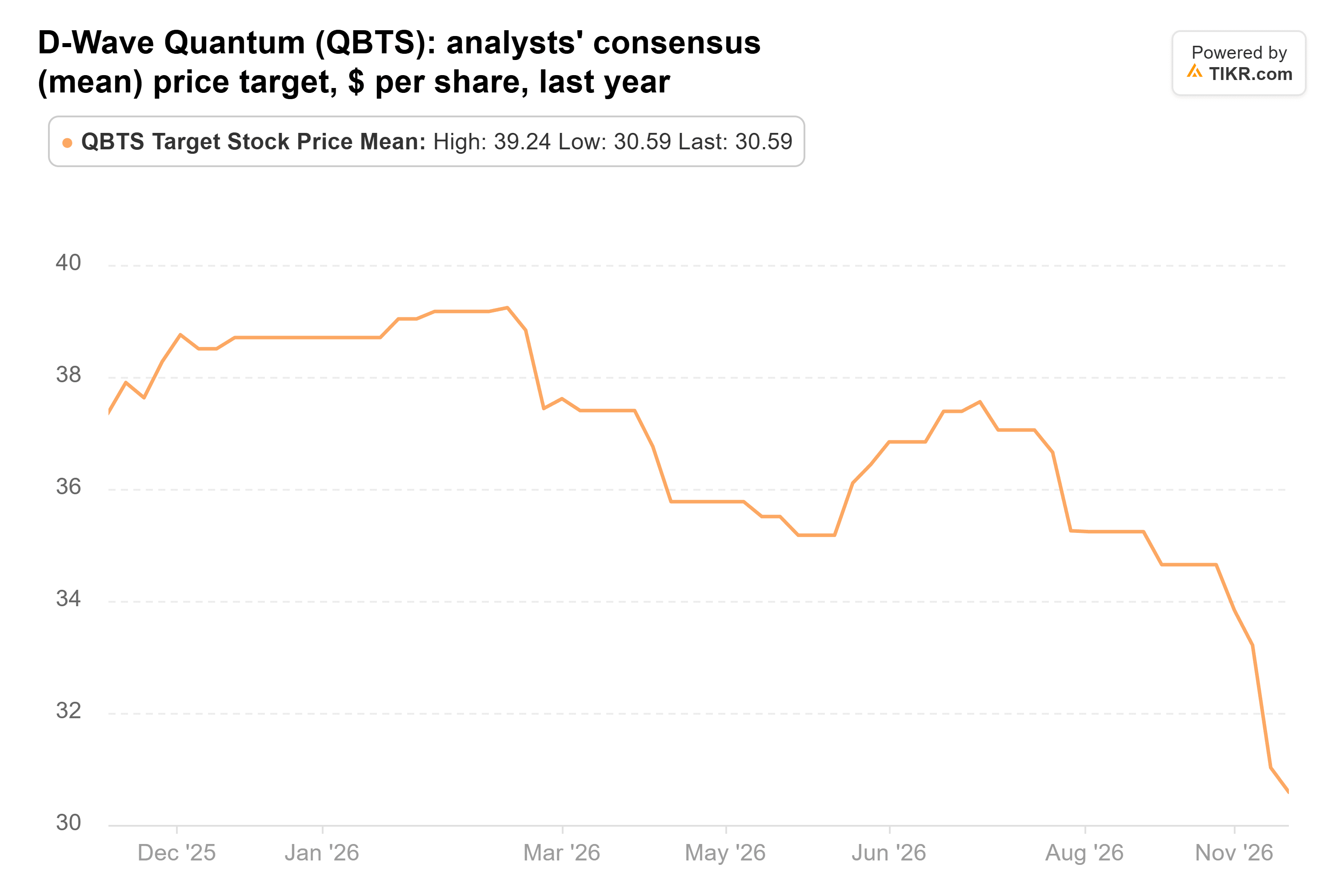
- The Street’s consensus target has fallen from $38 to $31 since December 2025, and estimates for D-Wave’s losses keep getting deeper.
- $31 looks too optimistic for the next 12 months. The fourth-quarter report is the next test.
D-Wave Quantum (QBTS) is 67% below its December 2025 high, and Canaccord Genuity just trimmed its price target to $31 from $35. The firm kept its Buy rating on Nov. 11, and $31 is 191% above the stock’s last close.
Three Misses, Then a Soft Quarter
D-Wave missed consensus revenue in each of the three quarters from late 2025 through mid-2026, while GAAP operating expenses nearly doubled to $55.0 million in the second quarter, from $28.5 million a year earlier.
In the third quarter, reported Nov. 10, revenue rose 21% to $4.5 million, ahead of the $4.34 million consensus, but bookings fell 19% to $1.9 million and operating expenses climbed 84% to $55.9 million.
TIKR Tracks 17 Analysts on D-Wave Quantum. How Many Say “Buy”?
See the full breakdown of Buy, Hold, and Sell ratings on D-Wave Quantum, along with Wall Street’s revenue and earnings estimates, all in one place. More than 500,000 investors use TIKR to research stocks like this one. See D-Wave Quantum’s Analyst Ratings
How Canaccord Gets to $31
Canaccord called the quarter solid but halved its fourth-quarter system sales estimate to $20 million from $40 million. Its new target sits right on the Street’s $31 average. Getting there takes three things:
- Florida Atlantic University’s $20 million machine, due in the fourth quarter, with much of it booked as revenue then.
- More system sales: acting CFO Greg Golkov said the pipeline’s dollar value rose more than 75% in the third quarter, “driven by strong interest in system sales.”
Revenue growth of 70% to 86% a year, from $24.6 million in 2025 to the $145 million analysts expect for 2028:
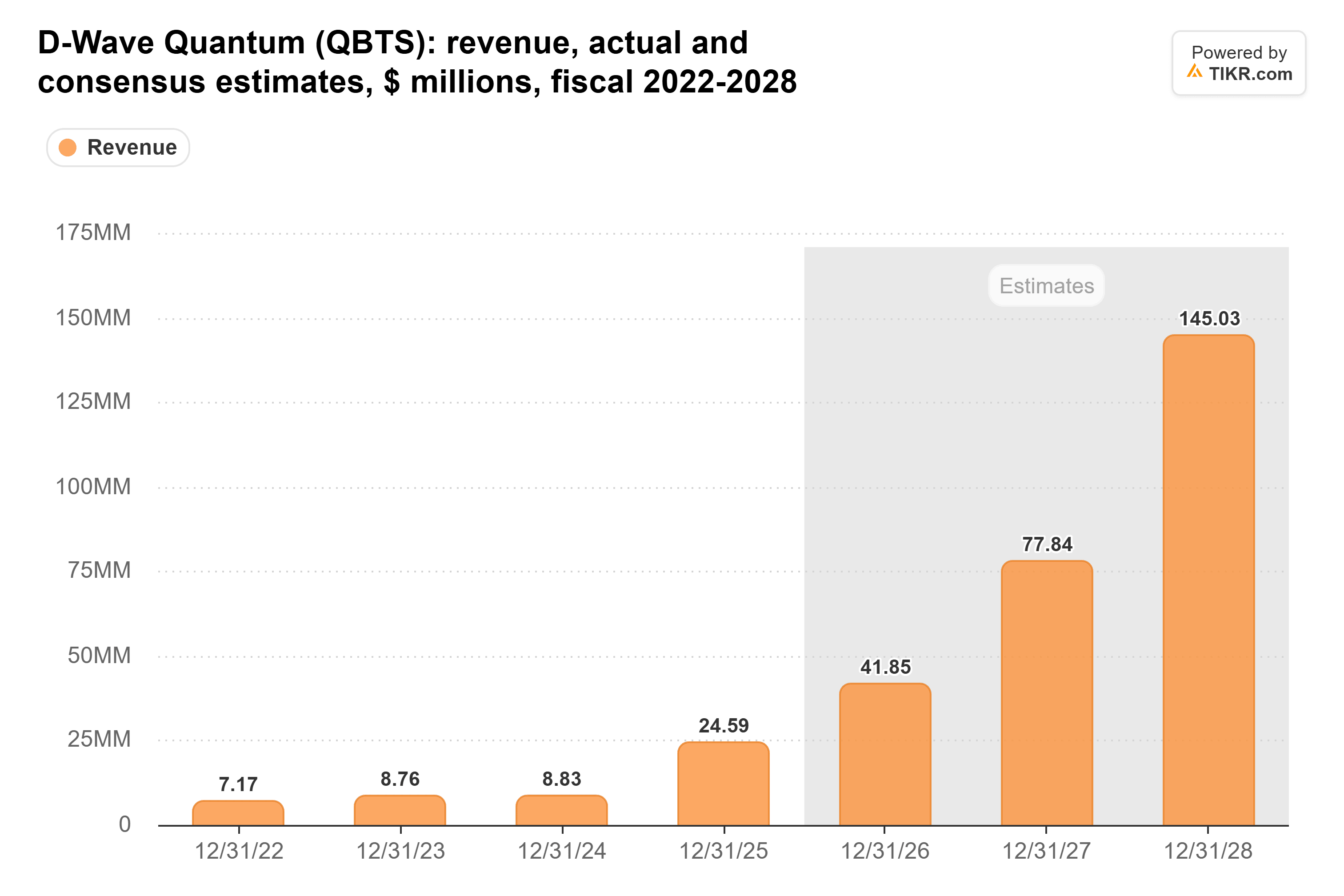
Then the market has to pay up again. Even if 2028 revenue arrives on time, $31 asks investors to pay about 56% more for each dollar of next year’s sales than they pay today.
Does $31 Add Up for D-Wave?
The consensus target has slid from $38 in December 2025, and individual targets now run from $18 to $43:
D-Wave has about $10.4 million of revenue through September, so the $41.9 million consensus for 2026 calls for about $31.5 million in those three months alone. Even with Canaccord’s $20 million of system sales, everything else would have to bring in about $11.5 million, roughly 2.5 times D-Wave’s entire third-quarter revenue.
Loss estimates keep deepening: analysts see a loss of $0.31 a share for 2026 and $0.39 for 2027, from $0.30 and $0.38 three months ago. The multiple has come down hard:

At 48x forward sales, the stock looks cheap against its 153x three-year average. But that average includes a run to 839x in October 2025.
A 2027 Story, at Best
The risk I’d watch is the supply chain. IonQ now owns SkyWater, which makes D-Wave’s chips, and CEO Alan Baratz said D-Wave will keep qualifying other manufacturers.
I think $31 is too optimistic for the next 12 months. D-Wave has the liquidity to keep building, with $503.4 million in cash and marketable securities at September’s end. But $31 needs investors to warm back up to a business with deepening loss estimates and a year riding on one machine. If the fourth-quarter report early next year shows Florida Atlantic’s system delivered, full-year 2026 revenue near $42 million and a second system order in hand, I’d take $31 more seriously.
So What Is D-Wave Quantum Stock Actually Worth?
TIKR lets you forecast the future price of any stock in less than a minute. Just enter a few assumptions into TIKR’s valuation model and see what D-Wave Quantum could be worth. Start from Wall Street consensus estimates, or adjust the inputs to reflect your own view of the business. It’s free to use.
Disclaimer:
Please note that the articles on TIKR are not intended to serve as investment or financial advice from TIKR or our content team, nor are they recommendations to buy or sell any stocks. We create our content based on TIKR Terminal’s investment data and analysts’ estimates. Our analysis might not include recent company news or important updates. TIKR has no position in any of the stocks mentioned. Thank you for reading, and happy investing!