


Key Takeaways
- A $400,000 portfolio split evenly across UPS, Enterprise Products Partners and Pfizer pays about $1,960 a month in dividends at today’s prices.
- Enterprise Products Partners has the most room behind its payout, with distributable cash flow at 1.69x its distributions in fiscal 2025.
- UPS and Pfizer both paid out more than their free cash flow in fiscal 2025, at 113% and 108%, though UPS’s cash flow is recovering.
- If Pfizer halved its dividend, the portfolio’s income would fall to about $19,600 a year, and to about $15,700 if Pfizer stopped paying.
Nearly $2,000 a month in income from three stocks, without selling a share.
Take a hypothetical retiree who splits $400,000 evenly across United Parcel Service (UPS), Enterprise Products Partners (EPD) and Pfizer (PFE) at today’s prices. That buys about 1,200 shares of UPS, about 3,600 units of Enterprise Products and about 4,550 shares of Pfizer. Together, the dividend checks come to about $23,600 a year, or about $1,960 a month.
That’s a 5.9% yield on this part of the portfolio. (Of course, no one should ever own just three stocks.) Two of the three are paying out most of their free cash flow, so what each business is doing right now matters a lot for the income.
| Stock | Shares | Cost | Income a year | Share of income | Coverage |
|---|---|---|---|---|---|
| UPS | 1,190 | $133,232 | $7,806 | 33% | 85% of free cash flow (TTM) |
| Enterprise Products Partners | 3,526 units | $133,318 | $7,898 | 34% | 1.69x distributable cash flow (fiscal 2025) |
| Pfizer | 4,577 | $133,328 | $7,872 | 33% | 89% of free cash flow (TTM) |
| Total | $23,577 |
Source: TIKR and StockAnalysis, at today’s prices; dividends at each company’s current rate.
6 safe dividend stocks paying retirees 6%+ yields
There are over 100 stocks paying 6%+ annual dividends today.
But after an extensive investment review leveraging TIKR’s proprietary data, we now believe only six of them are truly safe for retirees.
They’re all yours for free as part of our new investment report, which you can access right here.
UPS is shipping fewer packages and earning more on each
UPS is shrinking on purpose. Its U.S. average daily volume fell 3.3% in the third quarter of 2026 because UPS cut back on lower-margin Amazon volume. Even so, U.S. Domestic revenue rose 4.5% to $14.9 billion on higher revenue per piece. On Oct. 27, UPS raised its 2026 outlook to approximately $6.1 billion of adjusted free cash flow, against the around $5.4 billion of dividends it plans to pay.
UPS’s free cash flow fell from $10.8 billion in fiscal 2021 to $4.77 billion in fiscal 2025, while dividends paid rose from $3.44 billion to $5.40 billion:
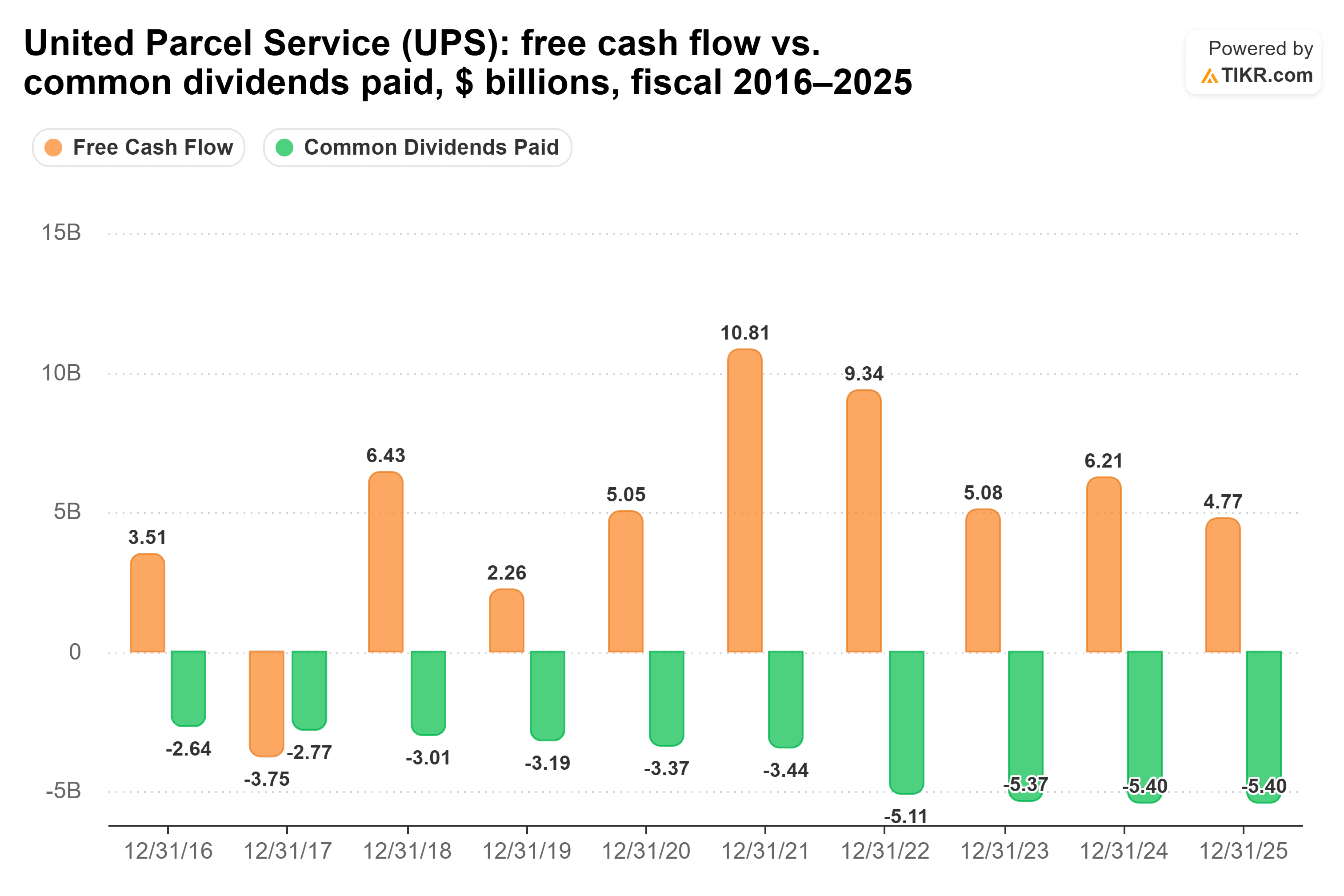
In fiscal 2025, the cash dividend payout ratio was a risky 113.3%. Over the twelve months to Sept. 30, 2026, it was back down to 85%. Consensus has the ratio at 88% for fiscal 2026. CEO Carol Tomé put it plainly on the third-quarter call: “So clearly, our dividend is safe and secure.”
The volume trade still has to pay off, though. UPS’s operating margin slipped to 7.6% in the third quarter from 8.4% a year earlier.
Enterprise Products has room to spare
Enterprise Products is the opposite story. Its Permian natural gas processing hit a record 4.6 Bcf/d in the third quarter of 2026, up 12%. With new plants and pipelines in service, operational distributable cash flow rose 27% to $2.3 billion, which covered the quarter’s distribution 1.9x. (As an MLP, Enterprise pays distributions on units, and unitholders get a K-1 at tax time.)
Distributable cash flow per unit has stayed well above the distribution every year since fiscal 2016, and in fiscal 2025 it was $3.66 against $2.17:
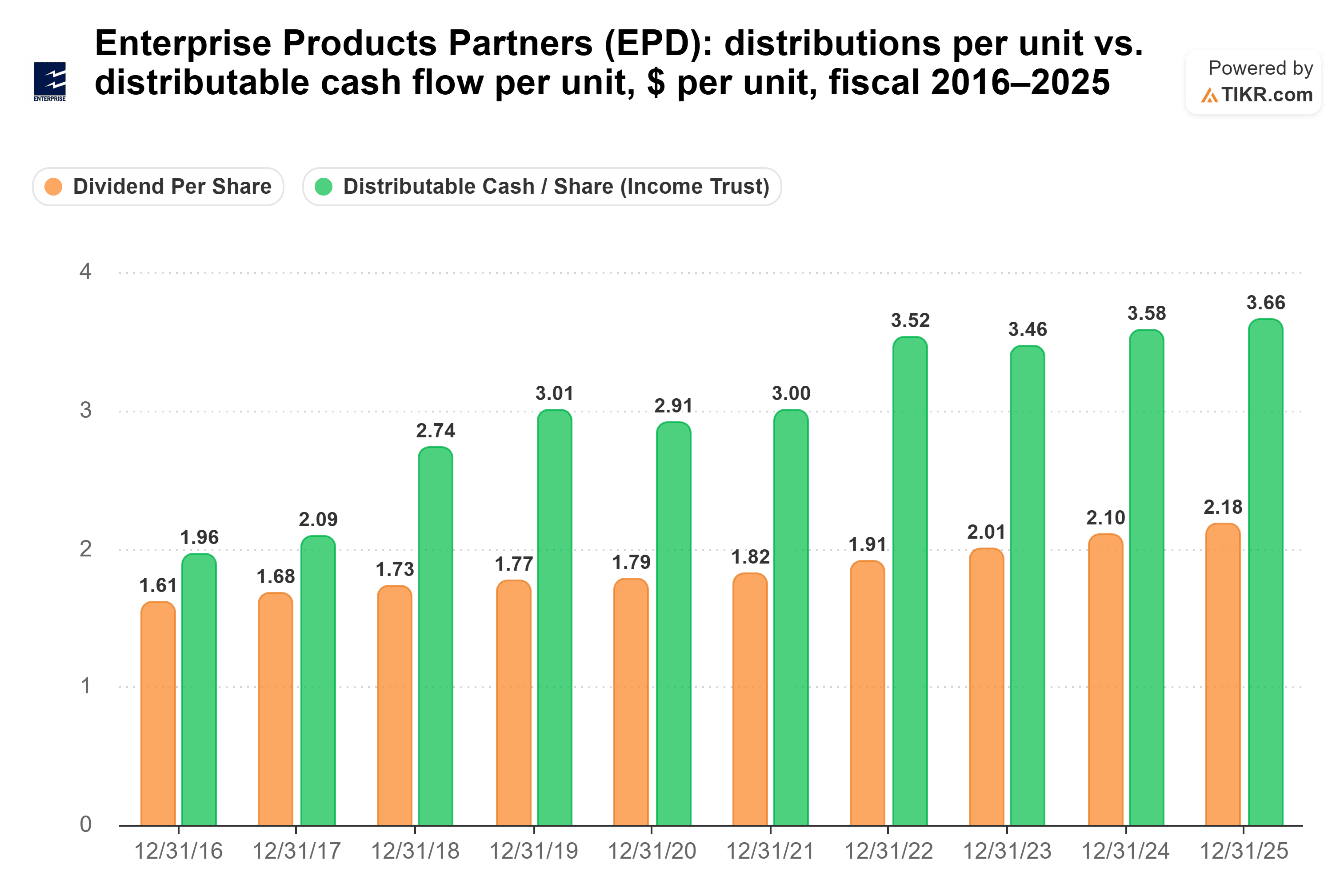
That works out to 1.69x coverage for fiscal 2025, and consensus expects 1.86x for fiscal 2026. The raises are getting smaller, though. On Oct. 8, Enterprise declared $0.56 a unit for the quarter, up 2.8% from a year earlier, compared with 4.0% a year from fiscal 2020 to fiscal 2025. And management expects 2027’s EBITDA growth to be more modest than 2026’s.
Pfizer’s new drugs have to carry the check
Pfizer is replacing its COVID sales and an aging lineup at the same time. In the third quarter of 2026, its launched and acquired products grew 32% operationally while Paxlovid fell 63%, which left revenue of $16.6 billion relatively flat. On Nov. 3, Pfizer raised its 2026 guidance to $62.0-$64.0 billion of revenue and $2.95-$3.05 of adjusted EPS.
The cash behind the dividend has shrunk, though. Free cash flow fell from $29.9 billion in fiscal 2021 to $9.08 billion in fiscal 2025, while dividends paid rose from $8.73 billion to $9.77 billion:
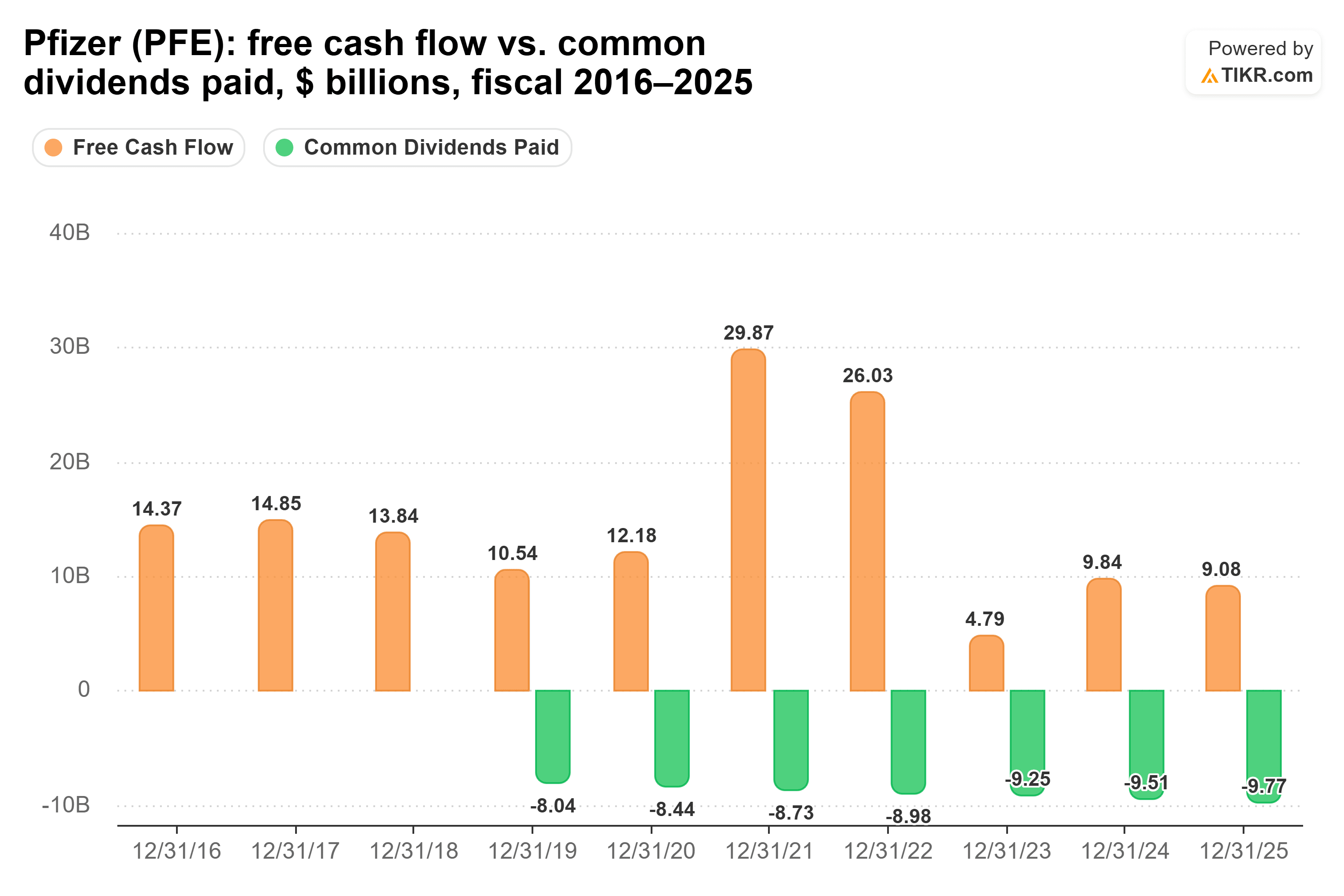
In fiscal 2025, the cash dividend payout ratio was a risky 107.7%. Over the twelve months to June 28, 2026, it was a thin 89%. On the second-quarter call, CEO Albert Bourla said: “We feel extremely confident that we will — even the most stretched scenarios that we are running, we will be able to maintain our dividend.”
The pressure doesn’t let up next year. Ibrance and Xtandi are losing exclusivity, and Cecile Guegan, named permanent CFO on Nov. 3, said two of Pfizer’s products will get Medicare’s negotiated prices in 2027.
Pfizer’s check is the one I’d watch
Pfizer has the least room on its own measure. If Pfizer halved its dividend, this portfolio’s income would fall to about $19,600 a year. If it stopped paying altogether, the income would fall to about $15,700.
At the end of the day, Enterprise Products’ check is the one I’d count on most, and UPS’s is getting safer. Pfizer’s dividend isn’t in trouble today, but it doesn’t have much cushion either. Pfizer’s 2027 guidance will show how much the Medicare prices and lost exclusivity cost it, so that’s the number I’d watch.
Enjoy your retirement in style with these safe 6%+ dividend yields
Dividends can hold the key to enormous wealth. But only if you buy the right ones.
Picking the right high-yield dividend stock can be the difference between a dream retirement…and scraping by every month, waiting for the next Social Security check to clear.
We’ve identified six stocks yielding 6%+ that we believe every retiree should know about right now.
Disclaimer:
Please note that the articles on TIKR are not intended to serve as investment or financial advice from TIKR or our content team, nor are they recommendations to buy or sell any stocks. We create our content based on TIKR Terminal’s investment data and analysts’ estimates. Our analysis might not include recent company news or important updates. TIKR has no position in any of the stocks mentioned. Thank you for reading, and happy investing!


