Key Takeaways
- Six big funds sold out of Walmart (WMT) or cut their stakes deeply in the Q3, according to their 13Fs for the quarter ended Sept. 30, days before Walmart’s Nov. 19 report.
- On valuation, the sellers have the better case: Walmart trades at 43x forward earnings, against a five-year average of 30x.
- Costco Wholesale (COST) is pricier still, while Target (TGT) and Dollar General (DG) trade at about 17x.
- Walmart looks fully priced going into the report, which has to show profit growing faster than its modest guidance.
Six big funds sold out of Walmart or cut their stakes deeply in the Q3, according to their 13Fs for the quarter ended Sept. 30, all filed Nov. 16. With Walmart reporting on Nov. 19, anyone who owns it has a few days to decide whether to follow them.
The filings say something about the competition, too. One of the sellers dumped Costco Wholesale as well, while Target and Dollar General show just how much investors are paying for Walmart.
Three sold out, three cut deep
The count covers big funds that have filed for the quarter and either sold out of Walmart or cut it by 20% or more:
| Fund (size) | Walmart in Q3 | Costco in Q3 |
|---|---|---|
| Junto Capital ($11 billion) | Sold all 1.49 million shares | – |
| Anomaly Capital ($5.9 billion) | Sold all 449,044 shares | – |
| Cartenna Capital ($2.7 billion) | Sold all 300,000 shares | – |
| Steadfast Capital ($10 billion) | Cut 29%, to 728,800 shares | Sold all |
| Blue Sparrow ($8.3 billion) | Cut 64%, to 355,000 shares | Added 95% |
| Main Street Research ($2.7 billion) | Cut 97%, to 9,304 shares | Held |
Source: each fund’s 13F for the quarter ended Sept. 30, 2026. Sizes are what each firm manages; Blue Sparrow’s is what its 13F holds in US stocks.
Junto’s exit was the biggest: a stake worth $168 million on June 30, or 3.1% of its 13F stocks. A 13F only shows what a fund held on the last day of the quarter, so it can’t tell us when these funds sold, what they got, or why.
Since Sept. 30, Walmart is up 23%. (That’s the share price’s change since quarter-end. The filings can’t show whether any of them bought back in.)
TIKR tracks 45 analysts on Walmart. How many say “Buy”?
See the full breakdown of Buy, Hold, and Sell ratings on Walmart, along with Wall Street’s revenue and earnings estimates, all in one place. More than 500,000 investors use TIKR to research stocks like this one. See Walmart’s Analyst Ratings
43x is a lot to pay for 11% growth
Consensus has normalized EPS rising from $2.64 in the year ended January 2026 to $3.63 in the year ending January 2029, about 11% a year:

The $2.89 analysts expect for this fiscal year already sits above the top of management’s $2.80-$2.87 guidance, so the Street is counting on a beat.
And the later years have edged down since June: the fiscal 2029 estimate was $3.71 then.
Investors have paid up for those earnings anyway:
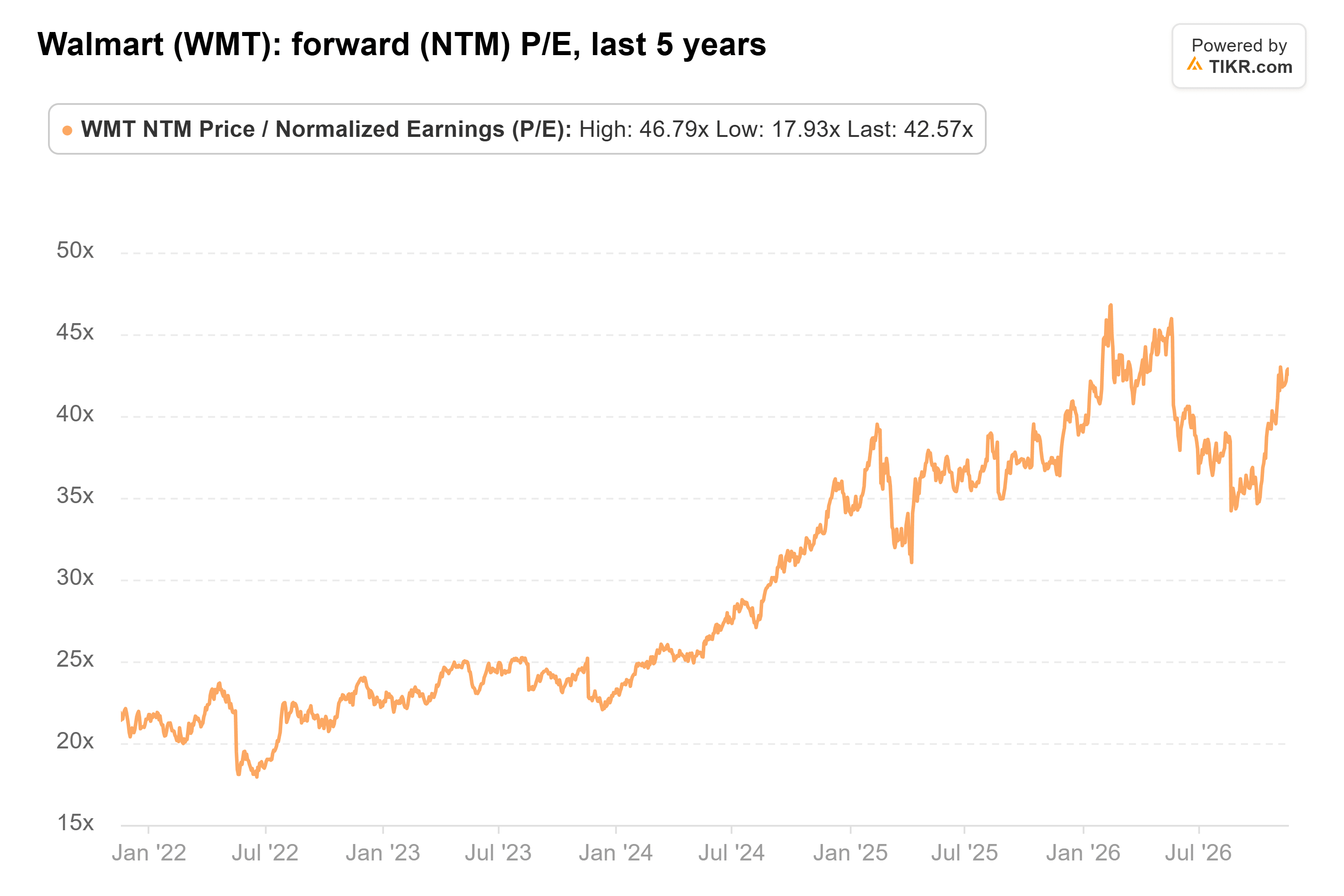
Walmart trades at 43x forward earnings, close to February’s peak of 47x and well above its five-year average of 30x. At that average, the fiscal 2029 estimate would be worth about $107 a share.
That premium stands out in the group. Target and Dollar General both trade at about 17x.
Target kept its $994 million of Q2 tariff refunds in its margins, while Walmart put its roughly $2.9 billion refund into more than 11,000 rollbacks.
Dollar General sits 15% below its 52-week high after the FTC and 20 states sued it over its pricing in October.
Costco is the one stock pricier than Walmart, at about 49x, and its $1,080 consensus target sits 2% below its price.
One of the six sold out of Costco too, a stake worth $219 million on June 30, while two held or added.
Nov. 19 has to beat a modest guide
The Street’s average target has climbed with the stock over the past year:

It’s $131.90 now, up from $113.83 a year ago but below June’s $138.95 peak, and just 3% above Walmart’s last close. 45 analysts cover the stock.
For Q3, Walmart guided adjusted operating income up only 2% to 4% in constant currency, with adjusted EPS of $0.62-$0.64, as its refund goes back into prices.
The bull case rests on advertising and membership, and they’re growing fast: advertising rose 46% to about $6.4 billion in the year ended January 2026.
The report has to show Walmart U.S. comparable sales, excluding health and wellness, holding at 3% to 4%, a sign the rollbacks are buying lasting traffic.
Capex is the main risk to that story: Walmart raised this year’s plan to about 4% of net sales in August, then committed about $6 billion over several years to expand its Symbotic automation deal in October.
Should you follow the funds? On price, I would. I wouldn’t buy Walmart at 43x ahead of a quarter guided for low-single-digit profit growth, and if I owned a big position, I’d trim some of it.
The ad business is real, but investors are already paying for a lot of it.
Of course, the bigger test is February’s fiscal 2028 outlook. If Walmart guides operating income growing at least twice as fast as sales, with capex below 4% of sales, 43x gets much easier to defend.
So what is Walmart stock actually worth?
TIKR lets you forecast the future price of any stock in less than a minute. Just enter a few assumptions into TIKR’s valuation model and see what Walmart could be worth. Start from Wall Street consensus estimates, or adjust the inputs to reflect your own view of the business. It’s free to use.
Disclaimer:
Please note that the articles on TIKR are not intended to serve as investment or financial advice from TIKR or our content team, nor are they recommendations to buy or sell any stocks. We create our content based on TIKR Terminal’s investment data and analysts’ estimates. Our analysis might not include recent company news or important updates. TIKR has no position in any of the stocks mentioned. Thank you for reading, and happy investing!