Key Takeaways
- A $400,000 portfolio split evenly across Comcast, Hormel Foods and AT&T pays about $20,500 a year in dividends at today’s prices, or about $1,710 a month.
- Comcast’s dividend is the best covered of the three, taking 24% of its free cash flow over the last twelve months, against 44% for AT&T and 82% for Hormel.
- If Hormel, the least covered, halved its dividend, the income would fall to about $17,000 a year. If it stopped paying, the income would fall to about $13,600.
- Hormel’s dividend still looks safe to me, and its Dec. 3 call, its first since closing the $1.055 billion Brakebush deal, is the next thing to watch.
Any retiree hunting for dividend income will look hard at stocks yielding around 5%. Comcast (CMCSA), Hormel Foods (HRL) and AT&T (T) all pay about that today.
So let’s take a hypothetical retiree who splits $400,000 evenly among the three. At today’s prices, that buys about 5,210 shares of Comcast, about 5,870 of Hormel and about 5,960 of AT&T. Their dividend checks add up to about $20,500 a year, or about $1,710 a month. That’s a 5.1% yield on this part of the portfolio. (Of course, no one should ever own just three stocks.)
The checks are about the same size. Each one, though, takes a very different share of its company’s free cash flow:
| Stock | Shares | Cost | Yield | Dividends a year | Share of income | Cash dividend payout ratio |
|---|---|---|---|---|---|---|
| Comcast (CMCSA) | 5,268 | $133,316 | 5.2% | $6,954 | 34% | 24% TTM, 36% forward |
| Hormel Foods (HRL) | 5,904 | $133,312 | 5.2% | $6,908 | 34% | 82% TTM |
| AT&T (T) | 5,981 | $133,316 | 5.0% | $6,639 | 33% | 44% TTM, 46% forward |
Source: TIKR, at today’s prices, with dividends at each company’s current annual rate. TTM is the twelve months to each company’s latest quarter. Forward is fiscal 2026 consensus.
6 safe dividend stocks paying retirees 6%+ yields
There are over 100 stocks paying 6%+ annual dividends today.
But after an extensive investment review leveraging TIKR’s proprietary data, we now believe only six of them are truly safe for retirees.
They’re all yours as part of our new investment report. Learn more about how to get access right here.
Comcast has the most room to spare
Comcast’s core business is losing customers. It lost 144,000 domestic broadband customers in the third quarter of 2026, against 91,000 a year earlier, as fiber and fixed wireless rivals keep pressing on price.
None of that has strained the dividend. Over the twelve months to Sept. 30, 2026, Comcast paid $4.82 billion in dividends out of $19.66 billion of free cash flow, a very comfortable 24%. Its free cash flow has stayed far above its dividends for a decade:
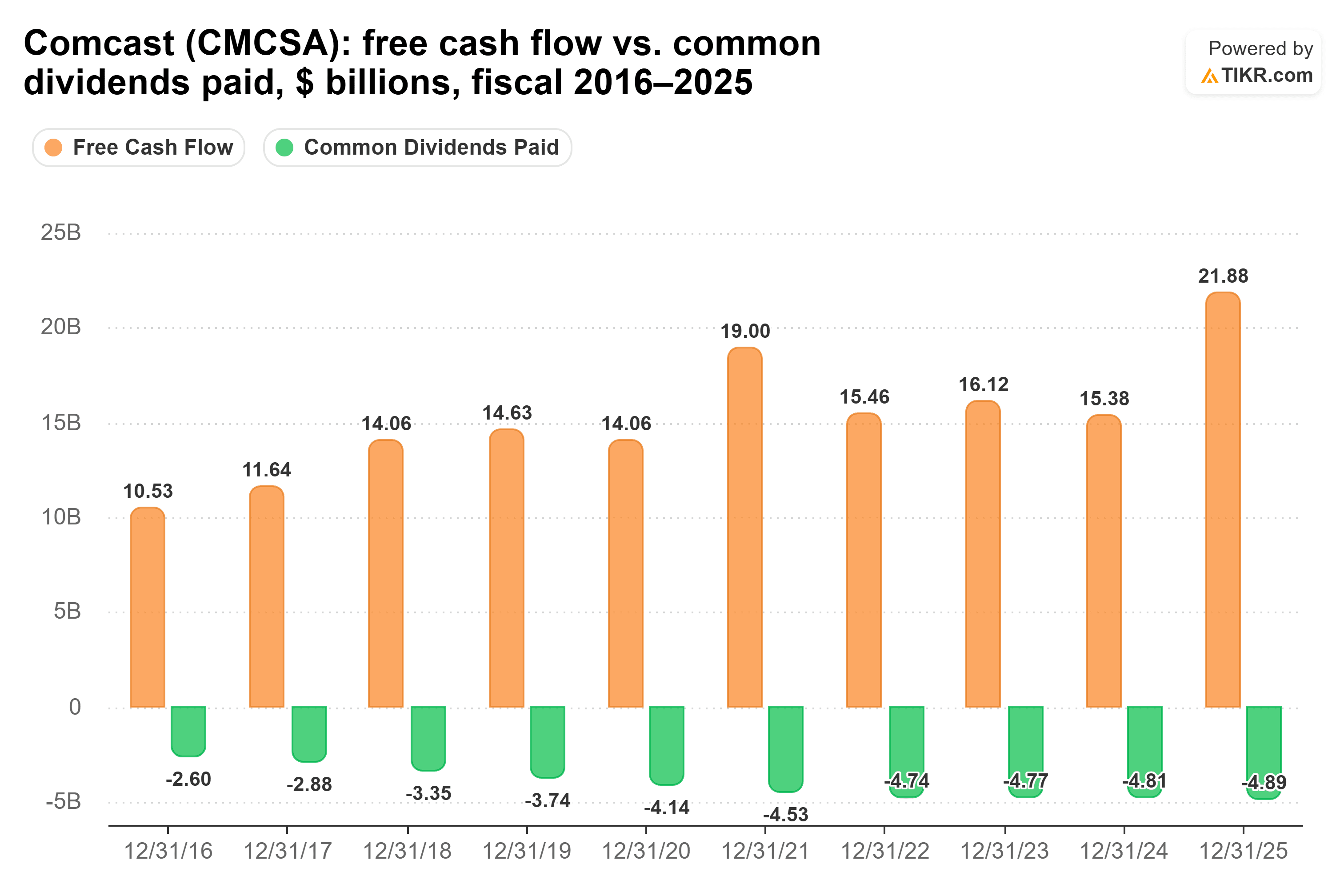
Analysts expect less this year. The 16 who estimate it see fiscal 2026 free cash flow 29% below its last reported figure, which lifts the ratio to 36%. That’s still well-covered. Comcast is spending on new pricing and free wireless lines, which Co-CEO Michael Cavanagh said on the third-quarter call are “necessary to strengthen customer relationships and position the business for a return to growth over the long term.”
The bigger unknown is the split: Comcast expects to spin off NBCUniversal and Sky by the middle of next year. For now, it declared $0.33 a share on Oct. 22, unchanged from the quarter before.
Hormel’s check is the tightest
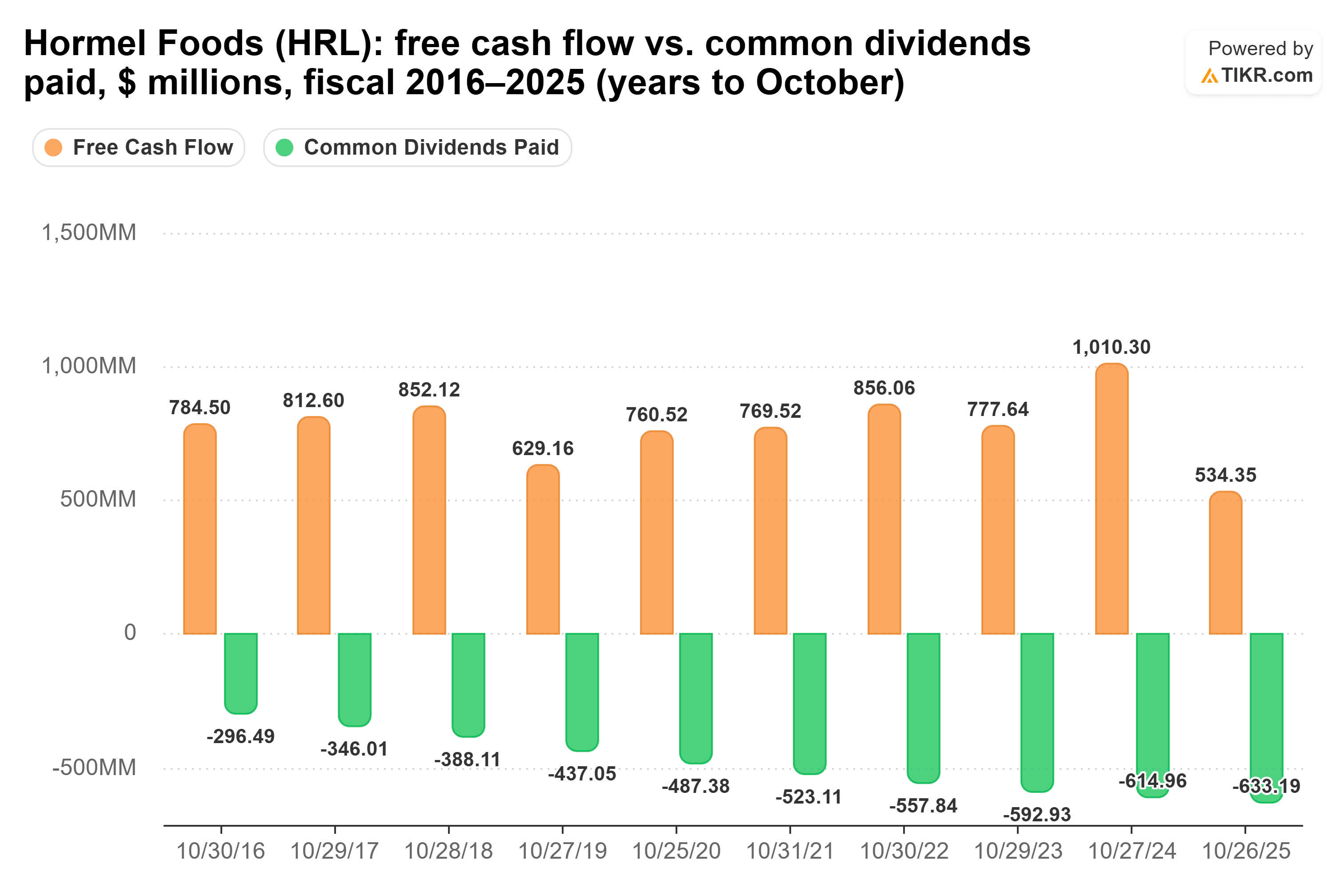
Comcast has cash to spare, but Hormel’s dividend takes most of what its business brings in. Over the twelve months to July 26, 2026, Hormel paid $641 million in dividends out of $781 million of free cash flow, a tight 82%. That’s a recovery from fiscal 2025, when free cash flow fell to $534 million from $1.01 billion the year before and came up short of the $633 million Hormel paid in dividends:
Foodservice grew organically for a 12th straight quarter in Hormel’s third quarter, even as retail volumes fell, and Hormel raised its fiscal 2026 adjusted EPS guidance to $1.45-$1.51. Now it’s doubling down: on Nov. 16, it closed its $1.055 billion cash purchase of chicken maker Brakebush Brothers, borrowing $700 million on Nov. 13 to help pay for it. Hormel came in with little debt, at 1.2x net debt to EBITDA over the last twelve months, and with interest covered 12.6x. John Ghingo, who took over as CEO on Oct. 26, said on the third-quarter call that “the dividend continues to be very important to us.”
AT&T’s check is solid, but flat
AT&T falls between the two on coverage, and its business is growing. Its third-quarter 2026 revenue rose 5.3% from a year earlier to $32.3 billion, and it added a record 769,000 internet customers on its fiber and fixed wireless services.
Over the twelve months to Sept. 30, 2026, AT&T paid $7.93 billion in dividends out of $18.01 billion of free cash flow, a well-covered 44%. Fiscal 2026 consensus puts the ratio at 46%. It’s that low because AT&T pays far less than it used to. Dividends paid fell from $15.1 billion in fiscal 2021 to $8.18 billion in fiscal 2025. Over the same stretch, free cash flow dipped to $12.4 billion in fiscal 2022 and then recovered to $19.4 billion:

The catch for a retiree is that this check won’t grow: AT&T plans to hold its dividend at $1.11 a share. Debt is its other weak spot. Its net debt is 3.1x adjusted EBITDA after its EchoStar spectrum purchase, and it doesn’t expect to get back to its 2.5x target until 2029.
Hormel’s check is the one to watch
Hormel is the least covered of the three, so it’s the one to test. If it halved its dividend, this portfolio’s income would fall to about $17,000 a year. If it stopped paying, the income would fall to about $13,600.
But being the least covered doesn’t make Hormel’s dividend risky. Its free cash flow covered the dividend again over the last twelve months, it took on the new loan from a low starting point, and its new CEO has called the dividend a priority. Comcast’s check is the one I’d count on most, with plenty of room even on this year’s lower estimate. AT&T’s should stay right where it is, for better or worse.
Hormel will share more on Brakebush and give its fiscal 2027 outlook on its Dec. 3 call, which will show how much cash it has left for its dividend after the new loan.
Enjoy your retirement in style with these safe 6%+ dividend yields
Dividends can hold the key to enormous wealth. But only if you buy the right ones.
Picking the right high-yield dividend stock can be the difference between a dream retirement…and scraping by every month, waiting for the next Social Security check to clear.
We’ve identified six stocks yielding 6%+ that we believe every retiree should know about right now.
Disclaimer:
Please note that the articles on TIKR are not intended to serve as investment or financial advice from TIKR or our content team, nor are they recommendations to buy or sell any stocks. We create our content based on TIKR Terminal’s investment data and analysts’ estimates. Our analysis might not include recent company news or important updates. TIKR has no position in any of the stocks mentioned. Thank you for reading, and happy investing!