Key Takeaways
- Walmart reports third-quarter results on November 19 after spending nearly $2.9 billion in tariff refunds on more than 11,000 price rollbacks.
- CEO John Furner said Walmart is “investing heavily in price because customers need us to,” even as U.S. comparable sales growth slowed to a six-year low.
- Target kept its $994 million refund in its margins, while Walmart is betting that lower prices win market share over time.
- The November 19 report needs to show Walmart U.S. comparable sales improving and operating income growth within the 2% to 4% guide.
Walmart (WMT) reports third-quarter results before the open on November 19. Management has already warned investors not to expect much profit growth.
That is by design. Walmart received nearly $2.9 billion in tariff refunds last quarter and poured most of it into lower prices, funding more than 11,000 rollbacks at Walmart U.S.
Target (TGT) took a different path with its own refund. It booked $994 million of tariff refunds in its second quarter, and operating income nearly doubled to $2.6 billion.
Investors disliked Walmart’s approach at first. The shares fell roughly 10% on August 20, their sharpest one-day drop since May 2022. They have rebounded strongly since late August, so the November report carries real expectations again.
A quarter flattered by refunds
Walmart’s second quarter, which ended July 31, looked strong on paper:
- Revenue rose 5.9% to $187.9 billion, or 5.1% in constant currency.
- Adjusted EPS of $0.81 beat the $0.74 consensus.
- Operating income jumped 28.8% to $9.38 billion.
The refunds did much of that work, though. They added a net 750 basis points to adjusted operating income growth of 17.4%. Underlying growth still landed at the top of the 7% to 10% guide.
Here’s how lumpy that makes the quarterly profit line…
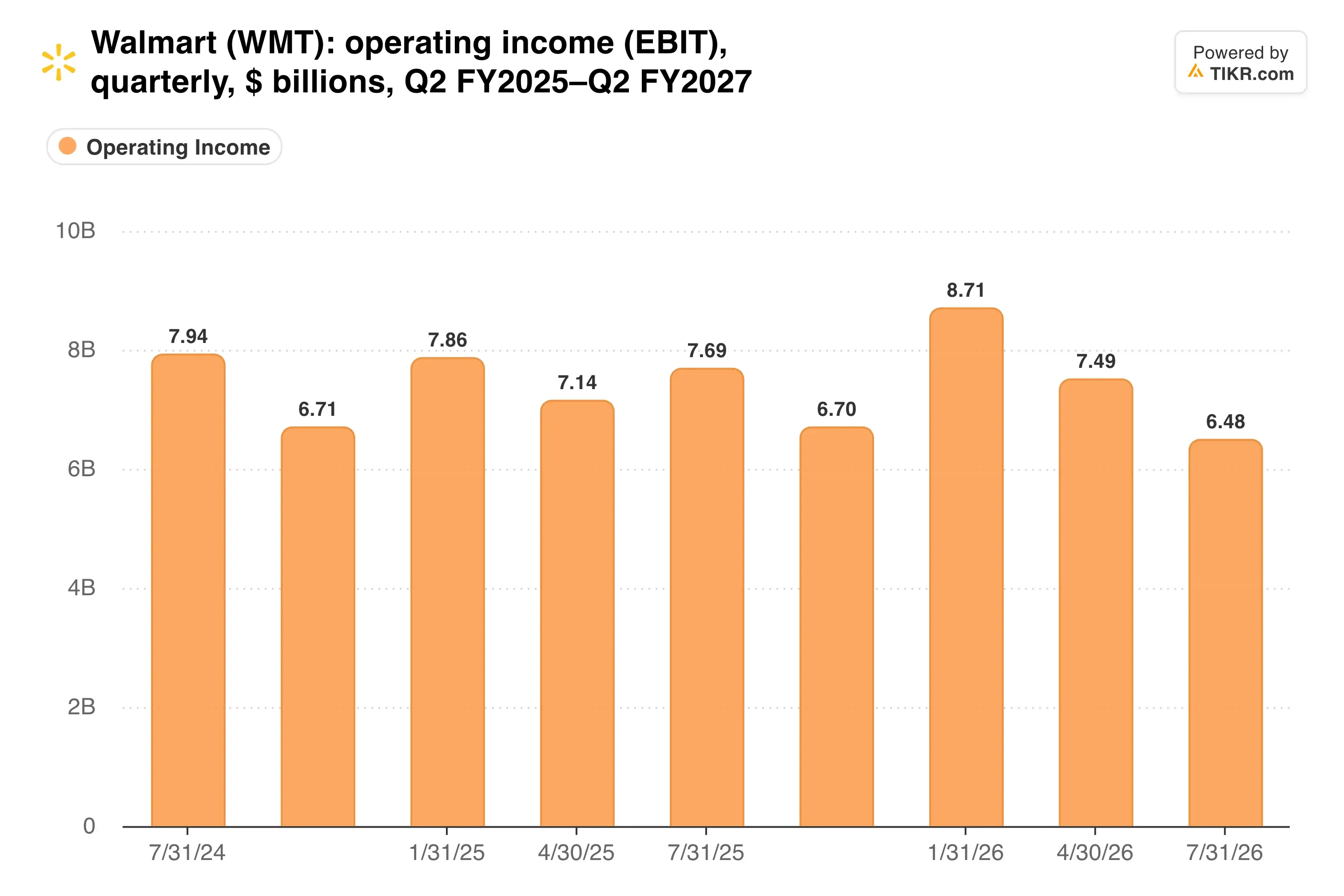
The third quarter loses that boost. Walmart guided adjusted EPS to $0.62 to $0.64, roughly flat with the $0.62 it earned a year earlier.
Spending the windfall on share
CEO John Furner framed the rollbacks as a long game. On the August earnings call, he said Walmart is “investing heavily in price because customers need us to.”
The traffic numbers show why. Walmart U.S. comparable sales grew 2.6%, the slowest pace in six years, as transactions rose 1.5%. Pharmacy pricing rules alone cut 125 basis points from that figure.
Target, meanwhile, posted comparable sales growth of 3.8% on 3.6% higher traffic. Its gross margin rate reached 33.7%, and the refunds supplied 3.7 points of that.
So whose margins actually held up better?
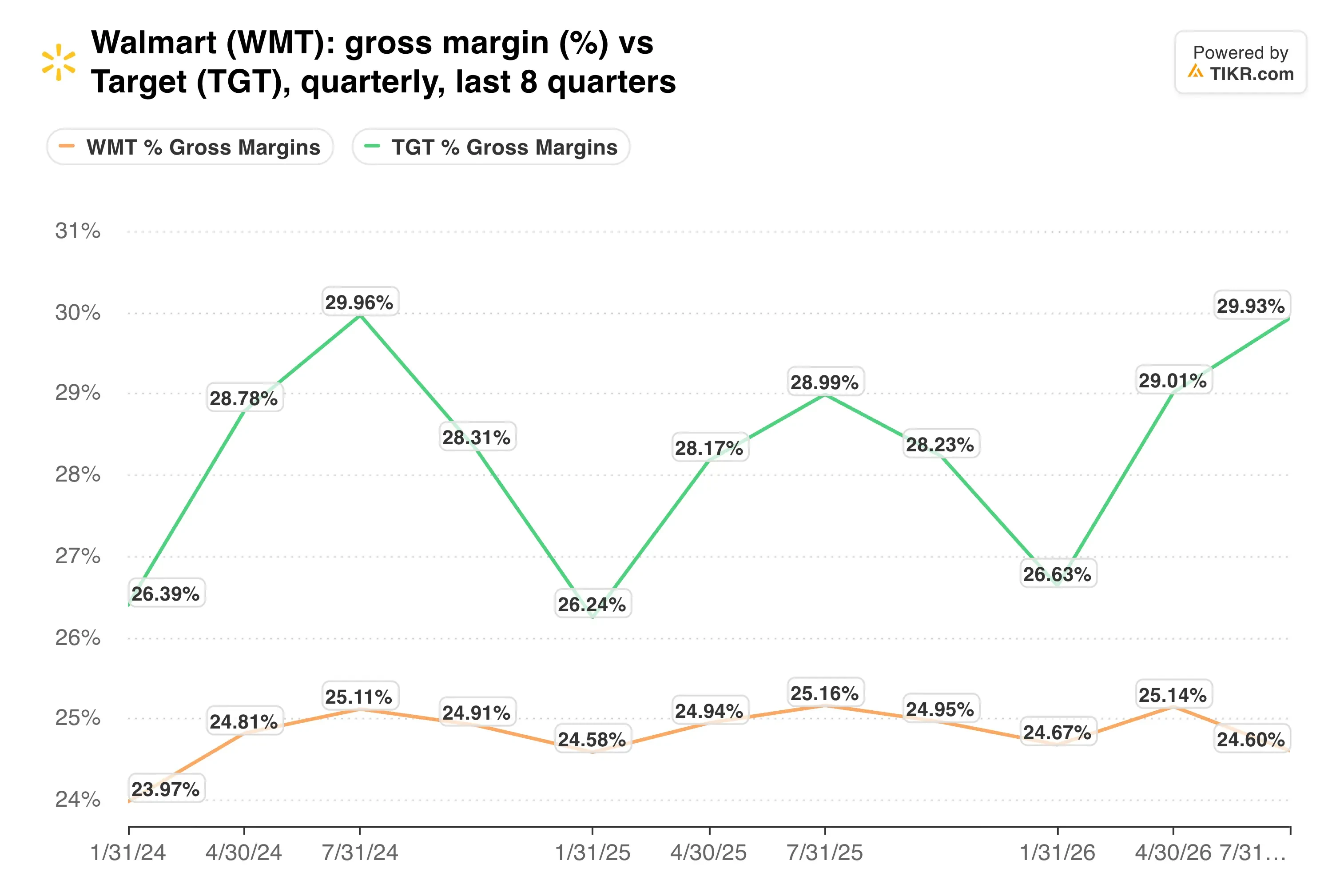
Walmart has a cushion Target lacks at this scale. Global advertising grew 38%, and membership fee revenue rose 17%, so higher margin income keeps building while shelf prices fall.
TIKR tracks 44 analysts on Walmart. How many say “Buy”?
See the full breakdown of Buy, Hold, and Sell ratings on Walmart, along with Wall Street’s revenue and earnings estimates, all in one place. More than 500,000 investors use TIKR to research stocks like this one. See Walmart’s Analyst Ratings
A premium that needs acceleration
That mix is why investors pay up for Walmart. The stock trades at roughly twice the broader market’s earnings multiple, a level that assumes profit keeps outrunning sales.
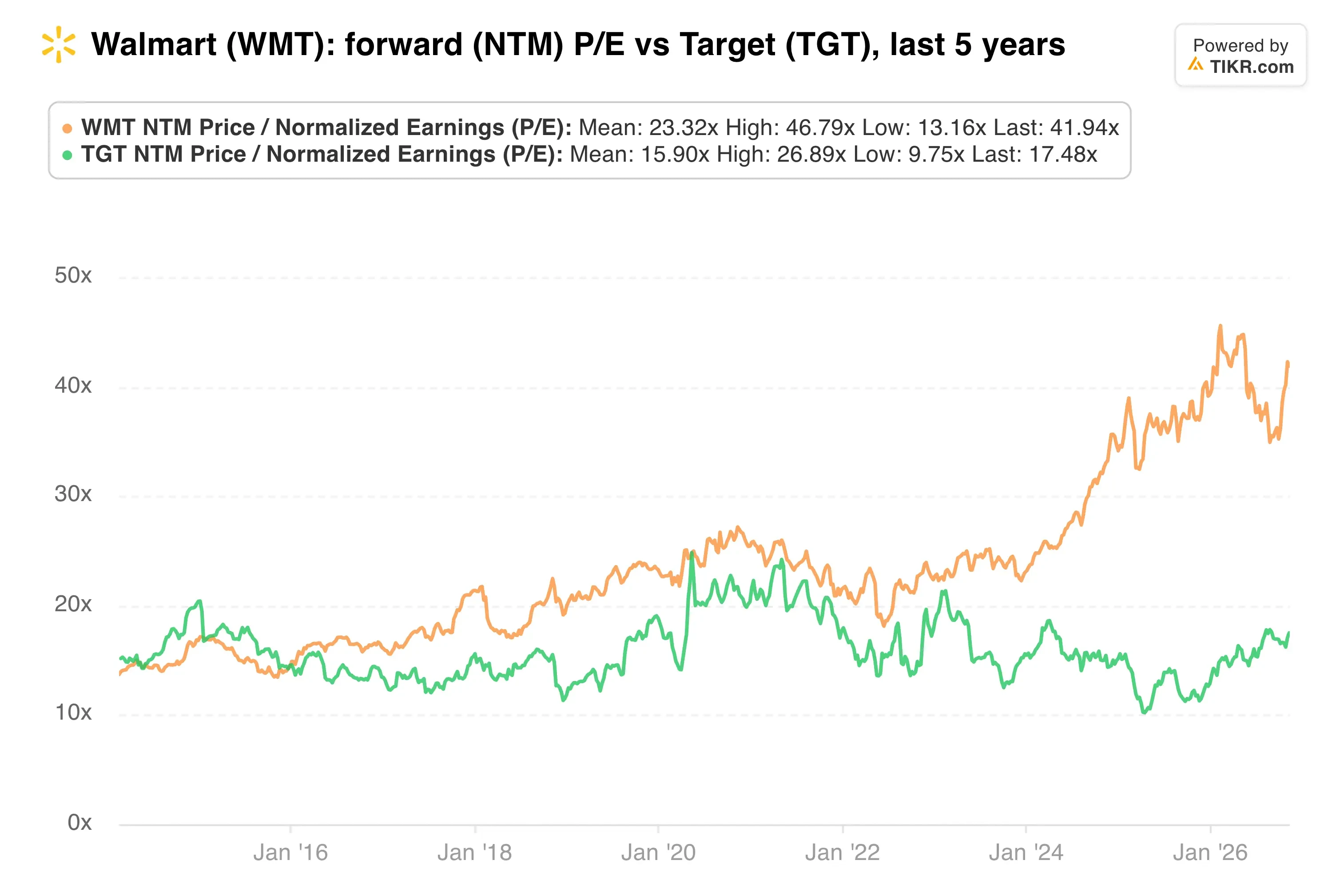
Yet the near-term guide is modest. Third-quarter sales should grow just 3% to 3.75% in constant currency, because the timing of Flipkart’s Big Billion Days event shaves more than 100 basis points. Fuel adds pressure too, since management expects more than $2 billion of extra fuel costs this fiscal year.
Full-year guidance still calls for sales growth of 4% to 5% and adjusted EPS of $2.80 to $2.87. Hitting that range while cutting prices would show the model works.
My take: Spending the refund on price is the right long-term call, because market share outlasts a one-time windfall. However, the stock already prices in much of that payoff. I’d want proof that traffic is improving before adding at this level.
The November 19 report is where that proof shows up. Watch Walmart U.S. comparable sales first, since management expects lower prices to lift them. Then check operating income growth against the 2% to 4% guide.
So what is Walmart stock actually worth?
TIKR lets you forecast the future price of any stock in less than a minute. Just enter a few assumptions into TIKR’s valuation model and see what Walmart could be worth. Start from Wall Street consensus estimates, or adjust the inputs to reflect your own view of the business. It’s free to use.
Disclaimer:
Please note that the articles on TIKR are not intended to serve as investment or financial advice from TIKR or our content team, nor are they recommendations to buy or sell any stocks. We create our content based on TIKR Terminal’s investment data and analysts’ estimates. Our analysis might not include recent company news or important updates. TIKR has no position in any stocks mentioned. Thank you for reading, and happy investing!