Key Takeaways
- Walmart (WMT) is preparing to launch AI agent profiles that let customers authorize purchases and set spending limits, while United Airlines (UAL) is restricting unauthorized third-party AI agents from booking flights.
- Amazon (AMZN) has restricted outside AI shopping agents, while Shopify (SHOP) expanded checkout access for browser-based agents in September, showing how differently companies are approaching AI-powered commerce.
- Walmart generated $706.4 billion in fiscal 2026 net sales, and customers using its Sparky AI assistant had average order values approximately 35% higher than non-users.
- Walmart traded at approximately 42x forward earnings as of November 11, compared with its five-year average of roughly 30x, leaving little room for disappointing earnings growth.
What Happened?
Walmart (WMT) is welcoming AI shopping agents at a time when other major companies are trying to keep them out.
On November 11, United Airlines (UAL) announced restrictions on unauthorized third-party AI agents booking flights, citing concerns about customer privacy, account security, and regulatory compliance.
Meanwhile, Amazon (AMZN) has moved to restrict outside shopping agents, while Shopify (SHOP) expanded its checkout capabilities in September to let authorized browser-based AI agents complete purchases on merchants’ websites.
Walmart is making a different bet: If customers increasingly use AI assistants to compare prices and buy products, the retailer wants those agents shopping at Walmart.
During the November 12 episode of Rapid Response, Walmart CEO John Furner explained the company’s plans:
“One of the things that we’re doing over the next few weeks is launching agent profiles.”
The initiative builds on Walmart’s October 21 announcement of Agent Profiles, which will let customers authorize individual AI agents, track their purchases separately, and set spending limits.
Customers can require approval for every purchase or allow agents to shop within preset limits. They can also revoke access, while agents cannot obtain customers’ payment-card information.
Walmart already works with shopping platforms including ChatGPT, Gemini, and Muse, giving it multiple ways to reach customers beyond its own website.
The strategy fits Walmart’s everyday-low-price business. An AI assistant comparing prices for groceries, household essentials, or other products could direct more purchases toward retailers offering competitive prices and convenient delivery.
That’s potentially an advantage over Amazon’s more restrictive approach. Shopify, meanwhile, is helping merchants capture similar demand by making their checkout systems accessible to AI agents.
But there’s an important question investors still cannot answer: How much additional revenue will these agents actually generate?
Walmart has not disclosed how many purchases outside AI agents currently make or which integrations will support Agent Profiles immediately at launch.
The strategy makes sense, but the financial payoff remains uncertain.
Is Walmart Stock Undervalued or Overvalued?
Walmart’s decision to welcome AI shopping agents could strengthen its e-commerce business, particularly if customers increasingly rely on automated assistants to compare prices and complete purchases.
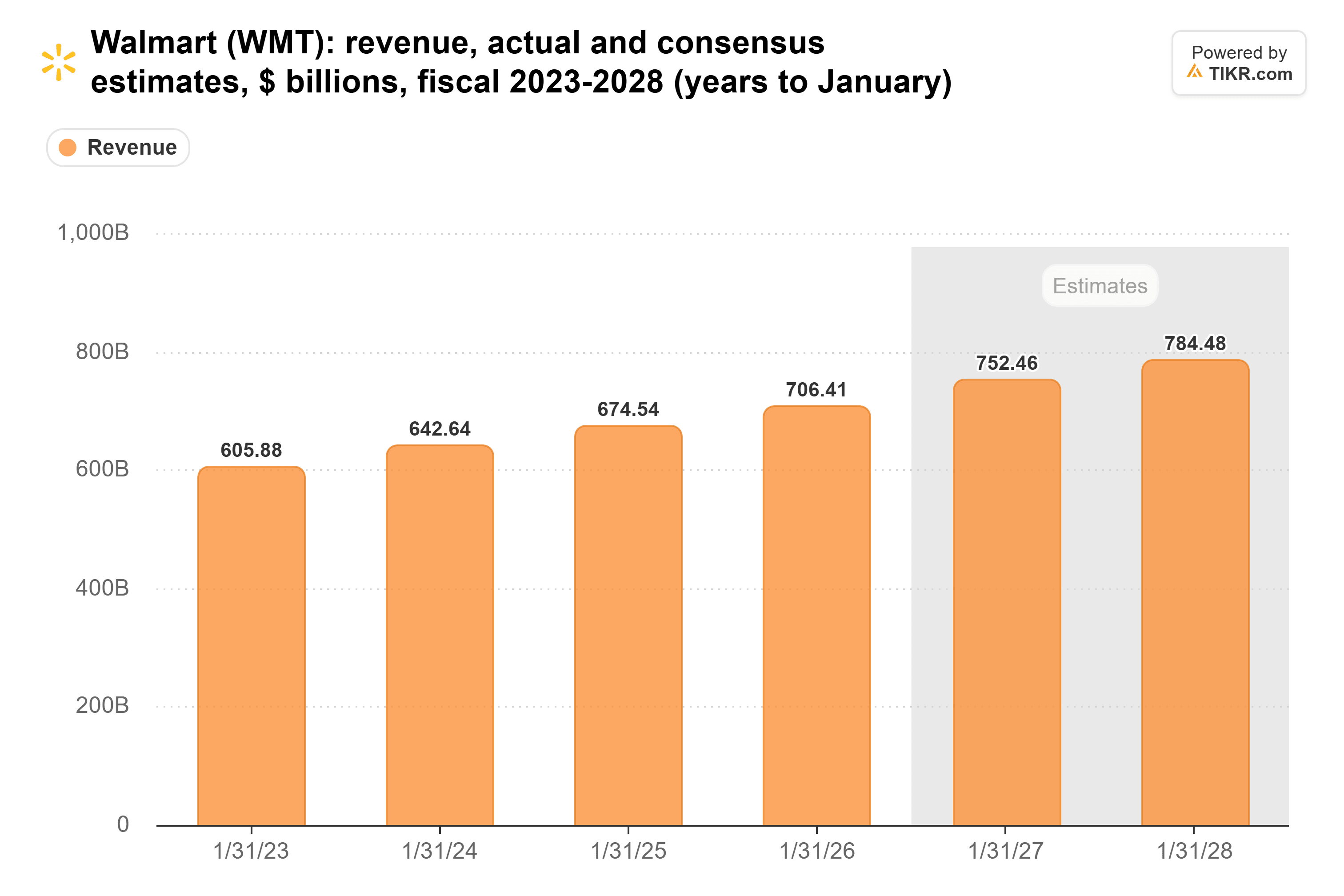
The retailer generated $706.4 billion in fiscal 2026 net sales, up 4.7% year over year, giving it a massive existing business through which even modest changes in shopping behavior could matter.
According to TIKR estimates accompanying the article, analysts expect sales to reach approximately $752.5 billion in fiscal 2027 and $784.5 billion in fiscal 2028, supported by e-commerce expansion and continued customer demand.
There’s already some evidence that AI-assisted shopping is associated with larger purchases.
During its fiscal 2026 fourth-quarter earnings call, management reported that customers using Walmart’s Sparky AI assistant had average order values approximately 35% higher than customers who didn’t use it.
That’s encouraging, but it doesn’t prove Sparky caused those customers to spend more. It also doesn’t establish how much revenue third-party AI agents could bring to Walmart.
The bigger opportunity may be keeping those purchases inside Walmart’s ecosystem, where advertising and membership income help support profitability.
There’s a risk on the other side, too. AI agents that focus on finding the lowest price could bypass sponsored product listings, potentially weakening an important source of higher-margin income.
Walmart’s operating margin was 4.2% of net sales in fiscal 2026, down from 4.4% the previous year. That makes it important for the company to turn e-commerce growth into stronger profits, not just higher sales.
Investors are already paying a substantial premium for that possibility.
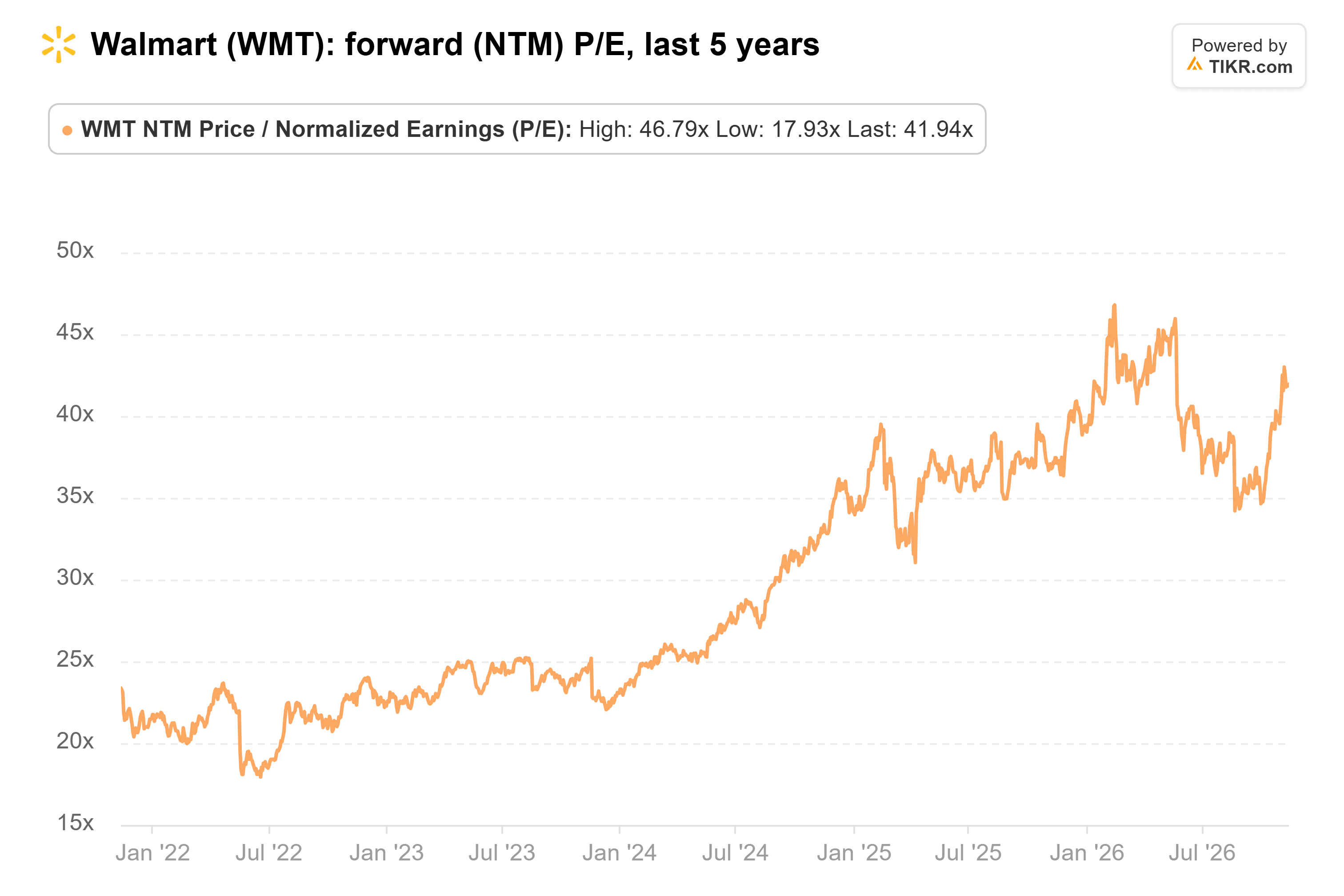
At approximately 42x forward earnings, based on November 11 TIKR data, Walmart trades well above its five-year average of roughly 30x and relatively close to its February peak of approximately 47x.
That makes Walmart stock look relatively expensive compared with its historical valuation, even though its growing e-commerce, advertising, and membership businesses could support higher earnings over time.
Over the next 12 months, the biggest drivers will be comparable sales, e-commerce growth, advertising and membership income, and whether operating margins improve.
The next test comes on November 19, when Walmart is scheduled to report fiscal third-quarter results.
Management previously guided for adjusted earnings of $0.62 to $0.64 per share and adjusted operating income growth of 2% to 4% in constant currency.
Those figures matter more to Walmart’s near-term valuation than the announcement of Agent Profiles alone.
The bottom line: Walmart’s decision to welcome AI shopping agents looks like a sensible long-term strategy, especially as Amazon restricts outside agents and Shopify expands access to AI-driven transactions. But at 42x forward earnings, much of Walmart’s potential growth already appears reflected in its valuation. Until the company demonstrates stronger earnings growth or measurable benefits from AI shopping, the stock looks more like a promising business at a premium price than an obvious bargain.
So what is Walmart stock actually worth?
TIKR lets you forecast the future price of any stock in less than a minute. Just enter a few assumptions into TIKR’s valuation model and see what Walmart could be worth. Start from Wall Street consensus estimates, or adjust the inputs to reflect your own view of the business. It’s free to use.
Disclaimer:
Please note that the articles on TIKR are not intended to serve as investment or financial advice from TIKR or our content team, nor are they recommendations to buy or sell any stocks. We create our content based on TIKR Terminal’s investment data and analysts’ estimates. Our analysis might not include recent company news or important updates. TIKR has no position in any of the stocks mentioned. Thank you for reading, and happy investing!