Key Stats for Vertex Pharmaceuticals Stock
- Today’s Performance: 7%
- 52-Week Range: $363 to $546
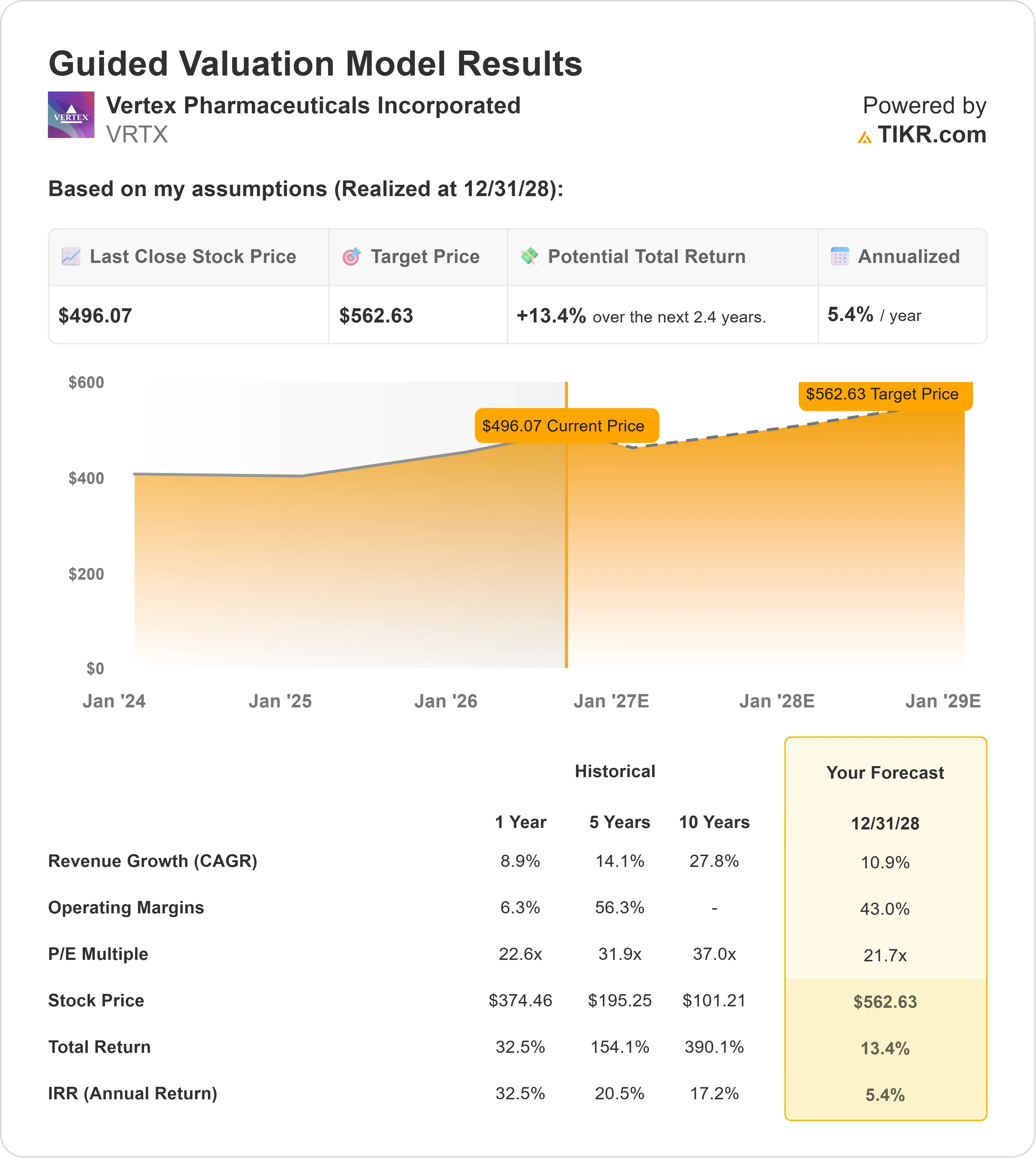
- Valuation Model Target Price: Around $563
- Implied Upside: About 6%
Analyze your favorite stocks like Vertex Pharmaceuticals with TIKR (It’s free) >>>
What Happened?
Vertex Pharmaceuticals stock has been caught in a debate over how long its highly profitable cystic fibrosis franchise can remain dominant while the company builds new businesses in pain, gene therapy, kidney disease, and rare endocrine disorders. Sionna Therapeutics had become one of the most closely watched threats because it was developing CF treatments intended to improve on Vertex’s existing medicines. That concern faded sharply today, sending Vertex shares up about 7% to $532 and as high as roughly $544 during the session.
Vertex stock rose today because Sionna Therapeutics reported disappointing Phase 2a results for SION-719, reducing a potentially important competitive threat to Vertex’s cystic fibrosis franchise. When added to Vertex’s Trikafta, SION-719 produced only a 1 mmol/L placebo-adjusted reduction in sweat chloride, a key measure of CFTR protein function, and Sionna subsequently stopped developing the program in that setting. Sionna shares plunged about 92%, while Vertex rallied as the result reinforced how difficult it may be for competitors to surpass Trikafta and Vertex’s newer ALYFTREK therapy.
The move also follows Vertex’s Q2 update, when revenue reached $3.33 billion, up 12% year over year, while non-GAAP EPS increased 5% to $4.73, and management raised 2026 revenue guidance to $13.1 billion to $13.2 billion. ALYFTREK, its newer once-daily CF medicine, surpassed $1 billion in first-half revenue, while CASGEVY, its gene-editing therapy for sickle cell disease and beta-thalassemia, generated $76 million, and JOURNAVX, its non-opioid acute-pain medicine, contributed $50 million. CEO Reshma Kewalramani said “the bar for any medicine to beat ALYFTREK is very, very high,” while Vertex also has a November 30 FDA decision date for kidney-disease candidate povetacicept and expects the Crinetics acquisition to close in Q3.
Competition outside CF matters as Vertex tries to diversify. Otsuka Pharmaceutical’s VOYXACT, already approved for IgA nephropathy, delivered a 51% placebo-adjusted reduction in proteinuria at nine months, giving investors a concrete benchmark for Vertex’s povetacicept ahead of its FDA decision. Vertex management said povetacicept produced a 52% reduction from baseline in proteinuria in its Phase 3 interim analysis, although those figures are not directly comparable because one is placebo-adjusted and the other is measured from baseline. The larger point is that Sionna’s setback helps protect the CF cash engine just as Vertex is spending to establish kidney disease, pain, gene editing, and rare endocrine disorders as additional growth pillars.
Value Vertex Pharmaceuticals instantly (Free with TIKR) >>>
Is Vertex Pharmaceuticals Fairly Valued?
Under valuation assumptions, the stock is modeled using:
- Revenue Growth (CAGR): Around 11%
- Operating Margins: Around 43%
- Exit P/E Multiple: Around 22x
Revenue growth around 11% looks defensible if ALYFTREK continues protecting Vertex’s CF franchise while CASGEVY and JOURNAVX scale. Management expects the two newer non-CF products to generate at least $500 million combined in 2026, giving the growth assumption specific commercial drivers rather than relying on a broad biotech recovery.
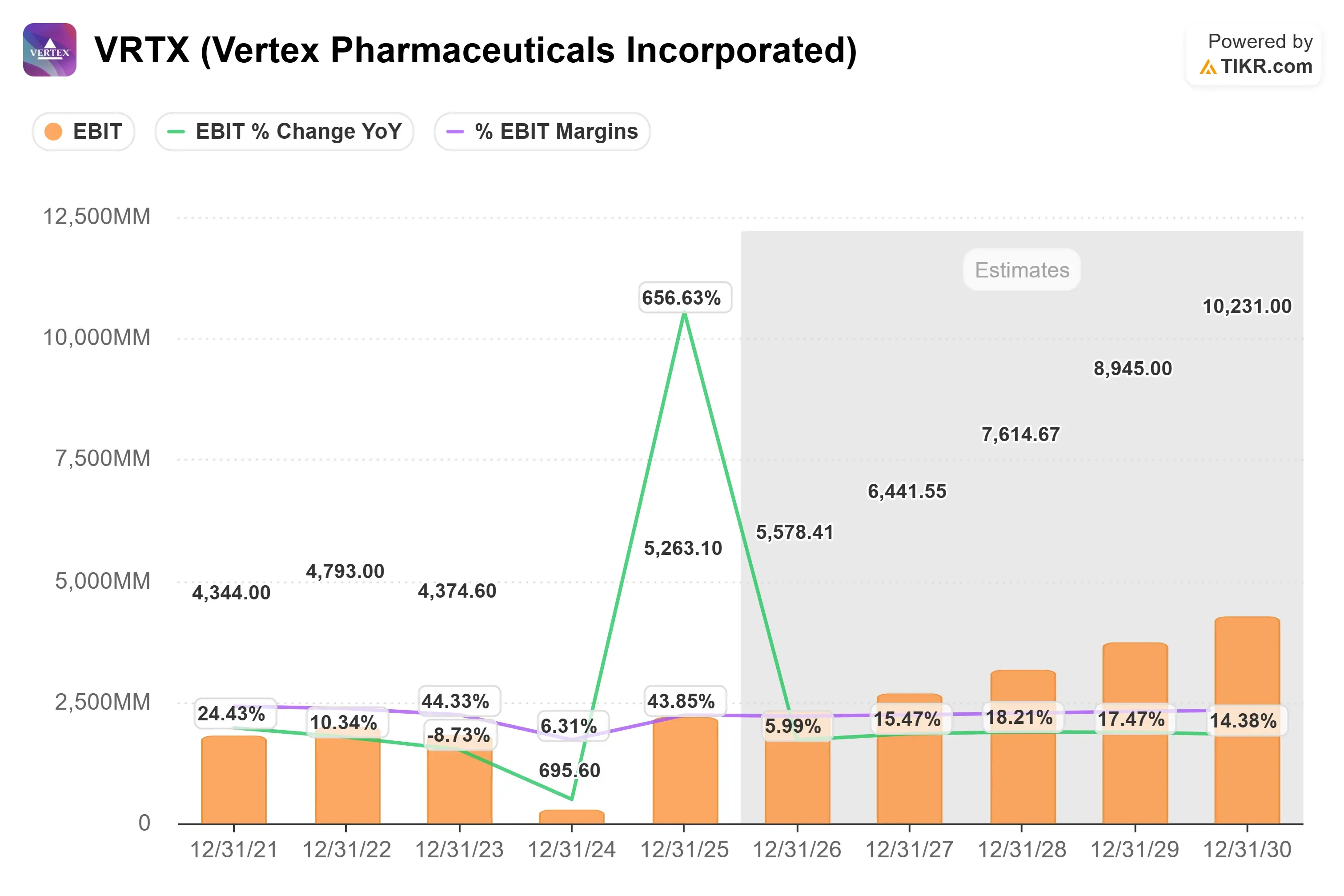
Margins around 43% depend heavily on protecting the economics of CF while Vertex spends to establish those newer businesses. The EBIT chart supports that thesis, with consensus estimates showing EBIT rising from roughly $5.6 billion in 2026 to around $10.2 billion by 2030 while margins remain around the low-40% range. Management also expects full-year gross margin just below 86%, even though CASGEVY carries higher manufacturing costs than Vertex’s small-molecule CF medicines.
See analysts’ growth forecasts and price targets for Vertex Pharmaceuticals (It’s free) >>>
The next 12 months bring several concrete tests of that diversification strategy. JOURNAVX prescriptions reached about 535,000 in Q2, CASGEVY treatment activity continues to build, povetacicept could open a major kidney-disease market if approved, and Crinetics would add rare endocrine diseases as a fifth commercial pillar. Vertex estimates Crinetics’ two lead assets represent around $5 billion in combined peak-sales potential. The Crinetics transaction is valued at approximately $10 billion, or about $8.8 billion net of estimated cash acquired.
The model uses an exit P/E of around 22x, so the valuation does not depend on aggressive multiple expansion. Its target price of around $563 implies only about 6% upside from Vertex’s current price near $532 after today’s rally, making the setup much less compelling than it was before the stock jumped.
At current levels, Vertex Pharmaceuticals appears fairly valued rather than clearly undervalued, with stronger performance through the rest of 2026 increasingly dependent on sustained CF leadership and evidence that ALYFTREK, JOURNAVX, CASGEVY, povetacicept, and the Crinetics portfolio can create meaningful earnings growth beyond cystic fibrosis.
How Much Upside Does VRTX Stock Have From Here?
Investors can estimate Vertex Pharmaceuticals’ potential share price, or what any stock could be worth, in under a minute using TIKR’s New Valuation Model tool.
All it takes is three simple inputs:
- Revenue Growth
- Operating Margins
- Exit P/E Multiple
From there, TIKR calculates the potential share price and total returns under Bull, Base, and Bear scenarios so you can quickly see whether a stock looks undervalued or overvalued.
If you’re not sure what to enter, TIKR automatically fills in each input using analysts’ consensus estimates, giving you a quick, reliable starting point.
Value Vertex Pharmaceuticals in under 60 seconds with TIKR (It’s free) >>>