Key Takeaways
- Uber stock is down 31% over the past year, and UBS has cut its price target to $106 from $110 while keeping its Buy rating.
- The business keeps growing: second-quarter gross bookings rose 22% in constant currency and non-GAAP EPS rose 35%.
- Robotaxi competition and the $14.8 billion Delivery Hero deal hang over the stock, which trades at a lower forward multiple than at any quarter’s end since early 2023.
- UBS’s target needs a higher multiple than Uber has averaged over the past three years, so I expect the rebound to take longer than a year.
Uber Technologies (UBER) stock has lost 31% over the past year, even as the business kept growing. UBS has cut its price target to $106 from $110 ahead of Wednesday’s report, and kept its Buy rating. That target sits 59% above Monday’s $66.71 close.
Investors found three reasons to worry
Early this year, Uber started deducting stock pay from its non-GAAP earnings, then missed on fourth-quarter earnings in February. Analysts’ consensus for 2026 earnings fell from $4.17 a share to $3.31, though most of that drop was the accounting change: Uber expects $1.95 billion to $2.10 billion of stock pay this year, close to $1 a share before tax.
Robotaxis came next. Waymo pulled its cars from Uber’s app in Phoenix, which both companies confirmed in June, and the Financial Times reported in July that Waymo had discussed ending the partnership altogether. Semafor reported in October that Waymo plans 20,000 cars by the end of 2027. CEO Dara Khosrowshahi said on the second-quarter call that Uber wants to be “the world’s leading commercialization platform for autonomous vehicles,” but autonomous rides are still under 0.5% of its trips.
Then, in July, Uber offered €41.50 (about $47.60) a share in cash for Delivery Hero, an equity value of $14.8 billion. Its debt had already climbed to $12.7 billion at the end of June, from $10.5 billion in December, and buybacks fell to $518 million in the second quarter.
UBS trimmed its numbers and kept its Buy
UBS’s Stephen Ju trimmed his 2026 and 2027 estimates for Uber’s bookings and EBITDA modestly, and his $106 target is still 5% above the $101 consensus.
The business gives him plenty to work with: in the second quarter, gross bookings grew 22% in constant currency and non-GAAP EPS grew 35%.
TIKR Tracks 50 Analysts on Uber. How Many Say “Buy”?
See the full breakdown of Buy, Hold, and Sell ratings on Uber, along with Wall Street’s revenue and earnings estimates, all in one place. More than 500,000 investors use TIKR to research stocks like this one. See Uber’s Analyst Ratings
Can Uber get to $106?
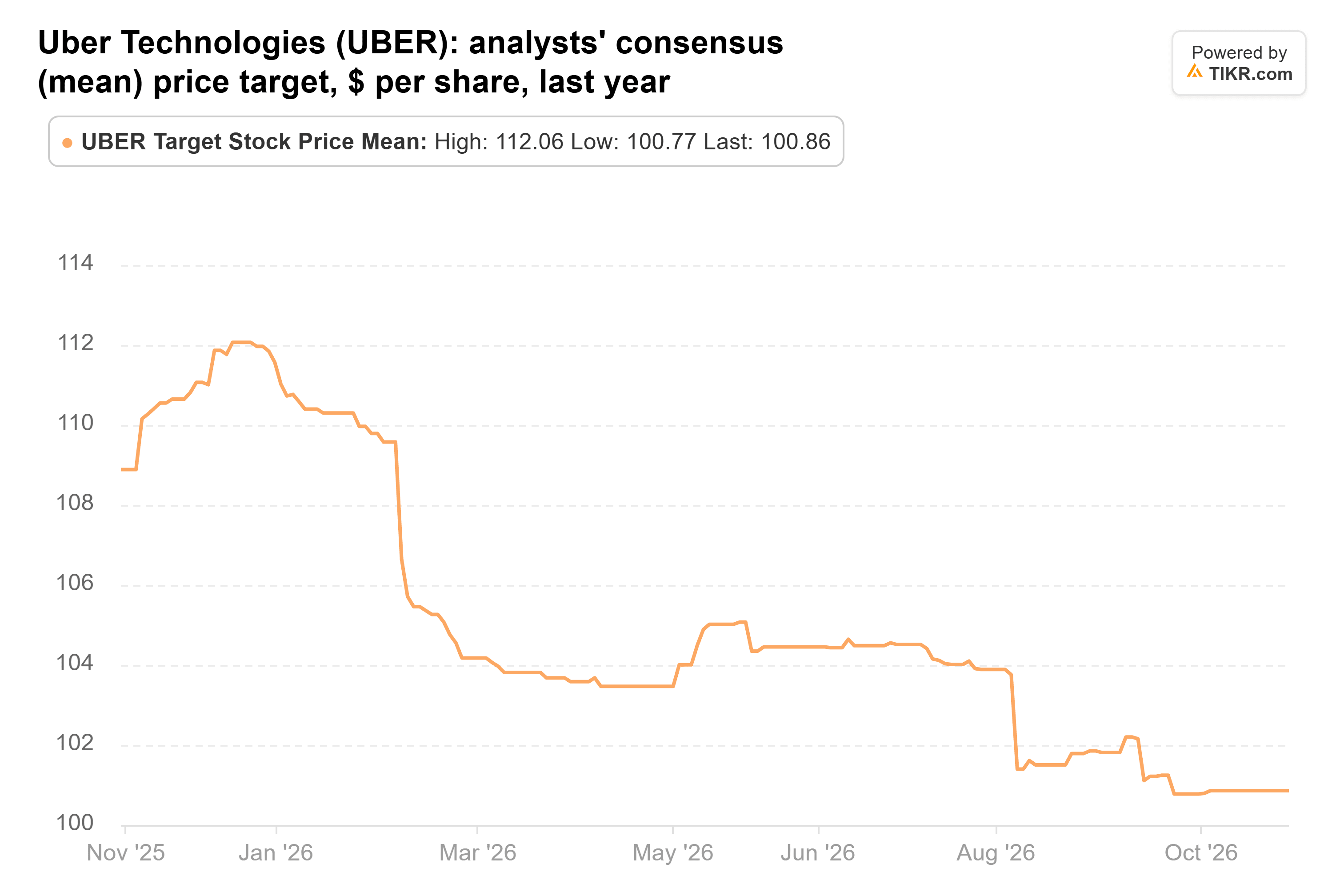
The 50 analysts who cover Uber have cut their targets far less than the stock has fallen. Their average target was $109 a year ago and is $101 now:
They expect normalized EPS to more than double, from $2.45 in 2025 to $5.51 in 2028:
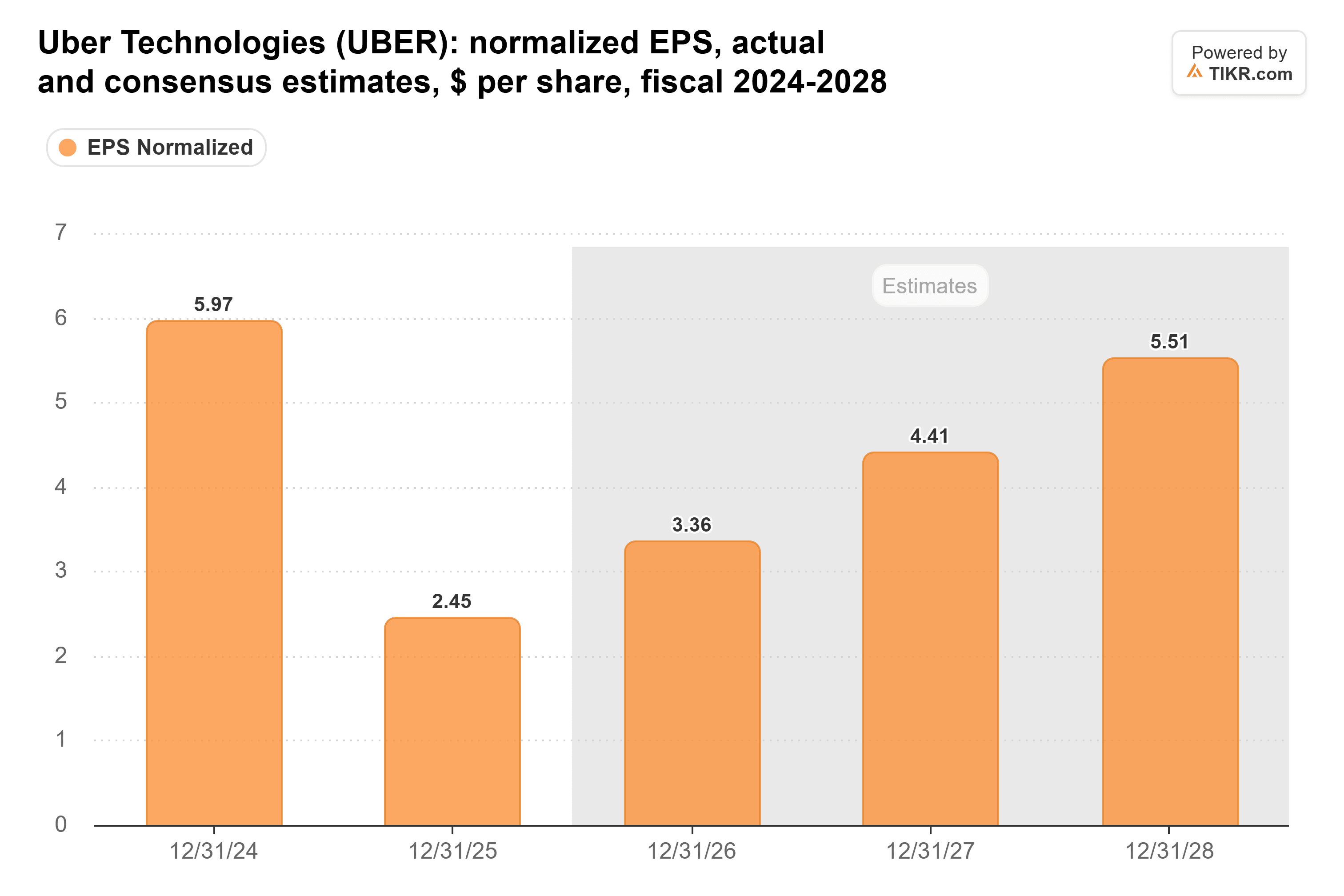
Over the past 90 days, analysts have raised their 2026 estimate and held 2027’s about steady.
The multiple is the problem. As of Oct. 30, Uber traded at 17x forward earnings. That’s below its five-year average of 19x and lower than at any quarter’s end since early 2023:
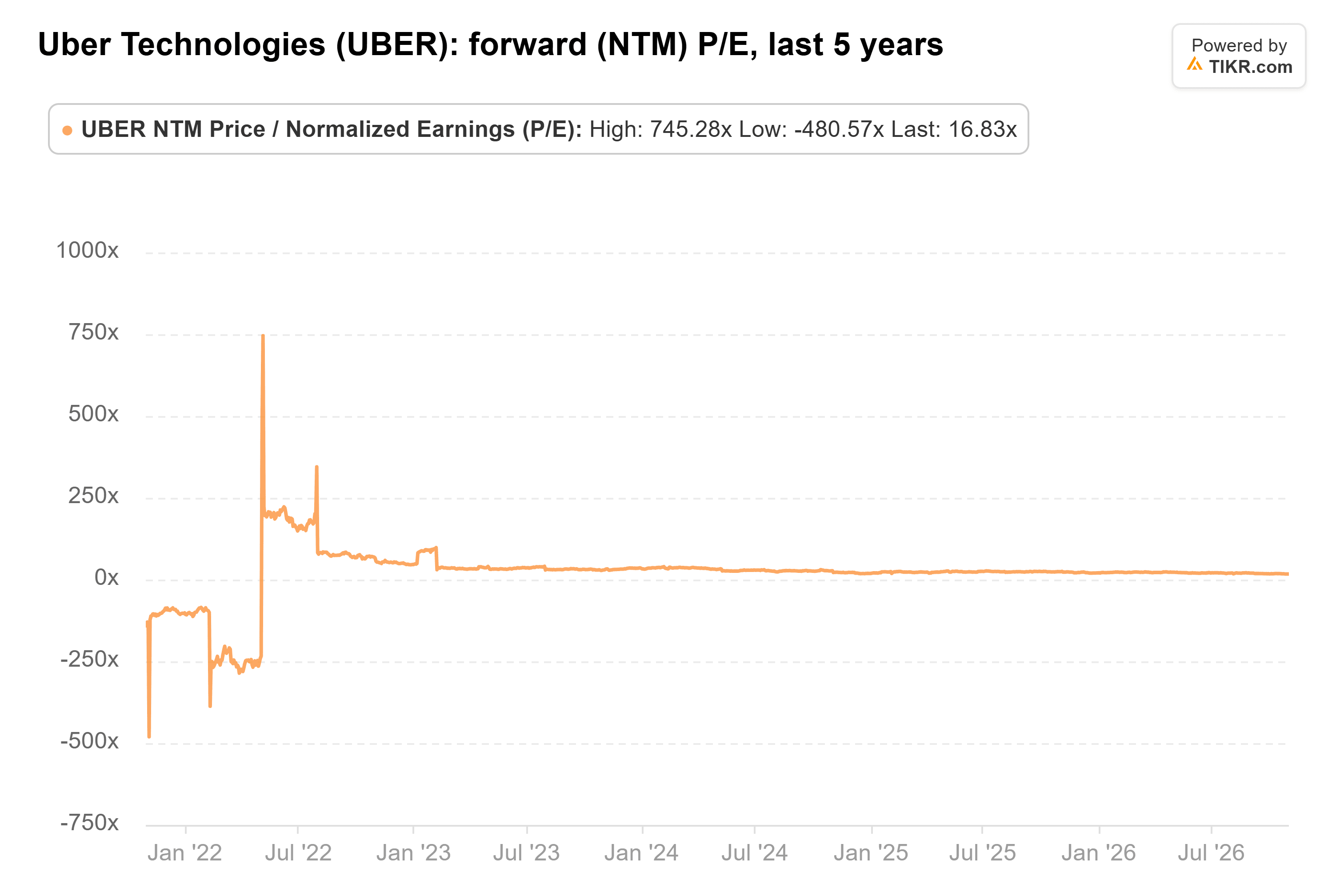
UBS’s $106 target works out to 27x the $3.88 a share analysts expect Uber to earn over the next twelve months. Uber has averaged 25x over the past three years, and 21x over the past one.
I’d give Uber more time than UBS does
Uber plans to spend $10 billion on autonomous vehicles over several years, and management hasn’t yet said what that will cost in profit.
UBS has the direction right, and the stock already trades below its own averages. But $106 asks investors to pay more for those earnings than they have on average in three years, with robotaxis and Delivery Hero still hanging over the stock. I think Uber gets there, but it’ll take longer than a year.
Uber reports its third quarter on Wednesday, Nov. 4, against guidance for non-GAAP EPS of $0.84 to $0.88. The bigger test is whether it reaches its goal of 15 autonomous cities by year-end.
So what is Uber stock actually worth?
TIKR lets you forecast the future price of any stock in less than a minute. Just enter a few assumptions into TIKR’s valuation model and see what Uber could be worth. Start from Wall Street consensus estimates, or adjust the inputs to reflect your own view of the business. It’s free to use.
Disclaimer:
Please note that the articles on TIKR are not intended to serve as investment or financial advice from TIKR or our content team, nor are they recommendations to buy or sell any stocks. We create our content based on TIKR Terminal’s investment data and analysts’ estimates. Our analysis might not include recent company news or important updates. TIKR has no position in any of the stocks mentioned. Thank you for reading, and happy investing!