
Key Stats for UBER Stock
- Past week performance: -1.7%
- 52-week range: $65 to $101
- Valuation model target price: $76
- Implied upside: 9.8% over 2.3 years
Weigh Uber’s growth against 5 years of analyst forecasts using TIKR’s new Valuation Model (It’s free) >>>
Uber Bets Big on Delivery While the Stock Waits
Uber Technologies (UBER) shares slipped about 1.7% over the past week, closing Friday near $70. The dip extended a long slide that leaves the stock about 31% below its 52-week high of $101. Investors remain focused on Uber’s $14.8 billion takeover of Delivery Hero, the German food delivery group. Uber launched its tender offer for all Delivery Hero shares on September 18.
Delivery Hero CEO Niklas Östberg agreed to stay beyond March 2027 to guide the transition. That adds continuity, but the deal still needs shareholder acceptance and regulatory approval. Separately, Uber expanded Costco delivery on Uber Eats to 47 U.S. states, covering nearly 600 stores.
Management’s confidence is visible. CEO Dara Khosrowshahi bought 141,000 shares at about $71 on September 10, a purchase worth roughly $10 million. “Uber’s platform advantage continues to compound: record consumers and engagement, and profitable growth across our business,” he said with Q2 results.
Still, the market remains cautious. Gross bookings, the total value of rides and orders, grew 22% in Q2, but the Q3 profit outlook came in slightly below Wall Street’s estimate. If UBER stock is going to regain momentum, Delivery Hero must add profit rather than just size.
See how analysts’ Uber targets compare with the stock’s 31% drawdown (It’s free) >>>
A Cheaper Uber, but the Model Wants Proof
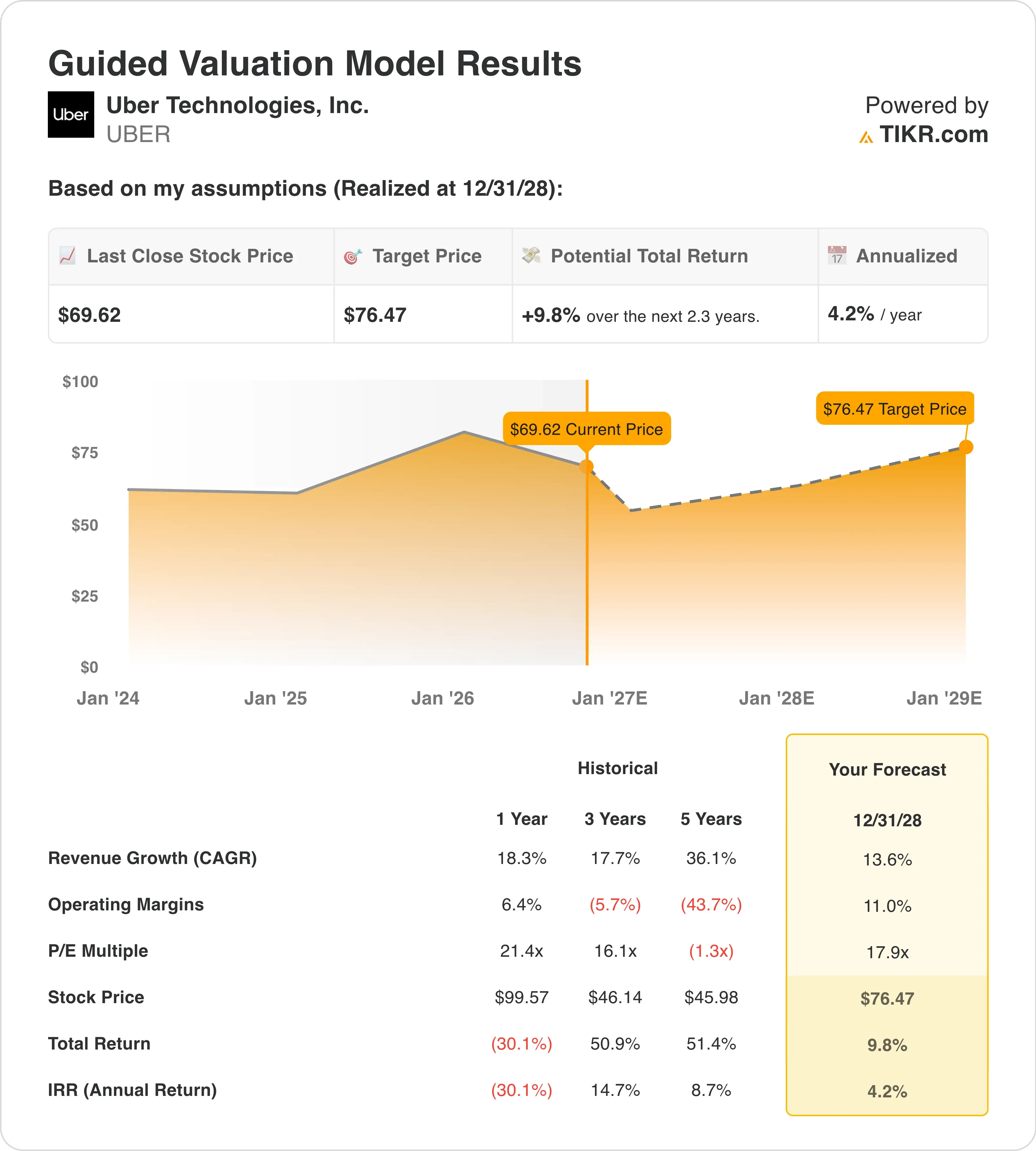
Under valuation model assumptions realized through 12/31/28, the stock is modeled using:
- Revenue Growth (CAGR): 13.6%
- Operating Margins: 11.0%
- Exit P/E Multiple: 17.9x
Based on these inputs, the model estimates a target price of $76, implying a 9.8% total return from the current share price of $70 and an annualized return of 4.2% over the next 2.3 years.
This is a multiple reset story. Uber’s P/E averaged 21.4x over the past year, but the stock now trades near 17.9x forward earnings. The model holds that lower multiple through 2028, so it assumes no rebound in sentiment.
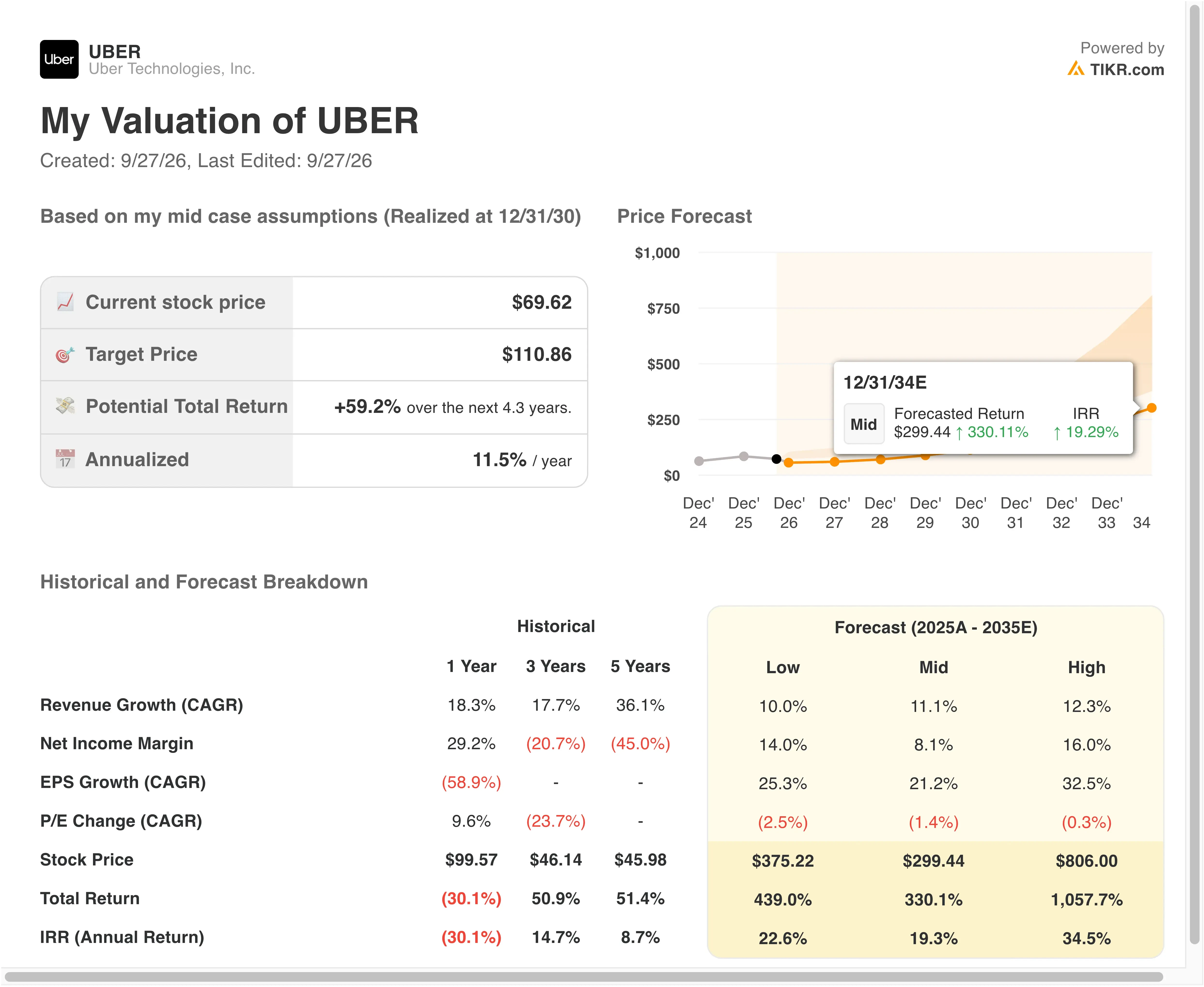
Revenue assumptions are conservative. A 13.6% growth rate sits below last year’s 18.3% and the 3-year pace of 17.7%. Part of that gap reflects business model changes, which cut reported revenue growth by 8 points in Q2 even as bookings rose 22%.
Margins, however, should expand. The 11.0% operating margin sits well above last year’s 6.4%, and non-GAAP operating income rose 40% in Q2. The modest target comes mostly from the multiple, because recent reported earnings include gains on equity stakes that may not repeat.
A 4.2% annual return signals limited upside under these inputs. Yet stretching the forecast to 2030 lifts the target to about $111 and the annual return to 11.5% as autonomous rides scale. Wall Street’s average target of $101 also sits well above the model, while DoorDash (DASH) continues to grow faster in delivery.
Model Uber’s autonomous vehicle upside with your own growth inputs (Free with TIKR) >>>
Uber, DoorDash, and Lyft in a Three-Way Race
DoorDash is Uber’s toughest delivery rival. Its Q2 marketplace gross order value rose 36% to $33.1 billion, or 23% excluding its Deliveroo acquisition. Uber’s delivery bookings grew 25%, with a record 3.8% segment margin. So the two companies are growing at a similar underlying pace.
Both are using acquisitions to go global. DoorDash already bought Deliveroo, while Uber is now buying Delivery Hero. The winner will likely be whichever platform removes overlapping costs fastest after closing.
In rides, Lyft (LYFT) is growing quickly from a smaller base. Its Q2 gross bookings rose 23% to $5.5 billion, slightly faster than Uber’s 20% mobility growth. However, Lyft’s adjusted EBITDA equaled just 3.2% of bookings. Uber’s mobility segment, by contrast, reached a 7.6% operating margin.
Uber’s moat is scale across both businesses. Uber One members drive about half of total gross bookings, which links rides and delivery into one habit. New challengers like Bolt, which plans to deploy 25,000 Lucid robotaxis across Europe, could test that edge in autonomous rides.
Project whether Uber’s robotaxi investments can unlock upside toward $103 >>>
What’s Driving UBER Stock Going Forward?
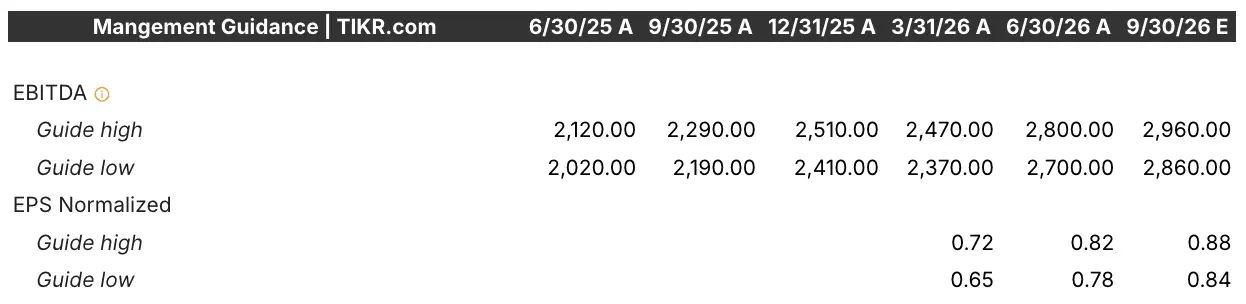
Q3 results, expected around November 3, are the next checkpoint. Management guided adjusted EPS of $0.84 to $0.88, so investors want a clean beat after a soft outlook. Bookings growth above 20% would also extend Uber’s streak to five straight quarters.
Autonomous vehicles are the long-term catalyst. Uber offers AV rides in seven cities and targets 15 by year-end. Spain also granted a permit for AV testing this month. These partnerships let Uber earn fees without owning expensive vehicles.
Cost cuts should support margins. Uber is reducing its workforce by about 10%, or roughly 3,300 jobs, to remove management layers. It also raised €4.5 billion in senior notes, which adds funding flexibility ahead of the Delivery Hero deal.
Regulation is the key risk. The FTC chair said AI developers should be liable for their agents’ actions, and that could raise compliance costs across tech platforms. Going forward, trailing free cash flow above $10 billion gives Uber room to keep buying back stock while it invests.
Compare Uber’s valuation with DoorDash and Lyft (Free with TIKR) >>>
Should You Invest in Uber Technologies?
The only way to really know is to look at the numbers yourself. TIKR gives you free access to the same institutional-quality financial data that professional analysts use to answer exactly that question.
Pull up UBER, and you’ll see years of historical financials, what Wall Street analysts expect for revenue and earnings in the quarters ahead, how valuation multiples have moved over time, and whether price targets are trending up or down.
You can build a free watchlist to track UBER alongside every other stock on your radar. No credit card required. Just the data you need to decide for yourself.
Analyze UBER stock on TIKR Free→
Disclaimer:
Please note that the articles on TIKR are not intended to serve as investment or financial advice from TIKR or our content team, nor are they recommendations to buy or sell any stocks. We create our content based on TIKR Terminal’s investment data and analysts’ estimates. Our analysis might not include recent company news or important updates. TIKR has no position in any stocks mentioned. Thank you for reading, and happy investing!