Key Takeaways
- Uber shares jumped more than 7% after third-quarter gross bookings rose 20% to $59.8 billion and revenue beat estimates.
- Fourth-quarter adjusted EPS guidance of $0.95 to $0.99 fell short of the $1.06 consensus as driver shortages and fuel costs weighed abroad.
- “We have more demand than we have supply,” Khosrowshahi said, and Uber is spending more on drivers while funding robotaxis.
- The fourth-quarter report, expected in early February, will show whether higher driver incentives loosen Mobility supply.
Uber (UBER) shares jumped more than 7% on November 4, and the reason was easy to see. Gross bookings grew 20% for a fifth straight quarter, and revenue of $14.77 billion topped the $14.69 billion analysts expected.
The outlook was messier. Uber guided fourth-quarter adjusted EPS to $0.95 to $0.99, below the $1.06 consensus, because driver shortages and higher fuel costs slowed ride growth abroad.
Lyft (LYFT) reported a day later with bookings up 17% to $5.6 billion. So the whole category is still growing, yet Uber now has to pay more to keep cars on the road.
“We have more demand than we have supply,” CEO Dara Khosrowshahi told CNBC.
Bookings did the real work
A UK business model change cut about $1.1 billion from revenue. That is why headline growth of 10% undersells the quarter, and gross bookings tell the cleaner story.
The key figures:
- Gross bookings rose 20% to $59.8 billion, with Delivery up 23% and Mobility up 17% in constant currency.
- Non-GAAP operating income grew 38% to $2.3 billion, or 3.9% of bookings, against 3.4% a year earlier.
- GAAP EPS fell to $0.25 after a $476 million loss on equity stakes, including Grab and Aurora.
Strip out those investment swings, and the earnings line looks very different…
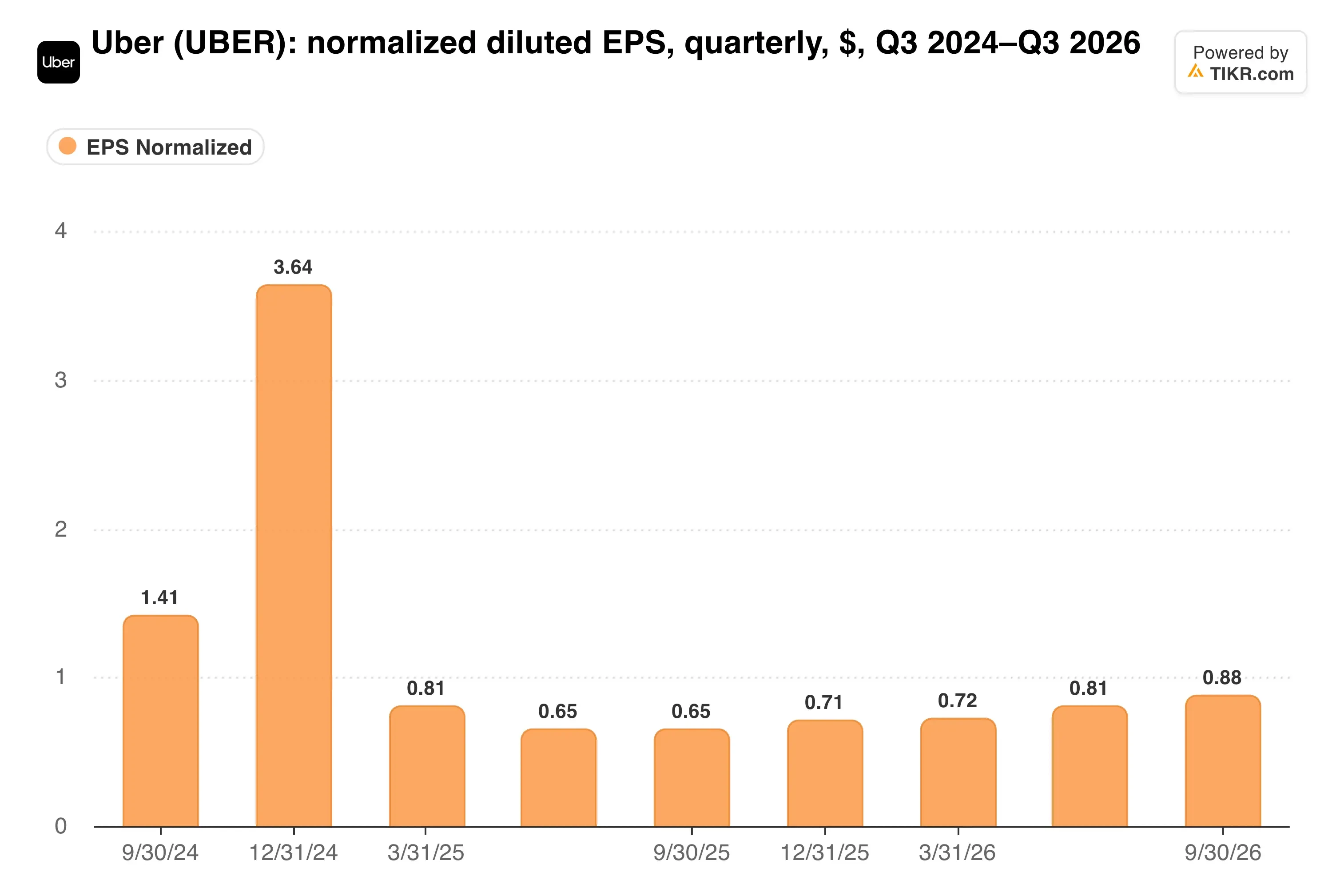
Non-GAAP EPS rose 35% to $0.88. That is the better read on the core business, and it keeps compounding.
Delivery is carrying more weight
Delivery bookings reached $28.5 billion, nearly matching Mobility at $29.5 billion. That balance matters because the ride business is where the supply squeeze sits.
Uber said the Middle East conflict trimmed about 75 basis points from Mobility bookings growth. It assumes a 100 basis point hit in the fourth quarter as well. India, Brazil and Canada also face tight driver supply, although Mobility trends improved in October.
Reported Mobility revenue fell 2% to $7.52 billion, since the UK change hits that segment. So how do the three segments compare once the noise is visible?
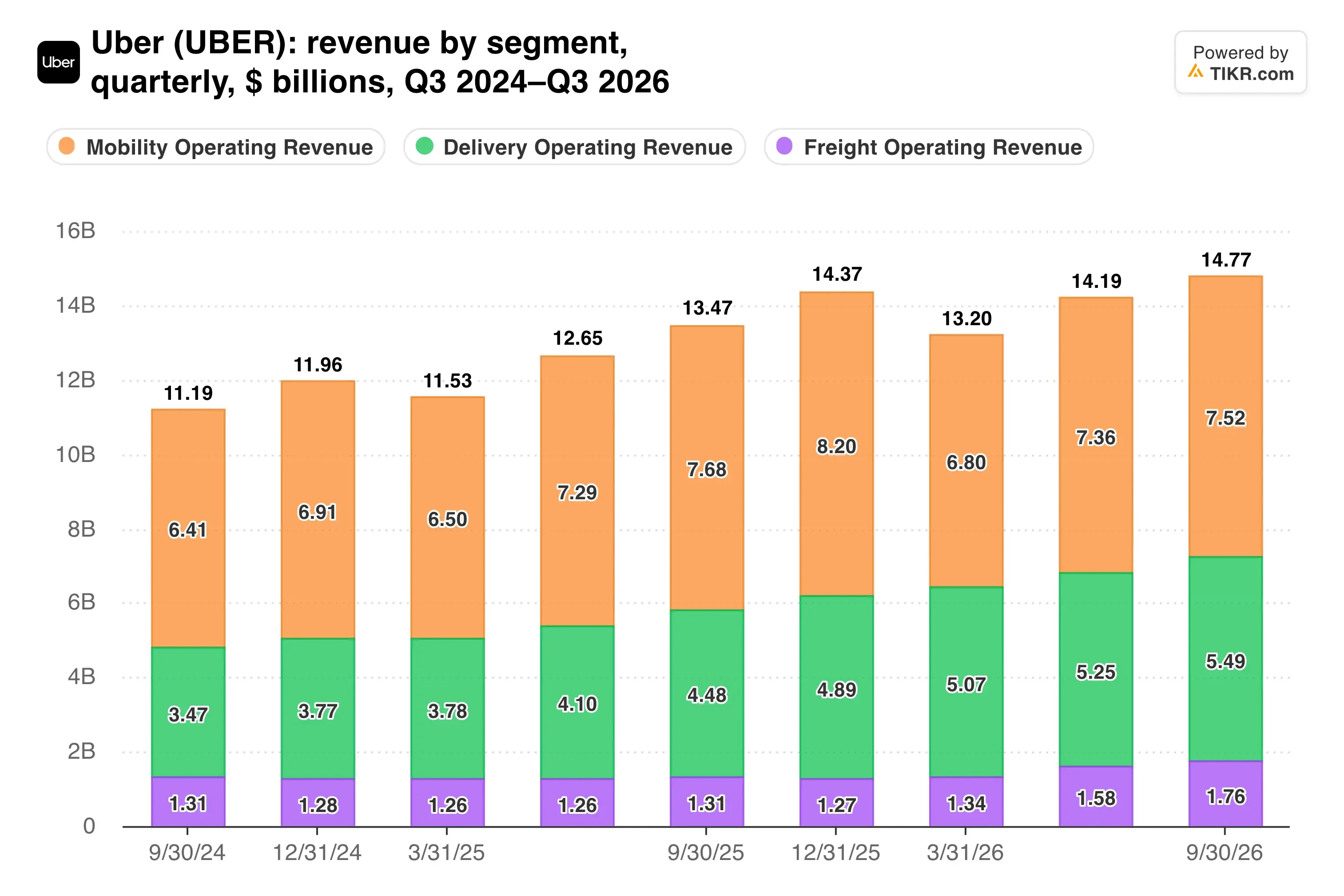
Delivery is the steadier engine right now. The pending Delivery Hero deal, at €41.50 per share and about $14.8 billion, would extend that lead. However, it is not expected to close until the second half of 2027.
TIKR tracks 50 analysts on Uber. How many say “Buy”?
See the full breakdown of Buy, Hold, and Sell ratings on Uber, along with Wall Street’s revenue and earnings estimates, all in one place. More than 500,000 investors use TIKR to research stocks like this one. See Uber’s Analyst Ratings
Paying drivers before robotaxis pay
The harder question is cost. Uber is shifting spending toward driver recruitment, retention and reactivation while it funds an autonomous push.
Khosrowshahi said about $10 billion of capital is committed to driverless partners, including Rivian and Nuro. Uber expects roughly 700 fully driverless vehicles on its platform by year end and more than 2,000 in 2027.
Cash flow gives Uber room to do both.
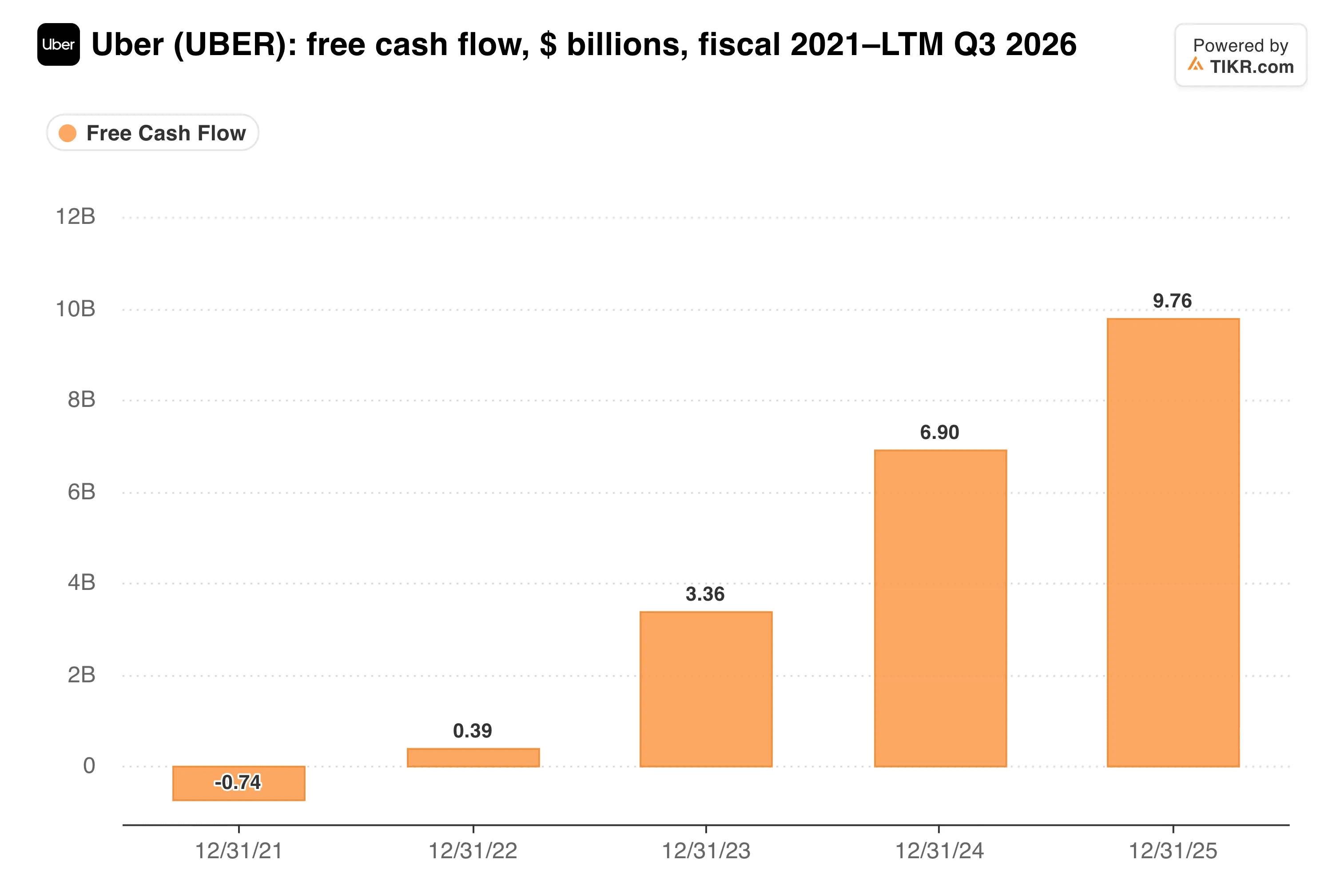
Free cash flow reached $2.5 billion, up 14%, and Uber still bought back $750 million of stock.
The peer gap helps too. Uber’s adjusted EBITDA equaled 5.0% of bookings, while Lyft posted 3.6%. Lyft also guided fourth-quarter bookings growth of 13% to 17%, below Uber’s 18% to 22%.
My take: I think the rally makes sense. Uber is growing faster than its closest rival at a wider margin, and the soft guide comes from driver spending while demand holds up. Still, 2,000 robotaxis is small for a platform handling 4.1 billion trips a quarter, so the autonomous payoff needs patience.
The next checkpoint is the fourth-quarter report, expected in early February. It will show whether EPS lands in the $0.95 to $0.99 range and whether higher driver incentives finally loosen Mobility supply.
So what is Uber stock actually worth?
TIKR lets you forecast the future price of any stock in less than a minute. Just enter a few assumptions into TIKR’s valuation model and see what Uber could be worth. Start from Wall Street consensus estimates, or adjust the inputs to reflect your own view of the business. It’s free to use.
Disclaimer:
Please note that the articles on TIKR are not intended to serve as investment or financial advice from TIKR or our content team, nor are they recommendations to buy or sell any stocks. We create our content based on TIKR Terminal’s investment data and analysts’ estimates. Our analysis might not include recent company news or important updates. TIKR has no position in any stocks mentioned. Thank you for reading, and happy investing!