Key Takeaways
- The Justice Department and the CFTC sued Arkansas to stop it from enforcing its gambling laws against Kalshi, the exchange that handles an estimated 60% of Robinhood’s prediction-market volume.
- Federal agencies arguing that these contracts belong to the CFTC lowers the risk on Robinhood’s fastest-growing line, where contracts traded rose 136% in October from a year earlier.
- DraftKings had an estimated 3% of sports prediction volume against Kalshi’s 76%, and now it’s chasing a leader with Washington on its side.
- The courts still decide this, starting with the Arkansas injunctions and three Supreme Court petitions on whether sports contracts are federal swaps.
Washington just went to court for Kalshi, and Robinhood Markets (HOOD) has as much riding on the outcome as anyone.
The Justice Department and the Commodity Futures Trading Commission (CFTC) sued Arkansas Attorney General Tim Griffin on Nov. 12. They’re asking a federal judge to stop him from enforcing the state’s gambling laws against the prediction-market exchange. The suit also leaves DraftKings (DKNG), which is spending heavily to catch Kalshi, chasing a leader with Washington in its corner.
Washington picks a side
Griffin sued Kalshi on Nov. 4, accusing it of running an illegal gambling platform. The federal suit argues three things: the Commodity Exchange Act gives the CFTC exclusive authority over futures, options and swaps on regulated platforms; Kalshi’s event contracts fall under that law; and so Arkansas can’t use its gambling laws against them. Kalshi isn’t even a party to the case. The government is defending its own authority over these contracts, and the order it wants would also shield CFTC-regulated firms and their partners, a group that could include Robinhood.
That’s a sharp turn from Nov. 10, when Politico reported that the CFTC had warned Kalshi it could face charges over how it told the agency about dozens of new products. Kalshi called it a procedural error. An agency that sues a state to keep Kalshi’s markets open seems unlikely to turn a filing dispute into a threat to the business.
TIKR tracks 32 analysts on Robinhood. How many say “Buy”?
See the full breakdown of Buy, Hold, and Sell ratings on Robinhood, along with Wall Street’s revenue and earnings estimates, all in one place. More than 500,000 investors use TIKR to research stocks like this one. See Robinhood’s Analyst Ratings
Robinhood has the most riding on Kalshi
InGame estimated this summer that about 60% of Robinhood’s prediction-market volume goes to Kalshi, which is why Robinhood had the most to lose from any charges. On those trades, Robinhood keeps the broker’s 1 cent of the 2-cent fee per contract. And this is Robinhood’s fastest-growing line. Customers traded 5.9 billion event contracts in October, up 136% from a year earlier, according to the company’s monthly data. Crypto notional volume fell 48% to $17.0 billion over the same period.
Robinhood has its own fights with the states, too. Louisiana Attorney General Liz Murrill sued Kalshi, Polymarket, Robinhood, Coinbase and others the same day the federal suit was filed, and a state judge ordered them that day to stop offering event contracts in Louisiana. The CFTC and the Justice Department sued Louisiana on Nov. 13 to block that order. Robinhood also stopped offering new sports contracts in Nevada from Dec. 1, 2025. The argument Washington is making in Arkansas is the one Robinhood needs in both places.
The estimates already count on a big 2027
Analysts expect normalized EPS of $2.47 this year, up from $2.34 in 2025, then $3.41 in 2027 and $4.29 in 2028:
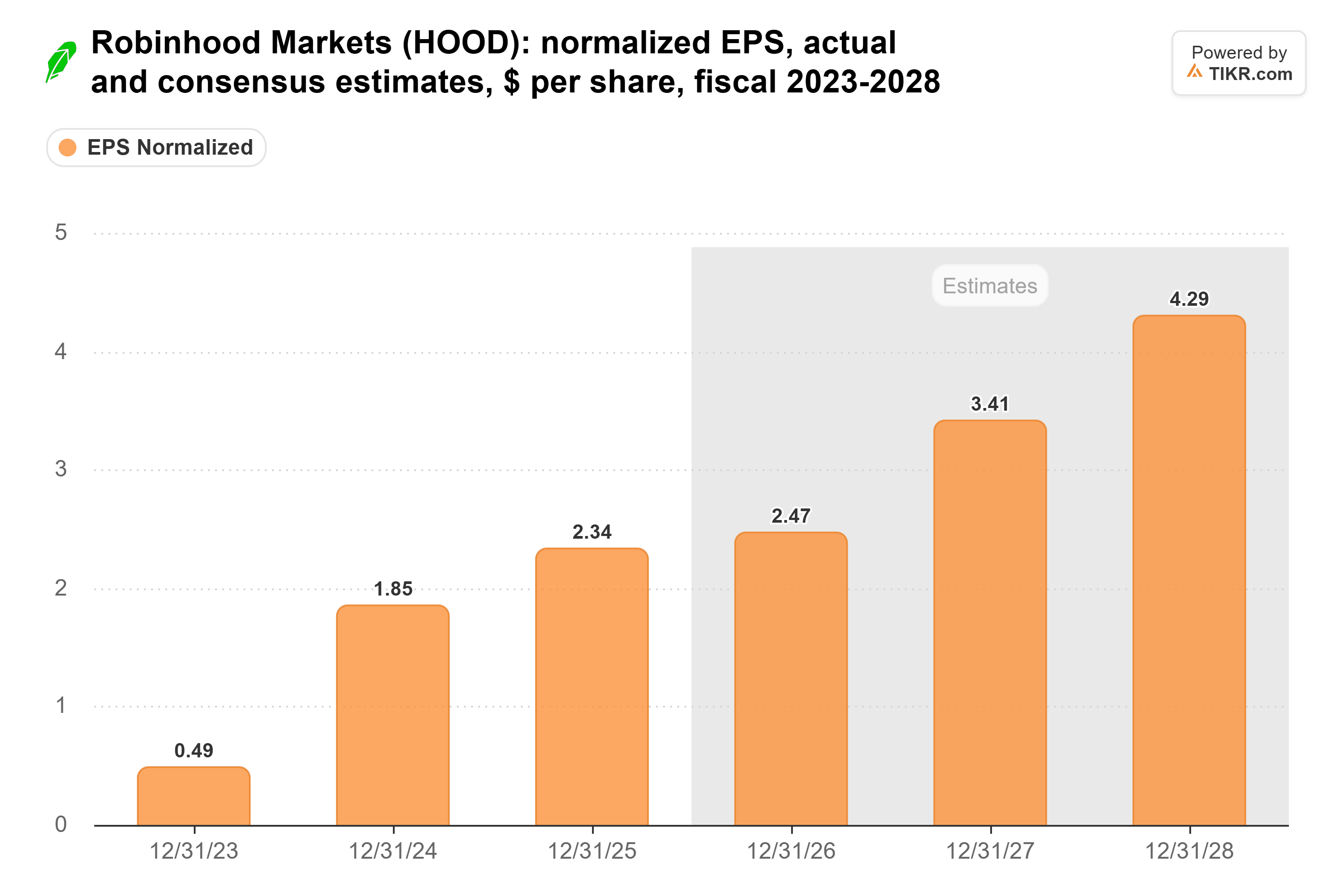
That’s a jump of about 38% in 2027, though only five to seven analysts make these estimates. A lawsuit doesn’t change this quarter’s numbers. But it lowers the odds that a state shuts off one of the lines that growth depends on.
Revenue has held up well, even as crypto trading slumped:
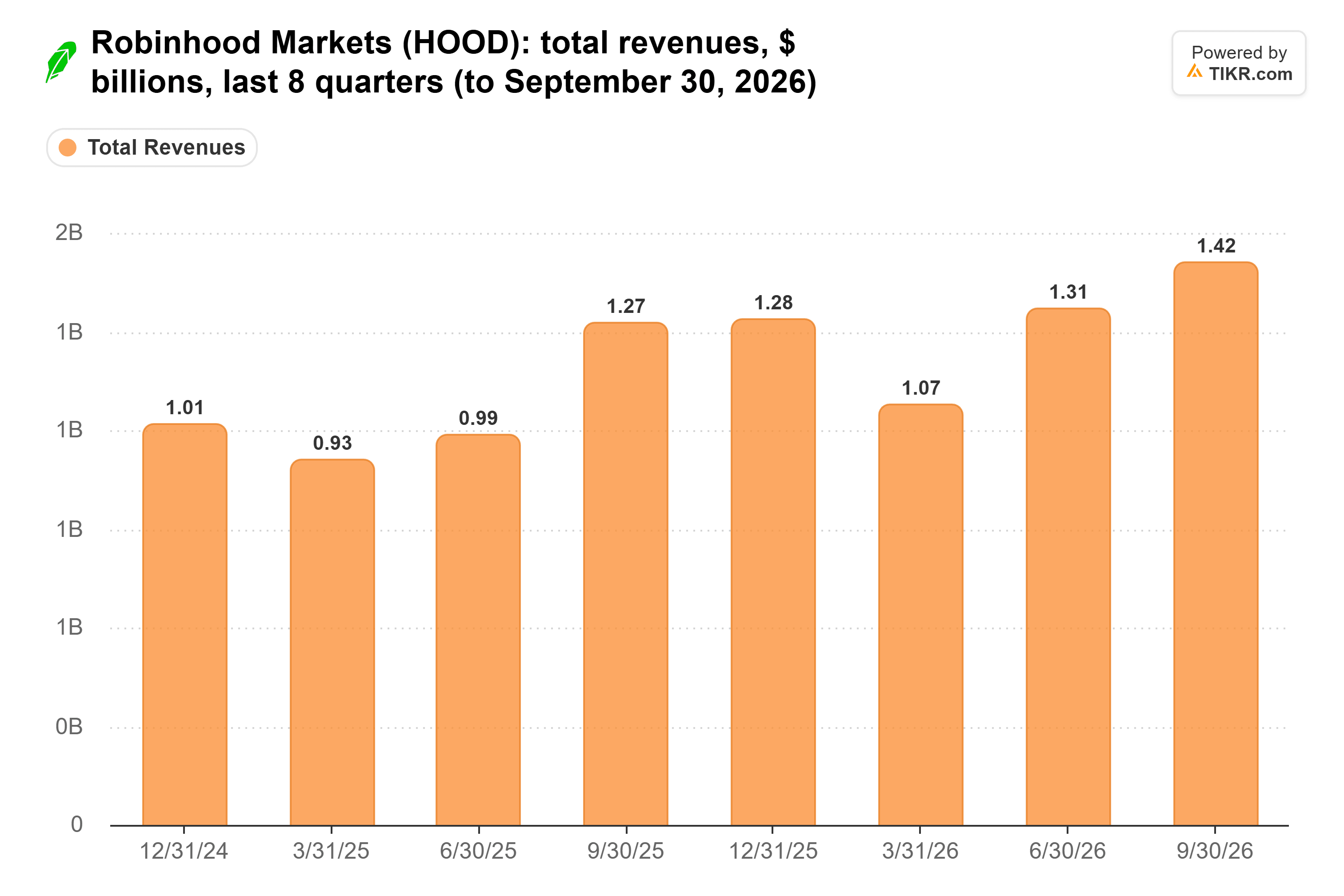
Third-quarter revenue of $1.42 billion was the highest of the last eight quarters, up from $1.27 billion a year earlier.
DraftKings is chasing a protected leader
Needham estimated that Kalshi took 76% of sports prediction-market volume in the NFL’s first week in September, against 3% for DraftKings’ own exchange. DraftKings plans to spend up to $700 million on Predictions this year to close that gap, and the stock fell 21% on Nov. 6 when it raised the bill and cut its 2026 outlook. Kalshi also pays no state gaming tax on its sports contracts. DraftKings paid $2.1 billion of gaming taxes in 2025, 34.9% of its revenue.
So far, it’s holding up: CEO Jason Robins wrote in DraftKings’ third-quarter business update that prediction market operators are having “no discernible impact on our Sportsbook business.” DraftKings’ exchange gets the same federal cover Kalshi does, but it’s starting from 3%.
The courts still get the last word
A federal suit doesn’t settle anything. A judge still has to rule on the injunctions. The bigger question is before the Supreme Court, where three petitions ask whether sports event contracts are federal swaps. One is Robinhood’s own appeal of an Aug. 28 Ninth Circuit ruling that let Nevada apply its gambling laws to those contracts. DraftKings’ own downside plan assumes sports contracts end in July 2028.
Robinhood has some cushion. Non-sports contracts rose to about 30% of its event activity in the third quarter, from 15%, CFO Shiv Verma said on the earnings call. And Rothera, its own exchange with Susquehanna, gives it somewhere to send volume besides Kalshi. The shares still fell 4% on Friday, Nov. 13, as October’s crypto volumes disappointed, Goldman Sachs trimmed its price target, and bitcoin slid.
The biggest risk to Robinhood’s fastest-growing business just got smaller: Kalshi’s own regulator is in court arguing that states can’t touch its contracts. But Louisiana’s order shows how fast a state can move, and a ruling for Arkansas or Louisiana would bring that risk right back. November’s operating data, due next month, will show whether event contracts keep growing as crypto cools.
So what is Robinhood stock actually worth?
TIKR lets you forecast the future price of any stock in less than a minute. Just enter a few assumptions into TIKR’s valuation model and see what Robinhood could be worth. Start from Wall Street consensus estimates, or adjust the inputs to reflect your own view of the business. It’s free to use.
Disclaimer:
Please note that the articles on TIKR are not intended to serve as investment or financial advice from TIKR or our content team, nor are they recommendations to buy or sell any stocks. We create our content based on TIKR Terminal’s investment data and analysts’ estimates. Our analysis might not include recent company news or important updates. TIKR has no position in any of the stocks mentioned. Thank you for reading, and happy investing!