Key Takeaways
- The FTC ordered nine companies, including DoorDash, Instacart, Walmart and Uber, to explain how they use personal data to set prices. The orders came one day before DoorDash announced its $17 billion deal to buy Instacart.
- The inquiry reaches Instacart’s past pricing experiments, which ran on retailer software it bought in 2022. Software for grocers is one of the businesses DoorDash named as a reason for the deal.
- An information request is a long way from an enforcement action. The bigger regulatory test is still the merger review, with closing expected in late 2027 or the first half of 2028.
- DoorDash trades at about 25x forward earnings, its lowest in three years, so the stock already carries plenty of doubt about the deal.
On Oct. 28, the Federal Trade Commission ordered nine companies to hand over details on how they use personal data to set prices and pay gig workers. Instacart (CART) and DoorDash (DASH) were both among them. So were Walmart (WMT), whose CEO pledged in September not to set prices with shoppers’ personal data, and Uber (UBER), which had held early talks to buy Instacart itself.
The next day, DoorDash announced a deal to buy Instacart for $65 a share, about $17 billion.
So DoorDash’s biggest deal now runs alongside two federal reviews: the merger review it already expected, and a pricing inquiry into both companies. Instacart’s side is the more exposed one, because of the pricing tests it ran last year.
What the FTC Wants
FTC Chairman Andrew Ferguson took over the agency when President Donald Trump took office. He framed the orders this way: “Consumers deserve to know whether companies use their web surfing habits or other personal data to estimate the highest price they can charge each consumer.”
Each company has 45 days from receiving the order to respond, and the FTC can go to federal court if it doesn’t. The order, which mostly covers January 2023 onward, asks for:
- the algorithms and software behind prices
- the data that feed them, including location, income, browsing history and a shopper’s estimated willingness to pay
- pricing studies and A/B tests going back to January 2021
For the four gig apps (DoorDash, Instacart, Uber and Lyft), it also covers how workers are assigned jobs and how their pay is worked out.
Instacart said it doesn’t use consumers’ personal information to set prices, and that the retailers it serves set the prices on its site.
TIKR Tracks 43 Analysts on DoorDash. How Many Say “Buy”?
See the full breakdown of Buy, Hold, and Sell ratings on DoorDash, along with Wall Street’s revenue and earnings estimates, all in one place. More than 500,000 investors use TIKR to research stocks like this one. See DoorDash’s Analyst Ratings
The Part of Instacart DoorDash Wants Most
Wall Street already expected DoorDash’s normalized EPS to nearly double from 2025 to 2028:

Those estimates, as of Oct. 27, don’t include Instacart yet. An information request gives analysts no reason to cut them, but the deal itself might weigh on them at first. DoorDash plans to invest more than 100% of the synergies in the first year after closing, with net synergies turning positive in year two on a multi-year path to $500 million or more a year.
Instacart adds a business of real size on top of that, with revenue more than doubling from 2021 to 2025:
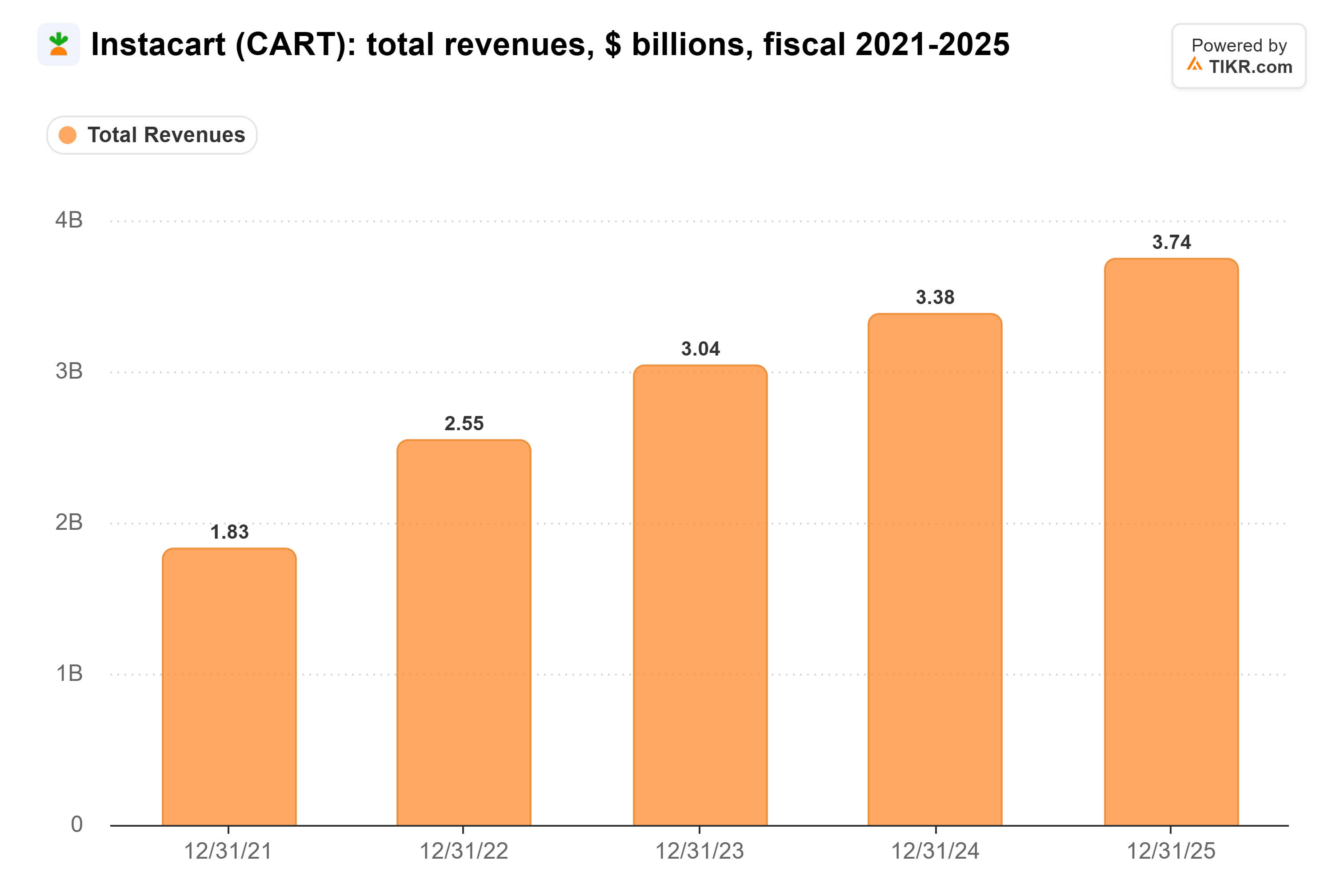
About $1.07 billion of Instacart’s 2025 revenue, or 28%, came from advertising and other revenue. That’s a big part of why DoorDash wants the company. Its deal announcement says more grocers could use Instacart’s technology to run their own websites and retail media networks, and that brands would gain a scaled alternative for reaching shoppers online.
That’s where the pricing question comes in. In December 2025, Consumer Reports, Groundwork Collaborative and More Perfect Union published a study of 437 shoppers. It found that 74% of the grocery items it tested on Instacart were offered at more than one price, and identical baskets varied by about 7% on average. Instacart ended its item-price tests that month. It said the tests were randomized and didn’t use shoppers’ personal data.
Groundwork’s executive director, Lindsay Owens, said on a recent episode of Bloomberg’s Odd Lots podcast that the group knew to run the study because of an earlier deal. In 2022, Instacart bought Eversight, an AI company whose platform let retailers run pricing experiments. As Owens put it, “what we ultimately exposed with our experiment was their experiment on shoppers.”
Those tests have stopped, but pricing studies and A/B tests back to January 2021 fall inside what the FTC asked for.
The Merger Review Still Matters More
An information request is a long way from a lawsuit, and the FTC may never challenge anything Instacart does. Instacart’s answers are due about six weeks after it got the order. Separately, the FTC’s proposed policy requiring companies to disclose personalized pricing is open for comment until Nov. 21.
The bigger test is still the merger review. DoorDash’s 2021 talks to buy Instacart fell apart partly over regulatory concerns. This time, DoorDash would owe Instacart $1.25 billion in certain cases if the deal falls apart.
Investors aren’t paying up for DoorDash’s growth while all this plays out. Its forward P/E sat at about 25x on Oct. 29, the lowest in three years and well below its 39x average:

What Could Still Trip Up DoorDash’s Instacart Deal
This inquiry adds paperwork and headlines to a deal that already faced a long review, and I don’t see it changing the outcome on its own. Instacart stopped the tests that drew the most fire, and at about 25x forward earnings, DoorDash shares already price in a lot of doubt.
The risk is that the pricing questions don’t stay in one lane. Instacart confirmed in December 2025 that the FTC had already asked about its pricing tools, so its answers to this order will be on file while antitrust reviewers weigh the merger. The first marker is Instacart’s response, due around mid-December.
So what is DoorDash stock actually worth if the deal doesn’t go through?
TIKR lets you forecast the future price of any stock in less than a minute. Just enter a few assumptions into TIKR’s valuation model and see what DoorDash could be worth. Start from Wall Street consensus estimates, or adjust the inputs to reflect your own view of the business. It’s free to use.
Disclaimer:
Please note that the articles on TIKR are not intended to serve as investment or financial advice from TIKR or our content team, nor are they recommendations to buy or sell any stocks. We create our content based on TIKR Terminal’s investment data and analysts’ estimates. Our analysis might not include recent company news or important updates. TIKR has no position in any of the stocks mentioned. Thank you for reading, and happy investing!