


Key Stats for ExxonMobil Stock
- Current Price: $156.71
- Target Price (Mid): ~$167
- Street Target (Mean): ~$170
- Potential Total Return: ~6%
- Annualized IRR: ~1% / year
Now Live: Discover how much upside your favorite stocks could have using TIKR’s new Valuation Model (It’s free) >>>
What Happened?
ExxonMobil (XOM) spent the weekend in oil headlines it had no part in writing. On August 28, President Trump announced what he called the biggest oil deal in history: a U.S. arrangement to take majority control of roughly 65 billion barrels of Venezuelan reserves across 17 fields. Chevron is the American major with boots on the ground in Venezuela. Exxon left almost two decades ago and, asked about the deal, declined to comment. That is the odd spot the stock sits in at $156.71: back in the news, tied to none of it, and easing off its late-August highs as the market weighs what more oil supply could mean for prices.
The bull thesis on Exxon was never a bet on scarce oil. It was a bet on the company earning more per barrel than anyone else in any price environment. A supply-expansion story tests whether investors still believe that once the crude tailwind fades. The Street thinks the stock is worth a little more than today’s price.
A Deal That Points Oil the Wrong Way for a Producer
The Venezuela announcement is a supply event, and supply events push prices down. The terms are loose: a U.S. official described a private joint venture holding a 100-year concession, with Washington controlling 55% of effective output through equity plus rights to buy oil at cost, and the private operator was unnamed. Venezuela’s interim government framed it as capable of drawing $100 billion into fields that today produce barely more than a million barrels a day. Analysts are skeptical that the barrels will arrive soon, given the collapsed infrastructure and the asset seizures that pushed the American majors out in the first place.
Exxon’s silence now is not the same as no answer. Its CEO gave one in January, at a televised White House meeting where Trump pressed executives to reinvest. Chairman and CEO Darren Woods called Venezuela “uninvestable” in its current state, telling the room that a company whose assets have been seized there twice would need durable legal protections and a change to the country’s hydrocarbon laws before committing capital that spans decades. Trump’s response days later was to threaten to keep Exxon out entirely. That exchange, more than any no-comment, is why Exxon’s name is absent from a deal built next to its own disputed acreage in Guyana’s Essequibo region.
See historical and forward estimates for ExxonMobil stock (It’s free!) >>>
The Quarter Under the Noise Was Built to Survive Falling Prices
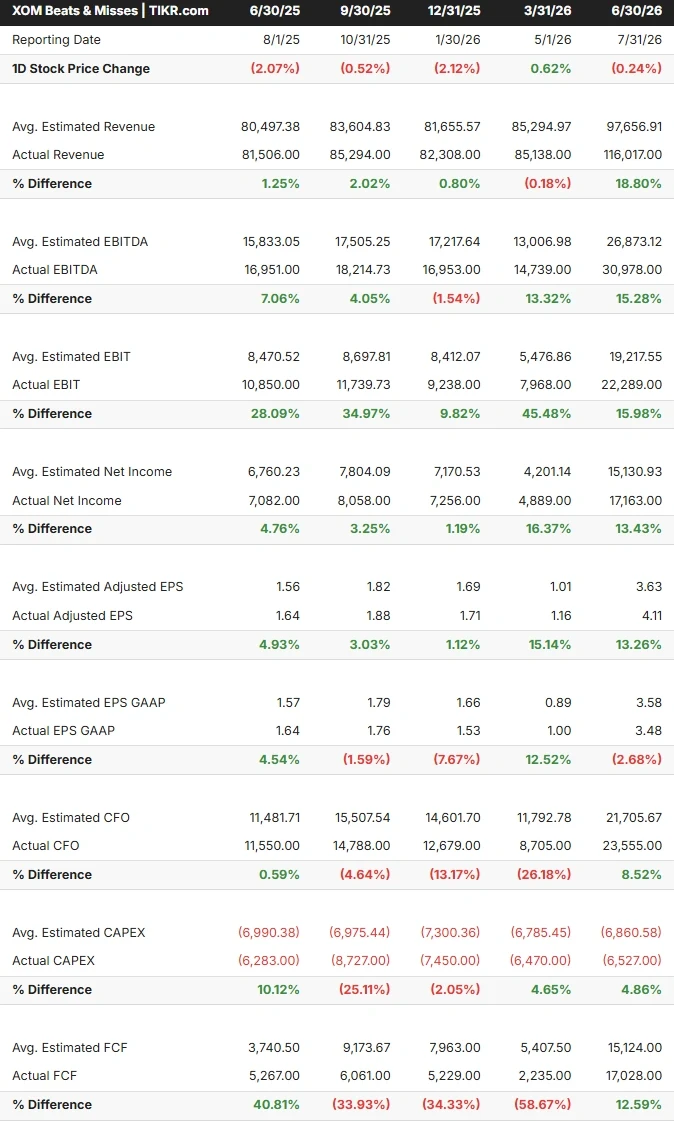
Strip out the geopolitics, and Exxon’s second quarter, reported July 31, made the case for why the stock does not need high oil to work. The company earned $14.5 billion, generated $23.6 billion of operating cash flow and $17.2 billion of free cash flow, and cut net debt by more than $7 billion, all while a Middle East conflict knocked out roughly 10% of upstream production. Revenue of $116.0 billion rose 42% year-over-year, and management returned $9.4 billion to shareholders through dividends and buybacks.
CFO Neil Hansen told analysts the company has taken $16.3 billion of structural cost out of the business since 2019, with a stated path to $20 billion by 2030, and now runs cash operating expenses near 2019 levels despite years of growth and inflation. That is what lets earnings hold when prices normalize, exactly the scenario a Venezuela supply deal makes more likely. The operating proof sat in the Permian, where a production record above 1.8 million oil-equivalent barrels a day was driven by an efficiency edge management quantified directly: 1,200 wells drilled at three miles or longer since 2020, against roughly 400 for the nearest competitor.
Guyana is the other half, and the quarter resets it. Exxon recovered its capital and costs on the development nearly two years earlier than planned, which lowers its future volume entitlement but inflects cash flow higher. Hansen was blunt about the trade: “It’s very much an inflection into free cash flow. Absolutely.” He told analysts the company expects roughly twice the level of Guyana’s free cash flow in 2030 as it saw in 2025. Fewer entitled barrels, more cash per barrel. For a company that keeps repeating that its focus is value over volume, that is the thesis working as designed.
Where the Model and the Street Actually Land
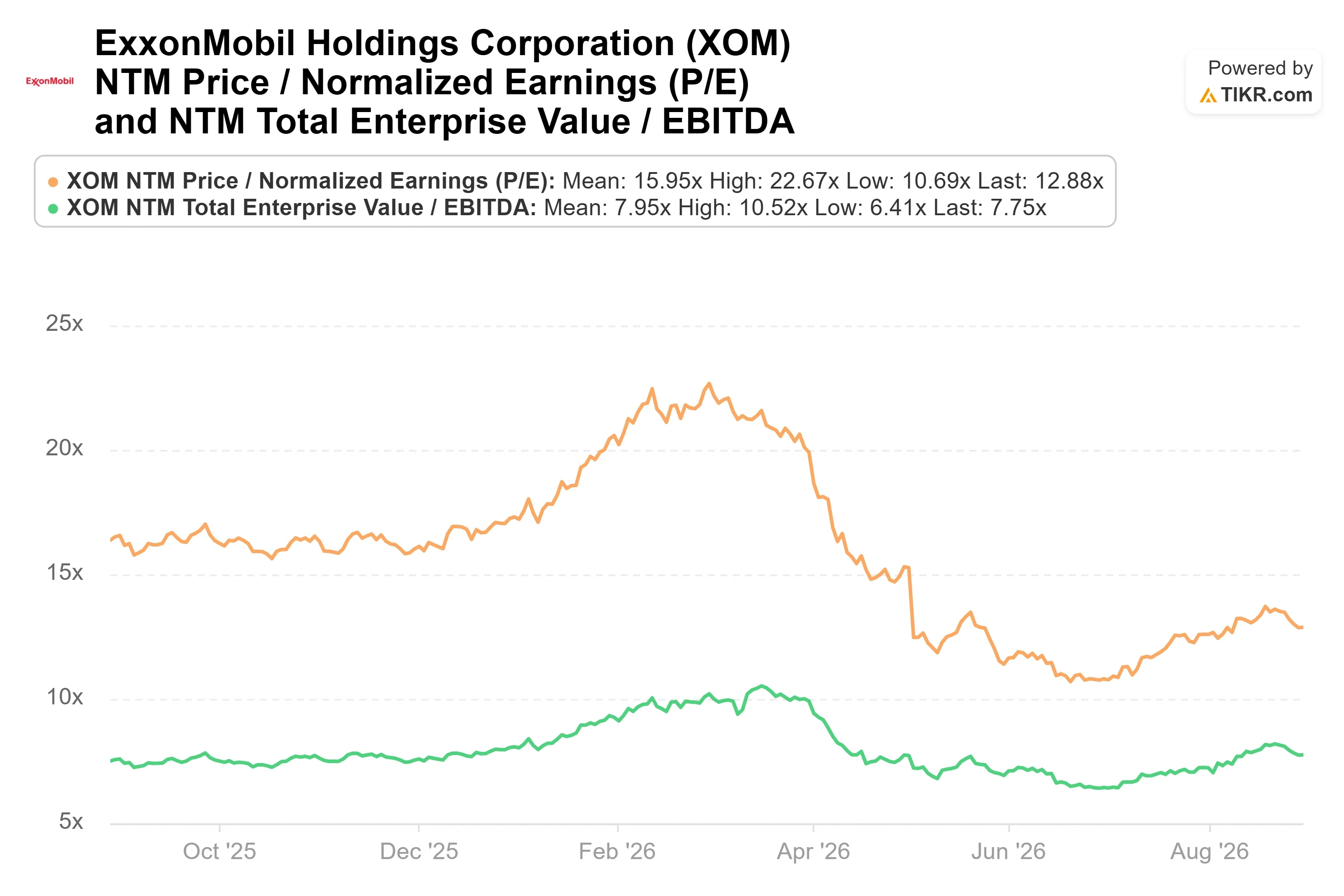
At $156.71, Exxon trades around 12.9 times next-twelve-month earnings and about 7.8 times NTM EV/EBITDA. Against integrated-major peers that sit mid-pack rather than at a bargain: TotalEnergies trades near 8.4 times forward earnings, while U.S. refiners like Valero and Marathon carry single-digit forward multiples reflecting narrower, more cyclical exposure. Exxon’s premium is a quality premium, defensible because no peer matches its combination of Permian scale, Guyana economics, and a downstream and chemical footprint that turned this quarter’s supply shock into record specialty margins.
The Street mean target is about $170, and recent revisions have been orderly: Morgan Stanley moved to $177, Barclays trimmed to $177 from $182, and a mid-month reiteration held a Buy at $174. The high target is $200, the low is $142, and the split leans positive without conviction, with 7 buys and 3 outperforms against 15 holds, 1 underperform, and 1 sell.
See how ExxonMobil performs against its peers in TIKR (It’s free!) >>>
TIKR Advanced Model Analysis
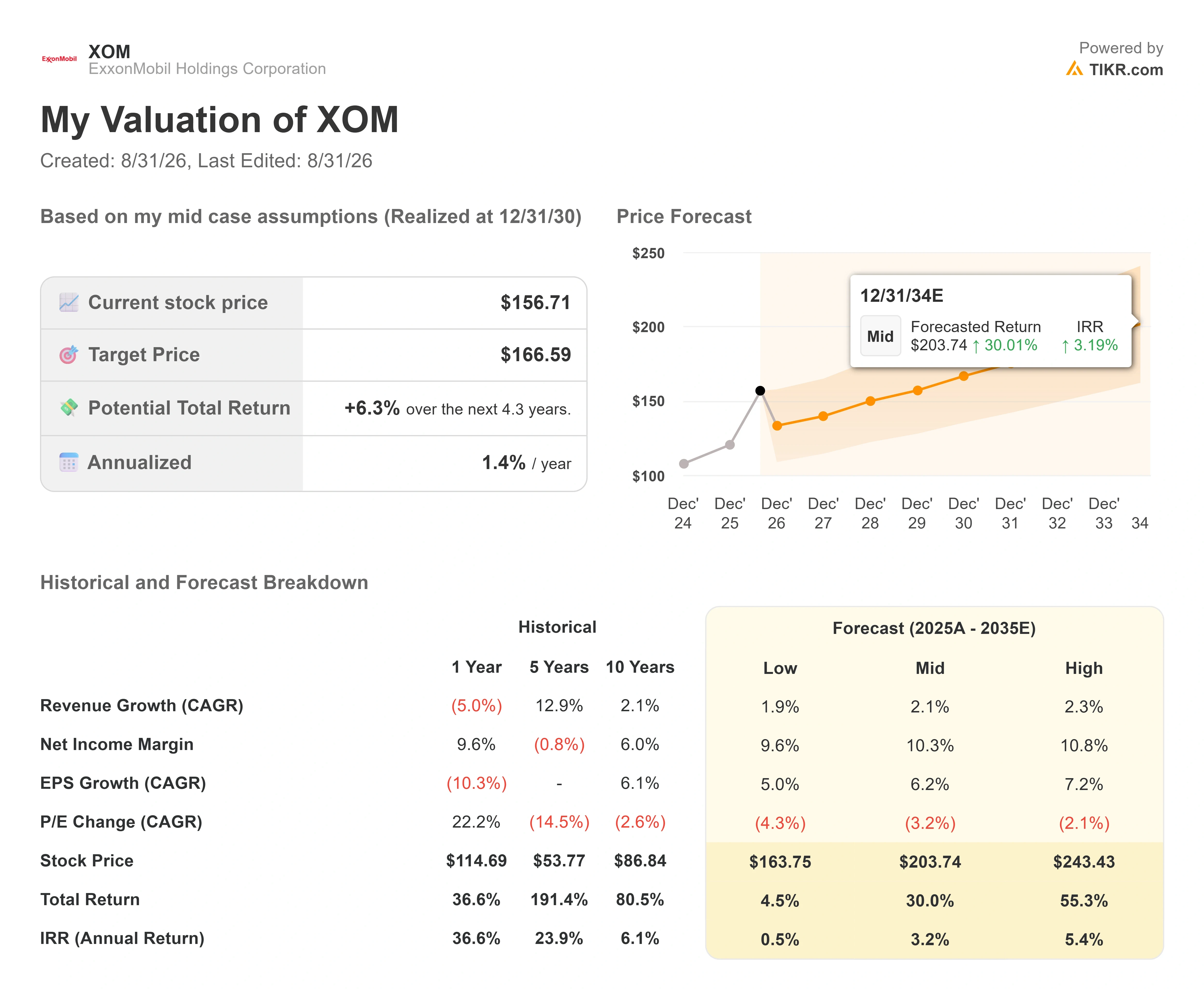
- Current Price: $156.71
- Target Price (Mid): ~$167
- Potential Total Return: ~6%
- Annualized IRR: ~1% / year
See analysts’ growth forecasts and price targets for ExxonMobil stock (It’s free!) >>>
Using the mid-case, the model values XOM at about $167 by the end of 2030, implying roughly 6% total return and around 1% annualized from today’s price. The two revenue drivers behind that number are Permian volume growth, still tracking management’s targeted expansion through 2030, and Guyana’s ramp toward its next production vessels even as entitled volumes step down. The margin driver is the structural cost program, the $16.3 billion already removed on the way to a targeted $20 billion, which protects net income margins if oil softens.
The primary risk runs the other way: a durable decline in crude, exactly what a Venezuela supply expansion plus a reopening of the Strait of Hormuz would bring, compresses the upstream earnings the model leans on. Upside is a world where refining and chemical tightness persist, and the cost savings drop straight to the bottom line, pushing the stock toward the Street’s high end. The downside is a fast oil normalization that leaves a fairly valued stock paying a full multiple on falling earnings.
Conclusion
The catalyst to watch is not the next earnings print in late October. It is oil. A Venezuela deal that actually moves barrels, layered on any easing in the Middle East, is the scenario that pressures the one part of Exxon’s story that the model cannot cut costs around. Watch WTI and refining crack spreads through the fall: crude holding above roughly $70 with margins still firm keeps the mid-case intact and the dividend comfortably covered, while a slide toward the low $60s alongside a Strait reopening is the outcome that turns a fairly valued stock into an expensive one. Exxon built a machine meant to earn through the cycle. The next two quarters test that claim against falling prices instead of rising ones.
See what stocks billionaire investors are buying so you can follow the smart money with TIKR.
Should You Invest in ExxonMobil?
The only way to really know is to look at the numbers yourself. TIKR gives you free access to the same institutional-quality financial data that professional analysts use to answer exactly that question.
Pull up ExxonMobil, and you’ll see years of historical financials, what Wall Street analysts expect for revenue and earnings in the quarters ahead, how valuation multiples have moved over time, and whether price targets are trending up or down.
You can build a free watchlist to track ExxonMobil alongside every other stock on your radar. No credit card required. Just the data you need to decide for yourself.
Analyze ExxonMobil on TIKR Free →
Looking for New Opportunities?
- See what stocks billionaire investors are buying so you can follow the smart money.
- Analyze stocks in as little as 5 minutes with TIKR’s all-in-one, easy-to-use platform.
- The more rocks you overturn… the more opportunities you’ll uncover. Search 100K+ global stocks, global top investor holdings, and more with TIKR.
Disclaimer:
Please note that the articles on TIKR are not intended to serve as investment or financial advice from TIKR or our content team, nor are they recommendations to buy or sell any stocks. We create our content based on TIKR Terminal’s investment data and analysts’ estimates. Our analysis might not include recent company news or important updates. TIKR has no position in any stocks mentioned. Thank you for reading, and happy investing!


