


Key Stats for Capital One Stock
- Current Price: $215.67
- Target Price (Mid): ~$332
- Street Target (Mean): ~$258
- Potential Total Return: ~54%
- Annualized IRR: ~10% / year
Now Live: Discover how much upside your favorite stocks could have using TIKR’s new Valuation Model (It’s free) >>>
What Happened?
Capital One Financial (COF) has an unusual problem for a stock trading at 10 times forward earnings: the analysts who cover it can no longer agree on what it is worth. In a single week in late August, Wolfe Research raised its target to $275 with an Outperform rating, while Deutsche Bank cut its target to $245 and held a Hold, pointing explicitly at the company’s post-Discover integration. UBS sits higher still at $280, and TIKR data shows the full Street range now runs from $214 to $300. The stock closed at $215.67 on August 28, going nowhere while the people paid to value it pull in opposite directions.
It is not a disagreement about credit quality, which keeps improving, or about revenue, which the Discover deal has reset sharply higher. It is a disagreement about the billions Capital One is spending to knit Discover, Brex, and its own technology stack together, and whether that spending is building durable earnings power or quietly capping it.
The Integration Is the Whole Argument, and Both Sides Have Evidence
Capital One’s common equity Tier 1 ratio fell 70 basis points in the second quarter to 13.7%, pressured by $2.7 billion of buybacks, the Brex close, and rising risk-weighted assets. Operating expenses grew 7% from the prior quarter, and only about a third of the announced $2.5 billion in operating expense synergies have shown up so far. A skeptic sees a company spending heavily today for benefits that keep sliding into next year.
The bulls read the same page and see the timing as the opportunity, because the earnings power being argued over has not hit the income statement yet. The debit revenue synergies are already fully in the run rate, while the remaining two-thirds of the cost synergies are scheduled to land through the second half of 2027. Underneath the spending, the credit improved rather than cracked: the domestic card charge-off rate fell 39 basis points from the prior quarter to 4.71%, and delinquencies dropped to 3.39%, even as the company released $662 million of allowance.
CEO Richard Fairbank put the strategic tension plainly on the July 21 call: “We are kind of living 2 lives at once here, really leaning into opportunities and really, really so carefully managing the expenses to be able to simultaneously deliver the earnings power that we expected at the outset of this deal.” That is the entire bull-bear debate compressed into one breath, and it came from the CEO, not an analyst. The loan-growth optics feed the same debate. Domestic card loans grew just 2.6% year over year, held back by the deliberate contraction of the acquired Discover book while it converts onto Capital One’s platform, a process Fairbank told analysts bottoms around the fourth quarter of 2026, with full migration by the first quarter of 2027. An analyst modeling that trough as permanent gets a very different 2027 than one modeling the reacceleration.

See historical and forward estimates for Capital One stock (It’s free!) >>>
Why the Cheapest Name in the Group Trades at a Discount That May Fade
Against its peer set, Capital One trades as if the integration overhang were permanent. Its next-twelve-months P/E of 9.85 times sits far below American Express at roughly 18 times and a consumer-finance peer group whose mean forward multiple is above 20 times, according to TIKR’s Competitors data. Part of that discount is structural, because Capital One carries more subprime and balance-sheet risk than a pure spend-based network like American Express, and it should trade at a gap. But ten full multiple points is not a verdict on business quality; it is a live bet that the integration disappoints.
Fairbank himself conceded the gap on the call, in a moment that has gone largely unremarked. Asked whether the market rewards the long-term value the company builds, he answered: “I believe that we probably don’t get appropriate recognition in the stock.” He tied that to the “horizontal accounting” the company has used since its founding, valuing each cohort of accounts over its full life rather than by the current quarter, the same discipline now underwriting the Discover and Brex bets.
Two August moves reinforce that management is playing a long capital game: Capital One will redeem all $1 billion of its Series M preferred stock on September 1 (per its SEC filing), and it extended its Capital One Arena naming rights in Washington for 20 years as part of a reported billion-dollar-plus renovation. If the cost synergies land on schedule through 2027 and Discover loan growth turns, the discount is the thing most likely to compress.

See how Capital One performs against its peers in TIKR (It’s free!) >>>
TIKR Advanced Model Analysis
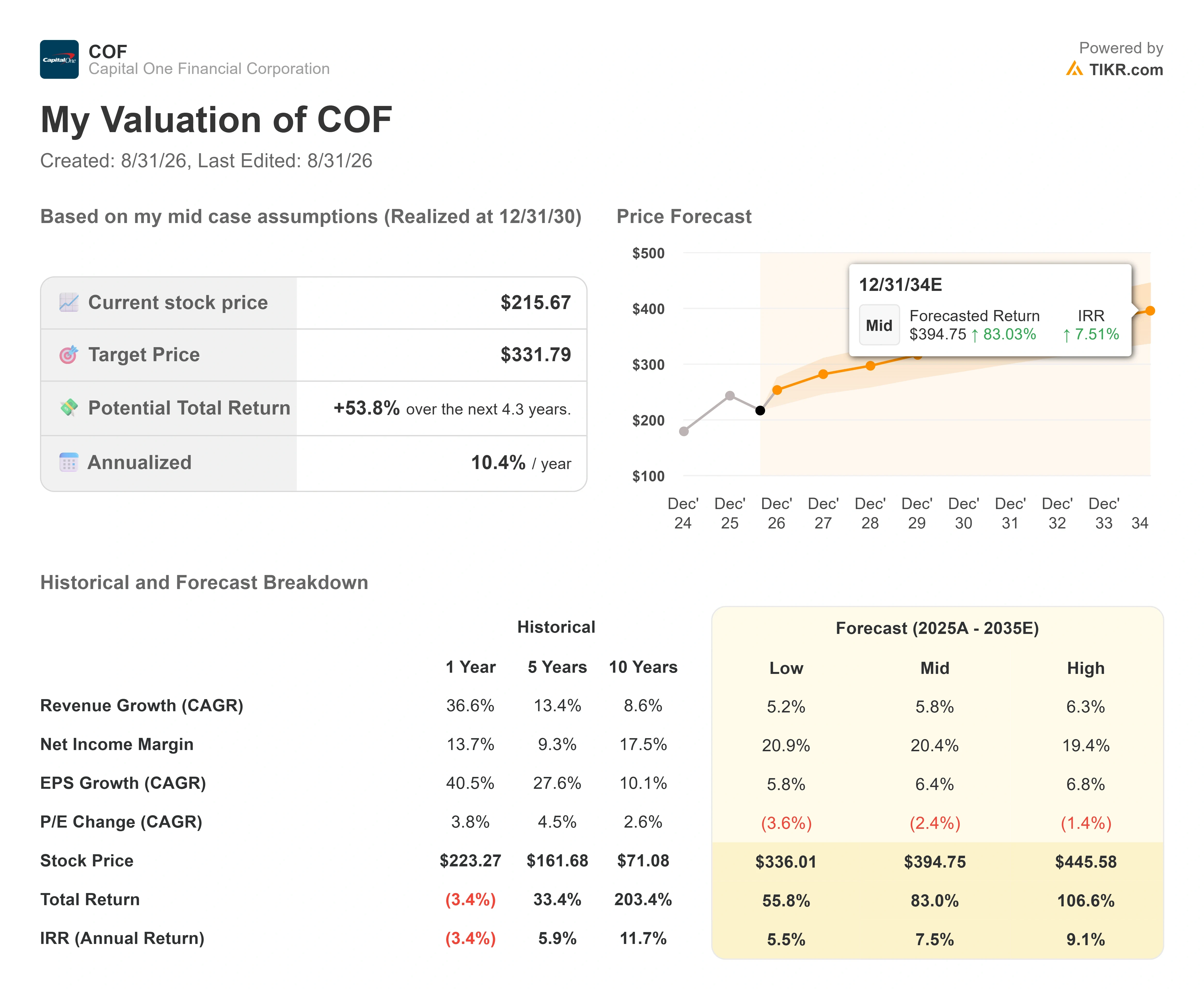
- Current Price: $215.67
- Target Price (Mid): ~$332
- Potential Total Return: ~54%
- Annualized IRR: ~10% / year
See analysts’ growth forecasts and price targets for Capital One stock (It’s free!) >>>
On mid-case assumptions realized at the end of 2030, a roughly 4.3-year horizon, the model values Capital One at around $332. That sits above the ~$258 Street mean and above TIKR’s $300 Street high, so the model is making a more patient case than this week’s notes.
Two revenue drivers carry the number: the reacceleration of domestic card loan growth once the Discover brownout ends around year-end, and the scaling of the acquired global payments network as card volume migrates onto it. The margin driver is the $2.5 billion synergy program, roughly two-thirds still to be realized through 2027. The primary risk is that the same driver inverted: if integration costs run longer or Discover loan growth is slow to return, the earnings-power reset arrives later and smaller. Upside is a company experiencing integration earnings at a scale that the current 10 times multiple ignores. The downside is dead money while the spending continues and the market waits for proof.
Conclusion
The next real test is not the target-price ping-pong; it is the fourth quarter. Fairbank has staked out year-end 2026 as the bottom of the Discover brownout, which makes Q4 results, reported in late January 2027, the first print where the loan book should stop shrinking and the cost synergies should visibly deepen. Good looks like domestic card loans flat to growing and synergy realization moving past one-third toward half. Bad looks like another quarter of contraction with the timeline slipping into late 2027.
See what stocks billionaire investors are buying so you can follow the smart money with TIKR.
Should You Invest in Capital One?
The only way to really know is to look at the numbers yourself. TIKR gives you free access to the same institutional-quality financial data that professional analysts use to answer exactly that question.
Pull up Capital One, and you’ll see years of historical financials, what Wall Street analysts expect for revenue and earnings in the quarters ahead, how valuation multiples have moved over time, and whether price targets are trending up or down.
You can build a free watchlist to track Capital One alongside every other stock on your radar. No credit card required. Just the data you need to decide for yourself.
Analyze Capital One on TIKR Free →
Looking for New Opportunities?
- See what stocks billionaire investors are buying so you can follow the smart money.
- Analyze stocks in as little as 5 minutes with TIKR’s all-in-one, easy-to-use platform.
- The more rocks you overturn… the more opportunities you’ll uncover. Search 100K+ global stocks, global top investor holdings, and more with TIKR.
Disclaimer:
Please note that the articles on TIKR are not intended to serve as investment or financial advice from TIKR or our content team, nor are they recommendations to buy or sell any stocks. We create our content based on TIKR Terminal’s investment data and analysts’ estimates. Our analysis might not include recent company news or important updates. TIKR has no position in any stocks mentioned. Thank you for reading, and happy investing!


