


Key Stats for SanDisk Stock
- Current Price: $1,484.98
- Target Price (Mid): ~$3,050
- Street Target: ~$2,125
- Potential Total Return: ~105%
- Annualized IRR: ~16% / year
Now Live: Discover how much upside your favorite stocks could have using TIKR’s new Valuation Model (It’s free) >>>
What Happened?
SanDisk (SNDK) spent August 13 telling Wall Street that its best feature is how little money it needs to grow. On August 27, it stood behind the largest manufacturing build in its history. SanDisk and joint-venture partner Kioxia announced plans to invest more than $31 billion in Japanese NAND plants through 2032, roughly 60% of everything the two have spent in Japan across a 25-year partnership. The figure spans both companies, runs largely through their joint venture, and is contingent on Japanese government support that is not yet confirmed.
Shares closed August 28 at $1,484.98, essentially flat on the day but lower for the week, caught in a memory-sector selloff after reports that Washington might let Apple source NAND from China’s Yangtze Memory. So investors are weighing a record capacity commitment against a fresh supply threat, on a stock still up more than 500% in 2026. The question underneath the noise is whether a company that just repriced itself on scarcity should be helping fund the end of it.
A Record Build From a Company That Swore It Didn’t Need One
At its investor day on August 13, detailed in the company’s investor relations materials, CTO Alper Ilkbahar built the technology case around spending less, not more. He told investors the rest of the industry spent 2.66 times more capital than SanDisk and Kioxia in 2025 to generate the same bit output, and that the partnership produced 29% of the industry’s bits over five years while spending only 13% of the capital. CFO Luis Visoso guided to mid-single-digit capital intensity as a percent of revenue.
On its face, a $31 billion build looks like a contradiction. It is not, and the reconciliation matters. The figure spans both partners through 2032 and runs largely through Flash Ventures, the JV vehicle, so SanDisk’s share flows through as contributions and equipment rather than a separate check. In fiscal 2026, SanDisk’s own property purchases were just $177 million. Against fiscal 2026 revenue of $20.25 billion and fiscal Q1 2027 guidance of $10.3 billion to $10.8 billion in a single quarter, mid-single-digit intensity still absorbs a very large absolute number. The headline is enormous. The intensity guidance survives it.
What the build buys is capacity for demand that SanDisk says it has already contracted. Part of the money funds a new fabrication facility at Kioxia’s Kitakami plant, priced near $11.3 billion, to expand production of BiCS10, the tenth-generation flash the two developed together. That is the node SanDisk began sampling to customers in August, and the one Ilkbahar said carries 65% more bits per wafer than the BiCS8 generation anchoring current production.

See historical and forward estimates for SanDisk stock (It’s free!) >>>
Why the Capex Isn’t Reckless, and Where the Skeptics Push Back
SanDisk’s fiscal 2026 was not a normal memory year. Revenue rose 175% to $20.25 billion, gross margin went from 30.3% to 71.6%, and the company swung from a net loss to $11.4 billion in net income. Data center revenue rose 437% year over year to $5.15 billion, and in the fourth quarter, it more than doubled sequentially to $3.0 billion.
The durability sits with the New Business Model agreements: eight customers, three of them U.S. hyperscalers, carrying $93.9 billion in total contract value and $91.1 billion still to be recognized, backed by $16.5 billion in financial guarantees. Those deals cover roughly half of expected fiscal 2027 bit shipments, and Visoso said they hold around 80% gross margin even at floor pricing. That is what separates this build from a top-of-cycle blunder: capital committed against a book that is already partly sold, not against a quarterly price auction.
At the Analyst Day, Bank of America’s Wamsi Mohan pressed the point that these agreements “typically have not held up very well” across past cyclical downturns, and asked why forecasts stretching to 2030 should be trusted now. Goeckeler’s answer was that these contracts reach the CEO and CFO level with board approval, unlike the transactional deals of the past, but he conceded the obvious: “Is it a guarantee? There’s no guarantees.” The real risk is not that the contracts vanish. It is the majority of bits still exposed to spot pricing when new industry capacity, including this build, lands later in the decade.

See how SanDisk performs against its peers in TIKR (It’s free!) >>>
The China Threat That Knocked the Stock Down
The selloff into the announcement followed a report that Washington might permit Apple to buy DRAM from China’s ChangXin and NAND from Yangtze Memory, possibly tied to easing tensions ahead of a September visit by China’s president. Memory names fell together, with SanDisk down about 6% on August 24. The fear is that U.S. and Korean suppliers lose a slice of Apple’s business over time.
The counterpoint, from analysts who called it an overreaction, is that Chinese NAND cannot yet qualify for Apple’s highest-end needs and that Yangtze has committed much of its newest output to domestic customers. This is a reported policy possibility, not an enacted rule, and any displacement of qualified NAND at Apple’s scale runs into years, not quarters. The exposure is not small, though: edge is SanDisk’s largest segment at $12.2 billion of fiscal 2026 revenue, roughly 60% of the company, so a threat to edge is a threat to the majority of the business.
TIKR Advanced Model Analysis
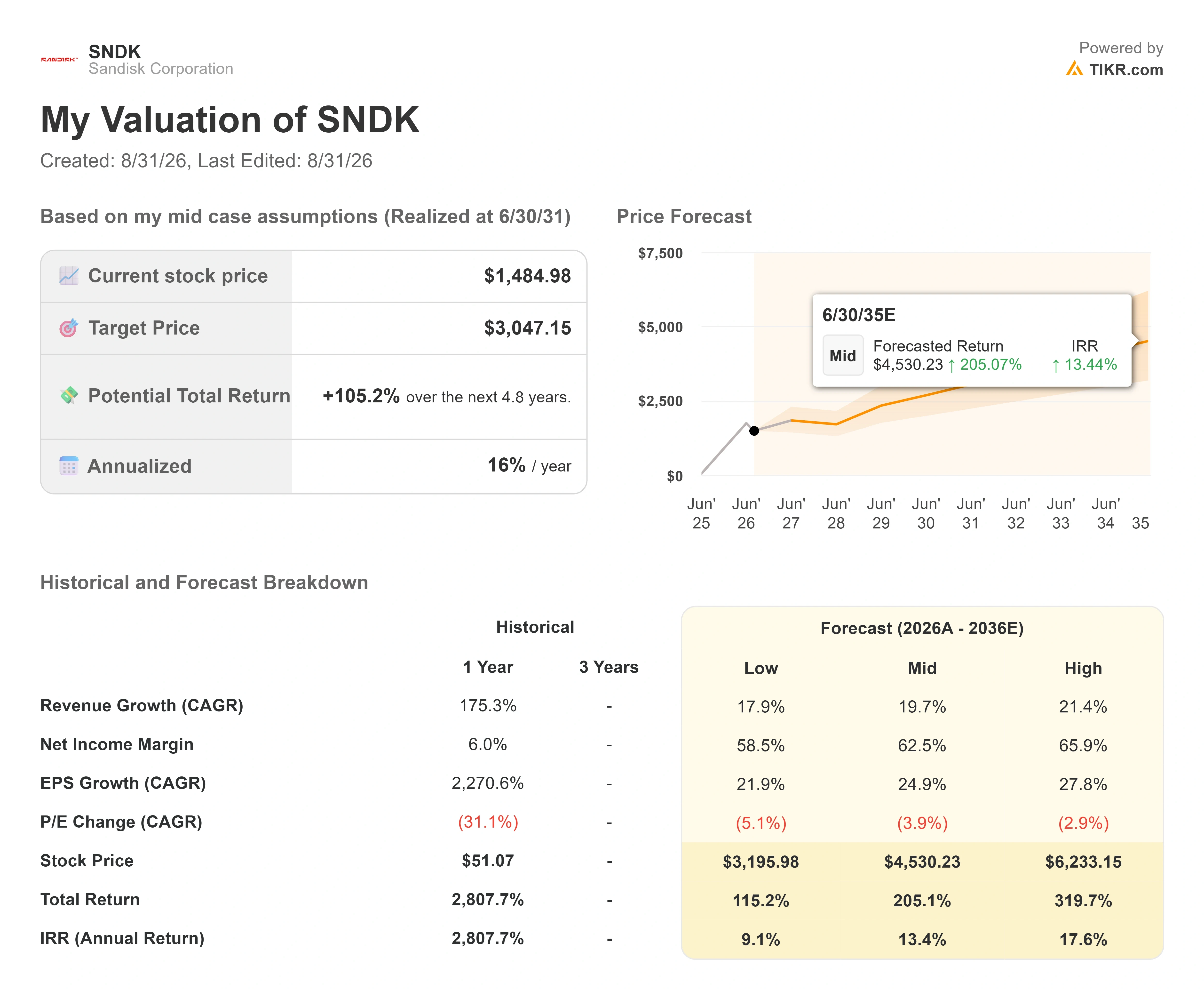
- Current Price: $1,484.98
- Target Price (Mid): ~$3,050
- Potential Total Return: ~105%
- Annualized IRR: ~16% / year
See analysts’ growth forecasts and price targets for SanDisk stock (It’s free!) >>>
TIKR’s mid-case model, realized in mid-2031, values SanDisk near $3,050, a total return of about 105%, and roughly 16% annualized over the next 4.8 years. It is a scenario built on stated assumptions, not a promise. Two revenue drivers carry it: mid-to-high teens bit-volume growth compounding through the BiCS10 transition, and the data center mix shift that took that segment to $5.15 billion and 38% of bits in a single year. The margin driver is the contract structure holding gross margin near management’s 80% floor instead of reverting to the sub-30% levels of the old cycle. The primary risk is the other half of the business, the bits still sold at spot, where the capacity SanDisk is helping fund could pressure pricing as it comes online.
Two targets frame the debate. The Street’s mean sits near $2,125, while the TIKR mid-case reaches around $3,050. The gap is the argument itself: the Street prices a cyclical that rerated, while the more bullish model assumes the contracts change the cycle. Upside is the floor proving real as the data center mix keeps climbing. Downside is spot NAND rolling over as new supply lands, dragging the non-contracted bits and compressing the multiple faster than the contracts can cushion.
Conclusion
Watch the mix. When SanDisk next reports, guidance already points to $10.3 billion to $10.8 billion in revenue with EPS of $44 to $46. The number that matters more than the headline is the data center share and whether NBM bits move toward the 50%-plus of supply management targets for fiscal 2027. A print led by contracted, high-margin bits says the $31 billion is funding a book that exists. A print leaning on spot pricing and edge recovery reads as fragile, because that is exactly the revenue the China threat and the next supply wave put in question. The build takes six years.
See what stocks billionaire investors are buying so you can follow the smart money with TIKR.
Should You Invest in SanDisk?
The only way to really know is to look at the numbers yourself. TIKR gives you free access to the same institutional-quality financial data that professional analysts use to answer exactly that question.
Pull up SanDisk, and you’ll see years of historical financials, what Wall Street analysts expect for revenue and earnings in the quarters ahead, how valuation multiples have moved over time, and whether price targets are trending up or down.
You can build a free watchlist to track SanDisk alongside every other stock on your radar. No credit card required. Just the data you need to decide for yourself.
Analyze SanDisk on TIKR Free →
Looking for New Opportunities?
- See what stocks billionaire investors are buying so you can follow the smart money.
- Analyze stocks in as little as 5 minutes with TIKR’s all-in-one, easy-to-use platform.
- The more rocks you overturn… the more opportunities you’ll uncover. Search 100K+ global stocks, global top investor holdings, and more with TIKR.
Disclaimer:
Please note that the articles on TIKR are not intended to serve as investment or financial advice from TIKR or our content team, nor are they recommendations to buy or sell any stocks. We create our content based on TIKR Terminal’s investment data and analysts’ estimates. Our analysis might not include recent company news or important updates. TIKR has no position in any stocks mentioned. Thank you for reading, and happy investing!


