


Key Stats for Ford Stock
- Current Price: $13.88
- Target Price (Mid): ~$21
- Street Target: ~$16
- Potential Total Return: ~51%
- Annualized IRR: ~10% / year
Now Live: Discover how much upside your favorite stocks could have using TIKR’s new Valuation Model (It’s free) >>>
What Happened?
Ford Motor Company (F) spent late July convincing Wall Street that its turnaround was real, and for about a month it worked. A second-quarter beat-and-raise and a Jefferies upgrade to Buy lifted shares back toward $14.50 through mid-August, keeping the stock modestly positive on the year. Then, on August 24, President Trump threatened a 50% tariff on all Canadian vehicles and parts starting January 1, 2027, and Ford fell 3.33% in a single session, closing at $13.93. By August 28, it sat at $13.88. The proposed duty points almost precisely at the Oakville Super Duty expansion that management had just finished promoting on the earnings call.
The core business is visibly healthier than it has been in years. And a policy shock, announced days ago and still only a threat, targets the exact growth project Ford is counting on. To be clear, Ford is not the most exposed automaker here: Toyota and Honda together built more than three-quarters of Canada’s 2025 vehicle output, more than the Detroit Three combined. But Oakville makes Ford a real secondary casualty, and the market cannot yet price a duty that does not take effect for four months.
The Quarter That Made the Bull Case Concrete
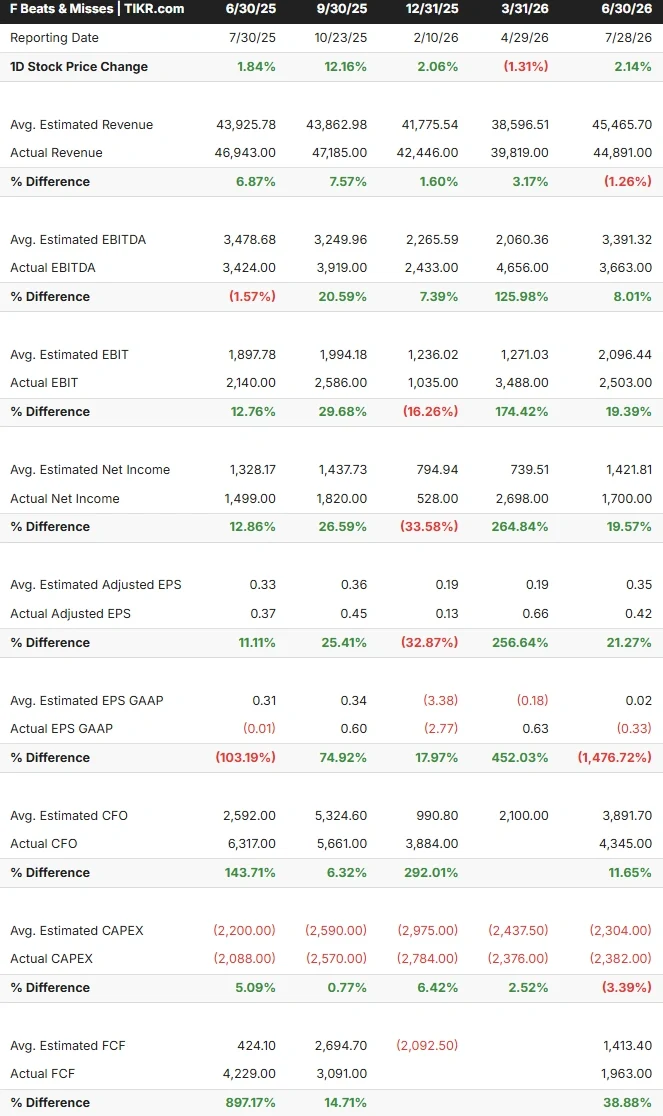
Ford delivered $48.3 billion in revenue and $2.5 billion in adjusted EBIT, with EBIT up 17% year over year even as revenue slipped 4%. That is the story in one line: profit rose while the top line fell, because the quarter’s strength came from mix and net pricing rather than volume. Off-road and passion products now make up 25% of U.S. sales, and Ford Blue swung to a 72% EBIT increase on richer trims and disciplined incentives. A $3.6 billion charge tied to the BlueOval SK battery joint venture pushed Ford to a $1.3 billion GAAP net loss, but the operating trajectory underneath it improved.
Management raised full-year adjusted EBIT guidance to $10 billion to $11 billion, a $1 billion increase at the midpoint, and lifted the free cash flow outlook to $6 billion to $7 billion without touching capital expenditure. CFO Sherry House framed the driver plainly: “this quarter’s EBIT strength was largely a result of strong mix and net pricing.” Pricing power is the hardest thing for a legacy automaker to fake, and this quarter it showed up in both the gross margin and the guidance. Jefferies agreed, upgrading Ford from Hold to Buy with a $17.50 target and arguing the second quarter marked the trough in volumes as F-Series production normalizes out of the Novelis aluminum disruption. With F-Series running at a lean 45-day supply, wholesale volume has room to recover in the back half.
See historical and forward estimates for Ford stock (It’s free!) >>>
A Tariff Aimed Straight at Oakville
On the call, management highlighted that Oakville launches in the fourth quarter with up to 100,000 units of additional Super Duty capacity, framed as a way to meet pent-up demand. Four weeks later, that capacity sits in the path of a proposed 50% duty on Canadian-built vehicles.
Trump’s tariff is a threat effective January 1, 2027, not a rule currently collecting duties, and it followed the collapse of U.S.-Canada trade talks both sides had believed were near completion. On the announcement, Stellantis fell more than Ford and General Motors fell less, a split that shows the market sorting Detroit by Canadian exposure.
Weeks before the threat, CEO Jim Farley spent unusual time on trade policy, arguing that Ford builds the most in the U.S. among its peers and wants a revised USMCA that levels the field against imports. “We want to make it easier for Ford and other U.S. makers to compete with Japan and South Korea,” Farley said, positioning Ford as the domestic manufacturer that should benefit from tougher content rules rather than lose from them. That is Ford’s central defense: a company that assembles heavily in the U.S. should come out ahead of importers if the rules tighten. The tariff as announced does not yet draw that distinction, which is the risk.
Where the Valuation Sits
At $13.88, Ford is not the cheap value play its low headline price suggests. It trades at 8.27 times next-twelve-month earnings, a premium to General Motors at 6.30 times, and on an enterprise-value-to-EBITDA basis, its 13.1 times sits above GM’s 7.6 times and roughly in line with Toyota’s 12.3 times. In other words, the market is already paying up for Ford relative to its closest Detroit peer, not discounting it. That makes the bull case dependent on the fundamentals continuing to improve rather than on the stock being statistically cheap, and it raises the stakes on the drags that remain. Model e still loses about $4 billion in 2026, commodity headwinds run above $2 billion for the year, and the second half carries heavier UEV and Ford Energy investment. The tariff lands on top of a valuation that has little cushion built in, since a January 1 effective date leaves four months for a deal, a court challenge, or an exemption to change the math.

See how Ford performs against its peers in TIKR (It’s free!) >>>
TIKR Advanced Model Analysis
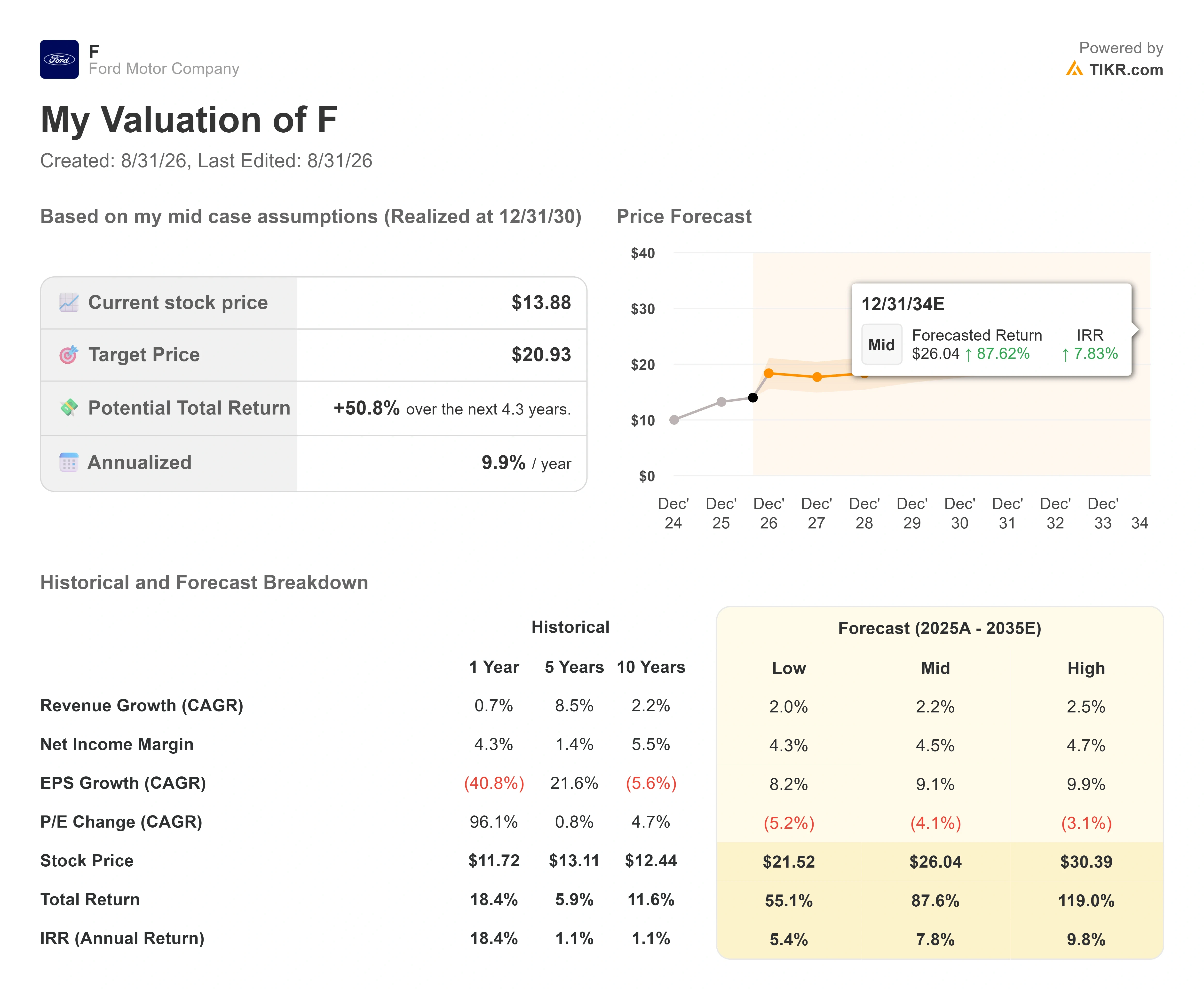
- Current Price: $13.88
- Target Price (Mid): ~$21
- Potential Total Return: ~51%
- Annualized IRR: ~10% / year
See analysts’ growth forecasts and price targets for Ford stock (It’s free!) >>>
TIKR’s mid-case model values Ford at around $21 per share, a total return of roughly 51% over the model’s 4.3-year horizon, or about 10% annualized. The case does not rest on heroic assumptions. Revenue CAGR in the mid case runs around 2%, carried by two drivers the quarter validated: Ford Pro’s software and physical services, where paid subscriptions grew about 50% to roughly 1.6 million, and the off-road and hybrid mix shift lifting Ford Blue pricing. The margin driver is the $1 billion in annual material and warranty cost reductions management is banking on as its J.D. Power initial-quality gains convert into lower warranty and recall spending.
The primary risk is now policy, not operations. A 50% Canadian duty that takes effect as written would raise the cost of the Oakville Super Duty capacity, pressuring the mid-case margin assumption directly. The upside is a company that keeps raising guidance through known headwinds while services and energy scale into higher-margin revenue. The downside is a trade war that turns a growth project into a stranded cost before it ships a full year.
Conclusion
The next real checkpoint is not an earnings date. It is January 1, 2027, and the weeks of negotiation before it. If a revised trade deal carves out an exemption for U.S.-committed manufacturers along the lines Farley argued for, Oakville survives, and the beat-and-raise becomes the dominant story again. If the 50% duty lands as written, the model’s margin assumption needs a haircut, and the discount to peers looks earned. Watch the September 8 Canadian counter-tariff date as the first tell of whether this de-escalates or hardens. Until then, Ford is a genuinely improved business wearing a policy risk it did not choose and cannot yet price.
See what stocks billionaire investors are buying so you can follow the smart money with TIKR.
Should You Invest in Ford?
The only way to really know is to look at the numbers yourself. TIKR gives you free access to the same institutional-quality financial data that professional analysts use to answer exactly that question.
Pull up Ford, and you’ll see years of historical financials, what Wall Street analysts expect for revenue and earnings in the quarters ahead, how valuation multiples have moved over time, and whether price targets are trending up or down.
You can build a free watchlist to track Ford alongside every other stock on your radar. No credit card required. Just the data you need to decide for yourself.
Looking for New Opportunities?
- See what stocks billionaire investors are buying so you can follow the smart money.
- Analyze stocks in as little as 5 minutes with TIKR’s all-in-one, easy-to-use platform.
- The more rocks you overturn… the more opportunities you’ll uncover. Search 100K+ global stocks, global top investor holdings, and more with TIKR.
Disclaimer:
Please note that the articles on TIKR are not intended to serve as investment or financial advice from TIKR or our content team, nor are they recommendations to buy or sell any stocks. We create our content based on TIKR Terminal’s investment data and analysts’ estimates. Our analysis might not include recent company news or important updates. TIKR has no position in any stocks mentioned. Thank you for reading, and happy investing!


