
Key Takeaways
- Nvidia’s latest 13F shows $48.33 billion of US stocks, nearly all of it in SpaceX, Intel, CoreWeave, Coherent and Synopsys.
- Analysts see 131% upside in CoreWeave, and 35% to 82% in the other four.
- Jensen Huang’s exit as Nvidia’s CEO puts its backing of these companies in question.
- If I could only buy one right now, it’d be Coherent, where earnings estimates are still rising.
Nvidia doesn’t just sell the chips behind the AI buildout. It also owns big stakes in the companies doing the building, and its 13F for the quarter ended Sept. 30, filed Nov. 16, shows $48.33 billion of US stocks across eight positions.
Those stakes matter more than usual right now. Jensen Huang resigned as CEO on Nov. 12, and The Wall Street Journal reported that interim CEO Colette Kress is expected to pull back on the computing deals and startup investments Nvidia has been financing.
Of Nvidia’s positions worth 2% or more, these are the five where Wall Street sees the most upside: CoreWeave (CRWV), SpaceX (SPCX), Coherent (COHR), Intel (INTC) and Synopsys (SNPS). Together, they made up nearly 98% of the portfolio at Sept. 30.
1. CoreWeave needs its lenders as much as its customers
Nvidia held 47.21 million CoreWeave shares worth $4.11 billion at Sept. 30, 8.5% of the portfolio and unchanged from June 30. Nvidia is also its chip supplier, a buyer of its capacity, and an investor that put in $2 billion at $87.20 a share in January. The stock has fallen 43% since Sept. 30, even after a third quarter that beat its own guidance, with revenue up 168% to $3.66 billion.
The worry is the bill for that growth: CoreWeave expects its next contract-backed loan to yield 7% to 7.5%. The consensus target has slipped from $130.54 a year ago, and a peak of $144.46 in August, to $115.34:
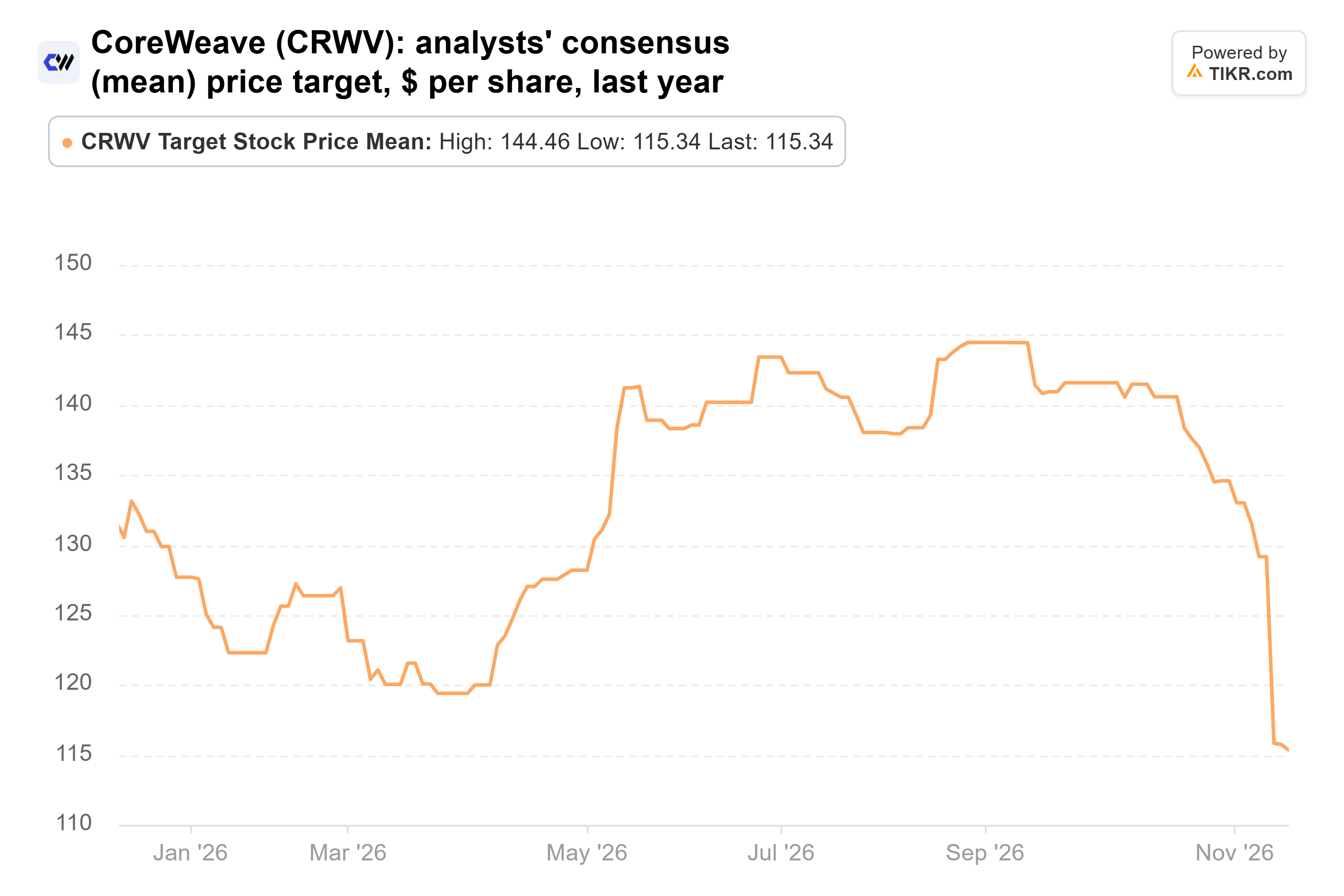
That’s still 131% above the last close of $49.89, if CoreWeave can keep borrowing at a cost its contracts cover.
TIKR tracks 41 analysts on CoreWeave. How many say “Buy”?
See the full breakdown of Buy, Hold, and Sell ratings on CoreWeave, along with Wall Street’s revenue and earnings estimates, all in one place. More than 500,000 investors use TIKR to research stocks like this one. See CoreWeave’s Analyst Ratings
2. SpaceX is Nvidia’s biggest bet, and it got bigger
SpaceX tops Nvidia’s portfolio: 130.47 million shares worth $19.68 billion at Sept. 30, 40.7% of the total, after Nvidia added 6% more shares in the quarter. Of these five, it’s the only stake Nvidia grew. The stock is down 6% since Sept. 30 and 37% below its 52-week high.
SpaceX is growing fast. Its third-quarter revenue rose 161% to $14.6 billion, and its AI segment brought in $7.56 billion of it. On Nov. 14, it caught Starship’s upper stage with its launch tower for the first time.
Analysts have chased all of that higher. The consensus target has more than doubled since SpaceX listed, from $114.00 in June to $257.50, its high so far:
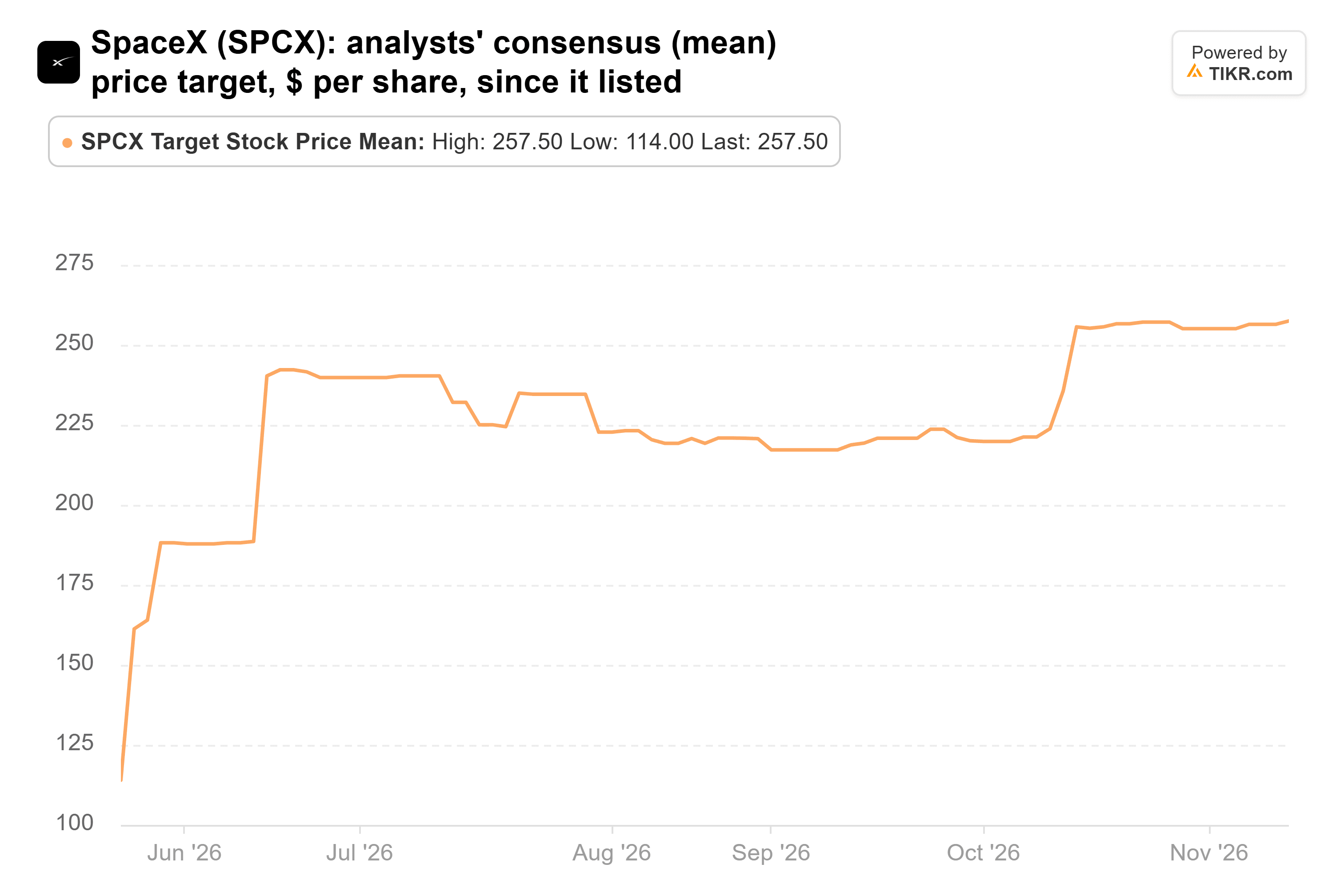
That’s 82% above the last close of $141.70. But one customer supplied 34.5% of third-quarter revenue, $170 of Morgan Stanley’s $300 target rests on enterprise AI, and management guides fourth-quarter capex to $35 billion to $40 billion.
3. Coherent trades below what Nvidia paid
Nvidia bought its Coherent stake outright: 7.79 million shares at $256.80 apiece in March, a $2 billion investment. Nvidia still held all of them at Sept. 30, worth $2.24 billion, or 4.6% of the portfolio. The stock has fallen 27% since then, to $210.86, which is below Nvidia’s price and 52% under its 52-week high.
Nvidia is also the lead customer for Coherent’s co-packaged optics, which management expects to bring in its first revenue in the December quarter. And analysts keep raising the earnings bar: consensus normalized EPS is $10.41 for fiscal 2027, the year ending June 2027, up from $9.42 a month earlier, and $15.79 for fiscal 2028. The weak spot is cash, since operating cash flow was negative $93 million in the September quarter and inventory rose to $3.3 billion. Still, two insiders bought $1.2 million of stock after the report.
The consensus target is off its August peak of $416.09, but it’s still more than double where it was a year ago:
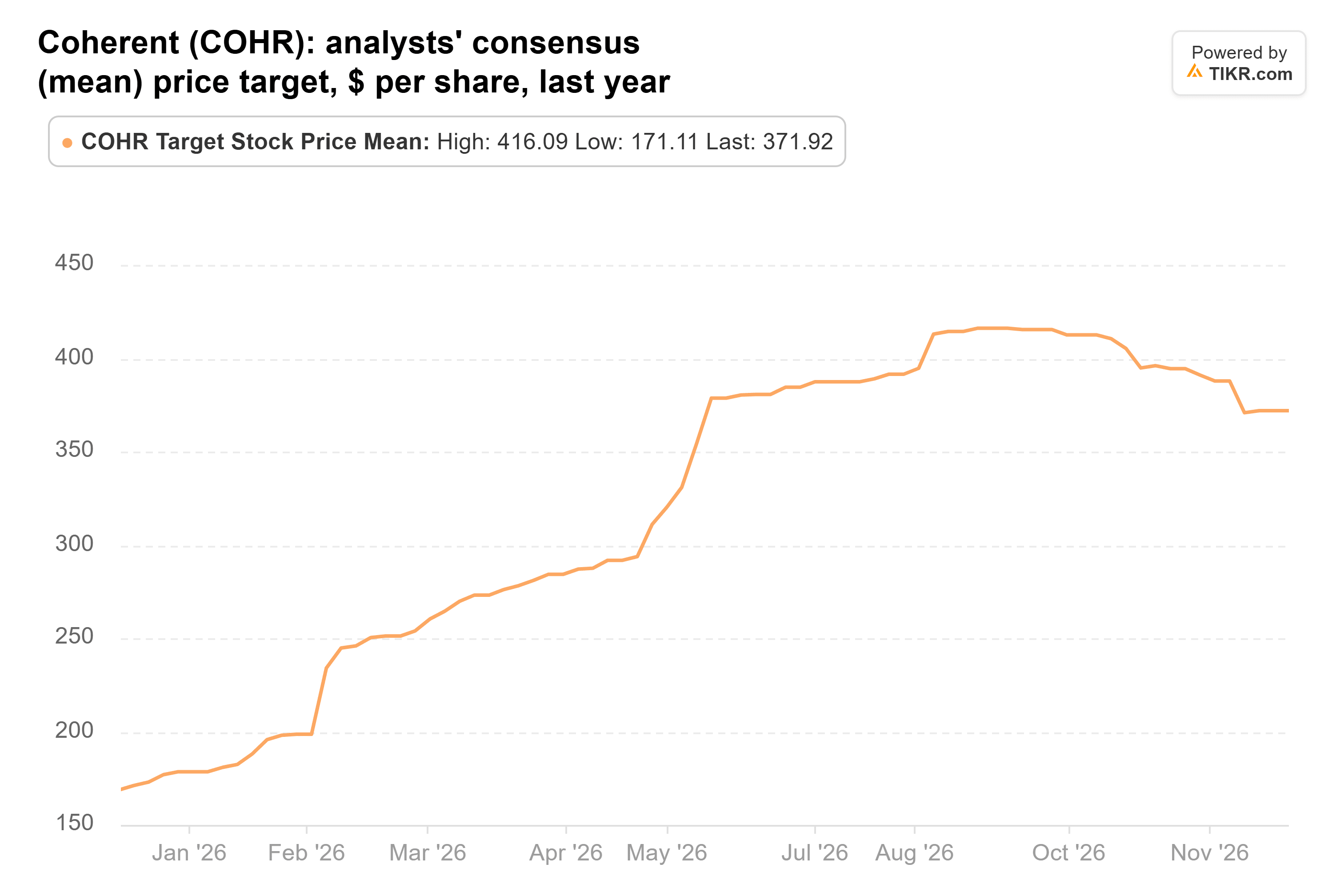
At $371.92, it’s 76% above the last close.
4. Nvidia is holding less Intel
Intel is Nvidia’s second-biggest holding: 161.08 million shares worth $19.37 billion at Sept. 30, or 40.1% of the portfolio. That’s 25% fewer shares than Nvidia held at June 30. The stock has fallen 54% since Sept. 30, after a weak outlook with its third-quarter report, and sits 61% below its 52-week high.
The server business is the bright spot. The data center segment’s operating margin cleared 40% in the third quarter, and CEO Lip-Bu Tan says AI systems now use about as many CPUs as GPUs. Tan also bought $9.7 million of stock after the drop. But analysts cut consensus 2027 normalized EPS to $1.79, from $2.11 before the report. And Huang championed the 2025 deal that paired Intel CPUs with Nvidia graphics and came with Nvidia’s $5 billion investment, so that deal’s future now rests on Nvidia’s next leader.
The consensus target has fallen from its October peak of $118.05, though it’s still far above the $37.27 of a year ago:
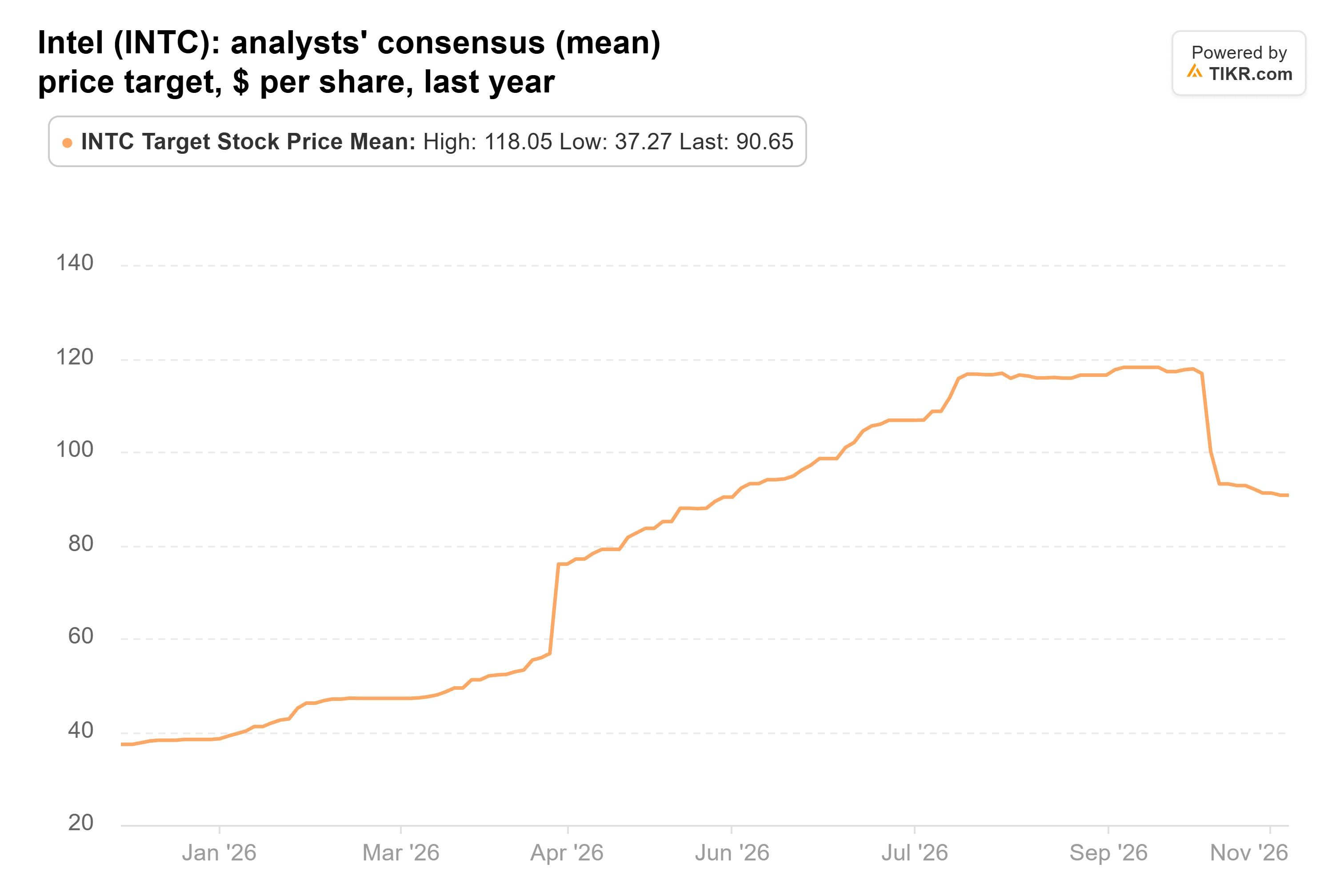
At $90.65, it sits 64% above the last close of $55.17.
5. Synopsys keeps beating its own guidance
Nvidia trimmed its Synopsys stake by 10% in the quarter, to 4.35 million shares worth $1.89 billion at Sept. 30, or 3.9% of the portfolio. The stock is up 0.1% since then and sits 19% below its 52-week high.
Synopsys’s numbers have been steadier. Revenue rose 42% to $2.48 billion in its fiscal third quarter, ended July 31, and most of the gain came from a full quarter of Ansys, which it bought in July 2025. Non-GAAP EPS of $3.91 beat the high end of its guidance. It guided to revenue of $9.69 billion to $9.74 billion for the fiscal year that ended Oct. 31, and it reports that year in early December.
Analysts’ view has barely budged, with the consensus target moving from $556.40 a year ago to $589.55:
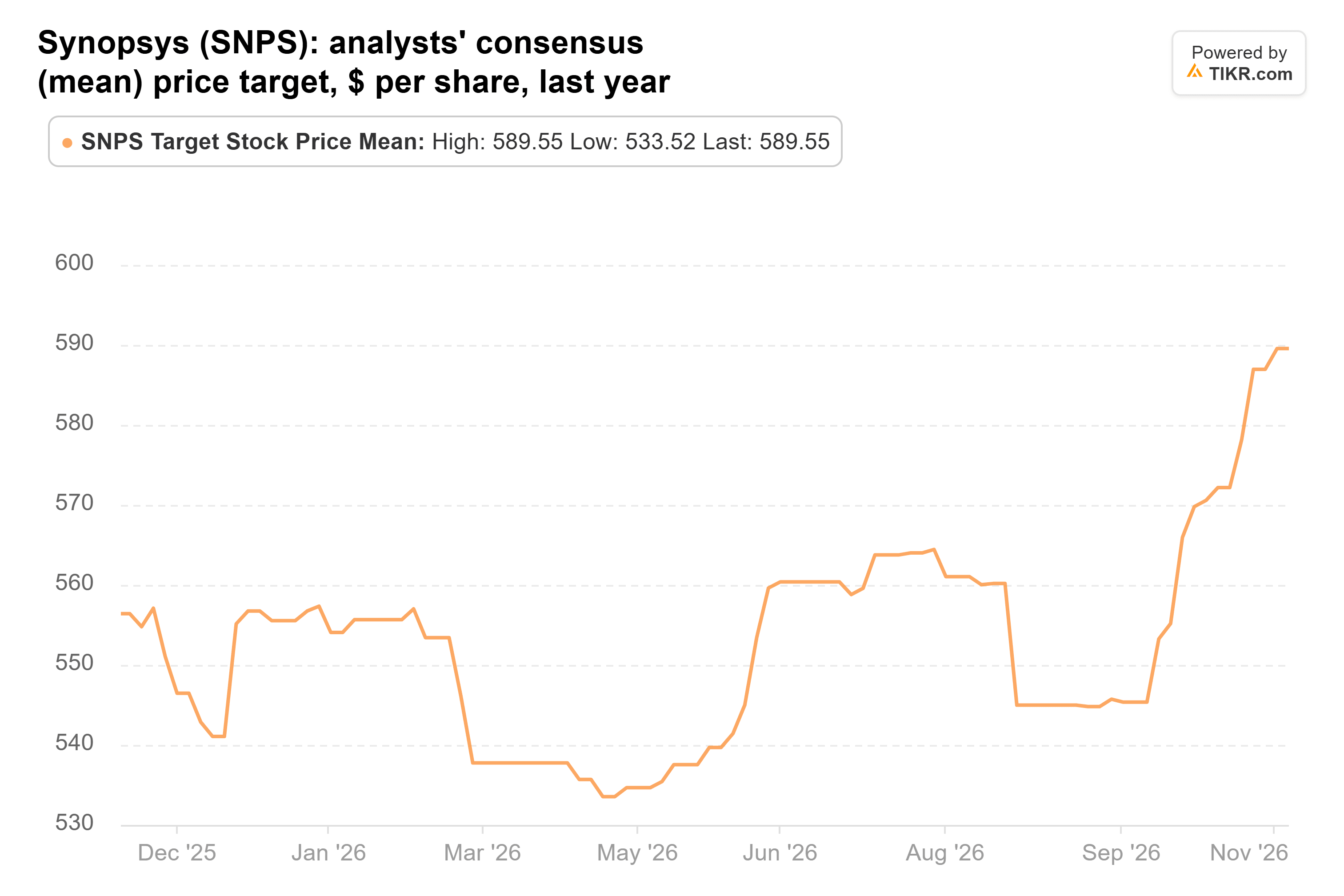
That’s 35% above the last close of $435.51.
Coherent is the one I’d buy
If I could only buy one right now, it’d be Coherent. Analysts keep raising its earnings estimates while the stock trades below what Nvidia paid in March. And its spending plan, about $1.6 billion of capex a year in consensus, is a fraction of what CoreWeave and SpaceX have to fund.
The risk is Nvidia itself. Under Kress, it may finance fewer of the AI buyers Coherent supplies, and it’s the lead customer for Coherent’s co-packaged optics. Coherent’s next report, in early February, will show whether operating cash flow has turned positive. Nvidia’s next 13F, for the quarter ending Dec. 31, is due by mid-February and will show whether Kress kept these stakes.
So what is CoreWeave stock actually worth?
TIKR lets you forecast the future price of any stock in less than a minute. Just enter a few assumptions into TIKR’s valuation model and see what CoreWeave could be worth. Start from Wall Street consensus estimates, or adjust the inputs to reflect your own view of the business. It’s free to use.
Disclaimer:
Please note that the articles on TIKR are not intended to serve as investment or financial advice from TIKR or our content team, nor are they recommendations to buy or sell any stocks. We create our content based on TIKR Terminal’s investment data and analysts’ estimates. Our analysis might not include recent company news or important updates. TIKR has no position in any of the stocks mentioned. Thank you for reading, and happy investing!