Key Takeaways
- Brad Gerstner’s Altimeter Capital filed its third-quarter 13F on Nov. 16, and the five holdings where Wall Street sees the most upside are CoreWeave, a memory chipmaker, Cerebras, NVIDIA and Taiwan Semiconductor.
- All five have fallen at least 21% since Sept. 30, leaving analysts’ average targets 63% to 131% above current prices.
- Each target rests on something still unsettled, from CoreWeave’s borrowing costs to the memory cycle and NVIDIA’s leadership.
- Taiwan Semiconductor is the one to buy now: its October sales hit a 2026 high, and it trades below its usual multiple.
Brad Gerstner’s Altimeter Capital, which manages $18.75 billion, runs a concentrated book. Its 13F for the quarter ended Sept. 30, filed Nov. 16, lists just 16 US stocks worth $9.80 billion, and NVIDIA alone makes up 23% of them.
The AI trade has taken a beating since, and Wall Street now sees big upside in Gerstner’s picks. Among his positions of at least 2%, the five where analysts’ average targets sit furthest above the price are CoreWeave (CRWV), Micron (MU), Cerebras (CBRS), NVIDIA (NVDA) and Taiwan Semiconductor (TSM).
1. CoreWeave: a strong quarter, a heavy debt load
Altimeter held 4.78 million CoreWeave shares worth $416 million at Sept. 30, 4.2% of its 13F stocks, after cutting the stake 21%. The stock has fallen 43% since, even though CoreWeave reported a strong third quarter on Nov. 10, with a backlog of about $132.5 billion and a higher 2026 revenue outlook of $13 billion-$13.3 billion.
The worry is the debt behind that growth: borrowings more than doubled to $46.9 billion at Sept. 30 from $21.4 billion at the end of 2025. Analysts’ average target has slid from a peak of about $144 in August to about $115:
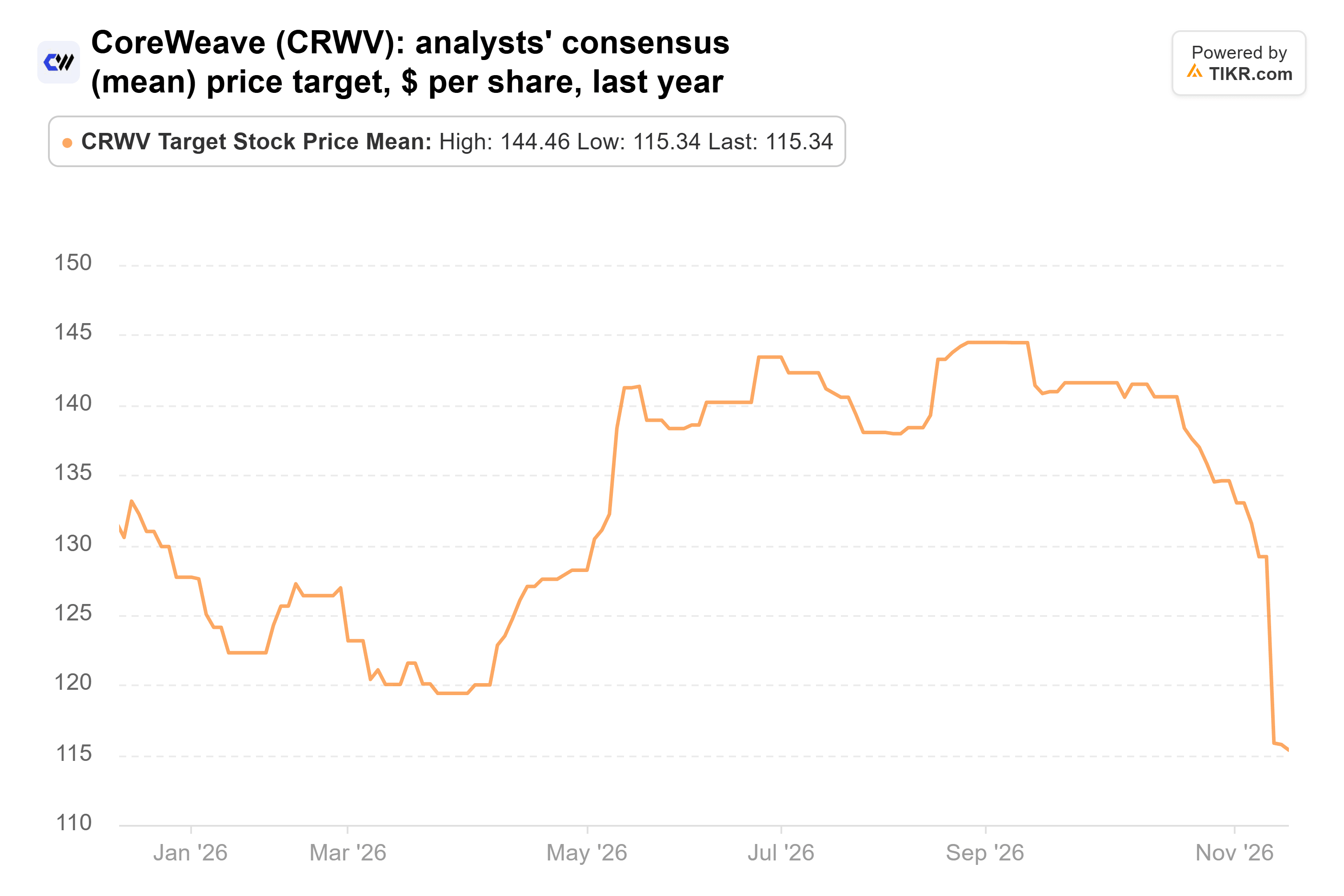
That’s still 131% above the price, from 41 analysts, and the forward price/sales multiple was already at its lowest since the 2025 IPO at Sept. 30, at 2.5x. CoreWeave’s next contract-backed loan, expected in the coming weeks at a 7% to 7.5% yield, will show whether it can keep borrowing at rates its contracts cover.
TIKR tracks 41 analysts on CoreWeave. How many say “Buy”?
See the full breakdown of Buy, Hold, and Sell ratings on CoreWeave, along with Wall Street’s revenue and earnings estimates, all in one place. More than 500,000 investors use TIKR to research stocks like this one. See CoreWeave’s Analyst Ratings
2. Micron: cheap, if the boom lasts
CoreWeave is also a Micron customer under a long-term supply deal, and Gerstner added to that side of the trade. Altimeter raised its Micron stake 24% in the third quarter, to 260,140 shares worth $277 million, 2.8% of its 13F stocks. The stock is down 33% since Sept. 30, most recently on tighter US export rules aimed at the AI chips its memory goes into.
Revenue reached $133.2 billion in fiscal 2026 (the year ended Sept. 3), up from $37.4 billion, and adjusted gross margin hit 87.0% in the fourth quarter. Analysts have chased it, and the average target is more than seven times what it was a year ago:
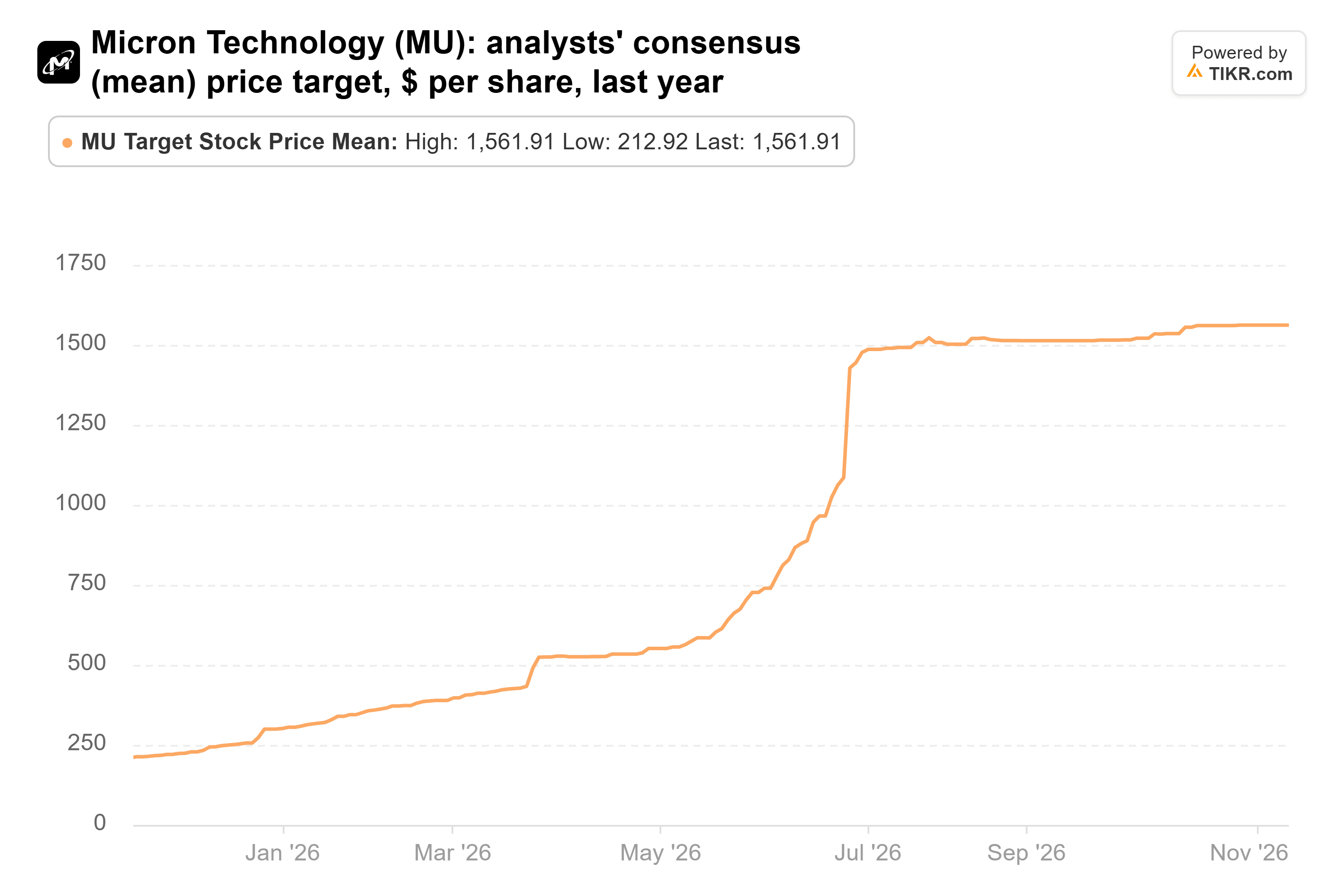
At about $1,562, from 49 analysts, it sits 119% above the price. On fiscal 2028’s consensus EPS of $206.89, that’s about 7.5x earnings, below the roughly 10x median of Micron’s quarter-end readings since 2014, so it needs no re-rating, only for record earnings to hold. Investors doubt they will: Micron trades at about 4x forward earnings, close to where it sat in 2017 and 2018, when the last memory cycle peaked. Management calls its fiscal first quarter, reported in mid-to-late December, the gross-margin floor for fiscal 2027.
3. Cerebras: growing fast, and priced for it
Gerstner bet far more on a much younger chipmaker. Cerebras listed in May, and it’s already Altimeter’s third-largest holding: 5.95 million shares worth $1.01 billion at Sept. 30, 10.3% of its 13F stocks, even after an 18% trim. It’s down 39% since.
Core revenue, Cerebras’ adjusted measure, rose 70% to $230.9 million in the third quarter, and the company raised its 2026 outlook and expects revenue to triple in 2027. CEO Andrew Feldman named Microsoft as a new cloud customer, with revenue from the deal expected to start in early 2027. But the GAAP net loss widened to $161.2 million, and executives said on the call that data-center delays have put parts of its OpenAI contract behind schedule.
Analysts have cooled since coverage began, with the average target down from $281 in early June to about $210:
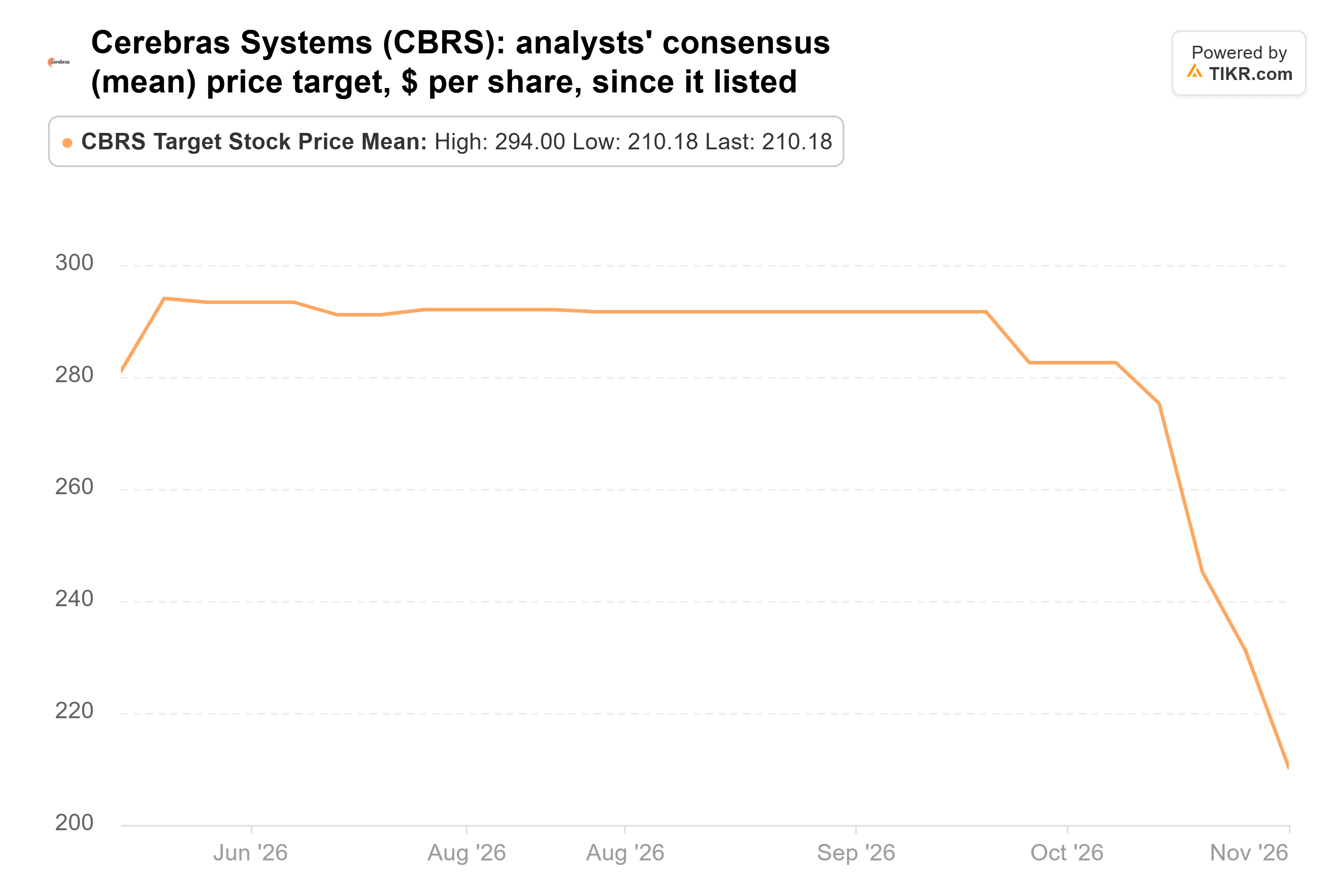
That’s still 102% above the price, from 11 analysts, and even the lowest target, $155, is about 49% above it. The catch is the valuation: at about 96x forward earnings, Cerebras needs that tripling to arrive on schedule.
4. NVIDIA: a big beat, without Jensen Huang
Cerebras is the challenger, and NVIDIA is still Gerstner’s biggest bet by far. Altimeter added 6% in the third quarter and held 10.01 million shares worth $2.29 billion at Sept. 30, 23.3% of its 13F stocks. The stock is down 32% since.
Jensen Huang resigned as CEO on Nov. 12, CFO Colette Kress is interim CEO, and the board isn’t considering bringing him back. The business kept going: revenue rose 103% to $115.8 billion in the quarter reported Nov. 17, above NVIDIA’s own $108.0 billion forecast, and it guided fourth-quarter revenue to $130.0 billion, with GAAP gross margin easing to 71%-72%.
The average target has still fallen by about a fifth since late October, with four firms cutting on Nov. 16 alone:
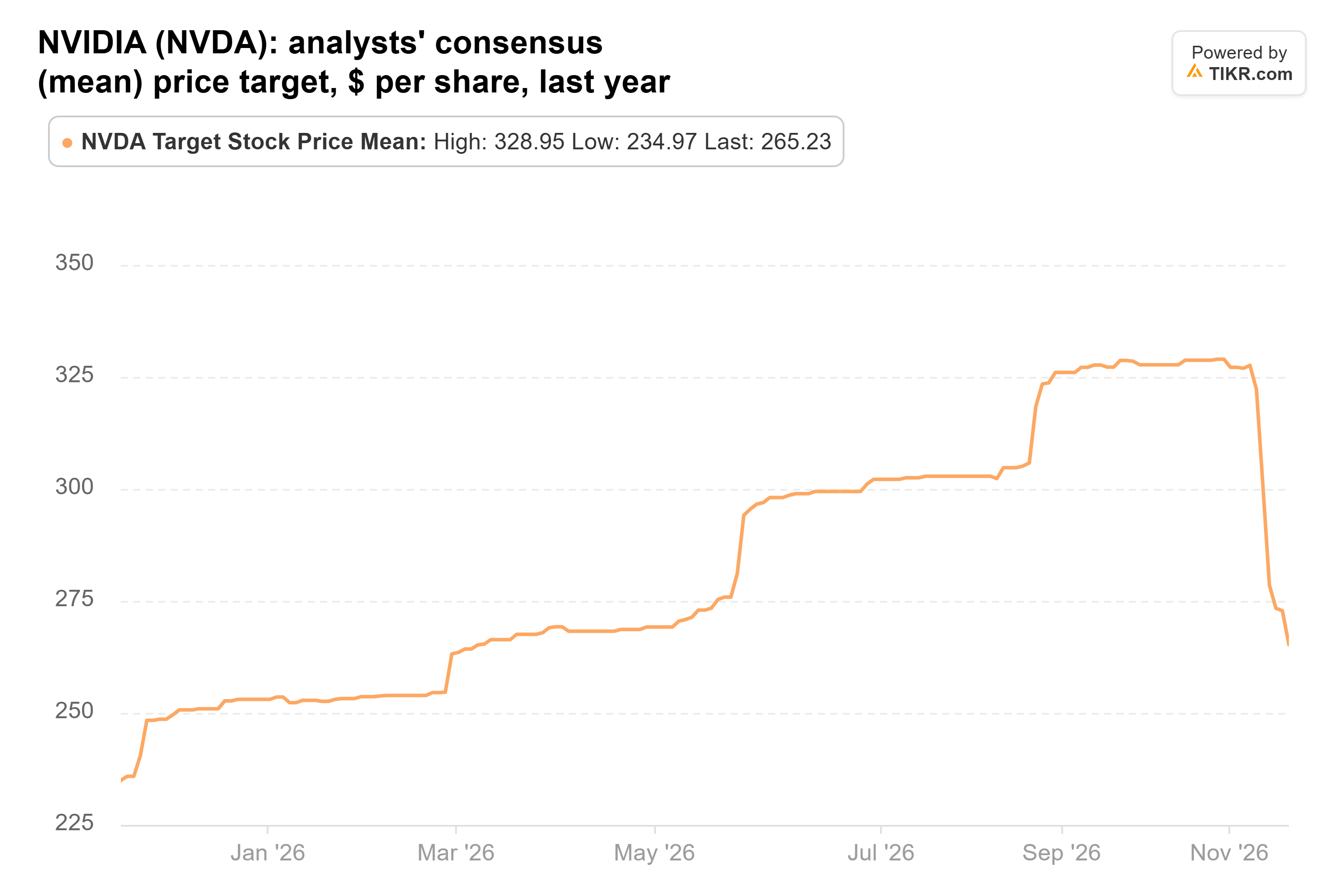
At about $261, from 63 analysts, it’s 68% above the price, and those estimates came before the Nov. 17 beat. On fiscal 2029’s consensus EPS of $21.34, the target is about 12x earnings, about half NVIDIA’s one-year average of 24x. At about 11x forward earnings today, below any quarter-end reading TIKR has going back to 2014, the stock needs no recovery in its multiple to get there, as long as estimates survive the search for a permanent CEO.
5. Taiwan Semiconductor: no slowdown yet
NVIDIA’s results matter for Taiwan Semiconductor too, since NVIDIA is widely reported to be the unnamed customer behind 19% of TSMC’s 2025 revenue. Altimeter left its stake unchanged: 1.43 million shares worth $654 million at Sept. 30, 6.7% of its 13F stocks. The stock is down 21% since.
October revenue rose 59.7% from a year earlier to NT$586.89 billion, a 2026 high, and third-quarter gross margin was 66.4%, up from 59.5% a year before. Analysts have kept raising their targets through the selloff, and the average sits at its high for the year, up from about $340 a year ago:
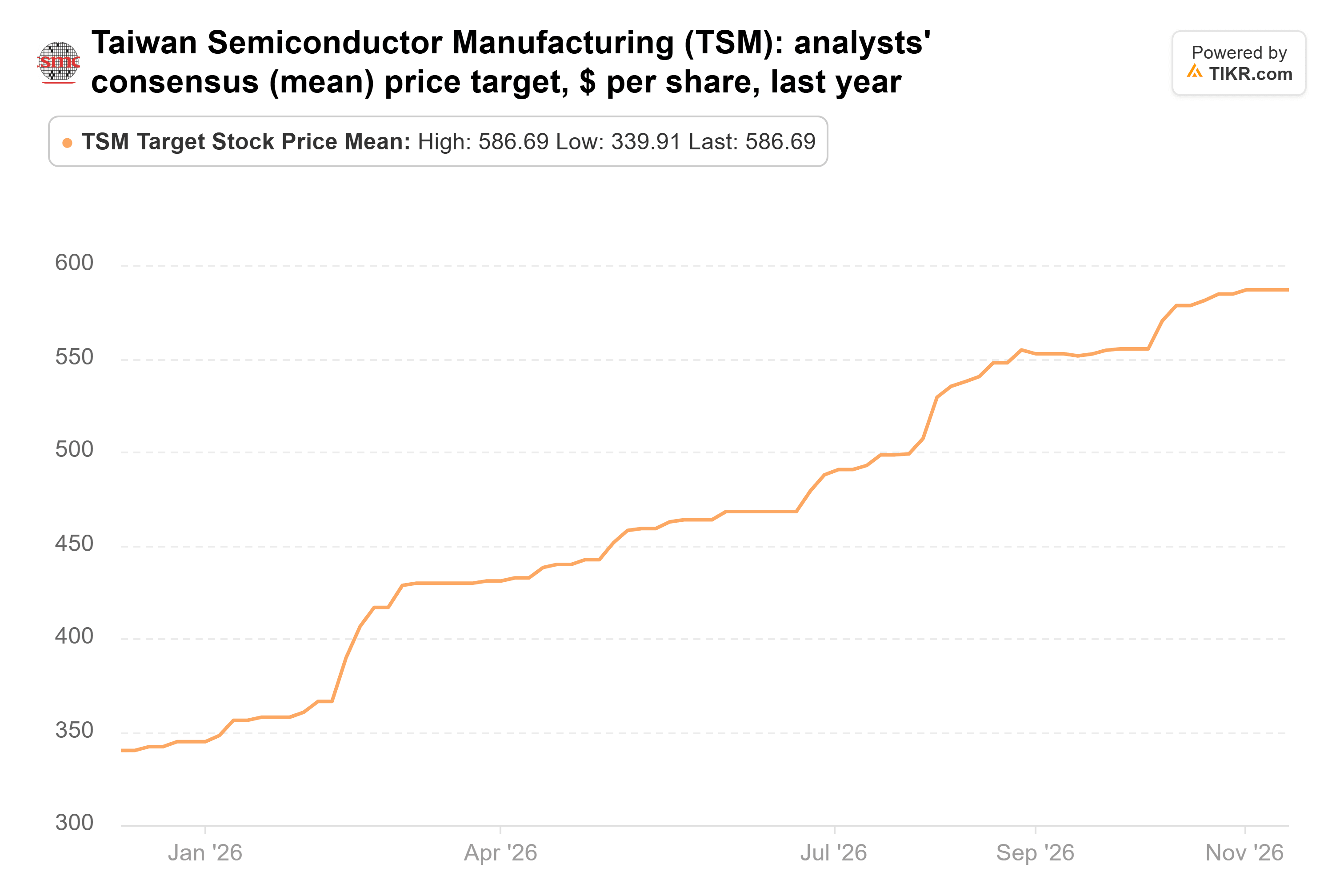
At about $587, from 21 analysts, it’s 63% above the price. TSMC trades at about 17x forward earnings, below its one-, three- and five-year averages of 21x, 19x and 18x. The risk is the build-out: management guides 2026 capital spending to $60 billion-$64 billion, mostly for capacity that arrives in 2028 and 2029.
The one I’d buy now
If I could only buy one right now, it’d be Taiwan Semiconductor. It makes chips for NVIDIA and for the companies trying to compete with it, its October sales show AI demand hasn’t cooled, and it costs less than its usual multiple.
TSMC’s November revenue, due around Dec. 10, is the next check, followed by its 2027 guidance in mid-January, where a weak outlook or a much bigger capital budget would change the answer. Altimeter’s next 13F, due by mid-February, will show whether Gerstner held on.
So what is CoreWeave stock actually worth?
TIKR lets you forecast the future price of any stock in less than a minute. Just enter a few assumptions into TIKR’s valuation model and see what CoreWeave could be worth. Start from Wall Street consensus estimates, or adjust the inputs to reflect your own view of the business. It’s free to use.
Disclaimer:
Please note that the articles on TIKR are not intended to serve as investment or financial advice from TIKR or our content team, nor are they recommendations to buy or sell any stocks. We create our content based on TIKR Terminal’s investment data and analysts’ estimates. Our analysis might not include recent company news or important updates. TIKR has no position in any of the stocks mentioned. Thank you for reading, and happy investing!