Key Takeaways
- Micron shares jumped about 12% on November 11 after CoreWeave’s strong quarter, a week after falling about 17% on a Bloomberg report that Micron paused a Taiwan fab.
- The Taoyuan plant was budgeted at up to $4.5 billion, roughly 15% of Micron’s fiscal 2026 capital spending, and Taiwan makes about 60% of its DRAM.
- Micron guided fiscal first-quarter revenue to $61.5 billion and expects supply to be “much tighter” in fiscal 2027 and 2028.
- The fiscal first-quarter report, expected in mid-December, will show whether gross margin holds near 86% while the Taiwan labor dispute drags on.
Micron Technology (MU) just had a week that sums up the memory trade in 2026.
The shares fell about 17% on November 5 after Bloomberg reported that Micron had all but halted a planned $4.5 billion plant in Taiwan. Then they jumped about 12% on November 11, when CoreWeave (CRWV) posted a strong quarter and a $132.5 billion backlog.
SK Hynix (000660.KS) had set the tone two weeks earlier. It reported an 80% third-quarter operating margin and said the memory shortage could last through 2030.
So demand looks solid. The open question is whether Micron can build fast enough to sell into it.
A labor fight stalls Fab 11E
The Taoyuan site, called Fab 11E, was meant to start making DRAM and high-bandwidth memory in 2028. Executives worry that a union deal Micron reached in Taichung last month could be overturned if the smaller Taoyuan union grows.
Three facts frame the risk:
- Taiwan accounts for about 60% of Micron’s DRAM output and a large share of its HBM.
- The Taoyuan union held a 24-hour strike on October 22 and has authorization to strike again.
- Micron says its Taiwan operations are running normally, and talks with the union are continuing.
Even so, the stock has swung harder than the news itself…
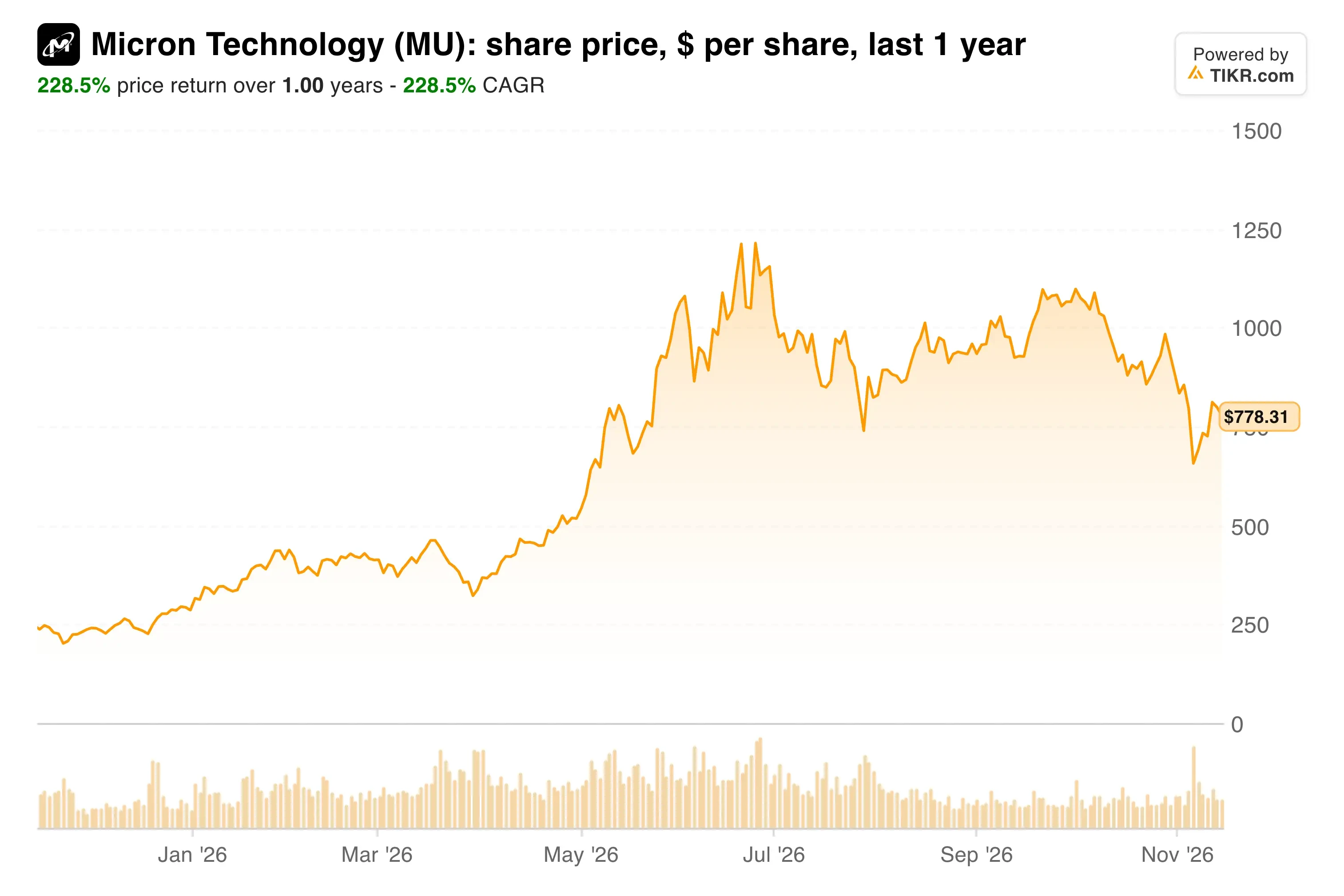
That volatility is the real story. Investors are trying to price how long this cycle lasts, so every supply or spending headline moves the stock.
The shortage pays the bills
Micron’s last quarter shows how much the shortage is worth. Fiscal fourth-quarter revenue rose 379% to $54.23 billion, and the core data center unit brought in $18 billion at a 90% gross margin.
Management also sounded more confident about next year. Micron’s prepared remarks predicted conditions “much tighter in fiscal 2027 and 2028 than they were in 2026.”
That’s why the Taoyuan pause stung. Micron needs new fabs to meet that demand, and its spending was already climbing fast.
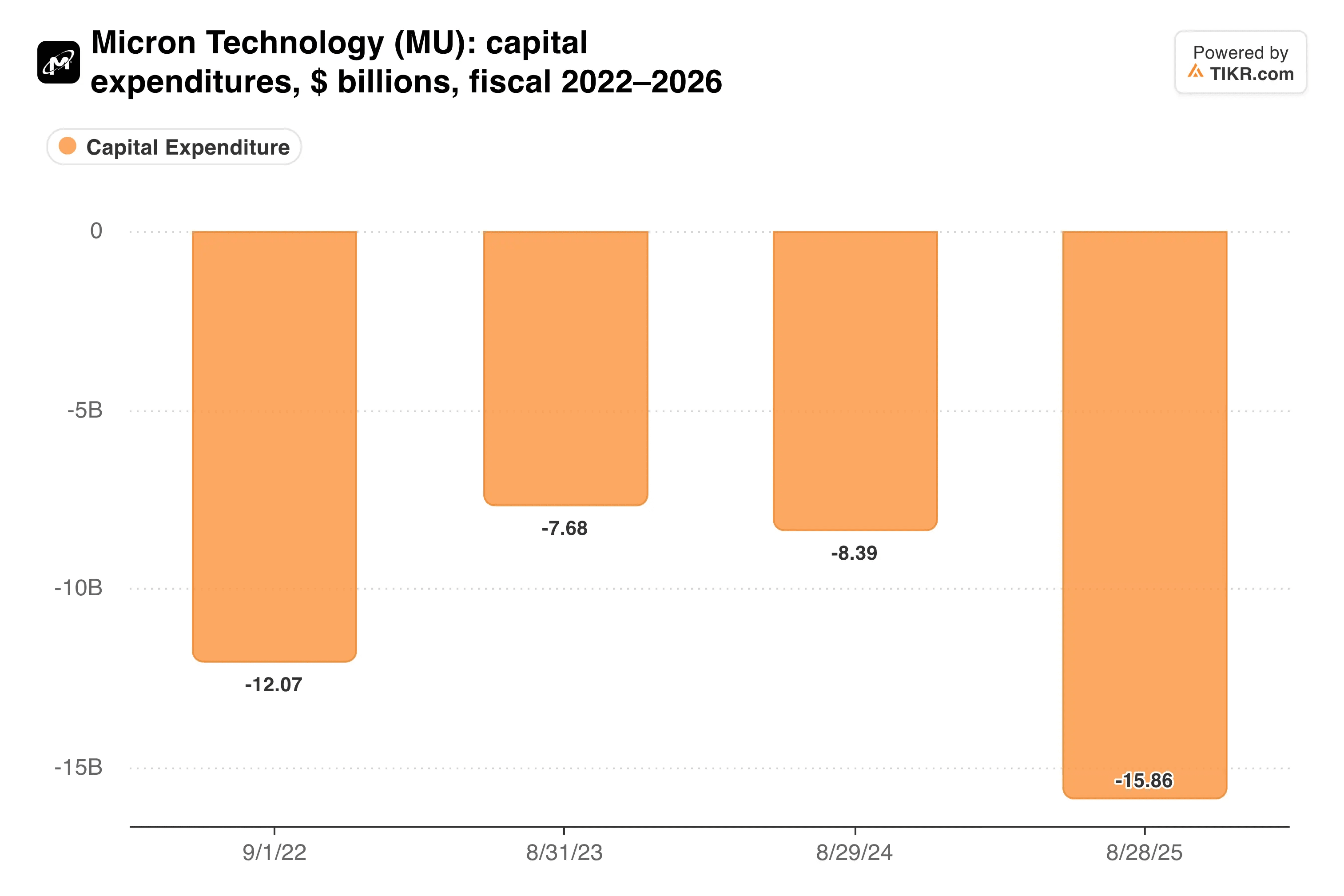
Capital spending nearly doubled to $30.7 billion in fiscal 2026. At up to $4.5 billion, the paused plant equals roughly 15% of that. Meanwhile, Micron is still expanding in Japan, Singapore and the US.
CoreWeave’s results back up the demand side. Its third-quarter revenue rose 168% to $3.66 billion, and it plans $37 billion to $39 billion of capital spending this year. CEO Michael Intrator called it a “breakout quarter.”
TIKR tracks 49 analysts on Micron. How many say “Buy”?
See the full breakdown of Buy, Hold, and Sell ratings on Micron, along with Wall Street’s revenue and earnings estimates, all in one place. More than 500,000 investors use TIKR to research stocks like this one. See Micron’s Analyst Ratings
Margins have little room left
The harder question is how much further profitability can run. So how far has gross margin already come?
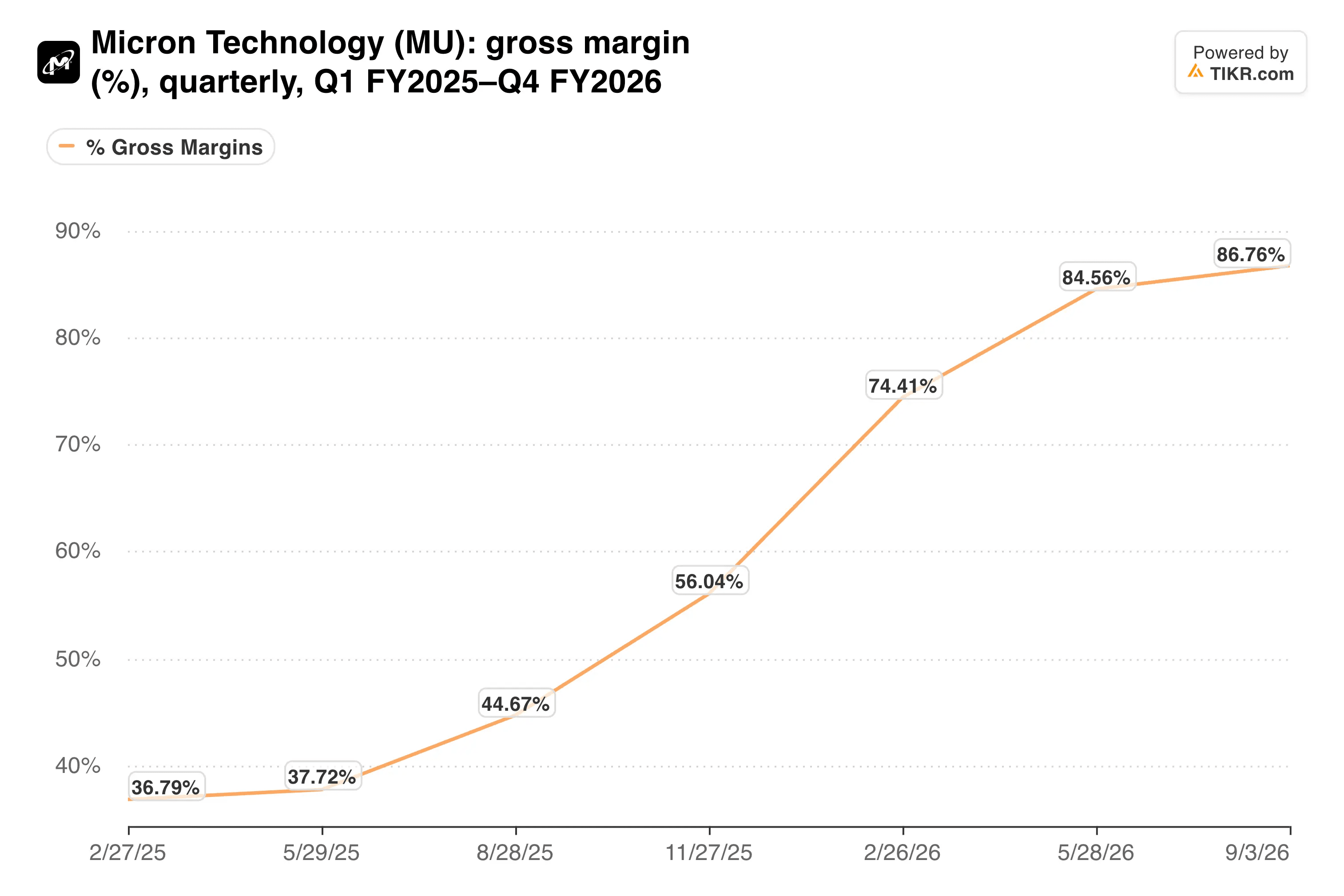
Gross margin went from 44.7% a year earlier to 86.8% last quarter. Micron guided to about 86% for the current quarter, on revenue of $61.5 billion and adjusted EPS of $38.15.
SK Hynix is a useful check. Its 80% operating margin sits just below Micron’s 82.3% adjusted operating margin, so both leaders are running close to peak pricing power.
The risks are clear, though. A longer labor fight in Taiwan, slower AI data center spending, or customer pushback on prices would all hit those margins first.
My take: The Taoyuan pause is a labor fight with a supply cost attached. Micron has $73.5 billion in cash and investments, so it can build elsewhere if talks fail. However, a stock this sensitive to headlines will keep swinging, and I’d want proof that margins can hold before calling a bottom.
The fiscal first-quarter report, expected in mid-December, is the next test. It will show whether revenue lands inside the $60 billion to $63 billion range while the Taiwan talks drag on.
So what is Micron stock actually worth?
TIKR lets you forecast the future price of any stock in less than a minute. Just enter a few assumptions into TIKR’s valuation model and see what Micron could be worth. Start from Wall Street consensus estimates, or adjust the inputs to reflect your own view of the business. It’s free to use.
Disclaimer:
Please note that the articles on TIKR are not intended to serve as investment or financial advice from TIKR or our content team, nor are they recommendations to buy or sell any stocks. We create our content based on TIKR Terminal’s investment data and analysts’ estimates. Our analysis might not include recent company news or important updates. TIKR has no position in any stocks mentioned. Thank you for reading, and happy investing!