Key Takeaways
- Teradyne (TER) fell approximately 21% during the week ended November 6, while Applied Materials (AMAT) declined nearly 15% as concerns about AI regulation and slowing data-center spending pressured semiconductor equipment stocks.
- Teradyne reported 70% third-quarter revenue growth to $1.31 billion, supported by record revenue in its Memory and Integrated Systems Test businesses.
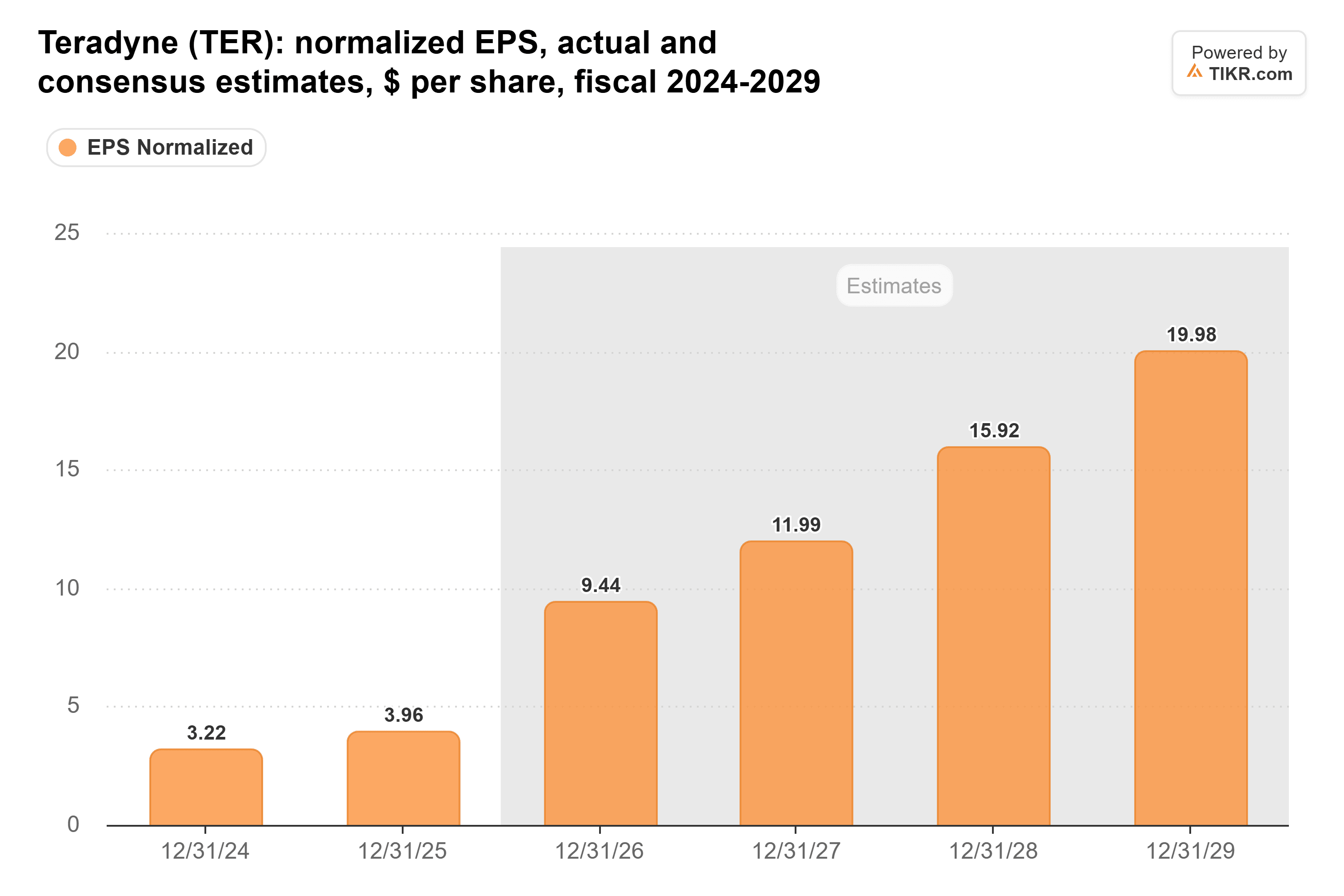
- Analysts projected Teradyne’s normalized EPS would roughly triple from $3.96 in 2025 to $11.99 in 2027, according to TIKR estimates dated October 31.
- Teradyne traded near 20x forward earnings on November 5, below its five-year average of 32x, although its subsequent rebound has reduced the original valuation discount.
What Happened?
Teradyne (TER) stock fell approximately 21% during the week ended November 6, while Applied Materials (AMAT) dropped nearly 15% as investors reassessed semiconductor equipment spending following the U.S. midterm elections.
According to historical trading data, Teradyne’s steepest declines came on November 4 and 5, when shares fell 6.8% and 15.2%, respectively.
The selloff coincided with concerns about potential AI regulation and slower data-center investment, both of which could eventually weaken demand for semiconductor manufacturing and testing equipment.
Reuters reported that the Philadelphia Semiconductor Index plunged more than 12% on November 5 as investors reassessed the outlook for AI infrastructure spending.
Teradyne supplies automated testing equipment used in semiconductor production, while Applied Materials provides technology used to manufacture advanced chips.
Both companies depend on customers continuing to invest in semiconductor production capacity, making their businesses sensitive to changes in capital spending.
However, Teradyne’s latest earnings showed that demand for its testing equipment remained strong despite the broader market selloff.
According to its official third-quarter earnings release, revenue jumped 70% to $1.31 billion from $769 million a year earlier.
Non-GAAP EPS reached $2.29, exceeding the $2.06 analyst consensus cited in the original research brief.
CEO Greg Smith said demand “extended across the AI value chain,” including memory and hard disk drive testing, high-speed interconnects, and robotics.
Teradyne also reported record quarterly revenue in Memory and Integrated Systems Test, highlighting demand for AI-related chip testing.
Still, third-quarter revenue was slightly below the $1.33 billion reported in the second quarter.
Management guided for fourth-quarter revenue of $1.25 billion to $1.35 billion, suggesting little sequential growth at the midpoint.
That raises questions about how quickly Teradyne can continue expanding despite strong year-over-year demand.
Meanwhile, Applied Materials is scheduled to report fiscal fourth-quarter results on November 12, with its outlook providing another important test of semiconductor equipment demand.
Is Teradyne Stock Undervalued or Overvalued?
Teradyne appeared potentially undervalued following its November 6 selloff, although its subsequent rebound has narrowed the original valuation discount.
According to TIKR’s October 31 estimates, analysts projected normalized EPS would increase from $3.96 in 2025 to $11.99 in 2027, representing approximately threefold growth.
On November 5, Teradyne traded at approximately 20x forward earnings, compared with its five-year average of 32x and its June 2026 peak near 70x.

According to S&P Global analyst consensus data, 18 analysts have an average Teradyne price target of $415.88, implying approximately 56% upside from the November 11 closing price of $265.78. However, analyst targets are estimates rather than guaranteed returns.
Over the next 12 months, stronger AI testing demand, increased memory investment, and continued semiconductor capital spending could support Teradyne’s earnings growth.
However, flat sequential revenue guidance, weaker equipment orders, and potential AI regulatory restrictions could pressure earnings estimates and justify a lower valuation.
Teradyne’s strong earnings growth suggests the November selloff may have been excessive, but its subsequent rebound has reduced the original valuation discount. If AI testing demand remains strong, the stock could have further upside, although weaker equipment orders or disappointing guidance would challenge that outlook.
So what is Teradyne stock actually worth?
TIKR lets you forecast the future price of any stock in less than a minute. Just enter a few assumptions into TIKR’s valuation model and see what Teradyne could be worth. Start from Wall Street consensus estimates, or adjust the inputs to reflect your own view of the business. It’s free to use.
Disclaimer:
Please note that the articles on TIKR are not intended to serve as investment or financial advice from TIKR or our content team, nor are they recommendations to buy or sell any stocks. We create our content based on TIKR Terminal’s investment data and analysts’ estimates. Our analysis might not include recent company news or important updates. TIKR has no position in any of the stocks mentioned. Thank you for reading, and happy investing!