Key Takeaways
- Target and Hasbro both yield 3.1%, so the 10-year question comes down to how fast each dividend grows.
- Target grew its dividend 11% a year from the year to January 2021 to the year to January 2026, but its latest raise was 1.8%.
- Hasbro’s dividend grew 0.6% a year from fiscal 2020 to fiscal 2025, though it used just 32% of free cash flow in the twelve months to June 2026, against 46% at Target in the twelve months to August 2026.
- Hasbro raised its 2026 buyback target from $100 million to at least $200 million, so watch whether any spare cash goes to a bigger dividend.
Hasbro (HAS) raised its 2026 outlook in July. It now expects revenue growth of 5% to 7% in constant currency, up from 3% to 5%.
A month later, Target (TGT) raised its own outlook, to net sales growth of around 5% for 2026.
Both stocks yield 3.1%, so $10,000 in either one pays $310 a year to start. What matters is how fast that check grows. So which one pays you more over the next 10 years?
| Metric | Target (TGT) | Hasbro (HAS) |
|---|---|---|
| Dividend yield | 3.1% | 3.1% |
| Annual dividend | $4.64 | $2.80 |
| Dividend growth, 5 years | 11.0% a year (years to Jan. 2021–Jan. 2026) | 0.6% a year (fiscal 2020–2025) |
| Cash dividend payout ratio, TTM | 46% (to Aug. 1, 2026) | 32% (to June 28, 2026) |
| Net debt/EBITDA | 1.49x | 1.92x |
| Interest coverage | 12.66x | 6.92x |
Target: still raising, just more slowly
Net sales rose 5.3% to $26.5 billion in the quarter ended Aug. 1, 2026, on comparable sales growth of 3.8%.
Over the twelve months to Aug. 1, 2026, Target paid $2.07 billion in dividends out of $4.46 billion of free cash flow, a well-covered 46%. That’s a healthier figure than the year to January 2026, when free cash flow fell from $4.48 billion the year before to $2.84 billion, against $2.05 billion of dividends…
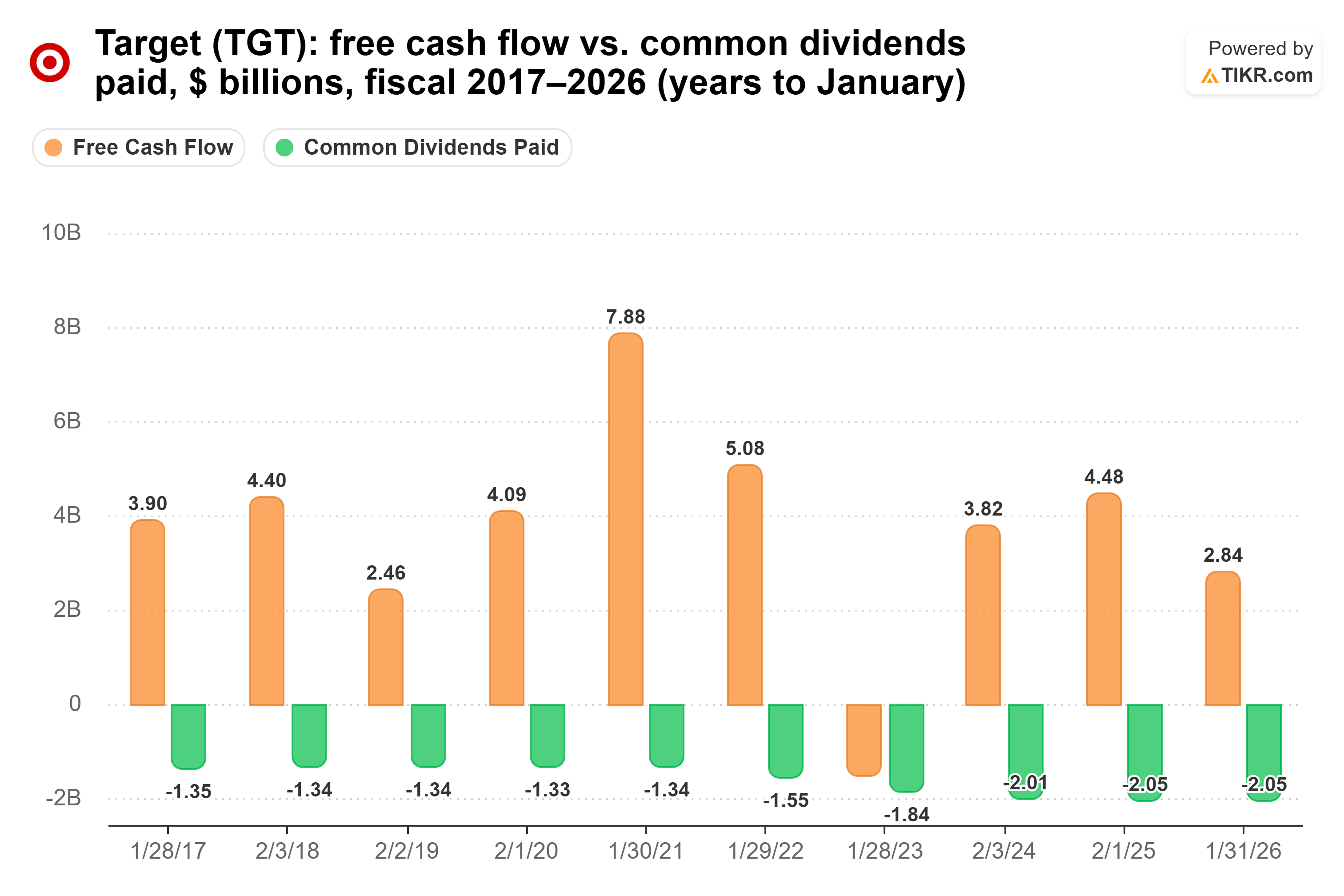
…and in the year to January 2023, free cash flow went negative.
Dividends per share grew from $2.70 in the year to January 2021 to $4.54 in the year to January 2026, but the latest raise was 1.8%, to $1.16 a share a quarter. Management wants to “balance our long-standing commitment to the dividend with our goal of moving towards a 40% payout ratio over time,” while building on “our more than 50-year record of annual increases.”
The risk is a down year: Target expects about $5 billion of capital spending in 2026.
Hasbro: plenty of cash, little dividend growth
Target’s dividend has grown faster than its business. Hasbro’s story runs the other way. Dividends per share went from $2.72 in fiscal 2020 to $2.80 in fiscal 2025, and the dividend is now $0.70 a quarter.
Meanwhile, revenue rose 16% in the second quarter of 2026, led by a 32% jump at Magic: The Gathering.
Over the twelve months to June 28, 2026, Hasbro paid $394 million in dividends from $1.21 billion of free cash flow, a comfortable 32%. Fiscal 2022 was the exception, when free cash flow of $245 million fell short of $385 million in dividends…

…and the payout ratio has dropped each year since, from 65.8% in fiscal 2023 to 47.3% in fiscal 2025.
So where’s the spare cash going? Into buybacks. Hasbro raised its 2026 repurchase target from $100 million to at least $200 million. As CFO and COO Gina Goetter put it: “Moving forward we are leaning into our $1B share repurchase authorization as we continue to balance investment in the business with returning cash to shareholders.”
The main risk is concentration: Hasbro names its reliance on Magic as a risk factor.
So which dividend wins?
Target pays you more over the next 10 years. At each stock’s 5-year rate, $10,000 in Target pays about $5,172 in dividends over the decade, against about $3,182 for Hasbro.
Target won’t keep up 11% a year, given that 1.8% raise and its 40% goal. But even at 1.8% a year, it pays about $3,363 over the 10 years, still ahead of Hasbro at its 5-year pace.
Hasbro’s latest year is the one wrinkle. TIKR’s per-share figures show its dividend up 33.3% in fiscal 2025, and at that pace Hasbro would win in a landslide. But it paid $390 million in dividends in fiscal 2024 and $393 million in fiscal 2025. That’s nearly the same cash, which doesn’t fit a dividend a third bigger.
None of this makes Hasbro’s dividend shaky. It’s the better-covered of the two today, at 32% of free cash flow against 46%, and its business is growing faster. Target still edges it, though: it keeps raising its dividend, carries less debt, and pays more over the decade even at its slowest recent pace.
Of course, a 32% payout leaves Hasbro plenty of room. If some of that buyback money ever goes to a real raise, the math changes.
So what is Target stock actually worth?
TIKR lets you forecast the future price of any stock in less than a minute. Just enter a few assumptions into TIKR’s valuation model and see what Target could be worth. Start from Wall Street consensus estimates, or adjust the inputs to reflect your own view of the business. It’s free to use.
Disclaimer:
Please note that the articles on TIKR are not intended to serve as investment or financial advice from TIKR or our content team, nor are they recommendations to buy or sell any stocks. We create our content based on TIKR Terminal’s investment data and analysts’ estimates. Our analysis might not include recent company news or important updates. TIKR has no position in any of the stocks mentioned. Thank you for reading, and happy investing!