


Key Takeaways
- Elon Musk said on Nov. 18 that SpaceX’s next direct-to-cell satellites start launching next year with 40x today’s bandwidth, and SpaceX aims for peak speeds of 150Mbps per user.
- On the two companies’ next-generation targets, AST SpaceMobile’s peak-speed lead shrinks from about 25x today to about 1.3x, though SpaceX’s target likely needs phones that support its new spectrum.
- AST had $70.9 million of revenue in 2025 and hasn’t yet booked wholesale service revenue from partners like AT&T and Verizon.
- T-Mobile, which already sells Starlink’s service, gains the most. AST’s next test is the launch of BlueBirds 14 to 16.
SpaceX (SPCX) says its phone service is about to get a lot faster, and AST SpaceMobile (ASTS) has the most to lose.
At the New York Times DealBook Summit on Nov. 18, Elon Musk said SpaceX starts launching its version 2 direct-to-cell constellation next year. It “will, I think, have forty times the bandwidth of the current direct-to-cell version one,” he said, adding that AT&T (T) and Verizon (VZ) may “lose some revenue here.”
But AT&T’s and Verizon’s satellite-to-phone plans run through AST, and AST’s commercial plan rides on them. T-Mobile (TMUS), meanwhile, already sells Starlink’s service as T-Satellite.
TIKR tracks 13 analysts on AST SpaceMobile. How many say “Buy”?
See the full breakdown of Buy, Hold, and Sell ratings on AST SpaceMobile, along with Wall Street’s revenue and earnings estimates, all in one place. More than 500,000 investors use TIKR to research stocks like this one. See AST SpaceMobile’s Analyst Ratings
AST’s 25x lead shrinks to 1.3x
In its first-quarter release, AST said a Block 1 BlueBird hit a peak of 98.9 Mbps to an unmodified phone, and management has since said it expects the bigger Block 2 satellites to get close to 200 Mbps with enough spectrum. Starlink’s T-Satellite service delivers roughly 4Mbps per user today, so AST’s measured peak is about 25x what a Starlink user gets.
SpaceX has already put a per-user number on its next generation. On Feb. 24, Udrivolf Pica, SpaceX’s spectrum and regulatory affairs lead, said at the ITU’s Space Connect conference: “We are aiming at peak speeds of 150Mbps per user.” Compared with AST’s Block 2 target, that leaves AST ahead by about 1.3x.
AST’s 98.9 Mbps is a measured result, and its bigger arrays may well keep it ahead in real-world use. SpaceX’s target also leans on new spectrum that phones will need to support, while AST’s works on the phones people already carry. But a carrier picking a satellite partner will now be comparing roughly 200 to 150. That’s a much harder sale for AST than 98.9 to 4, and the four big European carriers exploring a joint satellite-spectrum bid haven’t named a satellite partner for it.
AST needs 2027 to go right
AST needs about 45 to 60 BlueBirds in orbit for continuous service. It has 12 in orbit, and its date for reaching about 45 has slipped twice, most recently to mid-2027 in its Nov. 9 third-quarter report. BlueBirds 14 to 16 have shipped to Cape Canaveral but still have no firm launch date from SpaceX, whose Falcon 9 carries AST’s satellites.
Analysts expect revenue to climb from $70.9 million in 2025 to $1.65 billion by 2028:

Most of the 2026 estimate comes from gateway sales and government work, so Musk’s comments shouldn’t change it. The 2027 and 2028 estimates only hold up if carriers pay for AST’s service.
AST reported $42.3 million of revenue in the third quarter, and none of it came from wholesale service:
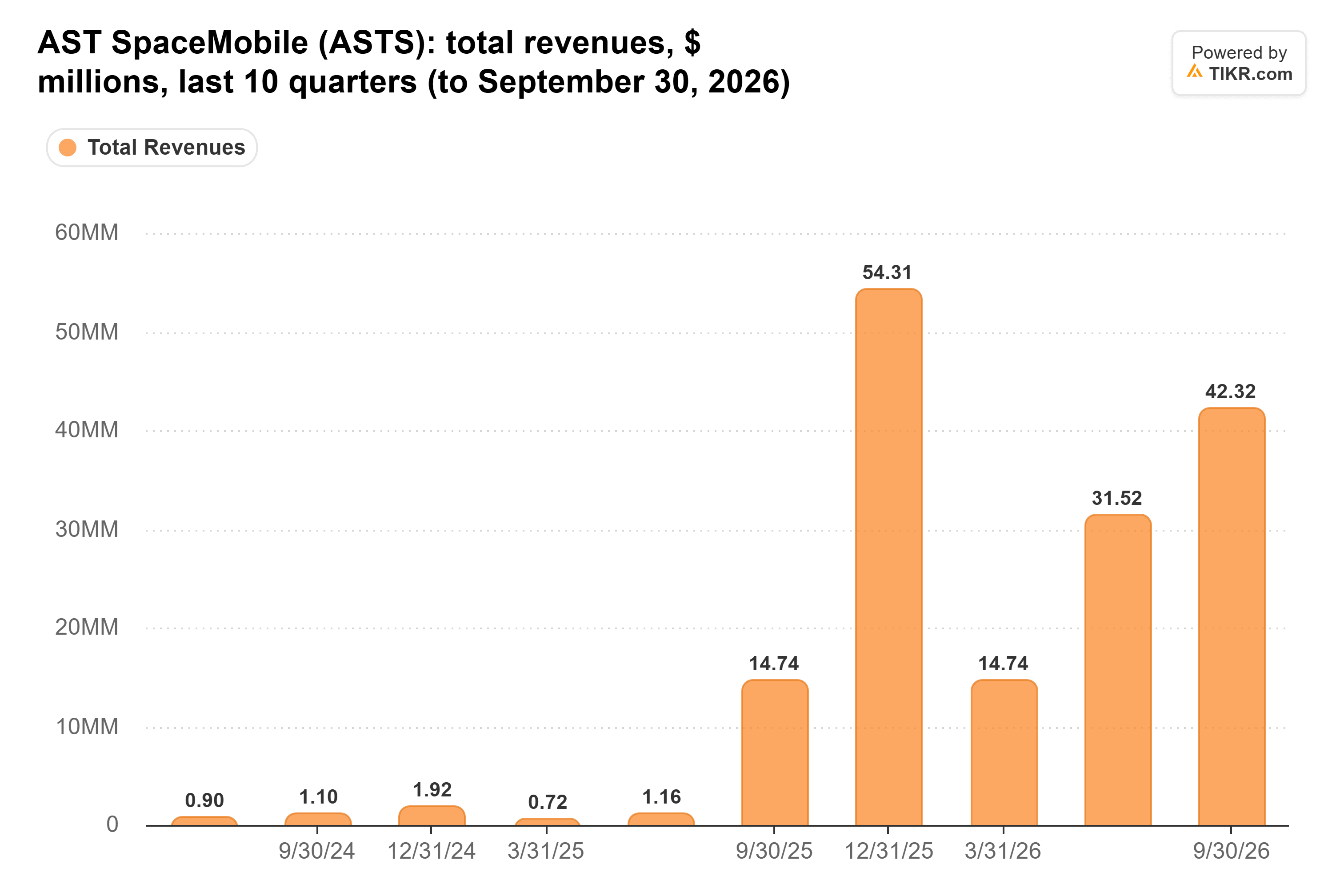
AST’s GAAP operating loss was $287.7 million in 2025, and its free cash flow went deeply negative:
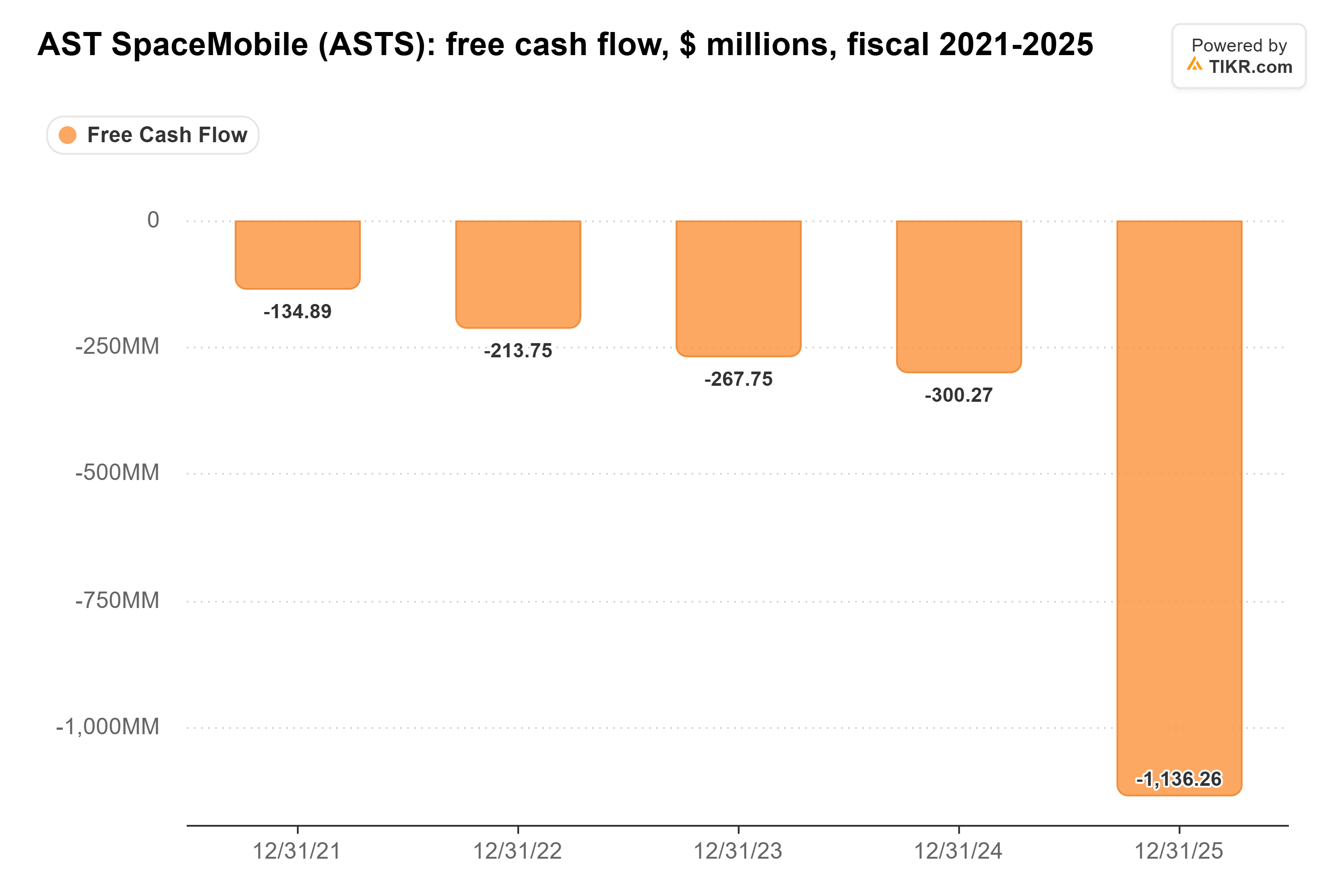
Over the 12 months to June, free cash flow was even worse, at negative $1.64 billion.
T-Mobile has the better seat
If V2 gets anywhere near 150Mbps, T-Mobile’s T-Satellite goes from texting and light data to real broadband on phones. AT&T can’t match that until AST’s service is fully live. AST plans to switch on intermittent service before year-end, but AT&T has pointed only to 2027 for a full launch, with no date. The catch for T-Mobile is that SpaceX also wants to sell phone service directly, which would turn its partner into a rival.
AST’s edge is getting smaller
Starlink plans to close most of the speed gap around the time AST has enough BlueBirds up for continuous service. That timing is the problem, and it makes the $1.65 billion 2028 estimate look a lot less certain than it did a week ago.
Of course, V2 hasn’t flown yet. AST’s first test is getting BlueBirds 14 to 16 into orbit, and then the 33 more it needs to reach about 45. Its fourth-quarter report, due early next year, needs about $61 million of revenue to reach the low end of its $150 million-$200 million guidance for 2026, which management reaffirmed on Nov. 9.
So what is AST SpaceMobile stock actually worth?
TIKR lets you forecast the future price of any stock in less than a minute. Just enter a few assumptions into TIKR’s valuation model and see what AST SpaceMobile could be worth. Start from Wall Street consensus estimates, or adjust the inputs to reflect your own view of the business. It’s free to use.
Value AST SpaceMobile for free
Disclaimer:
Please note that the articles on TIKR are not intended to serve as investment or financial advice from TIKR or our content team, nor are they recommendations to buy or sell any stocks. We create our content based on TIKR Terminal’s investment data and analysts’ estimates. Our analysis might not include recent company news or important updates. TIKR has no position in any of the stocks mentioned. Thank you for reading, and happy investing!


