Key Takeaways
- Of 460 big funds that have filed 13Fs for the quarter ended Sept. 30, 38 bought Taiwan Semiconductor and 27 sold, with Stanley Druckenmiller’s and Leopold Aschenbrenner’s funds among the sellers.
- GQG Partners made the biggest buy, about $2.22 billion of stock, while Aschenbrenner’s Situational Awareness sold its whole stake, about $1.27 billion.
- Nvidia’s latest quarter and ASML’s order book support the buyers, while TSMC’s cautious 2027 planning and record spending are the strongest case for selling.
- At 14x forward earnings, well below its 5-year average of 18x, with earnings estimates still climbing, the buyers have the stronger case.
Some of the best-known investors in tech just landed on opposite sides of Taiwan Semiconductor (TSM). Of the 460 big funds that have filed 13Fs for the quarter ended Sept. 30, 38 bought the stock and 27 sold, including Stanley Druckenmiller’s Duquesne Family Office and Leopold Aschenbrenner’s Situational Awareness. Since Sept. 30, the date those filings capture, the stock has fallen 30%.
The best read on who’s right comes from TSMC’s own supply chain. Nvidia (NVDA), widely reported to be its largest customer, just guided its revenue higher again. And chipmaking-tool supplier ASML (ASML) says it won’t be able to build enough machines for 2027 and 2028.
TIKR tracks 21 analysts on TSMC. How many say “Buy”?
See the full breakdown of Buy, Hold, and Sell ratings on TSMC, along with Wall Street’s revenue and earnings estimates, all in one place. More than 500,000 investors use TIKR to research stocks like this one. See TSMC’s Analyst Ratings
Aschenbrenner sold every share
The counts cover big funds only: ones readers know, or ones with $1 billion or more of US stocks in their 13Fs, with quant and index funds left out. A buy is a new position or 20% more shares, and a sale is an exit or a cut of 20% or more. (A 13F lists only US-listed shares, so a fund that cut its ADRs could still own TSMC’s Taiwan-listed stock.)
Situational Awareness, whose firm manages $9.28 billion, made the biggest sale: all 2.65 million of its shares, about $1.27 billion at the Sept. 30 price, according to its 13F filed Nov. 16. Chase Coleman’s Tiger Global, which manages $78 billion, filed the same day. It cut its stake 36% to 3.13 million shares, a sale worth about $797 million, though TSMC is still its fourth-largest position at 7.1% of its 13F stocks. Druckenmiller’s Duquesne cut its stake 94%, about $254 million of stock, leaving 32,700 shares, or 0.4% of its 13F stocks.
The buyers went big
GQG Partners, which manages $164 billion, made the biggest buy. Its 13F, filed Nov. 13, shows it raised its stake 562% to 5.74 million shares, about $2.22 billion of stock at the Sept. 30 price. That made TSMC its third-largest position, at 4.9% of its 13F stocks.
Lone Pine Capital, which manages $22 billion, raised its stake 1,595% to 1.72 million shares, about $737 million bought, according to its 13F filed Nov. 16. Greenwoods Asset Management, a Hong Kong firm whose 13F holds $2.95 billion of US stocks, raised its stake 1,074%, and TSMC is now 15.1% of that. And Andreas Halvorsen’s Viking Global added 23%, and TSMC became its largest holding.
Earnings estimates kept rising
Analysts expect TSMC’s earnings to keep climbing fast:
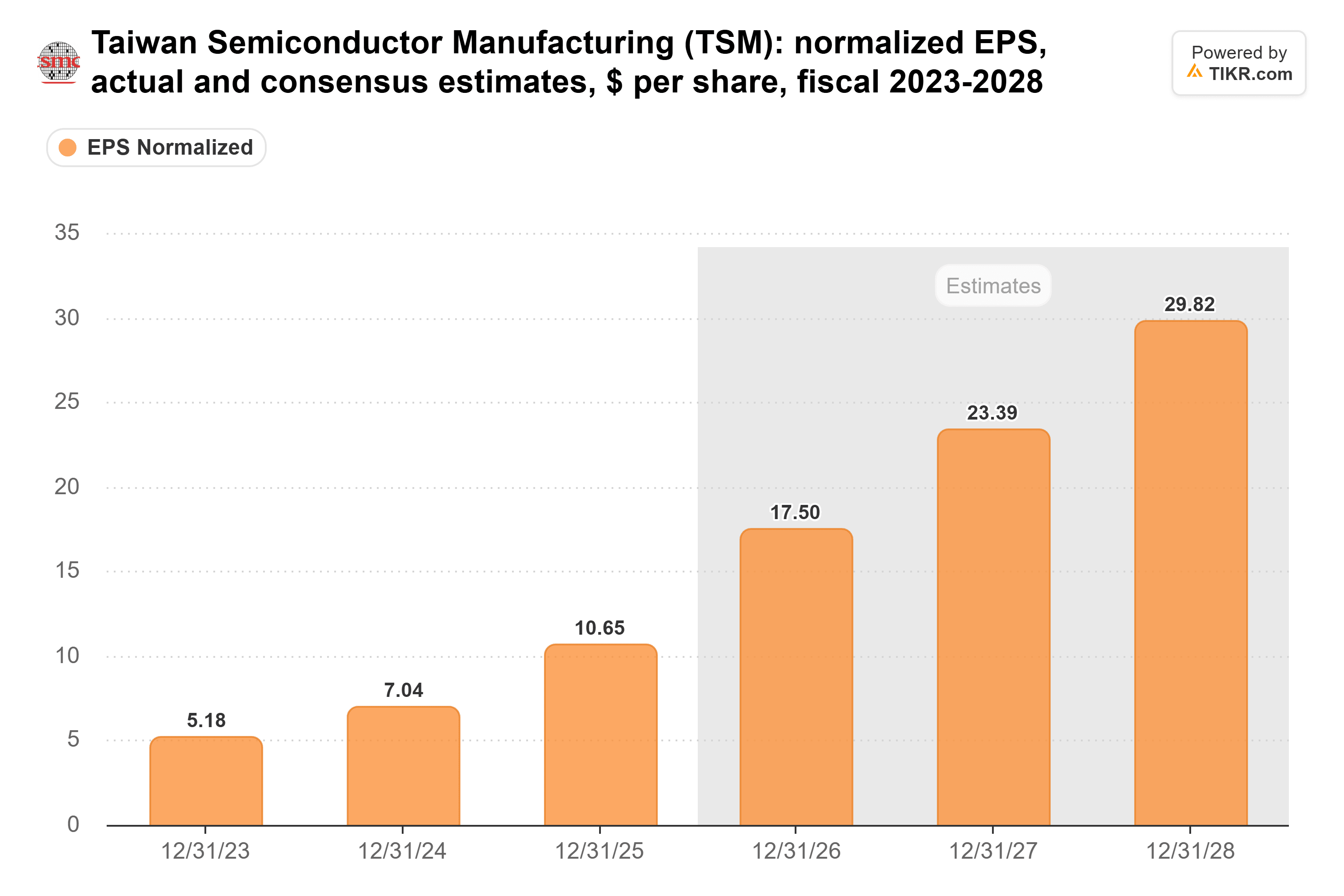
Consensus has normalized EPS rising from $10.65 in 2025 to $17.50 in 2026 and $29.82 in 2028. The 2027 estimate, $23.39, was $21.28 three months ago.
The demand behind those estimates is still there. Nvidia reported $115.8 billion of third-quarter revenue on Nov. 17, up 103% from a year earlier. It guided to $130 billion, plus or minus 3%, for a fourth quarter that has an extra week. And ASML CEO Christophe Fouquet said in October that its planned supply for 2027 and 2028 “will not fully meet the demand of our customers,” some of whom want to place orders “for 2029 and even 2030.”
Even so, the stock is cheap against its own history:
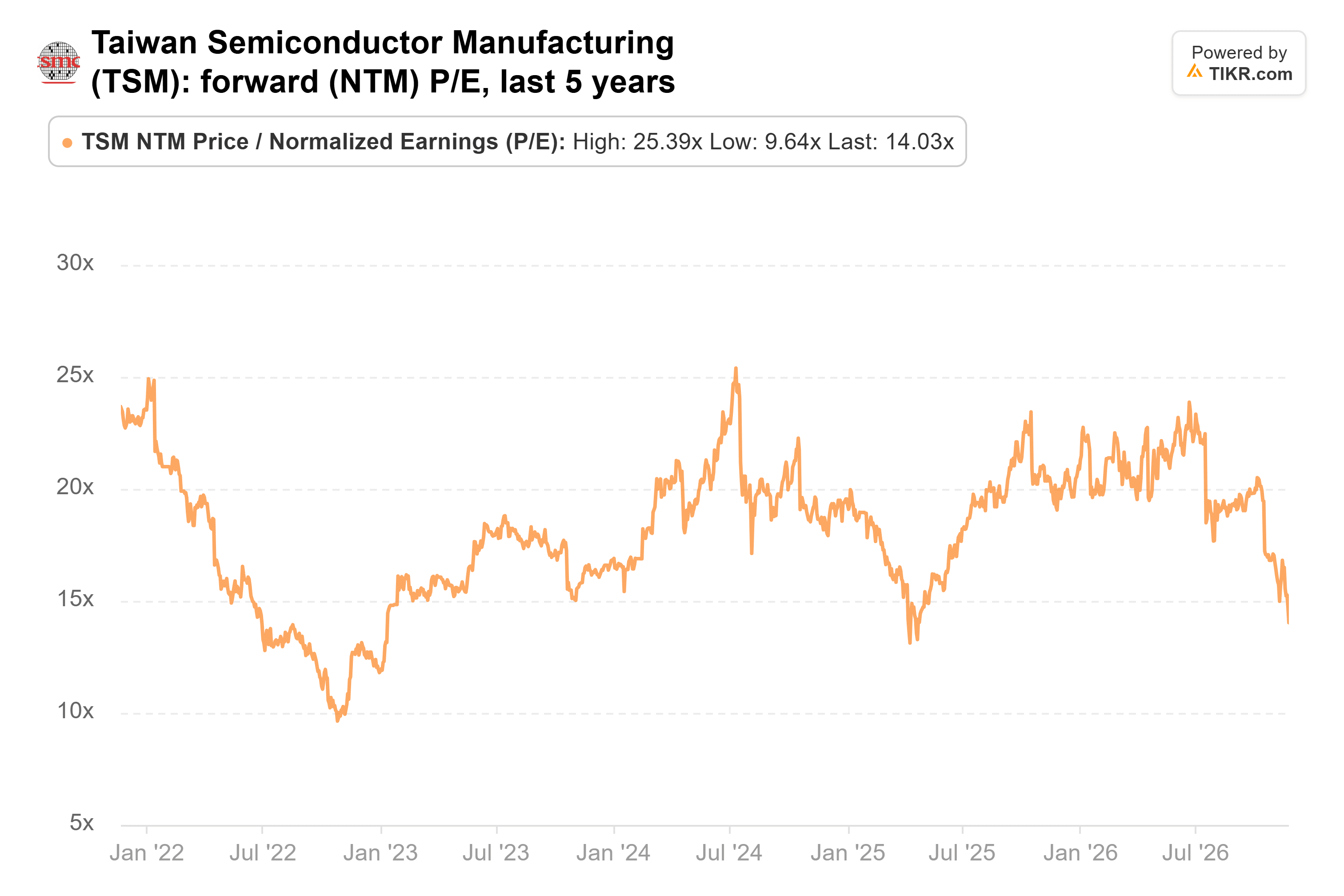
At 14x forward earnings, TSMC trades well below its 5-year average of 18x and far below its peak of 25x in July 2024.
Analysts’ consensus target has kept climbing too:

At $587, it’s up from $340 a year ago and 84% above the last close of $318.71. Even the lowest target, $440, sits well above that close.
Record spending is the risk
The risk is TSMC’s own building spree. Management guides 2026 capital spending to $60 billion to $64 billion, up from $40.9 billion in 2025, mostly for capacity that comes online in 2028 and 2029. On its October call, it said it’s “prudent in our business planning going into 2027.” The last time TSMC spent a record, in 2022, its revenue fell 4.5% the next year. It also reportedly suspended some advanced orders from Chinese chip designers on Nov. 19 as new US rules took effect, though China was just 5% of its third-quarter revenue.
Still, I’d side with the buyers. TSMC trades well below its usual multiple on estimates that are higher than they were in the summer. And its biggest customer and its key supplier both point to more demand ahead.
The next test comes in mid-January, with TSMC’s fourth-quarter results and its 2027 guidance. Management guides the quarter to $52.3 billion to $54.3 billion of revenue at a 65%-67% gross margin. A result at the top of that range, plus 2027 revenue growth guided near the 37.5% analysts expect in Taiwan dollars, would back the buyers. A 2027 growth guide in the low 20s would give the sellers the better of it.
So what is Taiwan Semiconductor stock actually worth?
TIKR lets you forecast the future price of any stock in less than a minute. Just enter a few assumptions into TIKR’s valuation model and see what Taiwan Semiconductor could be worth. Start from Wall Street consensus estimates, or adjust the inputs to reflect your own view of the business. It’s free to use.
Value Taiwan Semiconductor for free
Disclaimer:
Please note that the articles on TIKR are not intended to serve as investment or financial advice from TIKR or our content team, nor are they recommendations to buy or sell any stocks. We create our content based on TIKR Terminal’s investment data and analysts’ estimates. Our analysis might not include recent company news or important updates. TIKR has no position in any of the stocks mentioned. Thank you for reading, and happy investing!