Key Takeaways for Spotify Stock as of September 2026
- Year-Long Slide: Spotify (SPOT) stock has fallen 22.7% over the past year, a -23.5% annualized rate, even as Q2 revenue growth accelerated to 15% on a constant-currency basis.
- Deliberate MAU Hit: Management guided third-quarter monthly active users to 788 million, below the 793.6 million Street estimate, after choosing to add friction to free-tier usage in emerging markets to push conversion.
- Street Split: Coverage of 41 analysts carries 25 buys, 9 outperforms, and 7 holds, with a mean target of $615 sitting 13% above the $544 close.
- Model Divergence: TIKR’s mid-case model values Spotify stock at $1,040 by the end of 2030, a 91% total return and 16.1% annualized from here.
Why Spotify Stock Has Fallen 23% Even as Revenue Growth Accelerated
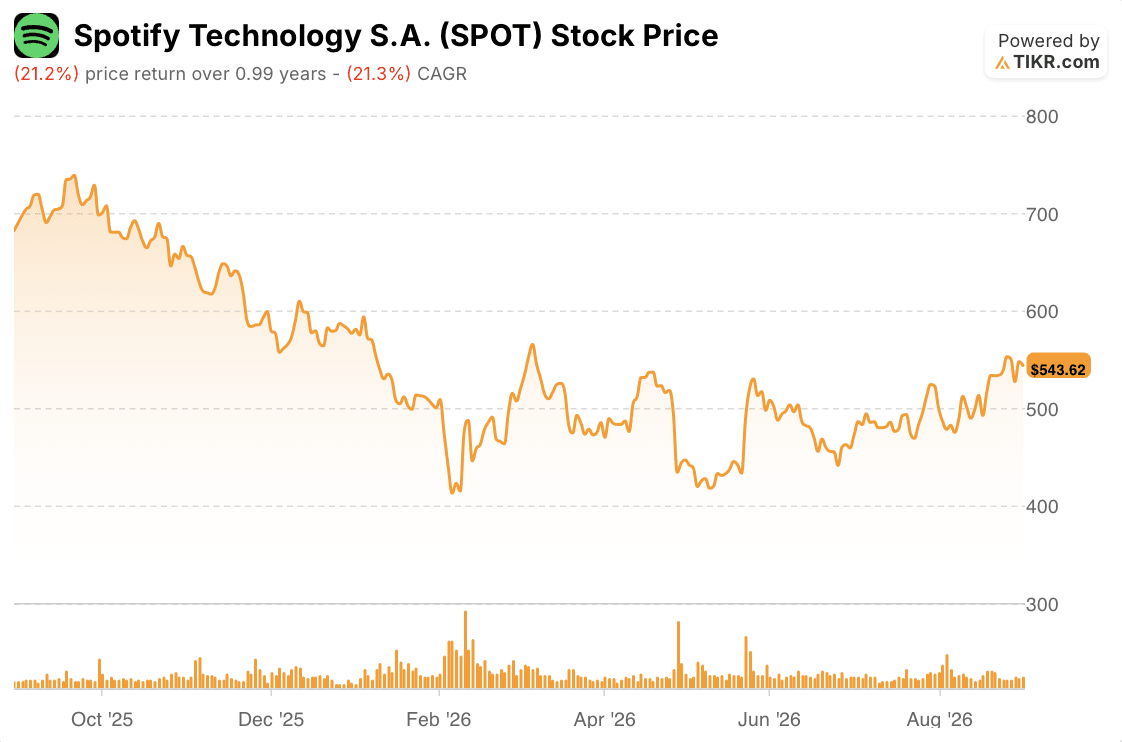
Spotify (SPOT) stock has dropped 23% over the past year, a -23.5% annualized rate, sliding from the mid-$700s toward $500 before closing at $543.62 on August 31. That decline happened while the underlying business kept improving. Q2 revenue grew 15% year over year on a constant-currency basis, up from 14% in Q1, and Spotify crossed 300 million premium subscribers for the first time in the same quarter.
The gap between those two facts traces back to guidance, not results. On the Q2 2026 earnings call, Spotify forecast third-quarter operating income of 670 million euros, below the 677.8 million euro consensus, and guided monthly active users to 788 million, short of the 793.6 million analysts expected. Co-CEO Alex Norström explained the shortfall was intentional: “We are adjusting elements like product optimization and ad load, among other things in select emerging markets. Now this strategy carefully increases friction in our free service with a goal of driving higher user conversion and revenue growth down the line. Yes, this will show itself in our Q3 MAU, but we believe it’s well worth it.”
That tradeoff, trading near-term reach for longer-term monetization, is exactly the kind of signal a market punishes before it can be proven right. CFO Christian Luiga also flagged roughly 200 million euros of incremental operating expense for the year tied to AI and marketing investment, temporarily compressing margin expansion even as gross margin hit a record 33.4% in Q2. A Reuters Breakingviews column published the next day noted Spotify’s forward earnings multiple has roughly halved over the past year to 33 times, evidence the re-rating has been about growth durability, not the numbers already on the books.
The stock’s slide, in other words, reflects a market discounting a strategic choice to slow growth for margin, not a business breaking down.
Spotify’s $1.5 Billion Buyback Upsize Signals Confidence Against the Slide
Spotify expanded its share repurchase authorization by $1.5 billion on August 20, lifting total buyback capacity to roughly $2.22 billion. That move followed $662 million in repurchases through early August, already up 30% from 2025 levels, and came two weeks after the stock touched some of its lowest prices of the year. Management buying back stock into the same weakness that guidance triggered reads as a bet that the market has overcorrected for a deliberate, self-inflicted MAU dip rather than a structural growth problem.
Spotify Stock’s Analyst Split and the Narrowing Target Gap
Spotify stock currently carries 25 buy ratings, 9 outperforms, and 7 holds among analysts covering the name, with 41 total contributors to a mean price target of $615.27. That target sits 13% above the $543.62 close, a real but modest gap compared to where the two figures stood a year ago.
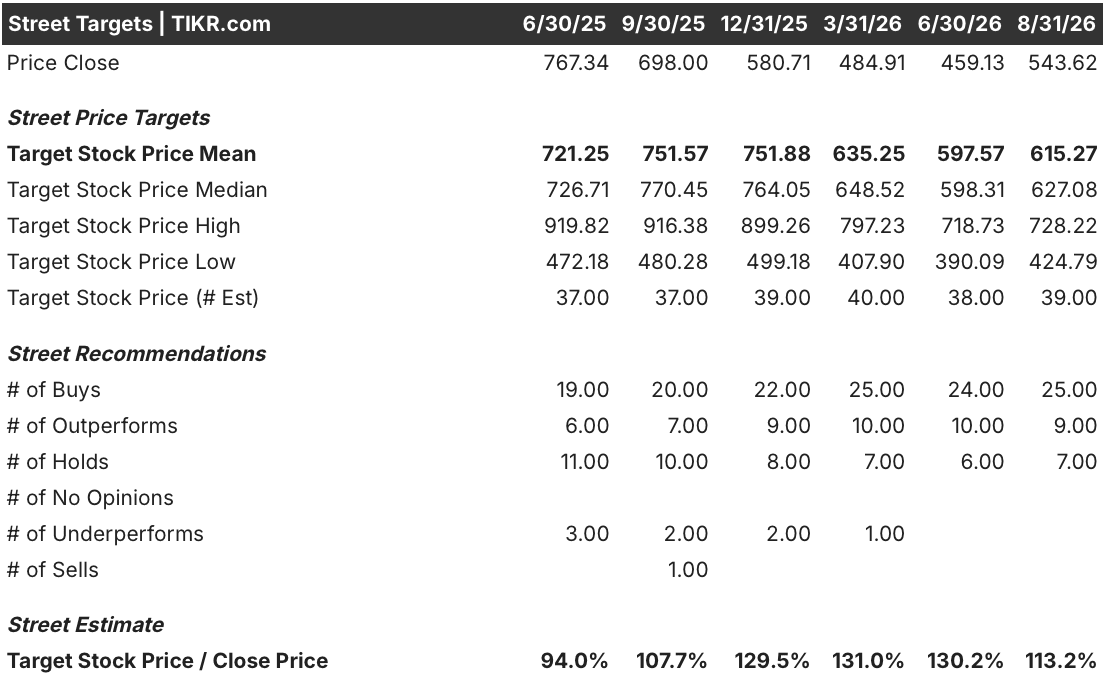
At the end of June 2025, the mean target of $721.25 actually sat 6% below the $767.34 close, before the stock’s decline outran the Street’s willingness to cut estimates. By December 2025, the target had barely moved to $751.88 while the price had fallen to $580.71, pushing the target 30% above the price.
That gap peaked near 31% by March 2026 before both figures fell together into midyear and have since partially recovered in tandem. Analysts, in short, held their targets through most of the drop rather than chasing the stock down, and coverage has stayed remarkably stable at 37 to 40 estimates throughout.
TIKR Values Spotify Stock at $1,040, Pricing In a Sustained Margin Ramp
TIKR’s mid-case model values Spotify stock at $1,040 by December 2030, implying a 91% total return from the current price of $544, or 16.1% annualized over roughly 4.3 years.
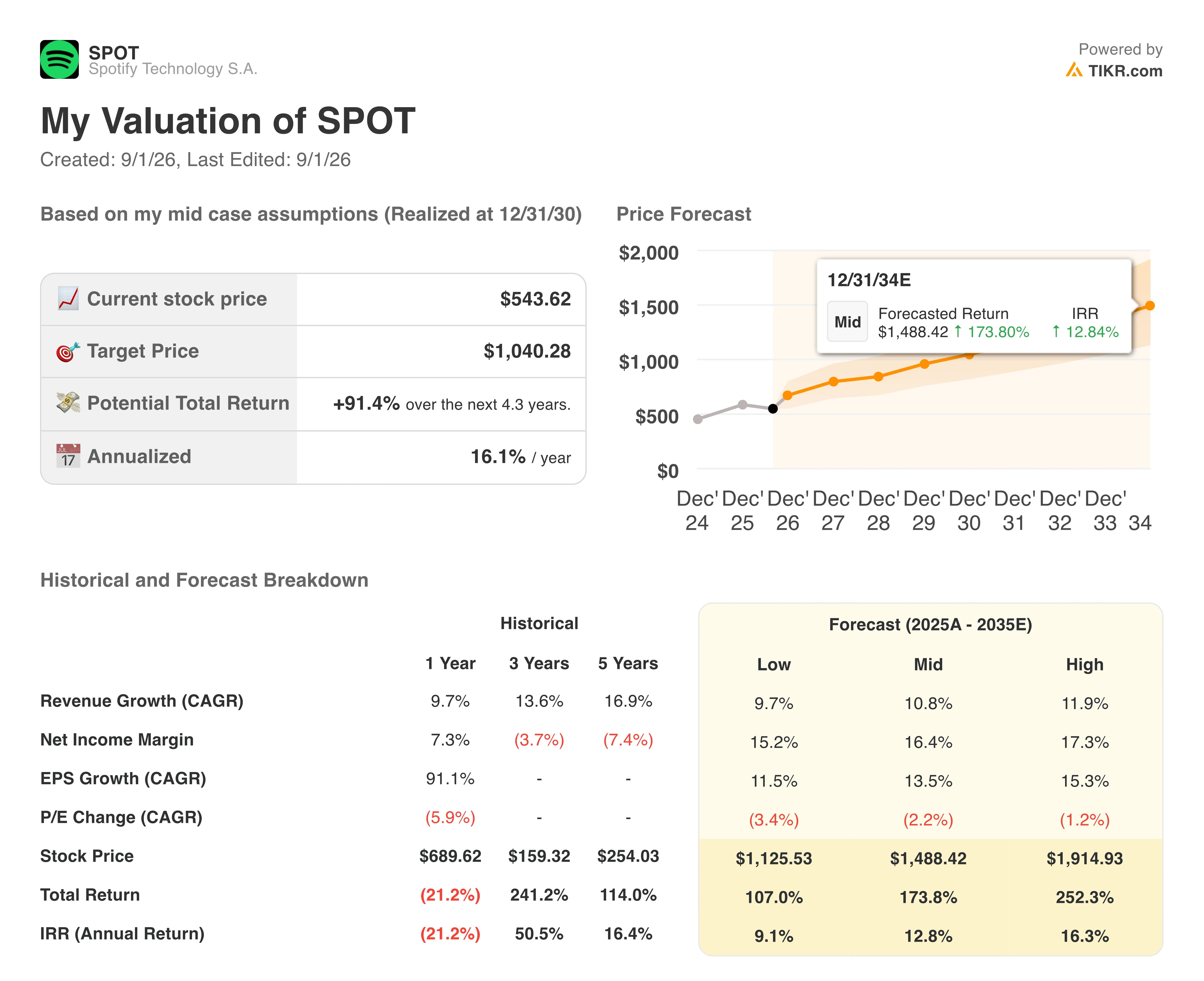
That annualized return sits well above what a mature, large-cap compounder typically prices in, reflecting how far the multiple has already compressed rather than an aggressive growth assumption.
The model’s case rests on the same thesis Norström described: emerging-market friction converting into ARPU growth, gross margin climbing toward the 35% to 40% range management targeted at its May Investor Day, and operating margin moving past 20% as the Q3 guidance dip proves temporary rather than structural.
Get TIKR’s full valuation model and 16.1% annualized return estimate on SPOT stock for free →
Should You Invest in Spotify Technology S.A.?
The only way to really know is to look at the numbers yourself. TIKR gives you free access to the same institutional-quality financial data that professional analysts use to answer exactly that question.
Pull up Spotify Technology S.A. stock and you’ll see years of historical financials, what Wall Street analysts expect for revenue and earnings in the quarters ahead, how valuation multiples have moved over time, and whether price targets are trending up or down.
You can build a free watchlist to track Spotify Technology S.A. alongside every other stock on your radar. No credit card required. Just the data you need to decide for yourself.
Access Professional Tools to Analyze SPOT stock on TIKR for Free →
Looking for New Opportunities?
- See what stocks billionaire investors are buying so you can follow the smart money.
- Analyze stocks in as little as 5 minutes with TIKR’s all-in-one, easy-to-use platform.
- The more rocks you overturn… the more opportunities you’ll uncover. Search 100K+ global stocks, global top investor holdings, and more with TIKR.
Disclaimer:
Please note that the articles on TIKR are not intended to serve as investment or financial advice from TIKR or our content team, nor are they recommendations to buy or sell any stocks. We create our content based on TIKR Terminal’s investment data and analysts’ estimates. Our analysis might not include recent company news or important updates. TIKR has no position in any stocks mentioned. Thank you for reading, and happy investing!