Key Takeaways
- Shell yields 3.3% and raised its dividend 9.1% over the past year; Eversource Energy yields 4.4% and raised 4.7%.
- Shell’s dividend took just 27% of free cash flow over the twelve months to June 30, 2026.
- Eversource’s payout ratio has held between 60% and 63% of normalized EPS for a decade, but it carries 5.83x net debt to EBITDA.
A dividend stock held for 20 years needs a check that keeps rising in the bad years, too.
Shell (SHEL) has the cash for it. On Oct. 29, it kept its quarterly dividend at $0.3906 per ordinary share, the same as the first two quarters of 2026 and 9.1% above the $0.3580 it paid a year earlier.
Eversource Energy (ES) had a rougher quarter. On Nov. 4, it reported third-quarter non-GAAP earnings of $0.92 a share, down from $1.19 a year earlier. Which one is worth holding for the next two decades?
| Metric | Shell (SHEL) | Eversource Energy (ES) |
|---|---|---|
| Dividend yield | 3.3% | 4.4% |
| Dividend growth, fiscal 2020-2025 | 17.4% a year | 5.8% a year |
| Dividend growth, fiscal 2015-2025 | -2.6% a year | 6.1% a year |
| Coverage | Cash dividend payout ratio: 27% (TTM to June 30, 2026) | Payout ratio of normalized EPS: 63% (fiscal 2025) |
| Net debt / EBITDA (LTM) | 0.54x | 5.83x |
| Interest coverage (LTM) | 7.76x | 2.32x |
Source: TIKR; Eversource’s yield is its current dividend at today’s price (StockAnalysis).
6 Safe Dividend Stocks Paying Retirees 6%+ yields
There are over 100 stocks paying 6%+ annual dividends today.
But after an extensive investment review leveraging TIKR’s proprietary data, we now believe only six of them are truly safe for retirees.
They’re all yours for free as part of our new investment report, which you can access right here.
Shell’s Spare Cash Goes to Buybacks
Shell’s free cash flow has covered its dividend every year since fiscal 2017:
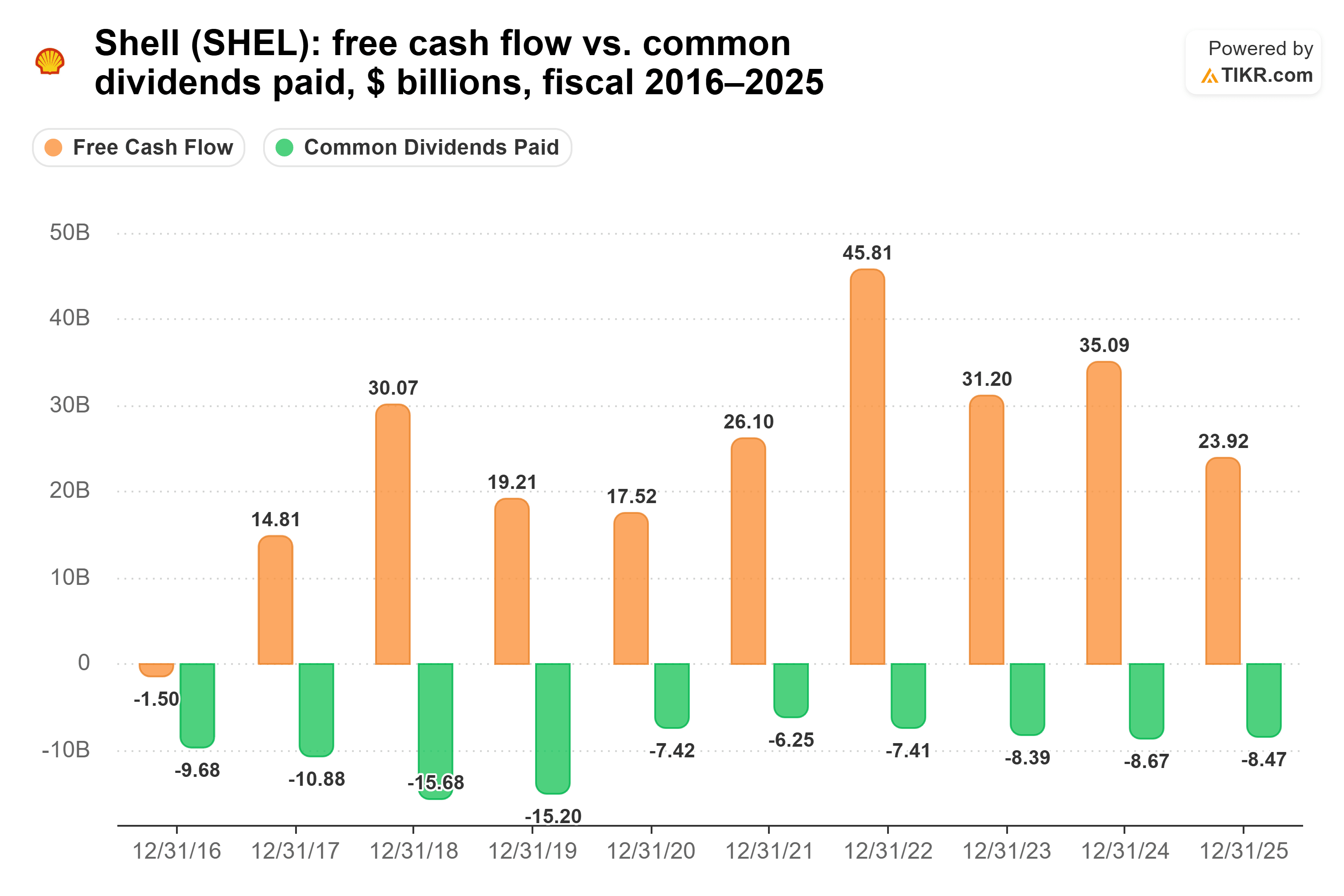
Even when free cash flow fell to $23.9 billion in fiscal 2025, the dividend took just 35.4% of it. Most of the rest goes to buybacks: in the third quarter, Shell paid $2.2 billion in dividends and spent $3.2 billion buying back stock. CFO Sinead Gorman called the policy of handing back 40% to 50% of operating cash flow through the cycle “sacrosanct.”
Shell’s dividend has been cut before. It fell from $1.88 in fiscal 2015 to $0.65 in fiscal 2020, so the 17.4% yearly growth since then starts from a low base.
Eversource’s Raises Come Every Year
Eversource’s cushion is much thinner, but it has hardly moved. Its payout ratio of normalized EPS went from 60.1% in fiscal 2016 to 63.2% in fiscal 2025, as normalized EPS rose every year from $2.96 to $4.76 and the dividend from $1.78 to $3.01 a share:
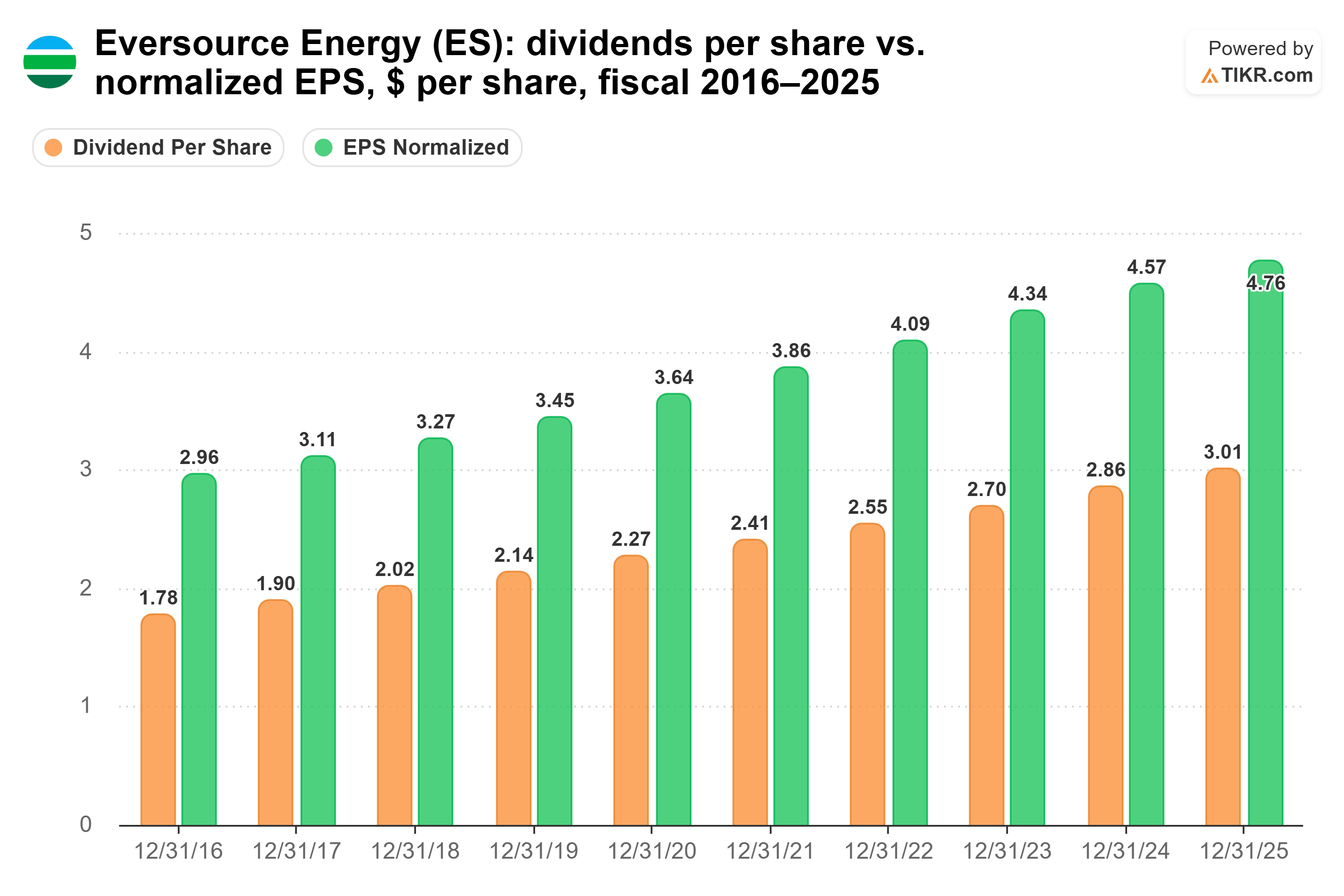
This year is softer. On Nov. 4, Eversource narrowed its 2026 guidance to $4.62-$4.70 a share. With the dividend now at $3.15 a year, the $4.66 midpoint puts the payout ratio at about 68%.
Debt is the weak spot: 5.83x net debt to EBITDA and 2.32x interest coverage.
So Which One Gets My Dividend Dollars?
Eversource gets my dividend dollars for the next 20 years, because its raises have tracked its earnings every year since fiscal 2016.
Shell could out-pay it. If Shell keeps raising 9.1% a year and Eversource 4.7%, $10,000 in Shell pays about $17,085 over 20 years against about $14,151. But Shell is raising into what it calls an elevated commodity price environment. At fiscal 2025’s 4.0% raise, Shell pays about $9,856, or $4,295 less than Eversource.
Shell’s dividend isn’t unsafe at 0.54x net debt to EBITDA; its raises ride the oil cycle. Eversource’s test is FERC, which cut its transmission return to 9.57% from 10.57%. Eversource has asked for 11.39% from Nov. 30, and a higher return would fund future raises.
Forget Eversource Energy: 6 Safe 6%+ Dividend Yields You Can Buy Right now
Dividends can hold the key to enormous wealth. But only if you buy the right ones.
Picking the right high-yield dividend stock can be the difference between a dream retirement…and scraping by every month, waiting for the next Social Security check to clear.
We’ve identified six stocks yielding 6%+ that we believe every retiree should know about right now. (And Eversource Energy isn’t one of them.)
Disclaimer:
Please note that the articles on TIKR are not intended to serve as investment or financial advice from TIKR or our content team, nor are they recommendations to buy or sell any stocks. We create our content based on TIKR Terminal’s investment data and analysts’ estimates. Our analysis might not include recent company news or important updates. TIKR has no position in any of the stocks mentioned. Thank you for reading, and happy investing!