


Key Stats for Seagate Stock
- 52-Week Range: $63.2 to $459.8
- Current Price: $429.4
- Street High Target: $700
What Happened?
Seagate Technology (STX), a hard drive manufacturer that supplies mass-capacity storage to cloud data centers running AI workloads, set company records for gross margin, operating margin, and non-GAAP earnings per share in its December quarter, with shares trading at $429.36 as Bernstein raised its price target to $620 on April 1 after calling the stock an attractive entry point following a sector-wide selloff.
The December quarter delivered $2.83 billion in revenue, up 22% year over year, with non-GAAP EPS of $3.11 beating the prior quarter by 19%, while Seagate simultaneously guided March quarter revenue to $2.9 billion with non-GAAP EPS of $3.40, implying continued sequential expansion in operating margins toward the mid-30% range.
The engine behind both results is HAMR, or Heat-Assisted Magnetic Recording, a proprietary technology that packs more data onto each disk platter, allowing Seagate to ship more storage capacity from the same number of drives and without adding production units, which compresses cost per terabyte while keeping supply disciplined and pricing stable.
Gianluca Romano, Chief Financial Officer, stated at the Morgan Stanley Technology, Media and Telecom Conference on March 3 that “both customers that were in full [qualification] for the 40-terabyte drive has now qualified the drive,” confirming that Mozaic 4, Seagate’s second-generation HAMR platform offering 40 terabytes per drive, began shipping volume to its two largest cloud service provider customers this quarter.
Seagate’s nearline capacity, which refers to high-capacity drives sold directly into cloud data centers, is fully allocated through calendar 2026, long-term agreements cover volume commitments into 2027 and beyond, and the company’s $1.071 billion TIKR model target by June 2030 is grounded in a 22.7% revenue CAGR driven by AI video storage demand, agentic AI data retention requirements, and a cost structure improving with every terabyte added per drive.
Wall Street’s Take on STX Stock
Mozaic 4’s qualification at both major U.S. cloud customers unlocks a 33% capacity jump per drive from 30 to 40 terabytes, directly widening the cost-per-terabyte gap that drives sequential gross margin expansion throughout calendar 2026.

STX’s normalized EPS is estimated at $3.47 for the March quarter, an 82.9% jump year over year, supported by 150-plus basis points of sequential operating margin expansion as Mozaic 4 volume ramps and the mix shifts away from legacy PMR drives toward HAMR-based products.
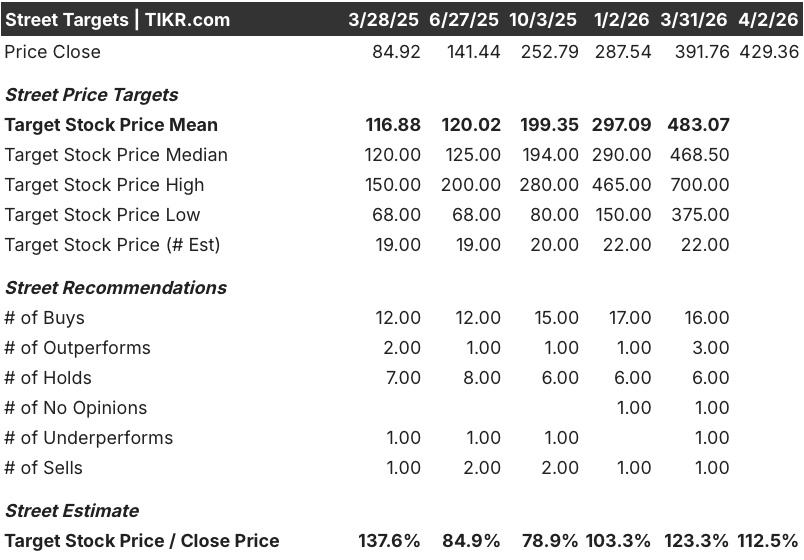
Analysts have been repricing aggressively: 16 buys, 3 outperforms, 6 holds, 1 underperform, and 1 sell across 27 analysts, with a mean price target of $483.07 implying roughly 12.5% upside from the April 2 close, a posture that still lags the pace of fundamental improvement given calendar 2026 visibility is essentially locked in.
The target range from $375.00 to $700.00 captures a real debate: the low reflects any deterioration in cloud capex or a faster-than-expected adoption of NAND alternatives at the data center edge, while the high prices in full realization of Mozaic 4 cost advantages and accelerating Video AI demand that Romano described as arriving faster than Seagate anticipated at its May 2025 Investor Day.
Priced at roughly 31x the March quarter annualized non-GAAP EPS run rate of $13.60, STX trades at a multiple that underweights a business with 82.9% year-over-year EPS growth, fully allocated supply through 2026, and a cost structure still in the early innings of HAMR-driven improvement, leaving STX meaningfully undervalued relative to its own earnings acceleration.
The Financial Turnaround Behind the Story
STX’s operating margin collapsed to -1.7% in fiscal 2023 as revenue fell 36.7% to $7.38 billion, then recovered to 6.6% in fiscal 2024 and surged to 21.2% in fiscal 2025 as revenue rebounded 38.9% to $9.10 billion, a swing in operating income from a $120 million loss to $1.93 billion in two years.
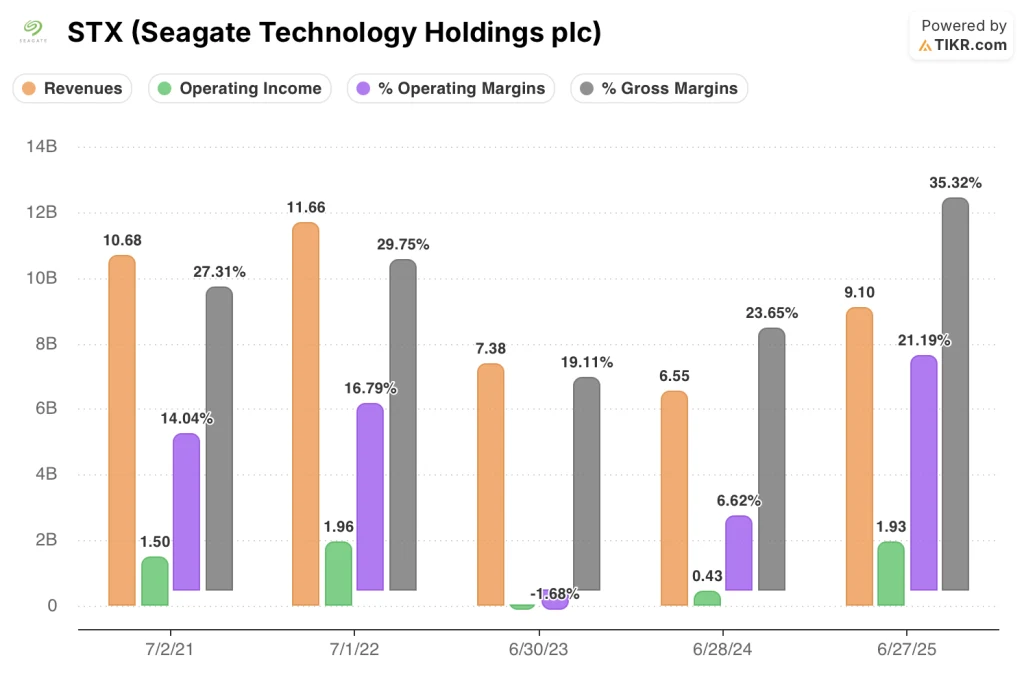
The driver is structural, not cyclical: gross margins nearly doubled from 19.1% in fiscal 2023 to 35.3% in fiscal 2025, reflecting Seagate’s shift toward higher-capacity nearline drives where the same manufacturing footprint generates materially more revenue per unit as average drive sizes increase.
Seagate’s gross margins nearly doubled from 19.1% in fiscal 2023 to 35.3% in fiscal 2025, and with Mozaic 4 volume ramping into the second half of calendar 2026 and OpEx holding near its 10% of revenue target, the forward estimates point to operating margins approaching 40% by the March 2027 quarter, a level that would have seemed implausible during the fiscal 2023 trough.
What Does the Valuation Model Say?

The TIKR mid-case model prices STX at $1,071.23 by June 30, 2030, implying a 24% annualized IRR, driven by a 22.7% revenue CAGR grounded in the Mozaic 4 ramp, Video AI storage demand arriving ahead of schedule, and an operating margin trajectory already tracking above the 30%-plus floor management committed to at its May 2025 Investor Day.
STX appears undervalued at current levels, trading at roughly 31x annualized run-rate EPS against 82.9% year-over-year earnings growth and a cost structure still in the early innings of HAMR-driven improvement.
If cloud customers slow capex meaningfully or if the Google TurboQuant compression algorithm, which triggered an 8% to 15% selloff across memory stocks in late March, proves to reduce HDD demand contrary to Bernstein’s assessment, the 22.7% revenue CAGR assumption breaks and the $1,071.23 target compresses toward the low-case $787.63.
The Q3 fiscal 2026 earnings release will be the first clean read on Mozaic 4 shipment volumes and whether March quarter operating margins cleared the mid-30% guidance threshold, the two numbers that confirm whether the TIKR model’s margin trajectory is tracking.
Should You Invest in Seagate Technology Holdings plc?
The only way to really know is to look at the numbers yourself. TIKR gives you free access to the same institutional-quality financial data that professional analysts use to answer exactly that question.
Pull up STX stock and you’ll see years of historical financials, what Wall Street analysts expect for revenue and earnings in the quarters ahead, how valuation multiples have moved over time, and whether price targets are trending up or down.
You can build a free watchlist to track Seagate Technology Holdings plc alongside every other stock on your radar. No credit card required. Just the data you need to decide for yourself.
Access Professional Tools to Analyze STX stock on TIKR for Free →


