Key Takeaways
- Scott Galloway predicts neocloud defaults and bankruptcies, naming CoreWeave, Nebius and IREN after a brutal week for all three.
- CoreWeave’s third-quarter interest expense of $846 million was about 4x its operating income, and it’s still rising.
- A near-term default looks unlikely, but shareholders need lenders to stay open until operating income passes interest.
- Galaxy Digital, whose data-center rent all comes from CoreWeave, has a stake too.
CoreWeave (CRWV), Nebius (NBIS) and IREN (IREN) are bouncing today after a brutal week. IREN lost 36% of its value last week, Nebius 30% and CoreWeave 26%.
Scott Galloway doesn’t think the bounce changes much. On the latest episode of Prof G Markets, he named all three as fires that will “crash and burn,” then went further:
“I think a lot of these neoclouds are going to go out of business. I think they’re going to default. I think we’ll see bankruptcies.”
That’s quite a call on a company with $132.5 billion of revenue backlog. And it reaches past the neoclouds: Galaxy Digital (GLXY) leases every rent-paying megawatt of its Helios campus to CoreWeave.
CoreWeave borrows to build
Galloway’s problem is that the group lacks “the existing businesses that are going to support them” through what he calls the beginning of an AI winter.
CoreWeave is the clearest case. It burned $7.25 billion of free cash flow in 2025, and analysts expect the hole to get much deeper:
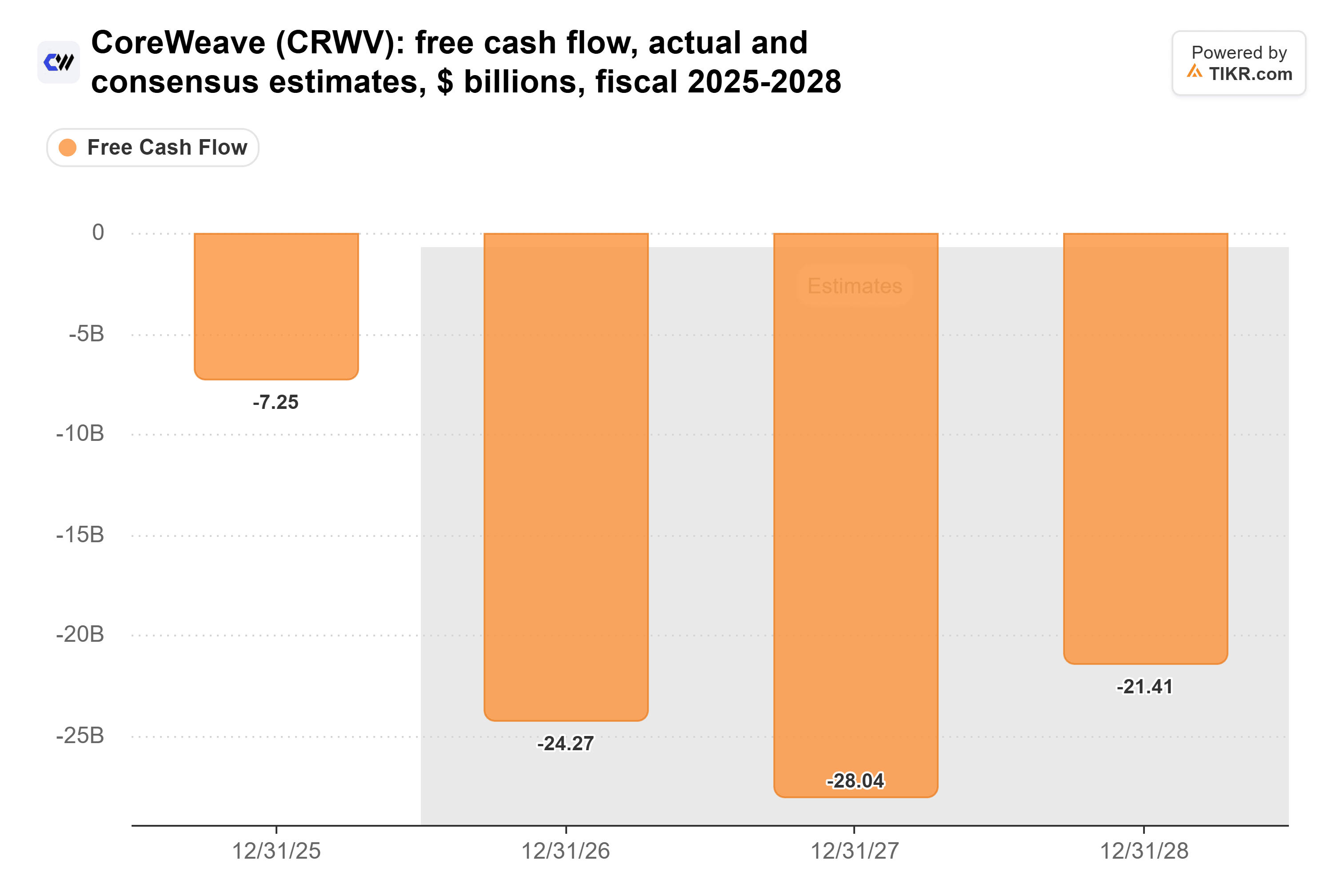
Consensus has it burning more than $20 billion a year from 2026 through 2028. Every one of those dollars has to come from lenders, customers paying up front, or new shareholders.
TIKR tracks 41 analysts on CoreWeave. How many say “Buy”?
See the full breakdown of Buy, Hold, and Sell ratings on CoreWeave, along with Wall Street’s revenue and earnings estimates, all in one place. More than 500,000 investors use TIKR to research stocks like this one. See CoreWeave’s Analyst Ratings
Roughly 4x, and climbing
One investor in r/stocks put the problem bluntly: “Net interest expense was roughly four times operating income.”
TIKR’s numbers back that up. CoreWeave’s interest expense has risen every quarter since late 2024, reaching $846 million in the third quarter, up from $149 million at the end of 2024:
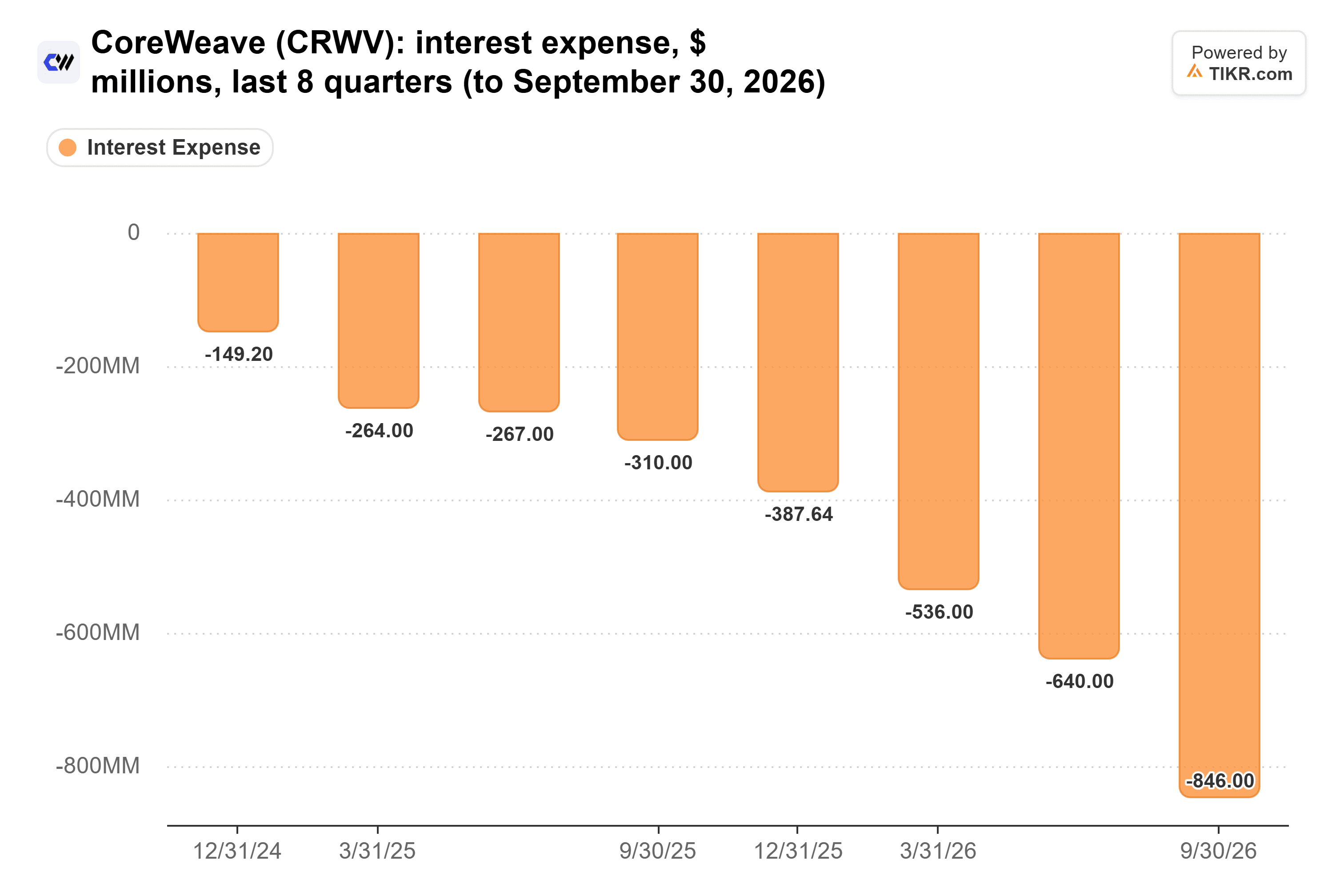
And it’s still climbing: management guides $1.05 billion to $1.15 billion for the quarter ending in December.
Operating income hasn’t kept up. CoreWeave’s operating margin hit 5.7% in the third quarter, its best since the end of 2024, after three of the four quarters before it were negative:

On about $3.7 billion of revenue, that’s a bit over $200 million of operating income against $846 million of interest.
Galaxy Digital has one tenant
Galaxy’s data-center segment earned $69 million of adjusted EBITDA in the third quarter, its first full quarter of rent from all 133 megawatts of Helios I. Galaxy also completed a $3.5 billion offering of senior secured notes to build Helios I’s second phase. It has a cushion, with $4.9 billion of cash, stablecoins and Treasuries, but its data-center business still has one tenant.
IREN’s 800-megawatt campus in South Australia and Nebius’s two India sites planned for next year raise the same question for them: how much has to be borrowed.
Lenders get paid first
Still, CoreWeave is pushing more of the cost onto customers. As Stanley Lee said on Bloomberg’s Odd Lots, “They required higher prepayments from their customers to push more of the burden of the upfront cost onto them.” CoreWeave also raised prices about 25% across GPU types in July.
Management says each contract repays the loan behind its GPUs within the contract’s first term. That protects the lenders. Shareholders are another story: in Galloway’s telling of a neocloud bankruptcy, “the bondholders now own this company.”
I don’t see CoreWeave defaulting anytime soon. But the interest bill is a real problem for the stock. Shareholders need credit to stay open until operating income passes interest, and consensus doesn’t have that happening until 2028.
The first test is the delayed-draw term loan CoreWeave said it would launch within weeks. A rate near the sub-6% on its March secured loan would say lenders still trust the contracts, and one closer to the mid-teens yields on its unsecured bonds would say they don’t. Then, in early 2027, the fourth-quarter report has to show interest within that guide.
So what is CoreWeave stock actually worth?
TIKR lets you forecast the future price of any stock in less than a minute. Just enter a few assumptions into TIKR’s valuation model and see what CoreWeave could be worth. Start from Wall Street consensus estimates, or adjust the inputs to reflect your own view of the business. It’s free to use.
Disclaimer:
Please note that the articles on TIKR are not intended to serve as investment or financial advice from TIKR or our content team, nor are they recommendations to buy or sell any stocks. We create our content based on TIKR Terminal’s investment data and analysts’ estimates. Our analysis might not include recent company news or important updates. TIKR has no position in any of the stocks mentioned. Thank you for reading, and happy investing!