Key Takeaways
- IonQ stock is down 25% in the past month, and Rigetti Computing and D-Wave Quantum have fallen even further.
- Dmitri Alperovitch argues AI will likely break today’s encryption before quantum computers can, taking away one of quantum’s few sure uses.
- That leaves simulation and optimization, where Rigetti’s revenue fell a third straight year, and long bets like Honeywell’s Quantinuum stake.
- IonQ grows fastest of the group, but at about 11x forward sales it needs a bigger quantum market than today’s.
Quantum computing stocks have had a brutal month. IonQ (IONQ) is down 25%, Rigetti Computing (RGTI) is down 28% and D-Wave Quantum (QBTS) has lost 36%.
Then on Friday, Dmitri Alperovitch, co-founder and chairman of the Silverado Policy Accelerator, took aim at the case behind all three in a post on X:
“So many people are obsessed with quantum computing, perhaps one of the most overhyped technologies of our time. Yet one of the few concrete things it’s sure to deliver is the ability to break public-key cryptography that isn’t quantum-resistant.
And it’s quite possible, perhaps even likely, that AI will break it long before we have a quantum computer with enough qubits to do it.”
Ouch.
His point reaches past the pure plays, too. Honeywell (HON) owned a majority of Quantinuum, which builds trapped-ion machines like IonQ’s, when Quantinuum went public in June.
AI could get there first
Breaking encryption is the one quantum payoff with a date attached. On IonQ’s first-quarter call, management put the window for a quantum computer to crack RSA-2048 at 2028 to 2029. IonQ is aiming for fault-tolerant machines in 2028, and Quantinuum for 2029.
If AI cracks those codes first, buyers have less reason to race for a quantum machine that can do it. My read: that deadline is a big part of why governments pay for this work, and by management’s count, the U.S. government made up about 40% of IonQ’s revenue in 2025 and the first half of 2026.
TIKR tracks 14 analysts on IonQ. How many say “Buy”?
See the full breakdown of Buy, Hold, and Sell ratings on IonQ, along with Wall Street’s revenue and earnings estimates, all in one place. More than 500,000 investors use TIKR to research stocks like this one. See IonQ’s Analyst Ratings
IonQ still has to grow into its price
IonQ’s revenue was $130.0 million in 2025, and it just raised its 2026 guide to $505 million to $515 million. Analysts expect $1.14 billion by 2028:
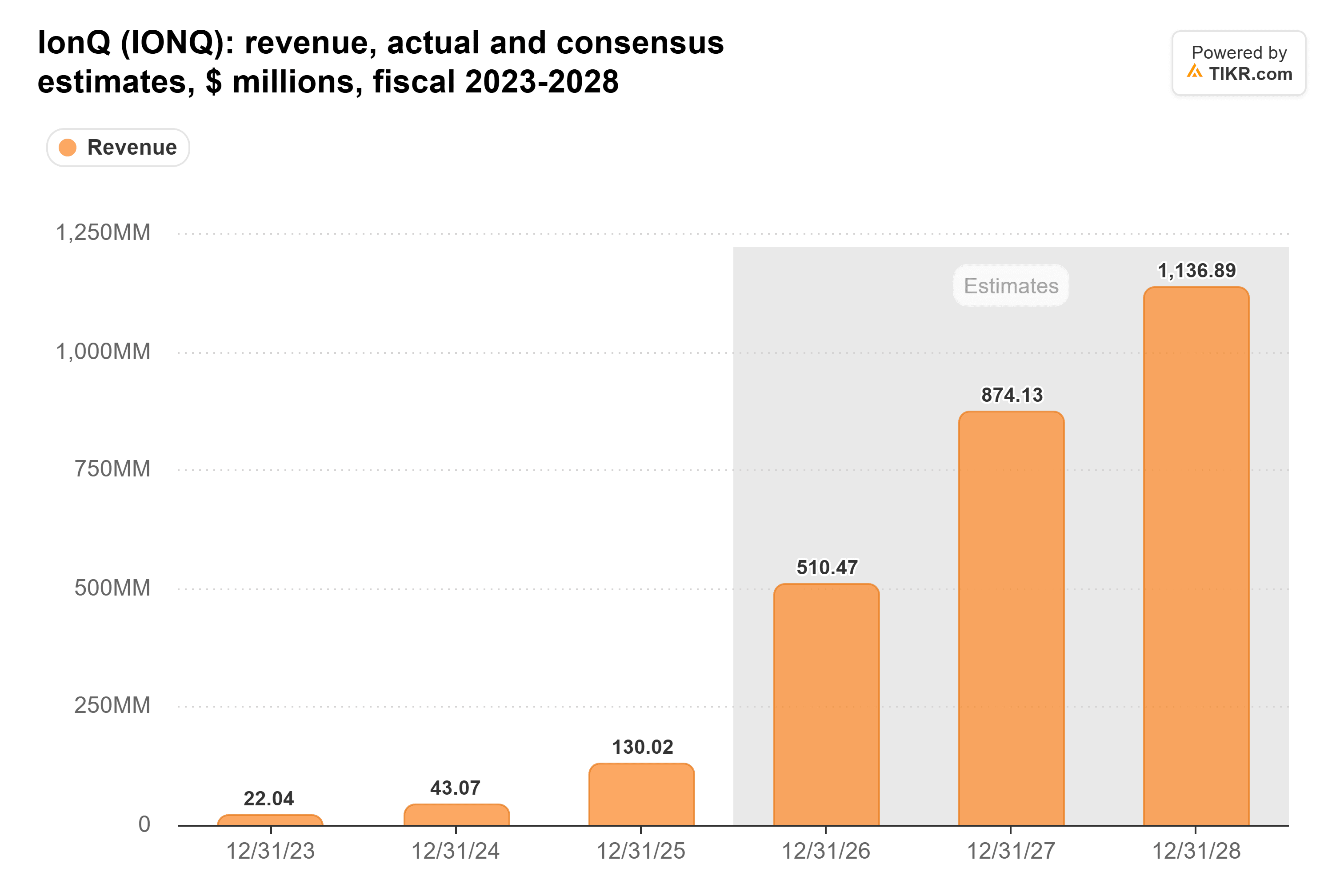
Part of that is IonQ’s SkyWater foundry, which brought in $83.5 million of the third quarter’s $173.8 million of revenue. But IonQ also says its Superion 256 capacity for 2027 is sold out.
The selloff has also taken IonQ’s valuation to its lowest point in three years:
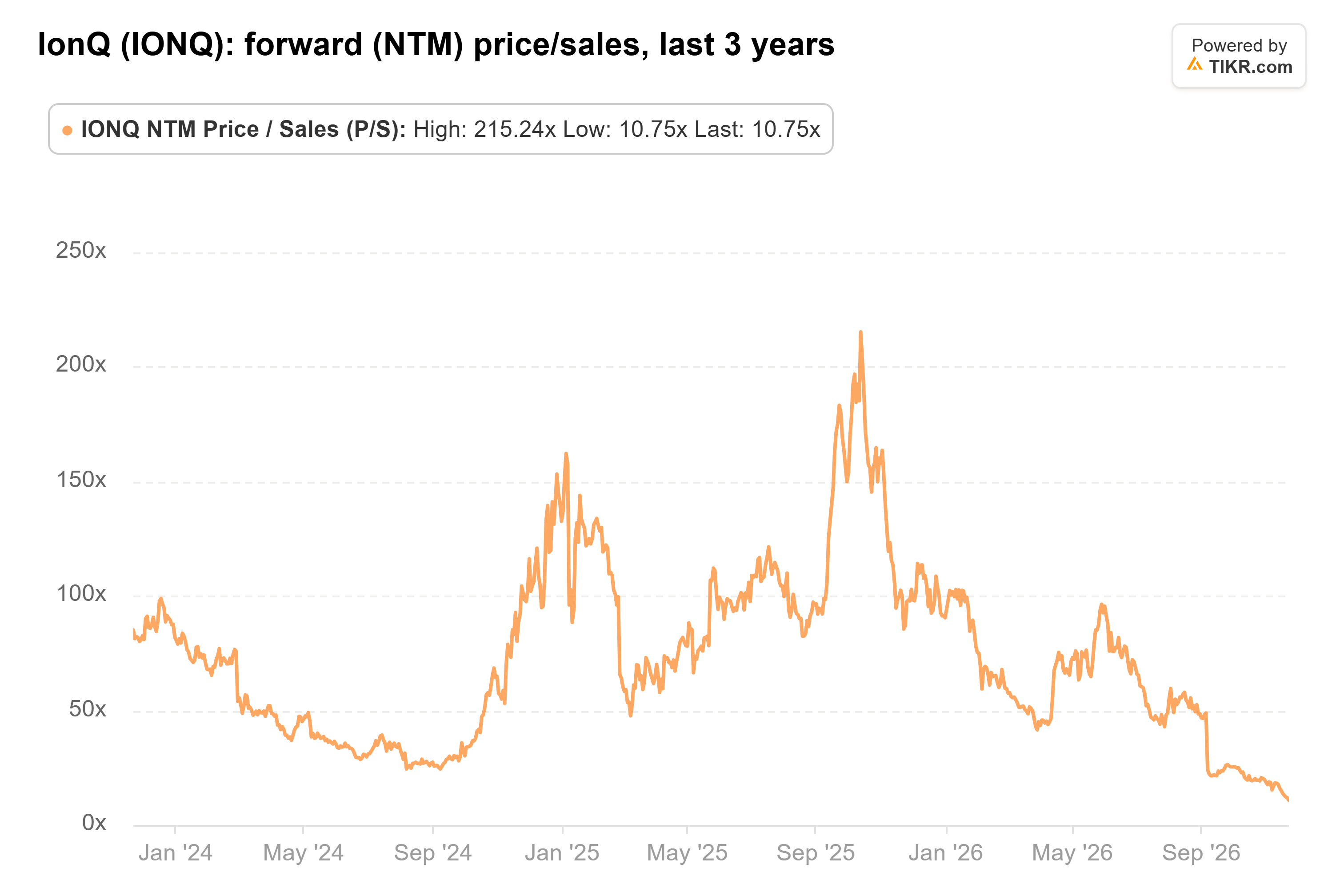
Even so, about 11x forward sales is a rich price for a company analysts expect to keep losing money through 2030.
Simulation and optimization are still a small market
Quantum companies also sell their machines for simulation and optimization work, and that market is still tiny. Rigetti’s yearly revenue has shrunk three years running, to $7.09 million in 2025 from $13.1 million in 2022:

CEO Subodh Kulkarni said on the third-quarter call that “none of us are at a point where we can demonstrate ROI with quantum computing over classical computing.” D-Wave’s third-quarter revenue was $4.5 million, and its bookings fell 19% from a year earlier to $1.9 million. That’s a thin base to lean on if encryption stops being the reason to buy.
Honeywell is the easier way to own quantum
Honeywell now guides to about $2.1 billion of free cash flow for 2026, with adjusted EPS of $8.40 to $8.45. That’s 22x forward earnings for an automation business guiding to 4% to 5% organic growth this year, with Quantinuum on top.
Here’s where I land: Alperovitch is right that quantum got ahead of itself. IonQ has the business to ride that out, but I’d wait for its 256-qubit system, due by year-end, to work before paying 11x sales.
Its fourth-quarter report in late February should show whether its adjusted EBITDA loss narrows from the third quarter’s $133.6 million, as management expects.
So what is IonQ stock actually worth?
TIKR lets you forecast the future price of any stock in less than a minute. Just enter a few assumptions into TIKR’s valuation model and see what IonQ could be worth. Start from Wall Street consensus estimates, or adjust the inputs to reflect your own view of the business. It’s free to use.
Disclaimer:
Please note that the articles on TIKR are not intended to serve as investment or financial advice from TIKR or our content team, nor are they recommendations to buy or sell any stocks. We create our content based on TIKR Terminal’s investment data and analysts’ estimates. Our analysis might not include recent company news or important updates. TIKR has no position in any of the stocks mentioned. Thank you for reading, and happy investing!