Key Takeaways
- Robinhood shares fell 6% today, a second straight drop, as Circle and Affirm slid with the market and Bitcoin.
- Monday’s drop followed a report that Kalshi plans to offer stock trading, and nine senators are pushing back on a CFTC move to loosen state limits on prediction markets.
- Interactive Brokers faces the same rival and the same rules, but its customer accounts rose 35% last quarter.
- Robinhood looks cheap against its own history if analysts’ 2027 estimates hold, and crypto volumes are the bigger test.
Robinhood Markets (HOOD) fell 6% today with no news from the company. Circle Internet Group (CRCL) dropped 5% and Affirm (AFRM) fell 5% as the S&P 500, the Nasdaq and Bitcoin all slid.
That adds to Robinhood’s 7% drop on Monday, after the Wall Street Journal reported that Kalshi plans to launch stock and ETF trading within two months. Interactive Brokers (IBKR) competes for the same self-directed traders, and it offers prediction markets too.
A partner turns rival
Kalshi already handles about 60% of Robinhood’s prediction-market volume, and now it wants Robinhood’s stock traders too.
On Nov. 16, nine Democratic senators asked the CFTC to withdraw or suspend its Nov. 5 interpretation, which tells prediction-market exchanges to drop certain geographic restrictions within 30 days. The fight adds uncertainty to a line that brought Robinhood $173 million of revenue in the third quarter.
Interactive Brokers is exposed to both worries. But its customer accounts rose 35% to 5.58 million in the third quarter. Net interest income made up $1.15 billion of its $1.91 billion of net revenue. A new rival from Kalshi is unlikely to change that.
TIKR tracks 32 analysts on Robinhood. How many say “Buy”?
See the full breakdown of Buy, Hold, and Sell ratings on Robinhood, along with Wall Street’s revenue and earnings estimates, all in one place. More than 500,000 investors use TIKR to research stocks like this one. See Robinhood’s Analyst Ratings
Crypto is the real test
Robinhood’s October numbers worry me more than Kalshi does. Its crypto volume fell 48% from a year earlier to $17.0 billion. Circle is caught in the same slump: its third-quarter revenue and reserve income rose 17% to $865 million, and the stock has kept falling anyway.
Analysts still expect Robinhood’s normalized EPS to rise from $2.47 this year to $3.41 in 2027:
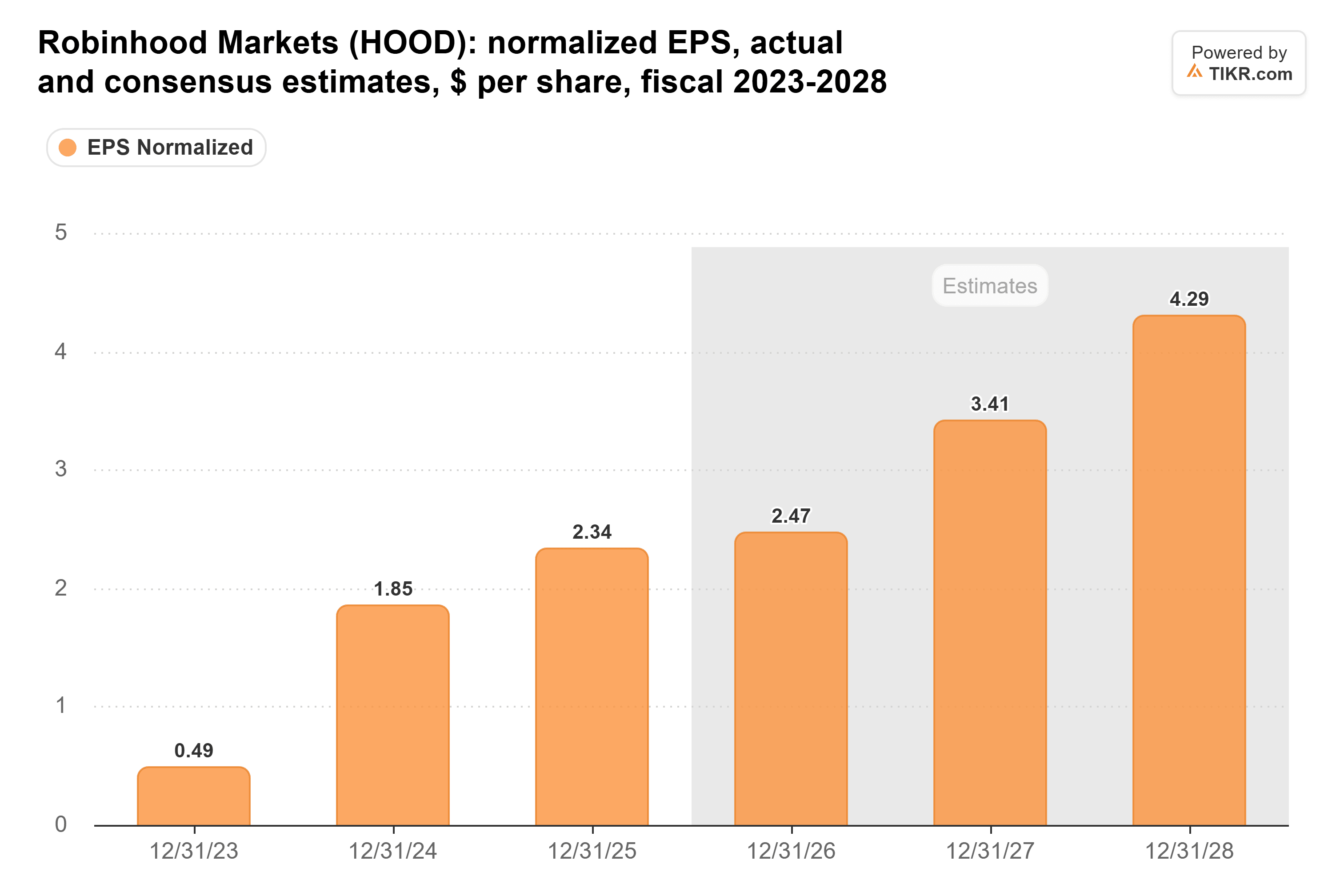
Those estimates came before this week’s headlines, and a 38% jump in 2027 depends on trading volume holding up.
Cheap, if the estimates hold
At Monday’s close, Robinhood traded at 23x forward earnings, against a three-year average of 37x:
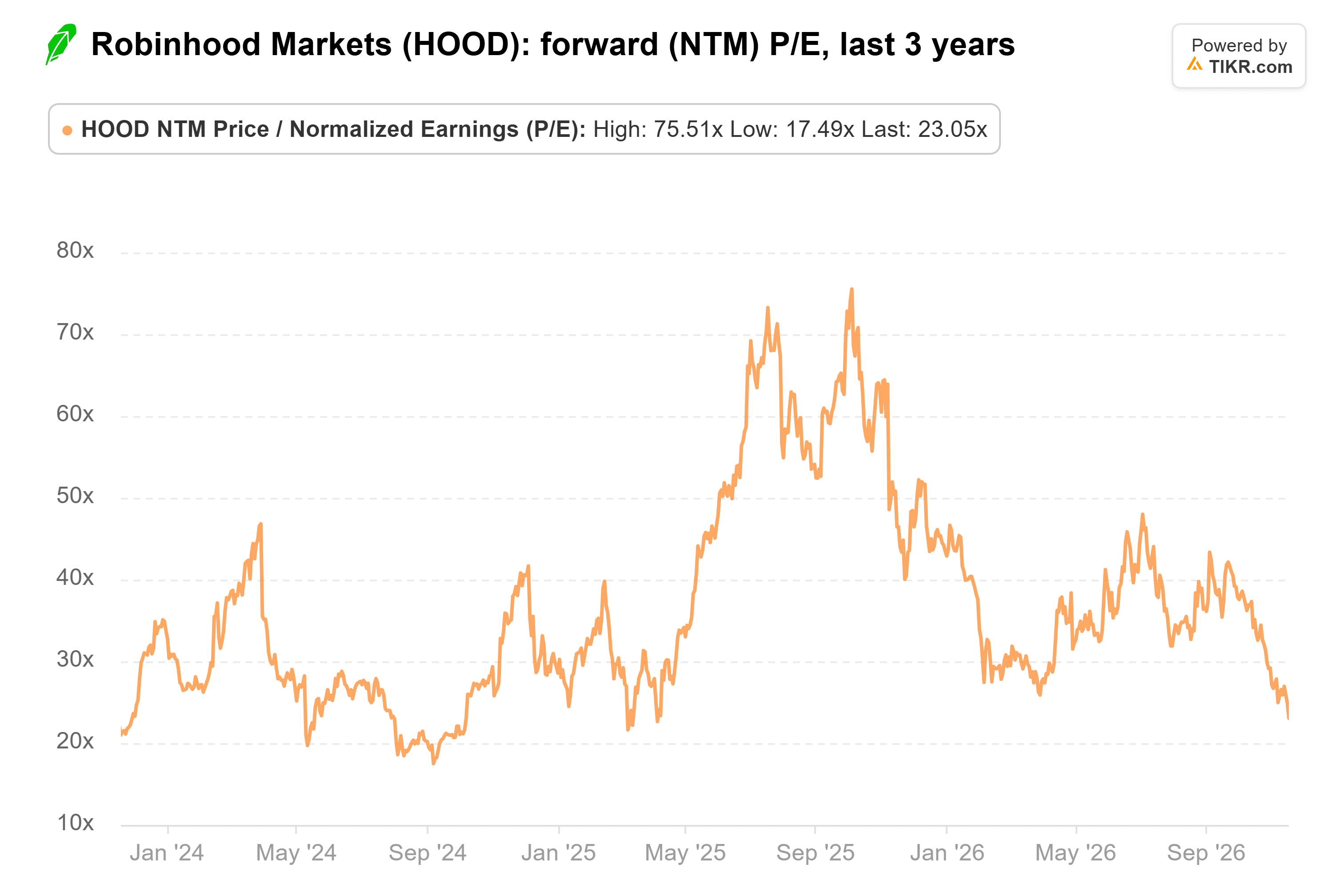
At today’s price, it’s even lower.
I think the selloff has gone further than the news justifies. Kalshi’s stock trading hasn’t launched yet, and the senators’ letter changes no rule. November’s operating data, likely out in mid-December, is the next test: crypto volume below October’s $17.0 billion would put those estimates at risk.
So what is Robinhood stock actually worth?
TIKR lets you forecast the future price of any stock in less than a minute. Just enter a few assumptions into TIKR’s valuation model and see what Robinhood could be worth. Start from Wall Street consensus estimates, or adjust the inputs to reflect your own view of the business. It’s free to use.
Disclaimer:
Please note that the articles on TIKR are not intended to serve as investment or financial advice from TIKR or our content team, nor are they recommendations to buy or sell any stocks. We create our content based on TIKR Terminal’s investment data and analysts’ estimates. Our analysis might not include recent company news or important updates. TIKR has no position in any of the stocks mentioned. Thank you for reading, and happy investing!