Key Takeaways
- Realty Income (O) reports third-quarter results Monday after the close, days after a Simply Wall St piece flagged it as expensive at about 42x earnings.
- On forward price to AFFO, which is how REITs are valued, the stock trades at 13x, below its five-year average of 15x.
- The Street expects 2026 AFFO per share of $4.44, up 3.7% from 2025 and at the bottom of management’s own guidance range.
- Watch the gap between AFFO and normalized FFO, and watch bond yields too: total debt reached $31.3 billion at June 30.
Realty Income reports third-quarter results Monday after the close, and a warning has come with the run-up to the report. A Simply Wall St piece this week cited a fair value of about $62 from its most-followed user narrative, roughly 9% above Thursday’s close, but its own earnings view suggested the shares look expensive heading into earnings. Shares closed at $57.20 on Thursday, 16% below their 52-week high, and go ex-dividend today.
That warning rests on earnings. The piece puts the stock at about 42x earnings, against roughly 28x for retail REITs.
Price It Like a REIT
P/E makes almost any landlord look expensive. In 2025, Realty Income booked $2.52 billion of depreciation and amortization, more than twice the $1.06 billion of net income it earned for common shareholders.
That’s why REITs are valued on adjusted funds from operations (AFFO). On forward price to AFFO, the stock sits below its own five-year average:
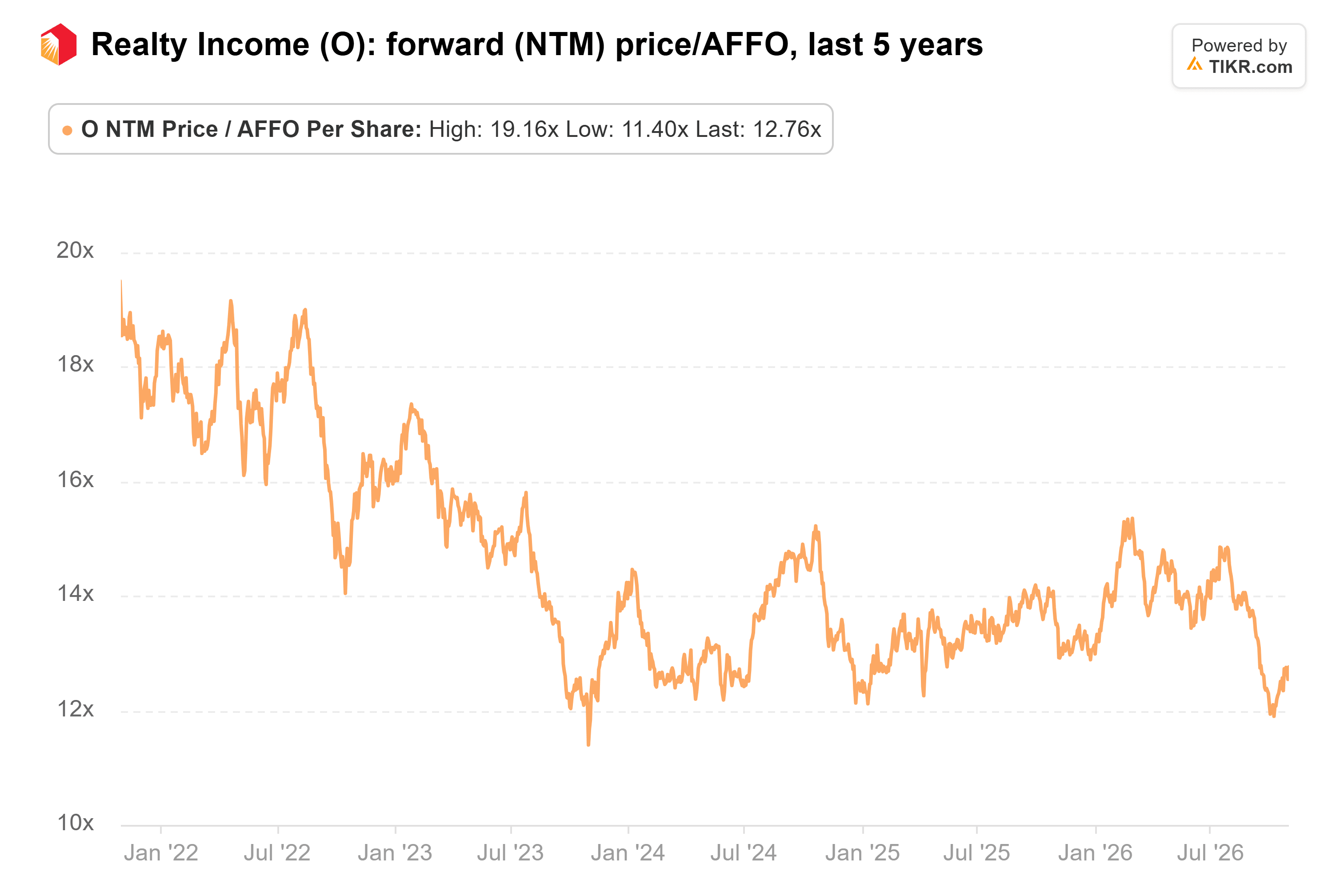
O Stock NTM Price/AFFO: 5-Year (TIKR)
Realty Income trades at 13x the AFFO per share analysts expect over the next 12 months. Its five-year average is 15x, with a high of 19x in April 2022 and a low of 11x in October 2023.
At that multiple, the price only asks for the Street’s expected growth to show up. It doesn’t pay anything extra for a rebound.
TIKR Tracks 25 Analysts on Realty Income. How Many Say “Buy”?
See the full breakdown of Buy, Hold, and Sell ratings on Realty Income, along with Wall Street’s revenue and earnings estimates, all in one place. More than 500,000 investors use TIKR to research stocks like this one. See Realty Income’s Analyst Ratings
What Monday Has to Show
So Monday’s question is whether AFFO per share is still growing as fast as the Street expects. Analysts expect $4.44 for 2026, up 3.7% from 2025’s $4.28, and the dividend stays well covered on those figures:
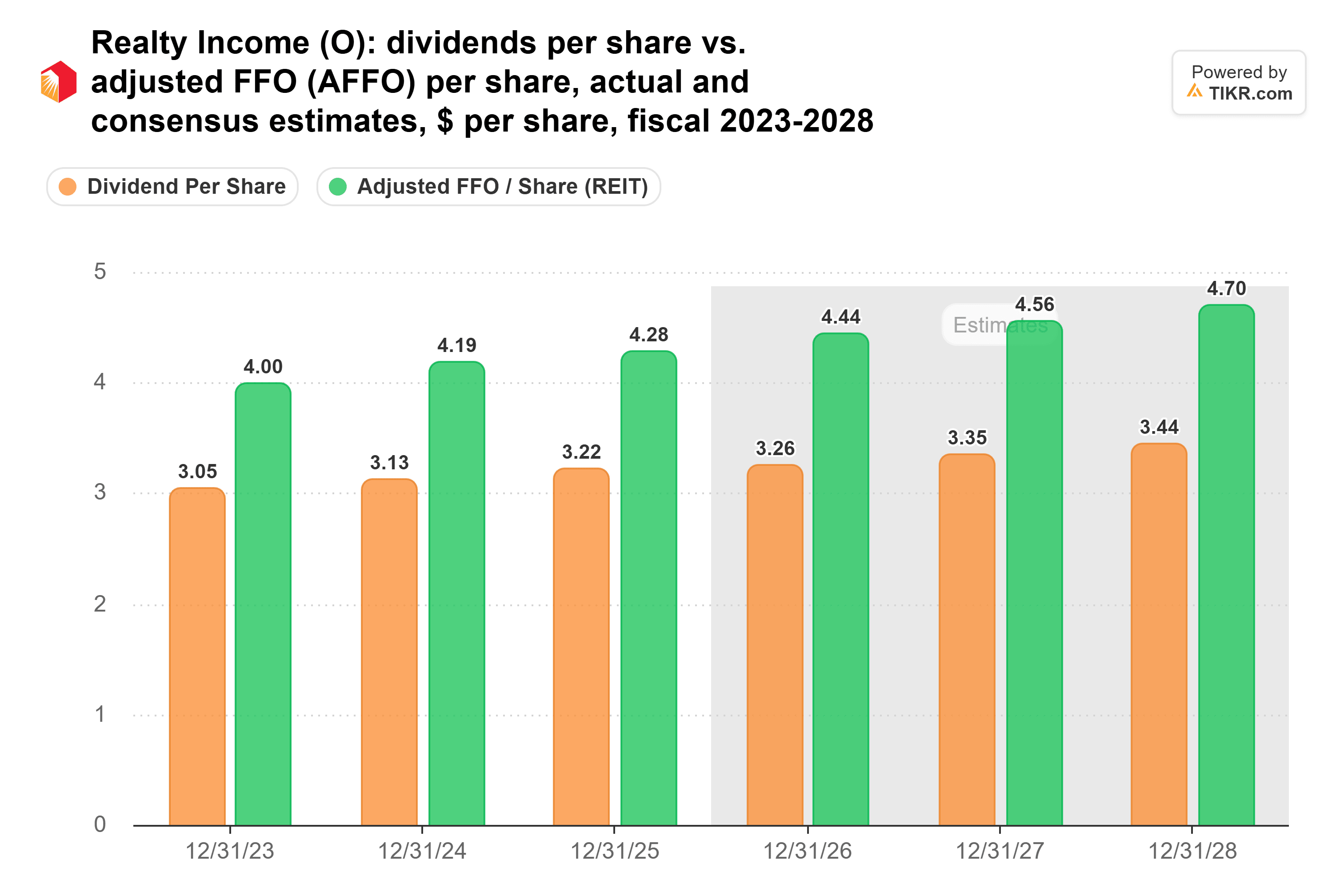
O Dividends per Share vs. AFFO per Share: Actual and Estimates, 2023-2028 (TIKR)
The $3.26 of dividends expected for 2026 would use up about 73% of that AFFO. That’s a comfortable payout for a REIT.
The $4.44 consensus sits at the bottom of the $4.44-$4.45 guidance range management set in August. Getting there takes about $1.11 a quarter in the second half. That’s roughly 2.3% above the second half of 2025, less than half the first half’s pace.
How Realty Income gets there matters too. AFFO per share rose 5.2% in the first half of 2026, while normalized FFO per share rose 1.4%. AFFO came in $76.6 million above normalized FFO in the half, against $3.2 million a year earlier. Over the same stretch, credit-loss provisions, which AFFO adds back, rose to $46.4 million, and the loan book nearly doubled to $3.36 billion.
Most of that landed in the first quarter, and the gap had already narrowed to about $23 million in the second. I’d want to see it keep shrinking on Monday, with the guidance range holding or moving up.
The Bond Market Gets a Vote Too
A net-lease landlord can trade as much on interest rates as on any single quarter. The stock fell 12% between June 30 and Sept. 30 as yields rose, even after management raised guidance. Realty Income pays for much of its growth with debt, which rose from $20.9 billion in September 2023 to $31.3 billion at June 30, 2026:
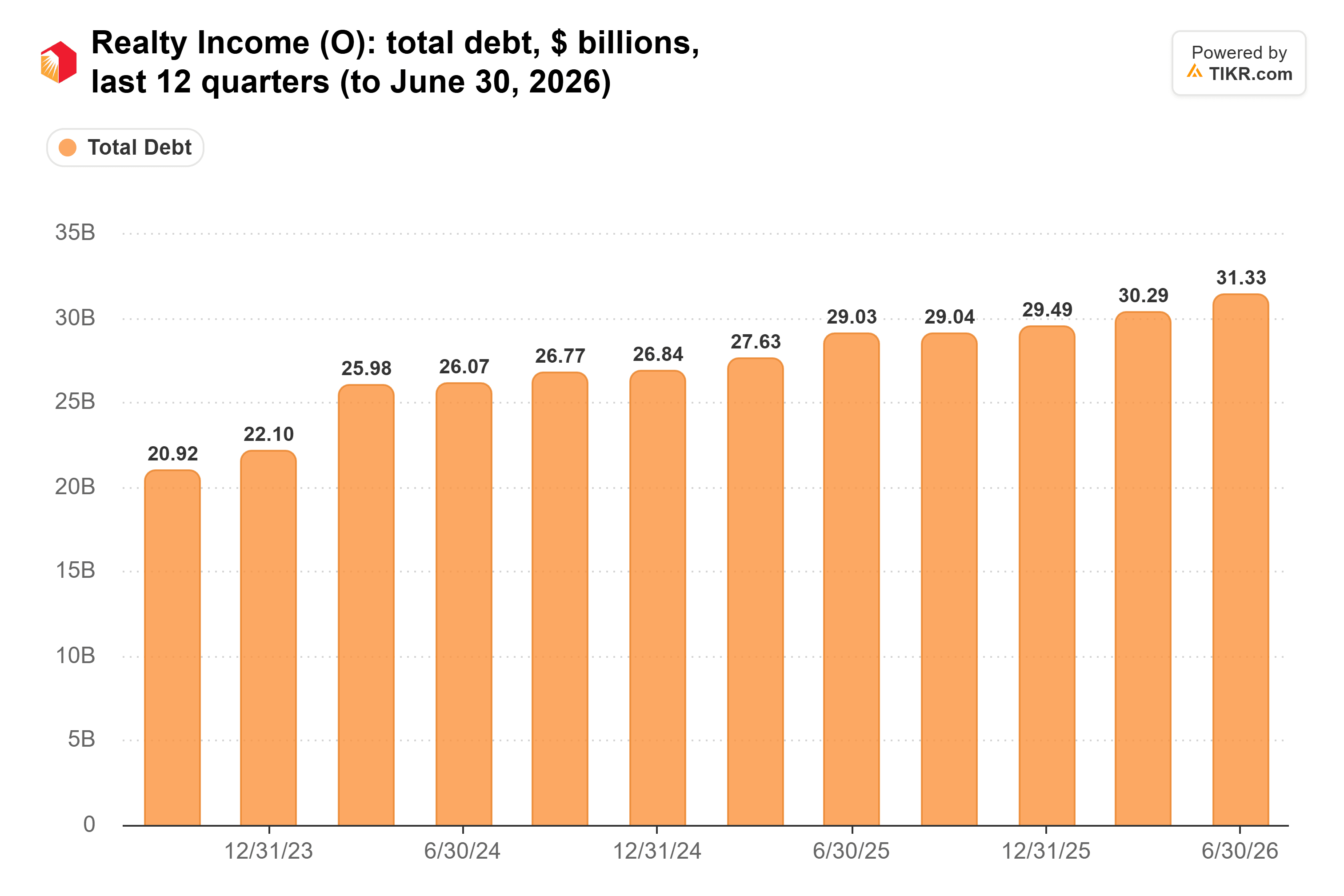
O Total Debt: Quarterly, Q3 2023-Q2 2026 (TIKR)
Analysts expect interest expense to rise 16%, from $1.25 billion in 2026 to $1.45 billion in 2027. The multiple matters for growth as well. In September, CFO Jonathan Pong said new equity effectively costs the AFFO yield. At 13x forward AFFO, that’s close to 8%, about the long-term cost of capital deals have to clear. So a jump in Treasury yields during report week could move the stock more than a penny of AFFO either way.
Cheaper Than It Looks
On the measure that fits a REIT, Realty Income doesn’t look stretched going into Monday. At 13x forward AFFO, the price asks for the Street’s expected growth and very little beyond it. If the third quarter keeps AFFO per share on track for $4.44 and the add-back gap keeps narrowing, the fair-value worry looks overdone.
The harder test is 2027 guidance early next year, when analysts expect AFFO per share to grow just 2.7%, to $4.56.
So What is Realty Income Stock Actually Worth?
TIKR lets you forecast the future price of any stock in less than a minute. Just enter a few assumptions into TIKR’s valuation model and see what Realty Income could be worth. Start from Wall Street consensus estimates, or adjust the inputs to reflect your own view of the business. It’s free to use.
Disclaimer:
Please note that the articles on TIKR are not intended to serve as investment or financial advice from TIKR or our content team, nor are they recommendations to buy or sell any stocks. We create our content based on TIKR Terminal’s investment data and analysts’ estimates. Our analysis might not include recent company news or important updates. TIKR has no position in any of the stocks mentioned. Thank you for reading, and happy investing!