Key Takeaways
- Cipher Digital (CIFR) shares have fallen 38% since the company announced $850 million of zero-coupon convertible notes, closing at $8.10 on Oct. 29. Third-quarter results come before the open on Monday, Nov. 2.
- Free cash flow was -$654 million in the quarter to June 30, 2026, and total debt reached $5.59 billion before the new notes.
- Analysts expect revenue to nearly quadruple to $853 million in 2027 as the leases start paying, but consensus still has free cash flow at -$2.5 billion that year.
- More financing looks likely, so Monday’s real test is whether rent starts on schedule and Barber Lake’s costs hold. That decides how much of the next money can come from project bonds.
Cipher Digital has kept sliding since the week it sold $850 million of zero-coupon convertible notes. The stock closed at $8.10 on Thursday, 38% below its $13.00 close the day before the deal was announced, and slipped to $7.76 after hours. At Thursday’s close, Cantor Fitzgerald’s $19 target implies 135% upside, even after Cantor cut it from $28 on Oct. 16.
The first numbers since the sale are almost here. Cipher reports its third quarter before the open on Monday, Nov. 2. The report has to show whether a Barber Lake lease worth more than $9 billion can carry the build-out, or whether the note sale was the first of several raises.
The Burn Is Speeding Up
Building three campuses at once pushed Cipher’s free cash flow to -$654 million in the quarter to June 30, 2026, from -$175 million a year earlier:
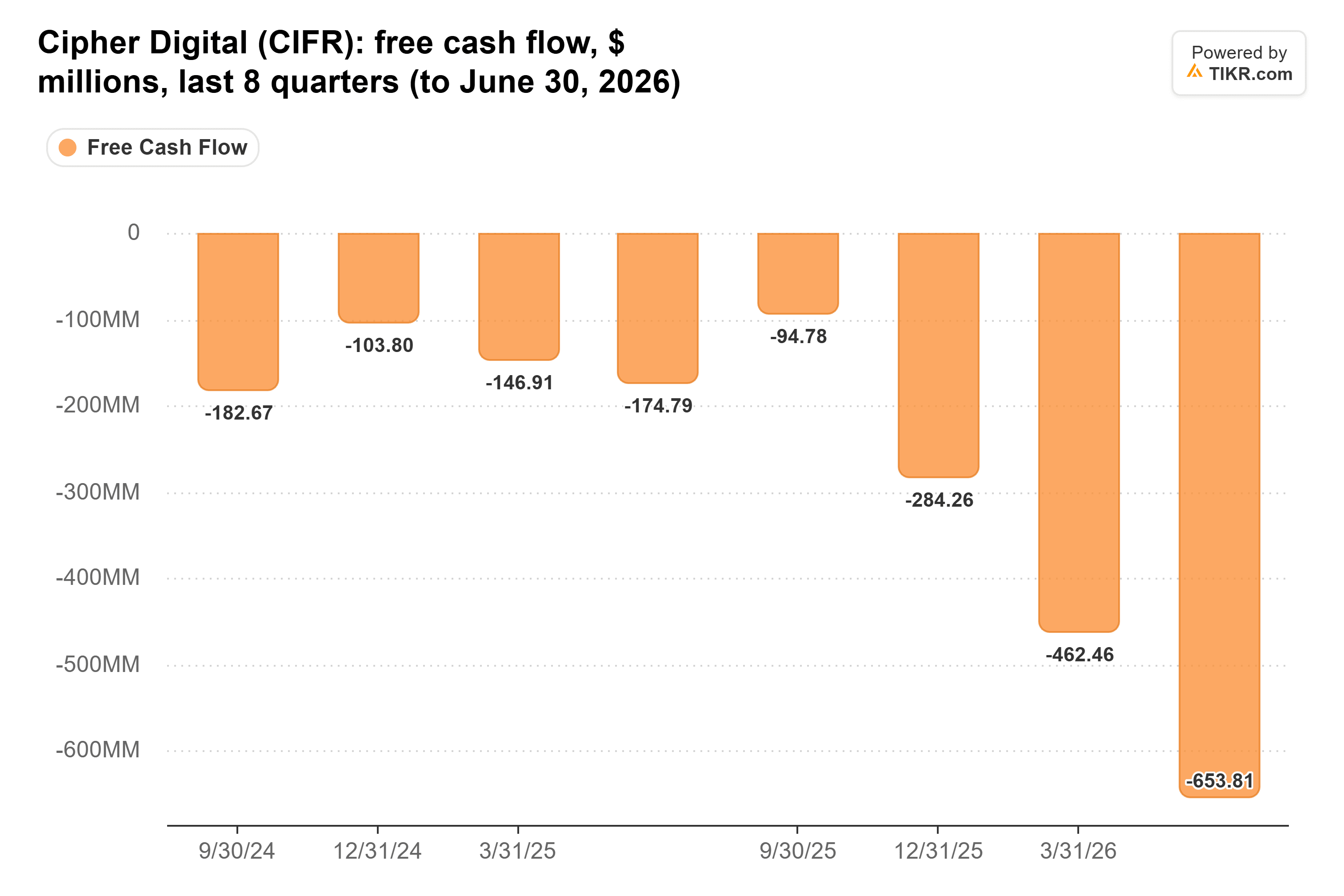
CIFR Free Cash Flow: Quarterly, Q3 2024-Q2 2026 (TIKR)
Analysts expect free cash flow of -$3.56 billion for all of 2026, though only three of them publish the number. Cipher burned about $1.12 billion in the first half, which leaves roughly $2.44 billion for the second half alone. At June 30, Cipher had $831.8 million of cash it could spend freely. Its other $3.73 billion is restricted: most of it can only fund specific site builds, and the rest sits in debt-service accounts and collateral.
TIKR Tracks 22 Analysts on Cipher Digital. How Many Say “Buy”?
See the full breakdown of Buy, Hold, and Sell ratings on Cipher Digital, along with Wall Street’s revenue and earnings estimates, all in one place. More than 500,000 investors use TIKR to research stocks like this one. See Cipher Digital’s Analyst Ratings
The Debt Piled Up Fast
Debt paid for most of that spending. Cipher’s total debt went from $189 million at June 30, 2025, to $5.59 billion a year later:
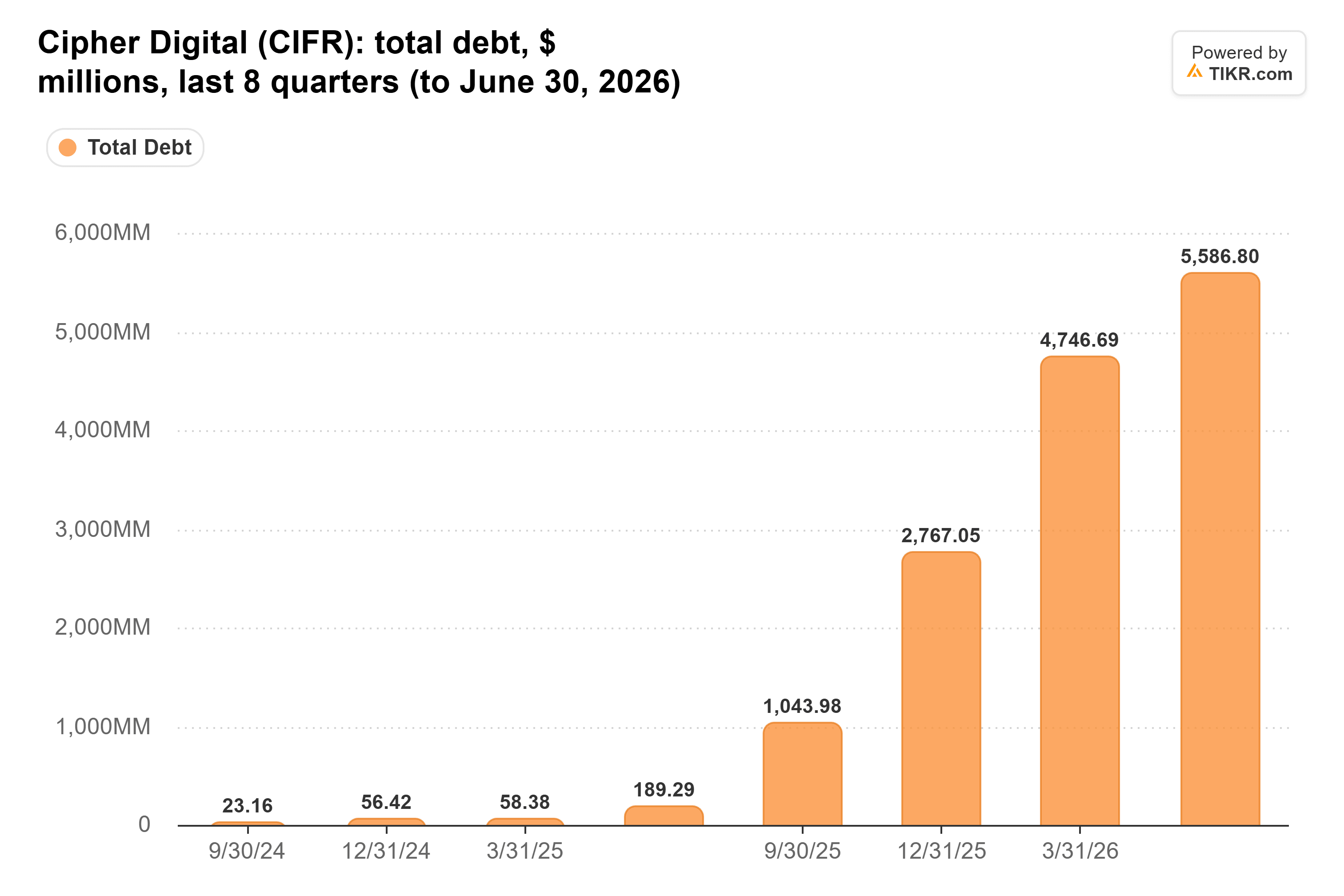
CIFR Total Debt: Quarterly, Q3 2024-Q2 2026 (TIKR)
And that’s before October’s $850 million of notes.
About $4.5 billion of the principal is project bonds at the three campuses, repaid from each campus’s rent. That’s the right way for a landlord to fund a build. The convertible notes sit at the parent and pay for Cipher’s own share of each project. Barber Lake alone now needs about $750 million more of Cipher’s equity. That’s roughly what the new notes raised once the capped calls were paid for.
The Backlog Pays Later
Revenue was $224 million in 2025, and analysts expect about the same this year, $217 million, as mining winds down and rent is just starting. They expect revenue to nearly quadruple to $853 million in 2027 and pass $1 billion in 2028:

CIFR Revenue: Actual and Consensus Estimates, 2023-2028 (TIKR)
But the burn doesn’t go away. Consensus still has free cash flow at -$2.5 billion in 2027 and -$2.4 billion in 2028, with capex of $2.2 billion and $2.5 billion. At June 30, Cipher had committed to $2.17 billion of construction. That isn’t the whole bill for the campuses it has already signed, as Barber Lake’s rising estimate shows. Still, $2.5 billion of capex in 2028 likely includes campuses Cipher hasn’t signed yet.
So Cipher will need more money, and what matters is where it comes from. Stingray’s $810 million bond fully funded that campus through substantial completion. Each campus funded that way adds rent without adding shares.
What Monday Has to Show
Start with rent. Amazon started paying rent at Black Pearl in August, two months early. Barber Lake’s data halls are due between the fourth quarter and the first quarter of 2027, with first rent in the fourth quarter. First-half revenue was $59.7 million, so the $217 million consensus needs about $157 million in the back half. If the third quarter lands near the roughly $38 million analysts expect, the fourth quarter has to bring in about $119 million, triple the third. Any hall that slips into 2027 takes its rent with it.
Then costs. Barber Lake’s estimated cost has risen 36% to 38%, to nearly $3 billion, and Cipher pays the first $359.3 million of overruns. CEO Tyler Page said on the August call that he expects cost per megawatt to “creep higher” as Cipher budgets its next builds.
Then the share count. It will show the roughly 40.7 million shares from October’s note swap and any other share sales. There’s also a warrant to watch. If the 24.18 million warrant shares held by Google are worth less than $430.0 million on the business day before Barber Lake’s lease commences, Cipher has to cover the gap with more warrant shares, cash or both. That bar works out to about $17.78 a share, more than double Thursday’s close.
A new lease could still move the stock more than anything in the quarter. In August, Page said Odessa’s first 2027 megawatts depend on getting a lease done “in the coming couple of months,” and Cipher hasn’t announced one since. He also expects all 477 megawatts at Odessa, Reveille and Ulysses to be signed, and none of those sites has to wait in Texas’s new grid-connection batch.
The note sale probably won’t be the last raise. Consensus has free cash flow at -$2.4 billion or worse every year through 2028, so the question is whether the next dollars come from project bonds backed by signed rent or from more shares. At $8.10, the stock trades 47% below the notes’ $15.31 conversion price, so these notes are unlikely to turn into stock soon. They’re debt for now, and holders can sell them back to Cipher at face value in November 2030. A quarter with rent on time and Barber Lake’s estimate holding at $2.94 billion to $2.97 billion would make project bonds the easier answer.
A clean report still won’t settle it. Barber Lake’s first rent lands in the fourth quarter, so the quarter that proves it comes in Cipher’s next report, early in 2027.
So what is Cipher Digital stock actually worth?
TIKR lets you forecast the future price of any stock in less than a minute. Just enter a few assumptions into TIKR’s valuation model and see what Cipher Digital could be worth. Start from Wall Street consensus estimates, or adjust the inputs to reflect your own view of the business. It’s free to use.
Disclaimer:
Please note that the articles on TIKR are not intended to serve as investment or financial advice from TIKR or our content team, nor are they recommendations to buy or sell any stocks. We create our content based on TIKR Terminal’s investment data and analysts’ estimates. Our analysis might not include recent company news or important updates. TIKR has no position in any of the stocks mentioned. Thank you for reading, and happy investing!