Key Takeaways
- Strategy sold 2.05 million new common shares last week and spent $188.3 million of the $283.8 million it raised buying back its STRC preferred stock, against $81.9 million on bitcoin.
- Peter Schiff says that sacrifices common stockholders to prop up the preferred, and Strategy’s own figures largely back him.
- Strategy’s year-to-date BTC Yield, its measure of bitcoin per share, was negative 3.7% in its third-quarter release, and Schiff puts it at negative 4.2% now.
- The buybacks only pay off for common holders if STRC sells again near $100, and Strategy hasn’t sold any since mid-May.
Michael Saylor had an update for Strategy (MSTR) shareholders on Monday: he posted on X that the company had bought 1,036 more bitcoin and repurchased $188 million of STRC, its variable-rate preferred stock.
Longtime bitcoin critic Peter Schiff replied the same day: “I see you’re back to sacrificing MSTR common stockholders to prop up STRC and Bitcoin.”
And this time, he has Strategy’s own filing to point to.
Two-thirds of the money went to STRC
Strategy’s 8-K, filed Monday, shows it sold 2,051,348 new common shares in the week to Nov. 8 for $283.8 million. Of that, $188.3 million went to buying back STRC, $81.9 million to bitcoin and $13.6 million to cash. Each new share raised about $138: about $92 of it went to STRC and about $40 to bitcoin.
Every existing share already has bitcoin behind it, so a new share that brings in only $40 of bitcoin waters that down. Strategy’s third-quarter release put its year-to-date BTC Yield, its measure of the change in bitcoin per diluted share, at negative 3.7%, down from 4.5% at the end of July. Schiff says it’s now negative 4.2%.
Strategy’s diluted share count has more than doubled in three years, from 184 million in the last quarter of 2023 to 428 million in the September quarter of 2026:
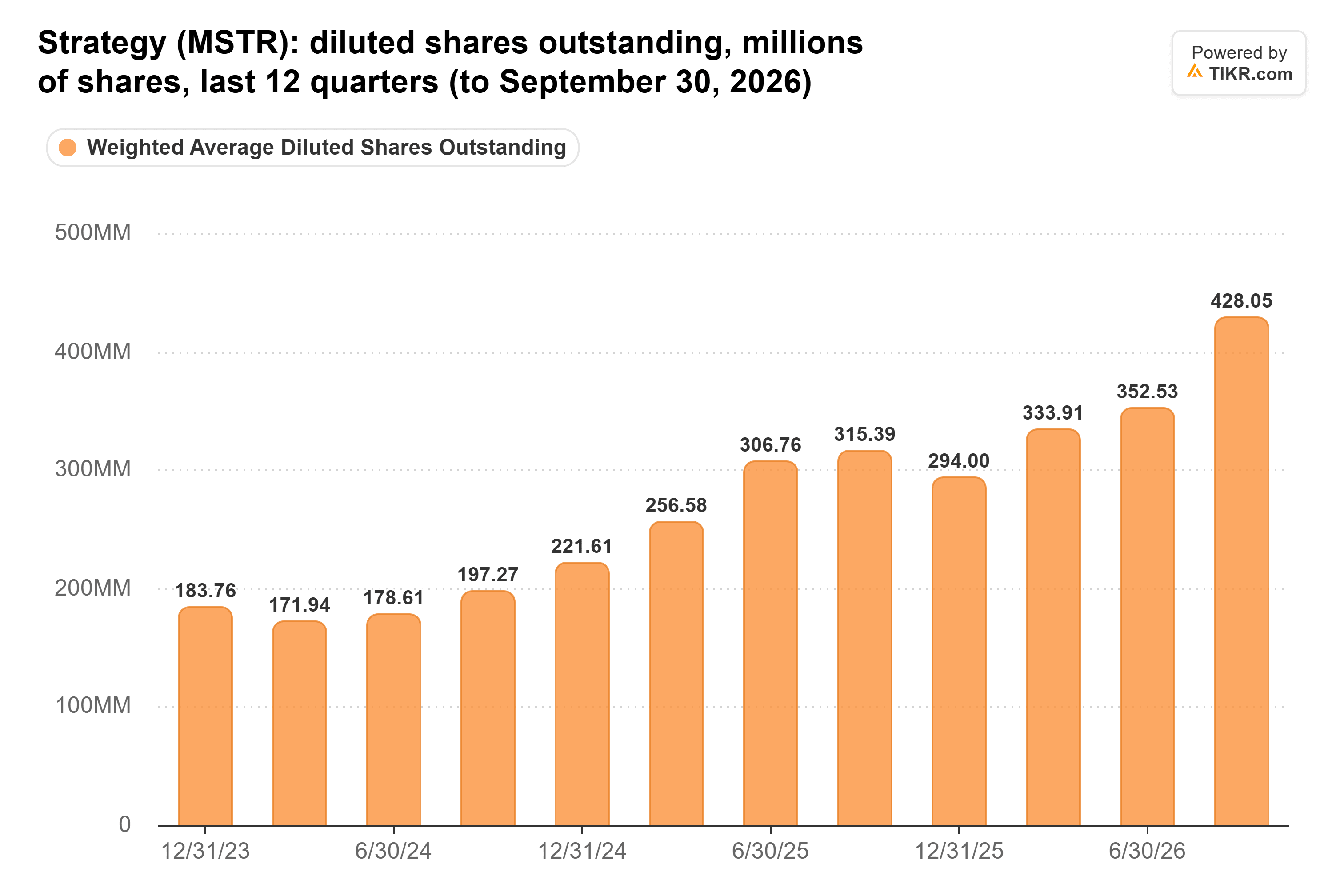
Most of those shares paid for bitcoin. Lately, more of the money goes to the preferred: in its last two weekly filings, Strategy spent $396.5 million buying back STRC and $147.4 million on bitcoin.
TIKR tracks 16 analysts on Strategy. How many say “Buy”?
See the full breakdown of Buy, Hold, and Sell ratings on Strategy, along with Wall Street’s revenue and earnings estimates, all in one place. More than 500,000 investors use TIKR to research stocks like this one. See Strategy’s Analyst Ratings
The premium is mostly gone
Strategy could sell stock and still grow bitcoin per share because the common traded far above the value of the bitcoin behind it. That meant each new share brought in more bitcoin than an existing share held. In May, management put the break-even for selling stock to buy bitcoin at 1.22 times the value of its bitcoin, net of the claims ahead of the common. Strategy’s price-to-book ratio shows how little of that cushion is left:
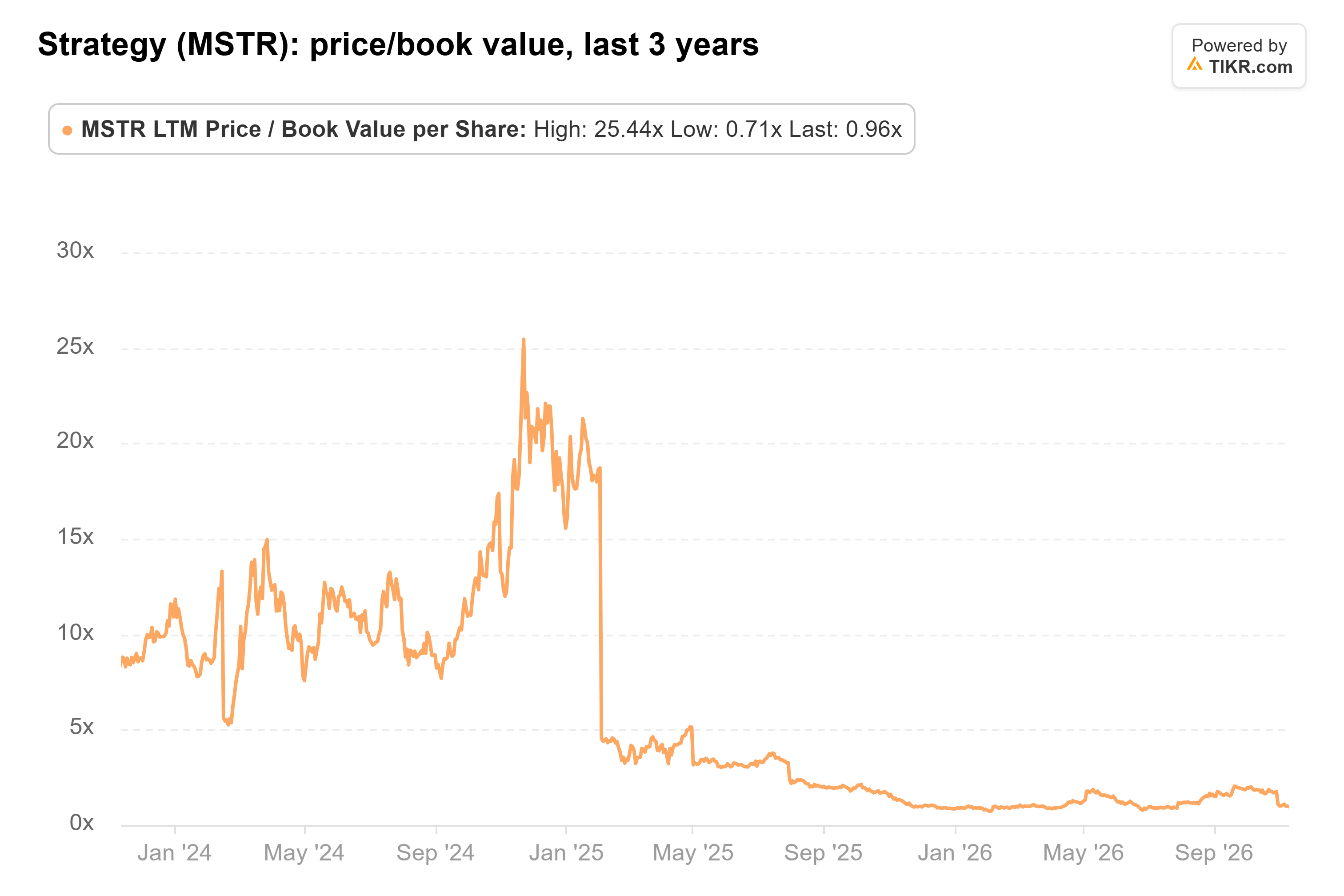
Strategy trades at 1.0x book, against a three-year average of 6.2x and a peak of 25.4x in November 2024. At that level, selling shares to buy bitcoin does little for bitcoin per share, and selling shares to retire preferred lowers it.
There’s no discount left to capture
Buying back preferred below its $100 face value does hand common holders the gap. Strategy’s first STRC buyback in July retired $28.9 million of face value for $25.0 million, a 13% discount. This year through late October, it paid $2.04 billion for $2.10 billion of STRC, an average discount of 2.6%, according to its third-quarter release.
Last week, it paid about $99.76 a share. That’s a discount of about $450,000 on $188.7 million of face value.
What common holders do get is one less 12% claim ahead of them, since retiring that STRC saves about $22.6 million a year in dividends. Strategy said in its second-quarter release that it wants STRC to trade at $99 to $100 over time, and that it would buy shares back below $100. It hasn’t sold any new STRC since mid-May, and the preferred fell as low as $71.25 in June.
There’s cash for dividends, less for buybacks
In a separate reply, Schiff told Saylor “you’re running out of cash.” Strategy’s cash and short-term investments are far bigger than they were a year ago:
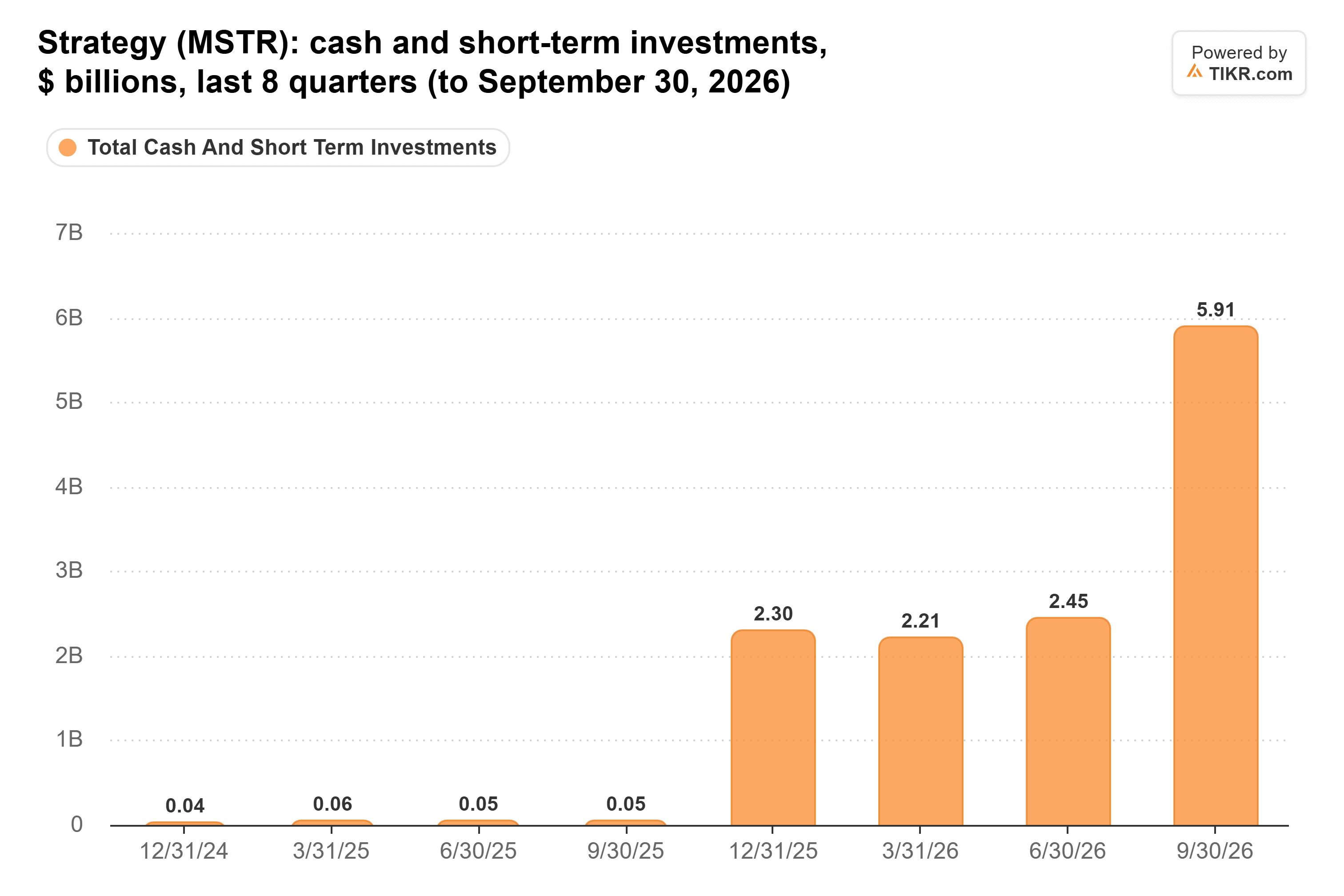
Strategy splits that cash into two pools. The USD Reserve, kept for preferred dividends and interest, held $4.77 billion on Nov. 8. That’s about three years of the roughly $1.51 billion a year it owes. USD Cash, the pool for everything else, was down to $146.2 million from $640.5 million on Oct. 11, after it paid for the previous week’s $208.2 million STRC buyback. So the dividends are covered, but Strategy now pays for its buybacks by selling new common stock.
Common holders are paying for STRC’s comeback
Schiff’s right about who’s footing the bill. Strategy is selling common shares at about book value and spending most of the money to hold its preferred near $100, while bitcoin per share falls. That only pays off for MSTR holders if STRC sells at par again, which would give Strategy funding that adds bitcoin without adding common shares. Until that happens, I’d count each Monday’s filing as a cost to common holders. With $560.3 million left in its preferred buyback program, watch the next few weekly filings and MSCI’s Nov. 11 list of companies its new index rule removes. Of course, if bitcoin turns higher and STRC holds par on its own, Saylor may never need that last $560.3 million.
So what is Strategy stock actually worth?
TIKR lets you forecast the future price of any stock in less than a minute. Just enter a few assumptions into TIKR’s valuation model and see what Strategy could be worth. Start from Wall Street consensus estimates, or adjust the inputs to reflect your own view of the business. It’s free to use.
Disclaimer:
Please note that the articles on TIKR are not intended to serve as investment or financial advice from TIKR or our content team, nor are they recommendations to buy or sell any stocks. We create our content based on TIKR Terminal’s investment data and analysts’ estimates. Our analysis might not include recent company news or important updates. TIKR has no position in any of the stocks mentioned. Thank you for reading, and happy investing!