Key Takeaways
- Elon Musk said on X that Starlink V4 should be able to outcompete undersea cables, with about 100 lasers per satellite running above 10 Tb/s each across more than 100,000 satellites.
- Long-haul data traffic would give Starlink revenue beyond consumer subscribers, whose average revenue per user fell to $69 in the third quarter from $83 a year earlier.
- Analysts expect $335 billion of revenue from all of SpaceX in 2028, about a third of the $1 trillion of Starlink revenue that investor Ron Baron models within 10 years.
- SpaceX trades at 13x forward sales, less than half its average since it listed, but V4 depends on Starship, whose next flight is set for Nov. 13.
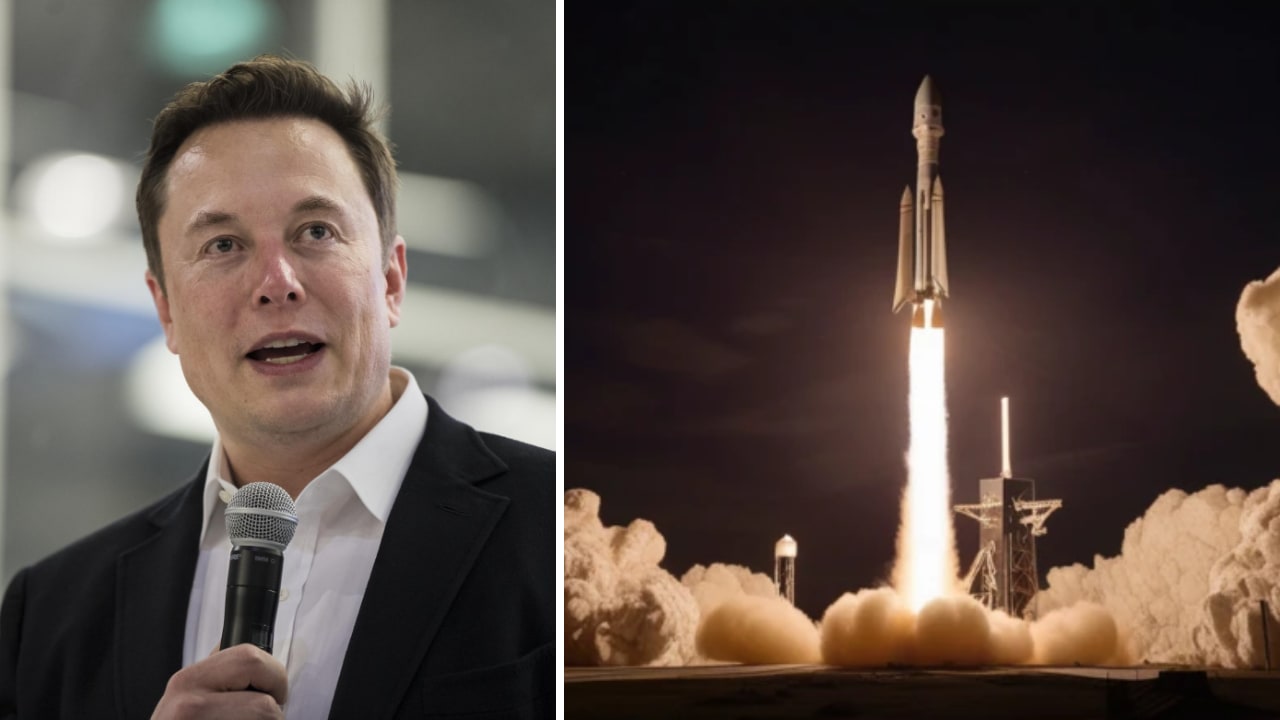
Since the midterms, SpaceX (SPCX) investors have mostly worried about its data centers. Elon Musk just gave them a reason to look at the ocean floor.
Last Friday, Sawyer Merritt shared Musk’s tease of the next-generation Starlink satellites: “Starlink version 4 will have 10x the capability of V3 (which itself is 10x better than V2).”
Then Musk went further:
“~100 lasers per satellite, each operating above 10 Tb/s, with over 100k satellites should be able to outcompete undersea cables. Speed of light in space is ~40% faster than cable and the path is direct, instead of following the outline of land masses.”
That would be a whole new market for Starlink.
TIKR tracks 40 analysts on SpaceX. How many say “Buy”?
See the full breakdown of Buy, Hold, and Sell ratings on SpaceX, along with Wall Street’s revenue and earnings estimates, all in one place. More than 500,000 investors use TIKR to research stocks like this one. See SpaceX’s Analyst Ratings
Each new Starlink customer pays less
Musk also said Starlink is “roughly doubling revenues per year at large scale,” in remarks posted on X by KanekoaTheGreat. He’s close. In the third quarter, consumer revenue rose 57% from a year earlier to $3.12 billion, and enterprise and government revenue rose 91% to $2.13 billion.
But consumer subscribers grew faster than consumer revenue, up 89% to 13.6 million, so average revenue per user fell to $69 from $83. Management has said that expanding into more countries may push that blended figure down over time. Long-haul data traffic would be a revenue line that doesn’t depend on signing up subscribers in cheaper markets.
It also wouldn’t depend on GPU rental prices. That matters more now that Musk has admitted that “If compute becomes plentiful and cheap, SpaceX revenue will drop.”
Baron’s number dwarfs the Street’s
In the same X post, Ron Baron, whose firm is a major SpaceX investor, says he has modeled Starlink at $1 trillion of revenue and a $14-15 trillion valuation within 10 years, and now thinks that’s “really light.” For comparison, Starlink’s Connectivity segment brought in $11.4 billion of revenue in 2025.
Wall Street’s consensus for all of SpaceX reaches $335 billion by 2028, about a third of Baron’s figure for Starlink alone:

Analysts have raised their 2027 and 2028 revenue estimates by 146% and 200% since the end of June. Over the same stretch, quarterly revenue from the compute business went from $2.56 billion to $7.56 billion. A post about satellites with no launch date shouldn’t move those estimates. So if Starlink can build a backbone business, it would be growth on top of what the Street models today.
V4 has to wait for Starship
Of course, none of this exists yet. Starship first carried V3 satellites to orbit on Sept. 28, with 26 on board, and SpaceX’s Gwynne Shotwell expects a few hundred V3s in orbit by mid-2027. V4 comes after that.
Musk’s launch dates keep slipping, too. On SpaceX’s second-quarter call in August, he expected Starship to fly once a day within a year. On the third-quarter call in October, he guided to weekly flights in the first half of 2027.
The undersea cables are already in the water. To take traffic from them, Starlink would have to beat them on price as well as speed, and that price has to cover the satellites, the lasers and the launches.
At 13x sales, you get the backbone for free
After the post-midterm selloff, SpaceX trades at 13x forward sales. That’s less than half its 28x average since it listed in June and far below its 62x peak in its first week of trading:
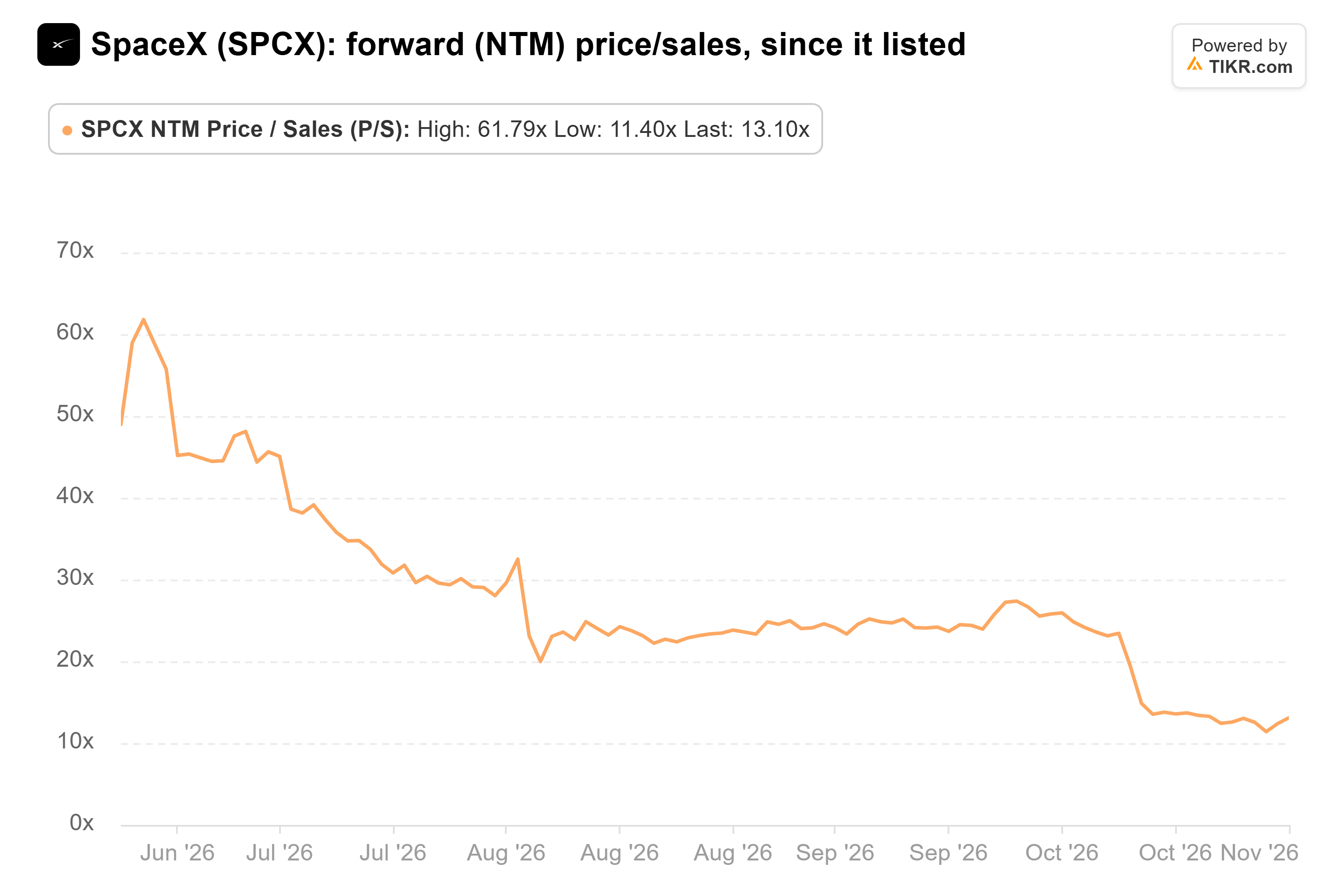
The way I see it, Musk’s backbone pitch is the best case yet that Starlink can grow beyond selling dishes and monthly plans, and at this multiple, I don’t think investors are paying anything for it. That said, it’s an option on the 2030s. For the next year or two, investors will keep valuing SpaceX on its compute rentals and whether they hold up.
Of course, SpaceX needs Starship to launch all of this, and Flight 15 on Nov. 13 is the next test of the launch pace Musk keeps promising.
So what is SpaceX stock actually worth?
TIKR lets you forecast the future price of any stock in less than a minute. Just enter a few assumptions into TIKR’s valuation model and see what SpaceX could be worth. Start from Wall Street consensus estimates, or adjust the inputs to reflect your own view of the business. It’s free to use.
Disclaimer:
Please note that the articles on TIKR are not intended to serve as investment or financial advice from TIKR or our content team, nor are they recommendations to buy or sell any stocks. We create our content based on TIKR Terminal’s investment data and analysts’ estimates. Our analysis might not include recent company news or important updates. TIKR has no position in any of the stocks mentioned. Thank you for reading, and happy investing!