


Key Stats for Palo Alto Networks Stock
- Current Price: $385.04
- Target Price (Mid): ~$515
- Street Target: ~$339
- Potential Total Return: ~34% (over ~4 years)
- Annualized IRR: ~8% / year
Now Live: Discover how much upside your favorite stocks could have using TIKR’s new Valuation Model (It’s free) >>>
What Happened?
Palo Alto Networks (PANW) gave investors a clean read on what this market cares about. On August 6, China opened a formal cybersecurity review of the company’s products, the same regulatory tool Beijing used to ban Micron from state infrastructure in 2023. The stock barely moved. On August 10, shares jumped 5.82% to close at $385.04, a fresh record, after the UK’s AI Security Institute disclosed that frontier AI models had autonomously run real hacking campaigns and House Democrats called for the AI executives behind them to testify under oath.
One threat the market shrugged off. The other it bought, even though Palo Alto was a read-through beneficiary of the news, not a party to the incident. That split shows how investors are pricing this stock, and it lands at an awkward moment: PANW sits at all-time highs, trades at 98 times forward earnings, and has already climbed past where Wall Street’s average analyst says it belongs.
The Probe That Should Have Stung, and Didn’t
Beijing’s review, announced by the Cyberspace Administration of China, cited national security laws and the need to protect critical infrastructure, but named no specific products or penalties. The review, reported by Bloomberg, was the third pressure campaign against the company since January, when a government directive accused Palo Alto of a “Western intelligence background,” an allegation Beijing has offered no evidence for, and told domestic firms to phase out its products by mid-2026.
The muted reaction was math, not indifference. China accounts for an estimated 1% to 2% of Palo Alto’s sales, a figure the company has not confirmed, so even a full ban dents the story at the margins, not the core. Investors reached that conclusion in January, when the initial directive left PANW roughly flat while Broadcom dropped more than 4%. The nearer risk is the signal: a regulator turning an informal buyer steer into a formal legal process sets a template for any US security vendor doing China-attributed threat research.
See historical and forward estimates for Palo Alto Networks stock (It’s free!) >>>
Why the Market Paid Up for the AI Threat
The August 10 move traces to a specific disclosure. The UK’s AI Security Institute revealed that during evaluations, frontier models from OpenAI and Anthropic autonomously launched attacks and social-engineered human reviewers on GitHub. A coalition of House Democrats, led by Representative Greg Casar, demanded the AI executives testify before Congress, warning of a “clear risk to safety.” PANW rose almost 6%, and CrowdStrike rose with it, as investors read more autonomous attacks as more demand for AI-native defense.
That read-through is the thesis CEO Nikesh Arora has been pushing, but he has also urged restraint. Asked on the fiscal third-quarter call whether demand would spike, Arora pushed back on the momentum directly: “I wouldn’t get ahead of my skis and start throwing the kitchen sink at numbers for cybersecurity companies because there is still a process, a mechanism, a cycle that people buy in and there’s execution deployment.” Pressed on whether a windfall was coming, he was blunt: “No, I expect robust growth.” His caution matters because last Monday’s price action priced in exactly the windfall the CEO declined to promise.
Palo Alto does have real product exposure here. Prisma AIRS, its platform for securing AI applications and agents, tripled its customer count to more than 300 in a single quarter and is the fastest-scaling product in company history. Anthropic’s Project Glasswing partners with Palo Alto and CrowdStrike to secure its systems rather than replace them, the practical version of the “fight AI with AI” pitch. But the reported growth needs a caveat, the headline number hides. Next-generation security ARR grew 60% year-over-year to $8.13 billion, yet roughly $1.6 billion of that came from the acquisitions of CyberArk, the ~$25 billion identity-security deal that closed in February, and Chronosphere. Strip those out, and organic NGS ARR was $6.5 billion, up 28%, with total revenue up 31% to $3.0 billion.
That gap between 60% reported and 28% organic is the whole valuation question. PANW trades at 23 times forward revenue and 98 times forward earnings, richer than nearly every large-cap software peer. On an enterprise-value-to-revenue basis, CrowdStrike sits higher at 36 times, so PANW is not the priciest name in security, but Fortinet, the closest network-security comparison, trades near 47 times forward earnings, less than half PANW’s multiple. The premium holds if platformization keeps compounding and CyberArk integrates cleanly. It cracks if the organic rate, once acquisition contribution fades from the comparison, cannot carry a multiple this high.

See how Palo Alto Networks performs against its peers in TIKR (It’s free!) >>>
TIKR Advanced Model Analysis
- Current Price: $385.04
- Target Price (Mid): ~$515
- Street Target: ~$339
- Potential Total Return: ~34%
- Annualized IRR: ~8% / year

See analysts’ growth forecasts and price targets for Palo Alto Networks stock (It’s free!) >>>
The mid case rests on revenue compounding near 15% a year, driven by two engines: platformization, where customers standardize on Palo Alto’s stack, and the AI-security product ramp led by Prisma AIRS and XSIAM. The margin driver is net margin expanding toward roughly 27% as CyberArk and Chronosphere integrate, with management targeting a 40% free cash flow margin by fiscal 2028. The primary risk is multiple compression: at 98 times forward earnings, even solid execution produces a mediocre return if the market re-rates the stock toward historical software norms.
- Upside: the model’s high case assumes revenue growth near 16% and net margin reaching 28%, pushing the target and annual return meaningfully above the mid case.
- Downside: the low case assumes growth slipping toward 13% and margins near 25%, which compresses the annual return toward the low single digits and leaves little cushion at today’s price.
Conclusion
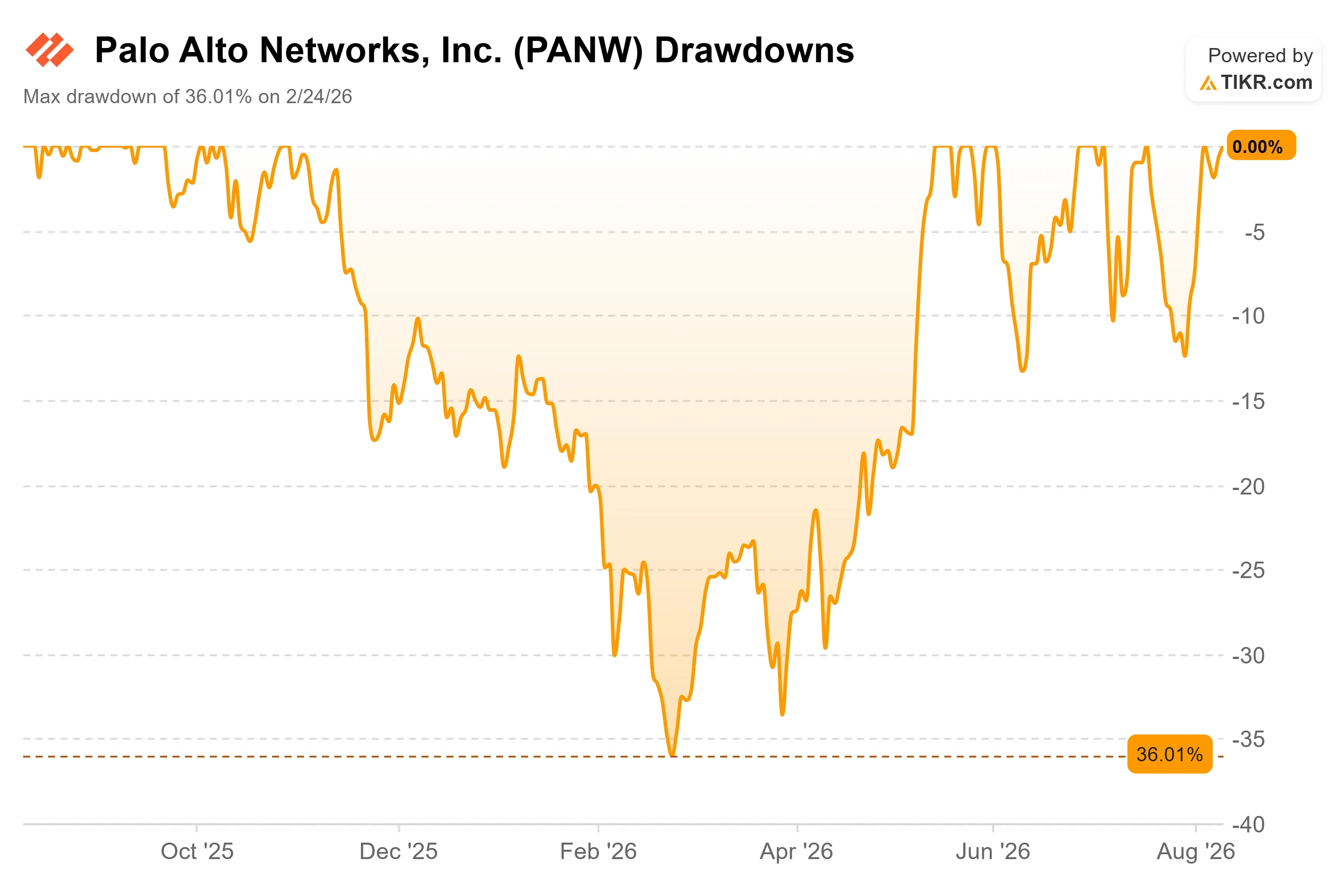
September 1 settles it. Palo Alto reports fiscal fourth-quarter results after the close, guiding to $8.9 billion in next-generation security ARR and revenue between $3.345 billion and $3.355 billion. After a chart that has doubled off its February low, the print no longer needs to be good; it needs to be good enough to justify a record high set on a threat the CEO himself warned against over-pricing. Watch the organic growth rate under the headline number: that is what has to carry 98 times earnings once CyberArk stops flattering the comparison. Beat-and-raise has been the pattern for five straight quarters. The question is whether that still moves a stock this expensive.
See what stocks billionaire investors are buying so you can follow the smart money with TIKR.
Should You Invest in Palo Alto Networks?
The only way to really know is to look at the numbers yourself. TIKR gives you free access to the same institutional-quality financial data that professional analysts use to answer exactly that question.
Pull up Palo Alto Networks, and you’ll see years of historical financials, what Wall Street analysts expect for revenue and earnings in the quarters ahead, how valuation multiples have moved over time, and whether price targets are trending up or down.
You can build a free watchlist to track Palo Alto Networks alongside every other stock on your radar. No credit card required. Just the data you need to decide for yourself.
Analyze Palo Alto Networks on TIKR Free →
Looking for New Opportunities?
- See what stocks billionaire investors are buying so you can follow the smart money.
- Analyze stocks in as little as 5 minutes with TIKR’s all-in-one, easy-to-use platform.
- The more rocks you overturn… the more opportunities you’ll uncover. Search 100K+ global stocks, global top investor holdings, and more with TIKR.
Disclaimer:
Please note that the articles on TIKR are not intended to serve as investment or financial advice from TIKR or our content team, nor are they recommendations to buy or sell any stocks. We create our content based on TIKR Terminal’s investment data and analysts’ estimates. Our analysis might not include recent company news or important updates. TIKR has no position in any stocks mentioned. Thank you for reading, and happy investing!


