Key Takeaways
- Palantir fell 3% today even though third-quarter revenue grew 96% to $2.31 billion, because total contract value grew just 6% to $2.92 billion.
- CEO Alex Karp says commercial customers are signing shorter contracts that start much bigger and grow fast, so less contract value gets booked at the start.
- Commercial contract value grew 17% and U.S. commercial customers grew 29%, but U.S. commercial remaining deal value rose only 4% from the second quarter.
- The stock is priced for years of fast growth, so the next two quarters’ bookings need to show those shorter contracts growing the way Karp says they will.
Palantir Technologies (PLTR) just had its first $2 billion quarter. Revenue of $2.31 billion grew 96% and beat the $2.18 billion analysts expected going in. Adjusted EPS of $0.44 topped the $0.41 expected, and management raised its guidance again.
The stock fell 3% today anyway.
Investors focused on a different number: total contract value (TCV), the full value of the deals Palantir signed in the quarter. It came to $2.92 billion, up just 6% from a year ago.
Today’s contracts are tomorrow’s revenue
Revenue counts what Palantir earns on contracts it has already signed. TCV counts what it signs now, which becomes revenue over the months and years ahead.
The slowdown came fast. Contract value grew 61% in the first quarter and 49% in the second, when Palantir booked $3.37 billion. U.S. commercial TCV hit a record $2.13 billion in the second quarter. This time it came in at $1.46 billion, up 11%.
That matters for a stock priced for years of fast growth. Going into the report, analysts expected revenue to climb from $4.48 billion in 2025 to $17.89 billion in 2028:

Palantir’s new 2026 guide of $8.53 billion, up 91%, already beats the $8.22 billion consensus, so I’d expect those estimates to rise. But the later years depend on contracts Palantir still has to sign.
TIKR tracks 32 analysts on Palantir. How many say “Buy”?
See the full breakdown of Buy, Hold, and Sell ratings on Palantir, along with Wall Street’s revenue and earnings estimates, all in one place. More than 500,000 investors use TIKR to research stocks like this one. See Palantir’s Analyst Ratings
Karp’s answer: shorter deals, much bigger starts
On the Nov. 2 call, CEO Alex Karp said that on the front line in commercial, he’s seeing “much quicker interaction, much quicker to deployment, shorter duration of the contract, but then an ability to expand that contract dramatically.”
The first deals are also far bigger than they used to be: “So instead of being, like, $250,000, it’s like $25 million to start.”
Shareholders would take that trade every time.
If Palantir signs a customer for one year instead of three at the same yearly price, it books a third of the contract value but earns the same revenue this year. So shorter contracts can hold TCV down even if demand hasn’t slowed, and renewals come around sooner.
The commercial numbers fit his story
Karp’s explanation is about commercial customers, and that’s where contract value held up best. Commercial TCV grew 17% to $1.65 billion, CFO David Glazer said on the call. That’s close to three times the company’s overall pace, so contract value from government customers fell from a year ago.
The growth inside existing accounts shows up in revenue. U.S. commercial revenue jumped 148% to $984 million and passed U.S. government revenue of $953 million for the first time. U.S. commercial customers grew 29% to 686. Revenue grew five times as fast as the customer count, which is what you’d expect if big first deals keep getting bigger.
The 4% is harder to wave off
Of course, shorter contracts are also what a company would say when deals get harder to sign. And one slow quarter for contract value could just be lumpiness.
But a second number points the same way. U.S. commercial remaining deal value, the value left on Palantir’s signed U.S. commercial contracts, reached $6.52 billion. That’s up 79% from a year ago but just 4% from the second quarter, while U.S. commercial revenue grew 29% over the same three months. Customer growth slowed too, from 35% in the second quarter to 29%.
Shorter contracts explain some of that, since they leave less value on the books. The backlog now covers about six and a half quarters of U.S. commercial revenue at this quarter’s pace, down from about nine a year ago. But a backlog that barely grew in a quarter when revenue jumped 29% is also what slower signing looks like.
What today’s price assumes
At Monday’s close, Palantir traded at 94x forward earnings. That’s below its five-year average of 102x, but nearly three times its 34x low from May 2022:
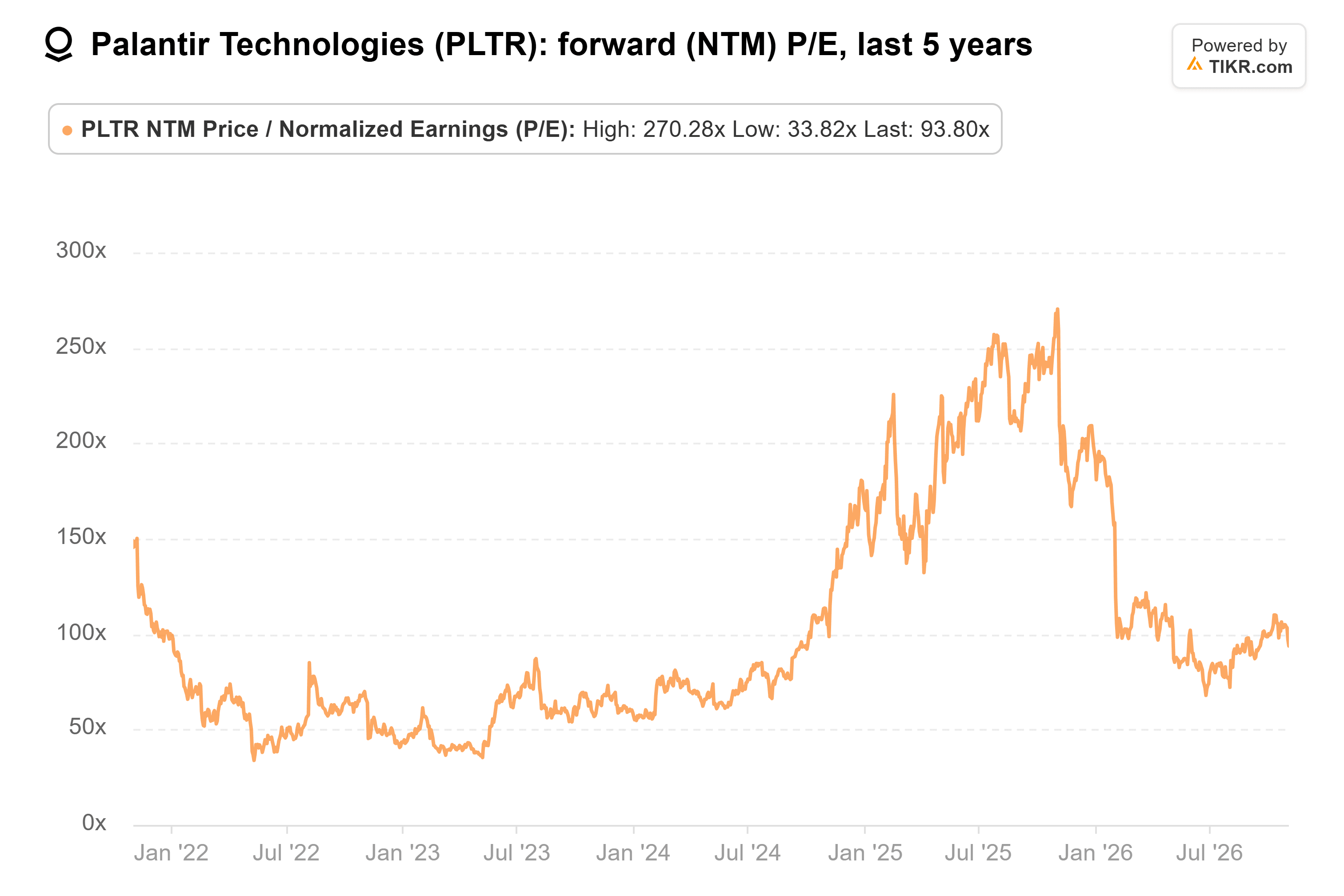
On the $2.35 of 2027 EPS analysts expected before the report, the stock traded at about 76x at Monday’s close, and today’s drop leaves it a bit lower.
Analysts aren’t backing off. Their average price target rose from $158 a year ago to $212.50 by Oct. 31:

That’s about 19% above Monday’s close. After the report, Citi raised its target to $265 from $250, and Morgan Stanley raised its target to $233 from $205.
Karp gets two quarters to prove it
If Karp is right, those shorter contracts come up for renewal sooner and the bigger deals he describes get booked. The fourth-quarter report in early February and the first-quarter report after it should then show U.S. commercial TCV climbing back toward the $2.13 billion record. Remaining deal value should also grow much faster than 4% a quarter. February also brings 2027 guidance, which needs to beat the 51% revenue growth analysts expected going in.
Management expects contracts to get longer again. Glazer said: “As we continue to deliver value with sovereign AI, over time, we expect both the duration and size of these contracts to increase.”
The way I see it, Karp’s explanation fits the commercial numbers well enough to earn him the benefit of the doubt for now. But investors paying that multiple are already counting on him being right. If remaining deal value grows only 4% again in February, I’d take the slowdown at face value.
So what is Palantir stock actually worth?
TIKR lets you forecast the future price of any stock in less than a minute. Just enter a few assumptions into TIKR’s valuation model and see what Palantir could be worth. Start from Wall Street consensus estimates, or adjust the inputs to reflect your own view of the business. It’s free to use.
Disclaimer:
Please note that the articles on TIKR are not intended to serve as investment or financial advice from TIKR or our content team, nor are they recommendations to buy or sell any stocks. We create our content based on TIKR Terminal’s investment data and analysts’ estimates. Our analysis might not include recent company news or important updates. TIKR has no position in any of the stocks mentioned. Thank you for reading, and happy investing!