Key Takeaways
- Oracle stock is down 10% in the past month, mostly in an AI infrastructure selloff that hit CoreWeave and Nvidia harder.
- Days after capping new capital raises at $20 billion through fiscal 2030, Oracle raised all of it, then reportedly dropped a Tencent deal and lost a Microsoft rental contract.
- Oracle’s plan for positive free cash flow in the second half of fiscal 2028 rests on a $664 billion backlog that leans heavily on OpenAI.
- At 14x forward earnings, the stock looks like a buy for investors who can wait until fiscal 2029, and the December quarterly report is the next test.
Oracle (ORCL) stock is down 10% in the month through the Nov. 17 close, mostly with the AI trade. The Nasdaq 100 fell 7.5%, and CoreWeave (CRWV) and Nvidia (NVDA) fell harder, by 15% and 27%.
All of Oracle’s own news came back to one question: can it turn its backlog into cash before the bills come due?
A $20 billion cap, spent in five days
At its Investor Day on Oct. 28, Oracle put a date on the cash. It expects free cash flow to turn positive in the second half of fiscal 2028 and to top $30 billion in fiscal 2029, on the way to $21 or more of non-GAAP EPS in fiscal 2030. It also capped new capital raises through fiscal 2030 at $20 billion, not counting refinancing. Analysts expect normalized EPS to more than double by fiscal 2029:
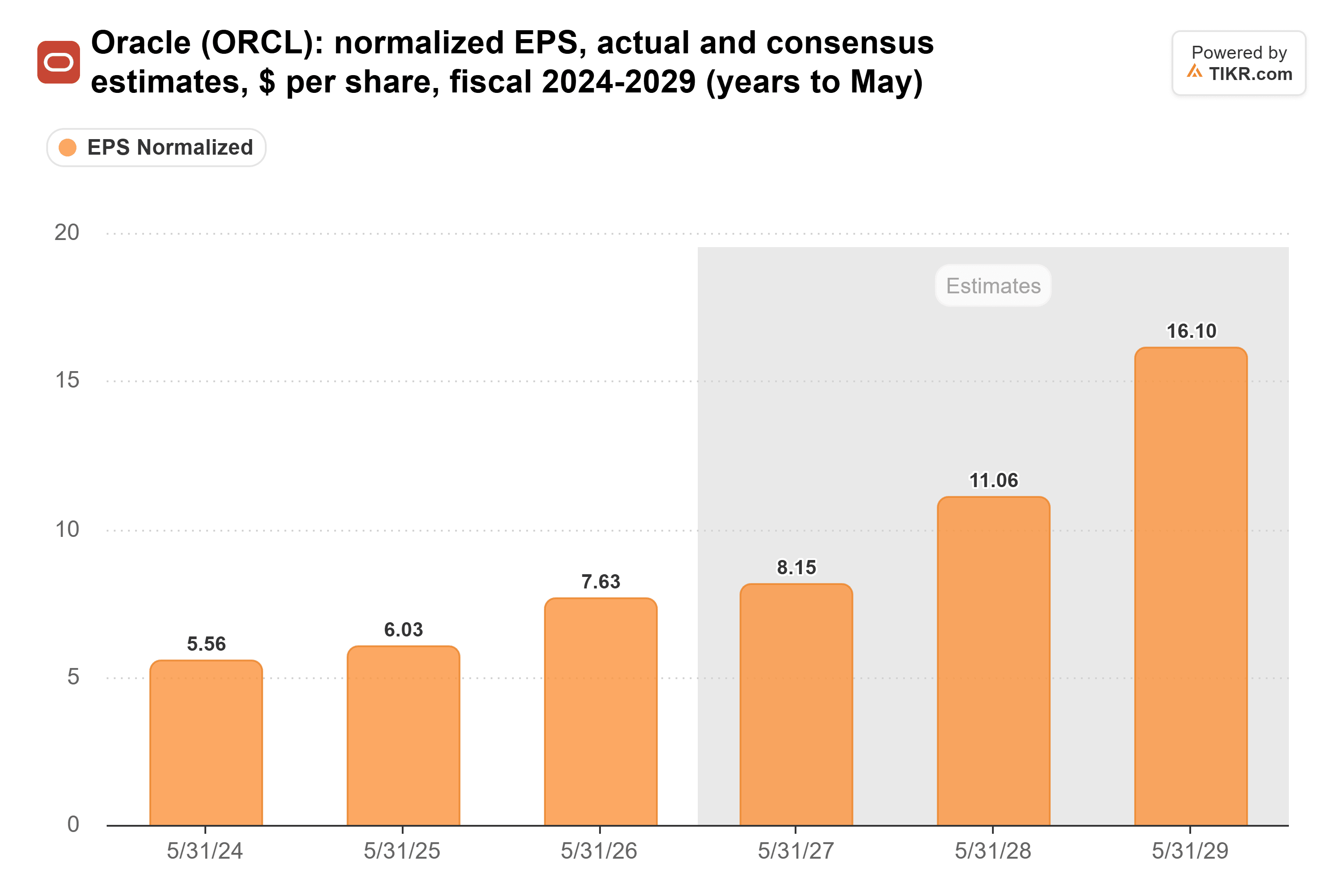
Then, Oracle used the whole cap at once. On Nov. 2, it priced 86.2 million new shares at $116 each, right around the stock’s Nov. 17 close of $115, and $10 billion of notes. That clears the overhang, but any cost overrun now has to come from customers, vendors or Oracle’s own cash.
TIKR tracks 42 analysts on Oracle. How many say “Buy”?
See the full breakdown of Buy, Hold, and Sell ratings on Oracle, along with Wall Street’s revenue and earnings estimates, all in one place. More than 500,000 investors use TIKR to research stocks like this one. See Oracle’s Analyst Ratings
Two deals ended, and the AI trade did the rest
The Financial Times reported on Nov. 4 that Oracle had walked away from a chip-leasing deal with Tencent worth about $7 billion after U.S. officials raised concerns. Two days later, Bloomberg reported that Microsoft is letting a 2023 contract to rent older Nvidia chips from Oracle wind down. Neither leaves much of a hole: Tencent’s deal was worth about 1% of Oracle’s $664 billion backlog, and GPUs up for renewal went at a 20% premium last quarter.
The customer that matters most is OpenAI. Steve Eisman, host of The Real Eisman Playbook podcast, ties about half of that backlog to OpenAI. That’s where Nvidia comes in. The Information reported on Nov. 12, the day Colette Kress became Nvidia’s interim CEO, that as finance chief she had pushed back on a proposed $250 billion credit backstop for OpenAI. If Nvidia guarantees less of OpenAI’s borrowing, OpenAI has to find that money somewhere else to pay Oracle.
CoreWeave pulled the group the other way. On Nov. 10, it beat on its third quarter, raised its full-year guidance and said customer prepayments and contract-backed loans would pay for its buildout. Oracle rose 8.8% with it the next day. CoreWeave also says new contracts are pricing at $20 million to $25 million per megawatt a year, above the roughly $16 million Oracle has cited. Can Oracle’s cost-plus deals keep up?
Cheap, if the cash shows up
Oracle trades at 14x forward earnings, against a five-year average of 21x:
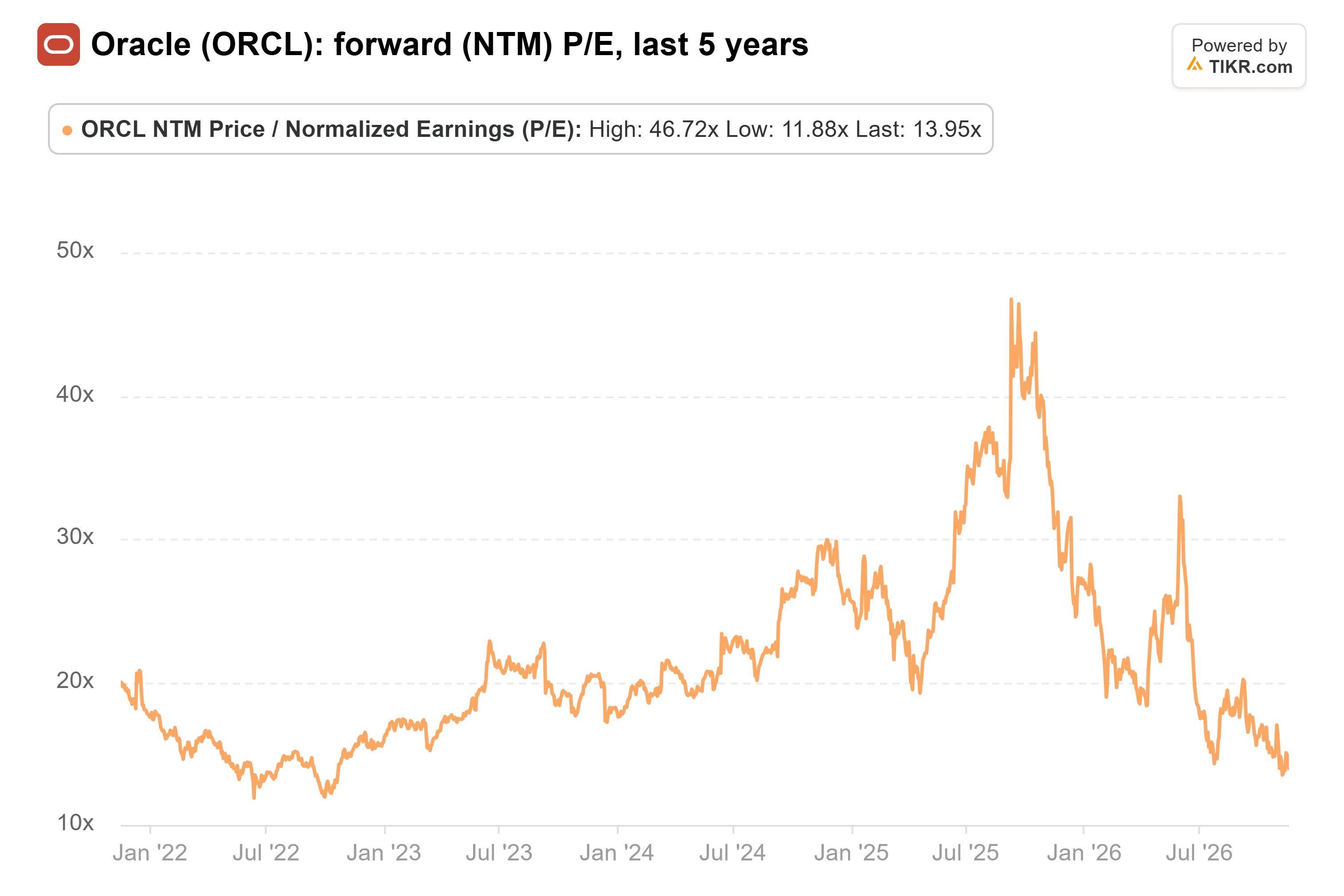
D.A. Davidson’s managing director and head of technology research, Gil Luria, thinks the upside is big if Oracle delivers. As he put it on the Nov. 16 episode of The Real Eisman Playbook, “If they execute perfectly, the stock is a multiple of where it is today.”
The math backs him up. If Oracle hits $21 of non-GAAP EPS in fiscal 2030 and the stock holds today’s 14x, that’s about $294 a share, more than 2.5x the Nov. 17 close. The $236 consensus target is about double. But perfect is a high bar. Free cash flow slipped below zero in fiscal 2025:
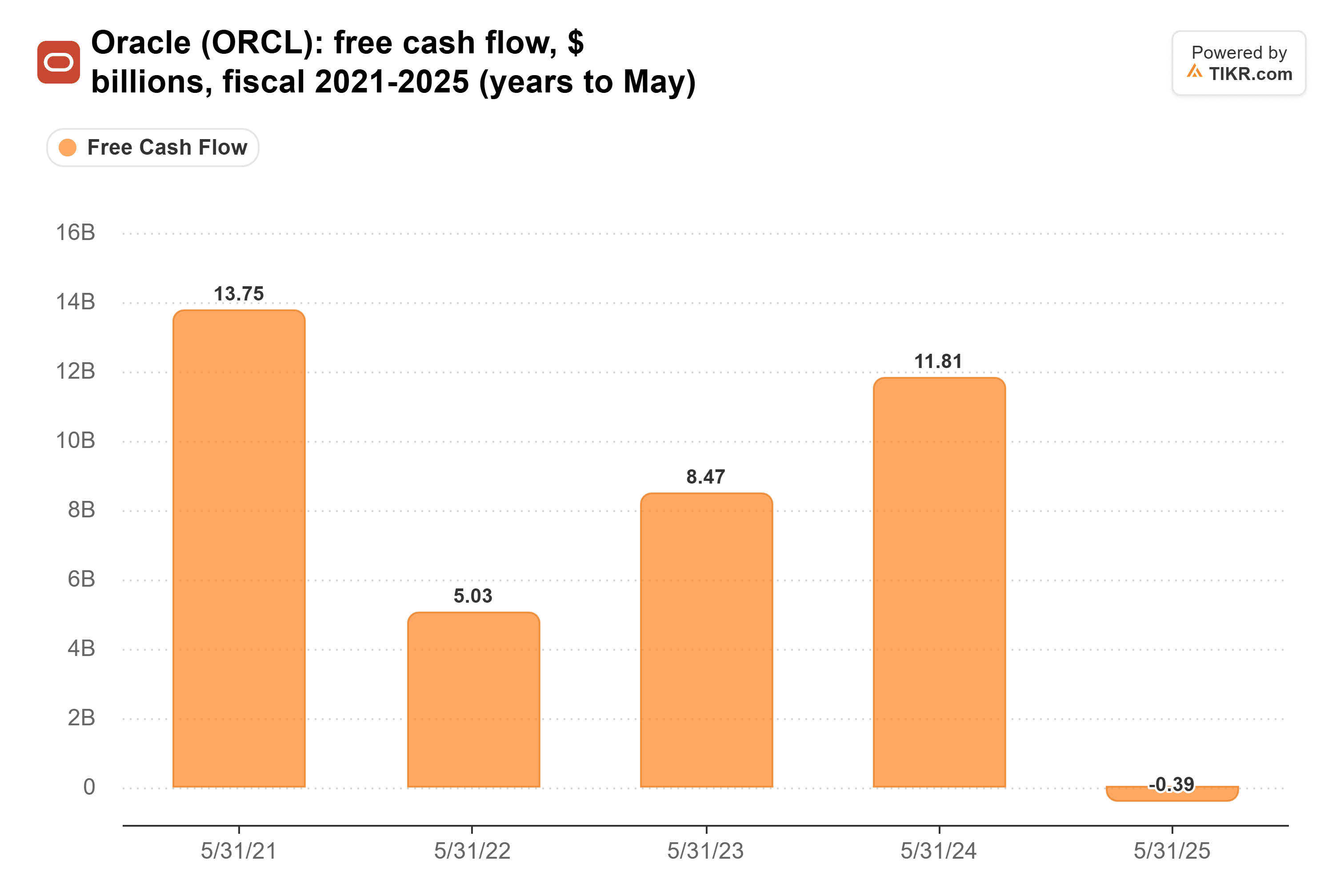
In fiscal 2026, it was negative $23.7 billion. Consensus has $17.5 billion for fiscal 2029, not much more than half of Oracle’s target.
Bottom line: Oracle’s plan still adds up if the backlog turns into cash. That makes the stock look like a buy for investors who can wait until fiscal 2029 and are willing to bet on OpenAI paying until then.
The first test is the fiscal second-quarter report in December. Oracle guided for revenue growth of 30% to 34% and non-GAAP EPS of $1.85 to $1.93. Results inside that range, with the backlog still above $664 billion, would show that losing Tencent and Microsoft didn’t leave a hole.
So what is Oracle stock actually worth?
TIKR lets you forecast the future price of any stock in less than a minute. Just enter a few assumptions into TIKR’s valuation model and see what Oracle could be worth. Start from Wall Street consensus estimates, or adjust the inputs to reflect your own view of the business. It’s free to use.
Disclaimer:
Please note that the articles on TIKR are not intended to serve as investment or financial advice from TIKR or our content team, nor are they recommendations to buy or sell any stocks. We create our content based on TIKR Terminal’s investment data and analysts’ estimates. Our analysis might not include recent company news or important updates. TIKR has no position in any of the stocks mentioned. Thank you for reading, and happy investing!