Key Takeaways
- Nvidia fell 4% on Monday after its board opened an investigation into CEO Jensen Huang.
- Nvidia’s 71% gross margin gives its biggest buyers every reason to back cheaper chips, and Anthropic training its AI almost entirely on chips Google designs shows how that can work.
- Analysts still expect Nvidia’s revenue to more than triple from fiscal 2026 to fiscal 2028, so the pressure is likelier to show up in its margin before its sales.
- Nvidia’s Nov. 17 report is the next test, with management already guiding gross margin down to 71% to 72% in the January quarter as memory costs climb.
Nvidia (NVDA) fell 4% on Monday after its board opened an independent investigation into reports that CEO Jensen Huang was the target of a foreign intelligence effort.
The rest of the chip trade went the other way. Advanced Micro Devices (AMD) jumped 13%, helped by a new collaboration with Google Cloud, and Broadcom (AVGO) rose 9%.
Stephen Witt, whose book The Thinking Machine tells the story of Huang and Nvidia, was asked on Monday’s Squawk Pod whether Nvidia’s competitors were feeling some glee. His answer came down to price. Nvidia’s margins, he said, “are 70, 80%. I mean, that’s the kind of margin, that’s like throwing chum in the water.”
And the sharks have already had a taste. Anthropic, expected to go public later this month, trained its AI “almost completely on Google’s TPU stack,” Witt said. Those are the custom chips Alphabet (GOOG) designs with Broadcom.
So it’s no surprise that Witt told this week’s Hard Fork podcast that what’s bad for Nvidia is good for AMD, Broadcom and Google.
TIKR tracks 61 analysts on Nvidia. How many say “Buy”?
See the full breakdown of Buy, Hold, and Sell ratings on Nvidia, along with Wall Street’s revenue and earnings estimates, all in one place. More than 500,000 investors use TIKR to research stocks like this one. See Nvidia’s Analyst Ratings
The orders are still there
Anthropic is one customer. Witt himself agreed that Anthropic runs its models on Nvidia chips it rents, and he said the inference market “still kind of favors NVIDIA.” Wall Street also sees Nvidia’s revenue more than tripling between the year ended January 2026 and fiscal 2028:
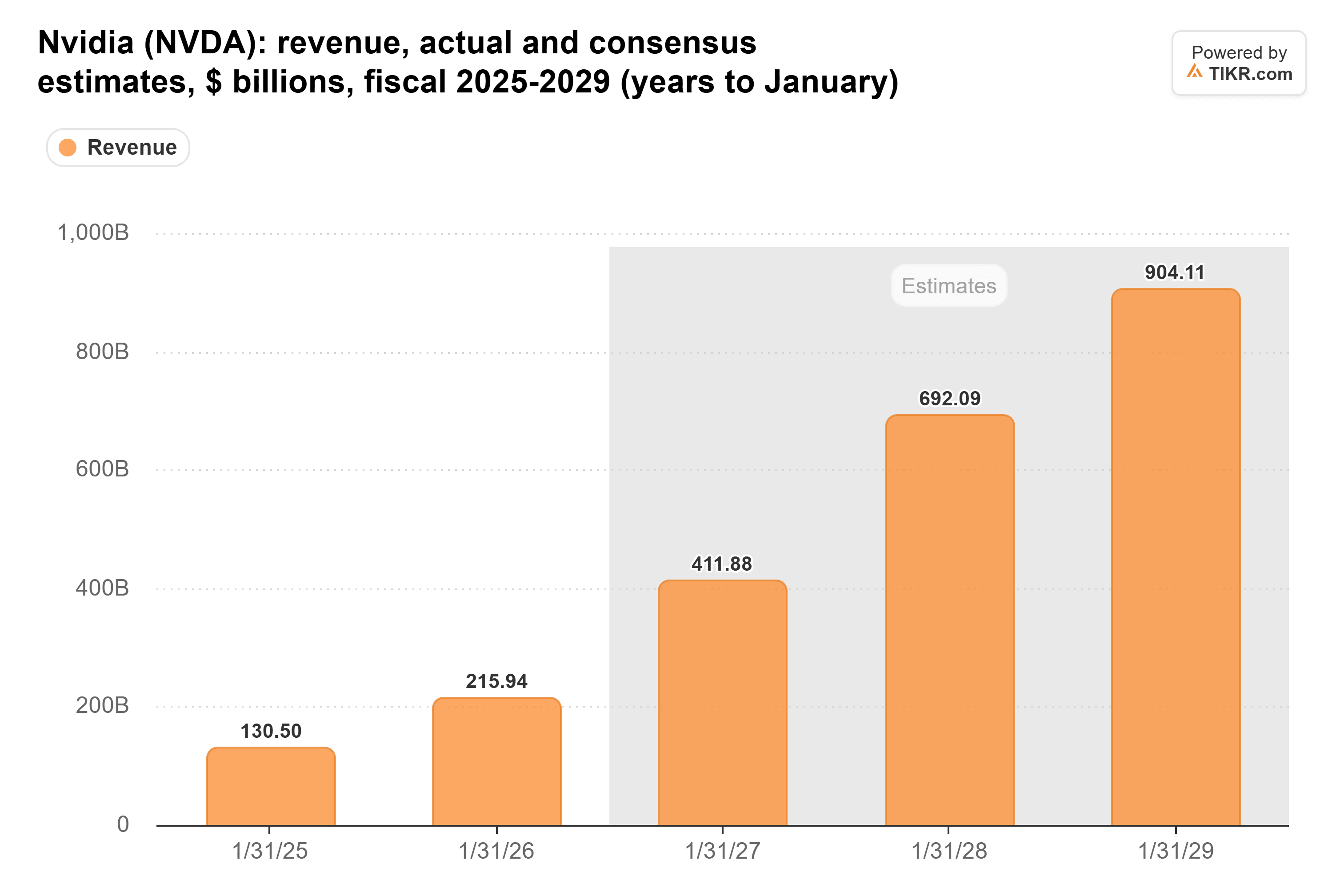
That’s $215.9 billion growing to $692 billion. When it reported in August, management guided to about 70% growth in fiscal 2028 and said supply was what held it there. A board investigation doesn’t change how many chips Nvidia can get made, so I don’t expect Monday’s news to move those estimates.
The margin is the bait
Witt’s warning is about the years after that. Nvidia’s gross margin has been in the 70s for three straight fiscal years:
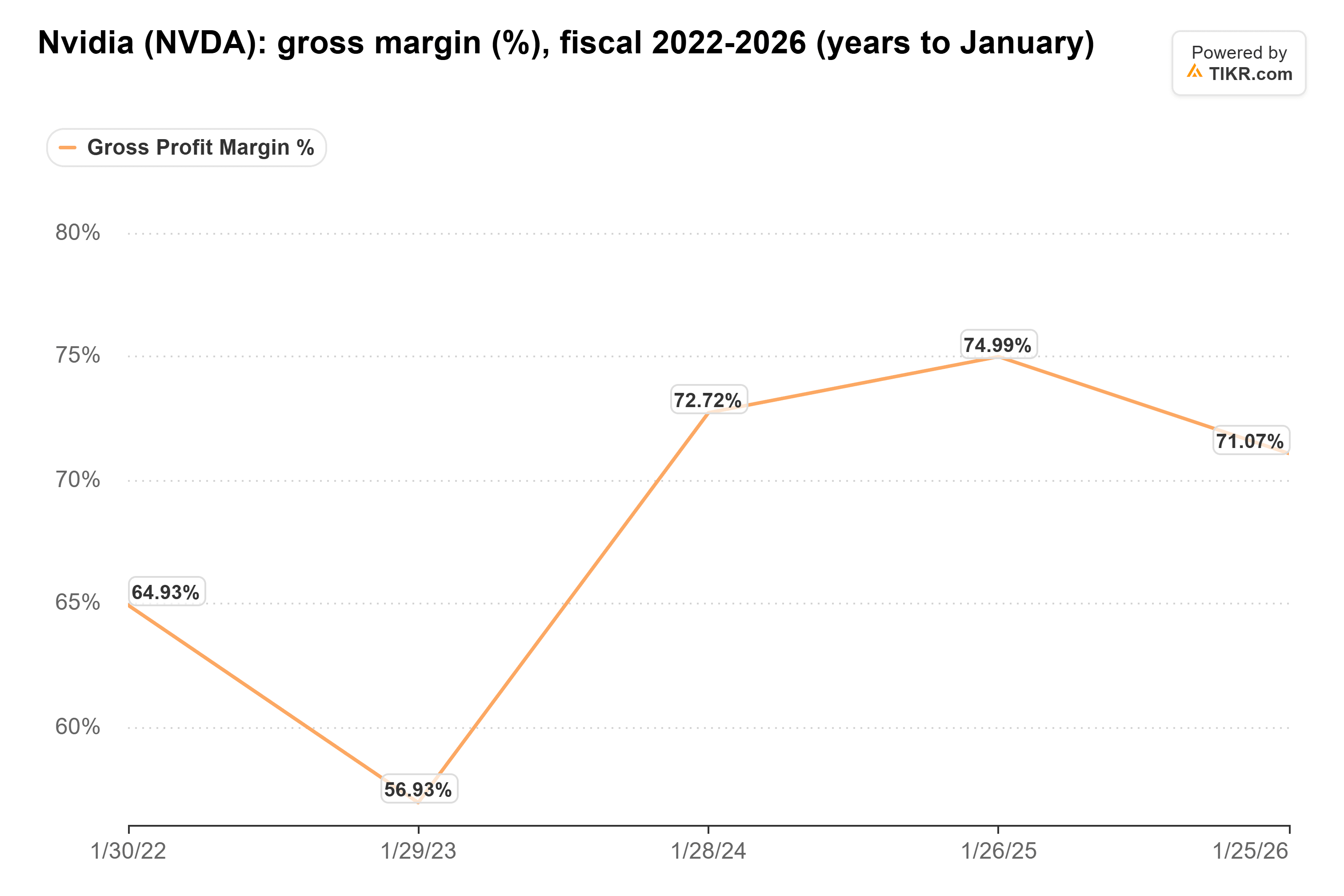
At last fiscal year’s 71.1%, about $29 of every $100 a buyer paid Nvidia went to the cost of making what it bought. The buyers paying the most are the ones best placed to go elsewhere. Management said in February that the five biggest cloud providers and hyperscalers make up a little over half of Nvidia’s data center revenue. Its annual report names Alphabet, Amazon and Microsoft among the cloud companies designing their own AI chips.
Nvidia knows it. Management said in August that it has put nearly $50 billion into frontier AI labs, and Anthropic is one of them.
Broadcom is building the alternative
Plus: every TPU Google adds is business for Broadcom, which is why Broadcom looks like the real winner of Google’s chip push. Analysts expect Broadcom’s revenue to more than quadruple from fiscal 2025 to fiscal 2028:
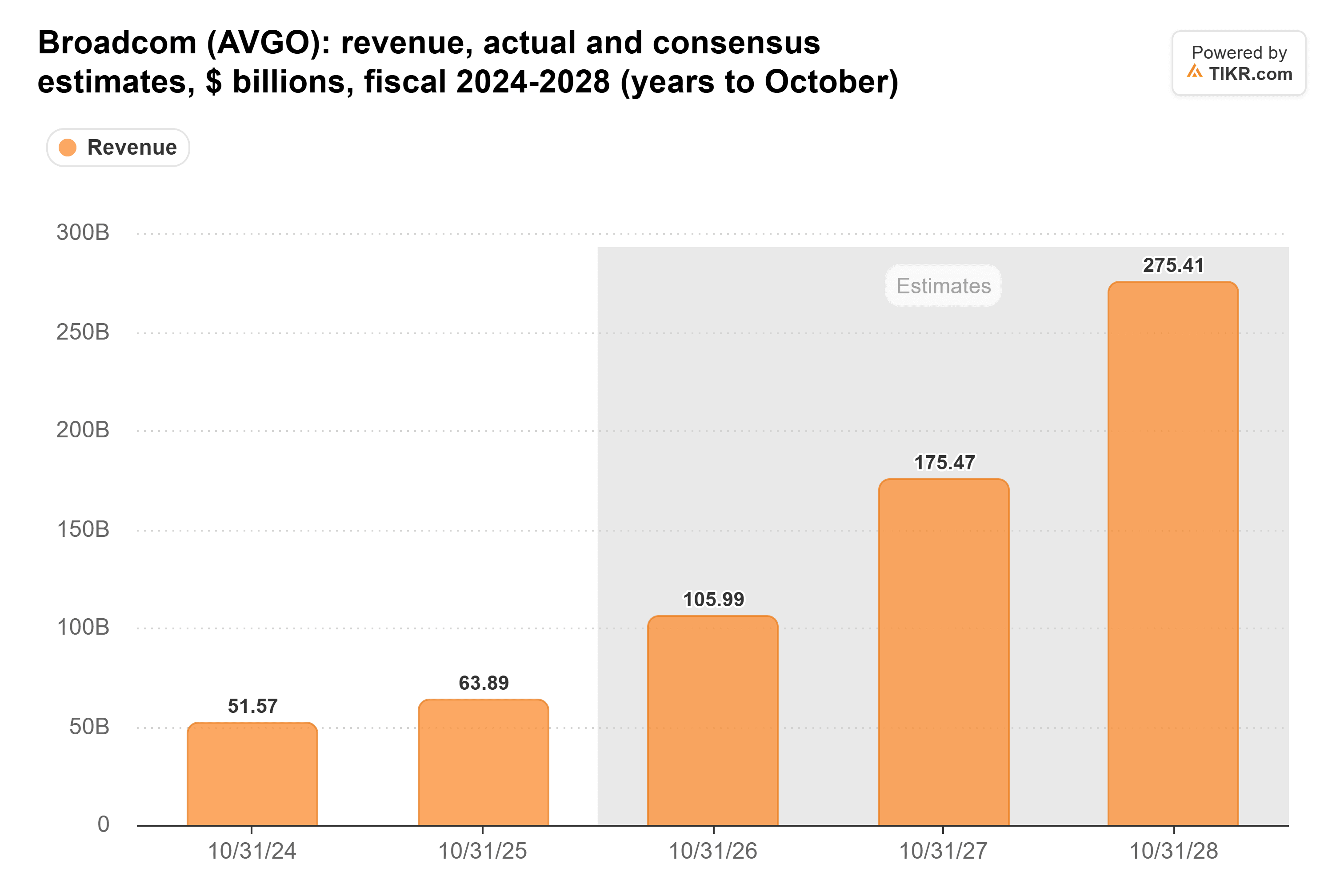
That’s $63.9 billion in fiscal 2025 growing to $275 billion. AMD, the other chipmaker Witt named, just guided to more revenue than Intel brought in a decade ago. Witt still calls Nvidia’s products “the best.” For AMD and Broadcom, though, every lab that trains its next model on cheaper chips is a win.
Watch the margin on Nov. 17
Frankly, I think Witt has this right, and investors who moved money out of Nvidia and into AMD and Broadcom on Monday seem to agree. A gross margin above 70% is a standing invitation for every big buyer to fund a cheaper chip, and Anthropic just showed that a frontier lab can train that way. I expect that pressure to show up in Nvidia’s margin well before it shows up in its revenue.
The first test is Nvidia’s Nov. 17 report. Management already expects gross margin to bottom at 71% to 72% in the quarter ending January 2027, down from 75.0% in the July quarter, as memory prices climb. If Nvidia holds that guide and its planned price increases stick in fiscal 2028, it still has plenty of pricing power before the sharks get a real bite.
So what is Nvidia stock actually worth?
TIKR lets you forecast the future price of any stock in less than a minute. Just enter a few assumptions into TIKR’s valuation model and see what Nvidia could be worth. Start from Wall Street consensus estimates, or adjust the inputs to reflect your own view of the business. It’s free to use.
Disclaimer:
Please note that the articles on TIKR are not intended to serve as investment or financial advice from TIKR or our content team, nor are they recommendations to buy or sell any stocks. We create our content based on TIKR Terminal’s investment data and analysts’ estimates. Our analysis might not include recent company news or important updates. TIKR has no position in any of the stocks mentioned. Thank you for reading, and happy investing!